Learning how to get started with ham radio is easier when you follow the decisions in the right order: define what you want to do, set a realistic budget, choose a license goal, pass the correct exam, match the radio to the activity, and plan your first contact. The equipment side of a first setup can begin around $30 and rise well beyond $1,000, while a practical local beginner setup often lands around $80 to $150 before licensing, session charges, or optional upgrades, based on typical entry-level costs in July 2026. The license, radio, antenna, local activity, and operating plan must fit together or the hobby can stall even after you pass. This roadmap shows what to decide at each stage and where to go when you are ready for the details.
Start With the Sequence, Not the Shopping Cart
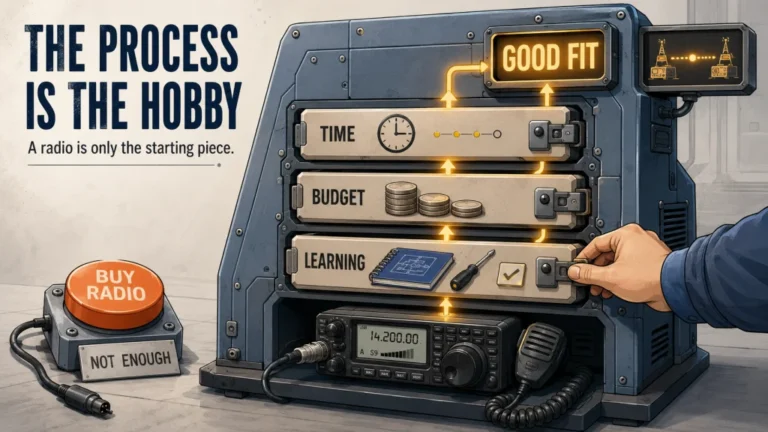
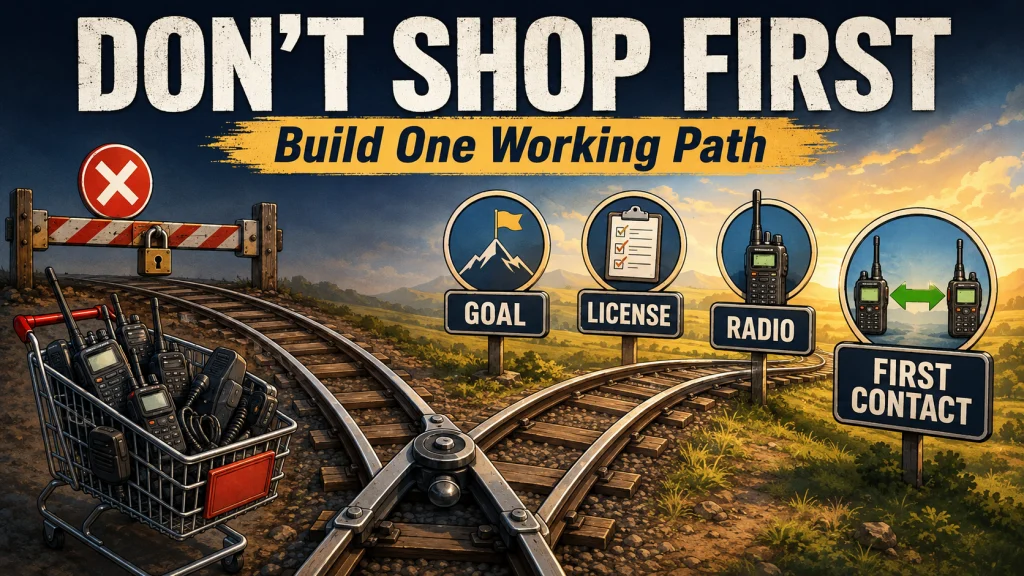
If you are learning how to get started with ham radio, the first move is not buying a handheld. The reliable order is goal, budget, license, exam, equipment, and first contact. Miss one of those decisions and you can end up licensed but inactive, or equipped but unable to use the radio for the activity you had in mind.
The question I hear most often after an exam session is some version of, “What radio should I buy?” It often comes before the new licensee has identified a local repeater, checked which bands the new license covers, or decided whether the goal is local conversation, mobile use, emergency preparedness, or HF communication. That sequence matters because the correct first radio changes with the job.
Field Note: I have watched new operators spend more time comparing feature lists than deciding who they expect to contact. The operators who move forward usually give the radio one clear first assignment, such as checking into a local weekly net, rather than expecting one purchase to unlock every part of amateur radio.
This article stays at roadmap level. It will not turn into a full license course, a detailed equipment review, or a programming tutorial. Readers who still need the broader context can first review the complete beginner introduction, then return here to put the steps in order.
The Five-Step Beginner Roadmap at a Glance
Finish one decision before opening the next. A useful roadmap needs a stop condition for each step. Without one, beginners keep researching indefinitely or jump ahead because shopping feels more concrete than planning. The table below shows what must be decided before the next step becomes useful.
| Step | Decision to make | Ready to move on when |
|---|---|---|
| 1. Budget | Choose an activity and set a total starting limit | You know what the budget must include, not just the radio price |
| 2. License goal | Choose Technician only or Technician plus General preparation | Your target privileges match the activity you want |
| 3. Exam | Use the current question pool and confirm session requirements | You are consistently ready for the correct exam and have registration details |
| 4. Equipment | Match handheld, mobile, or HF equipment to the planned use | You can explain what the first radio will do in your real location |
| 5. First contact | Select one reachable station, repeater, or scheduled net | You know when to listen, where to transmit, and what to say |
The stop conditions prevent two common mistakes. One is buying equipment before understanding the license and local operating environment. The other is treating the exam as the finish line, then discovering that no first contact has been planned.
Step 1: Set the Budget From the Activity
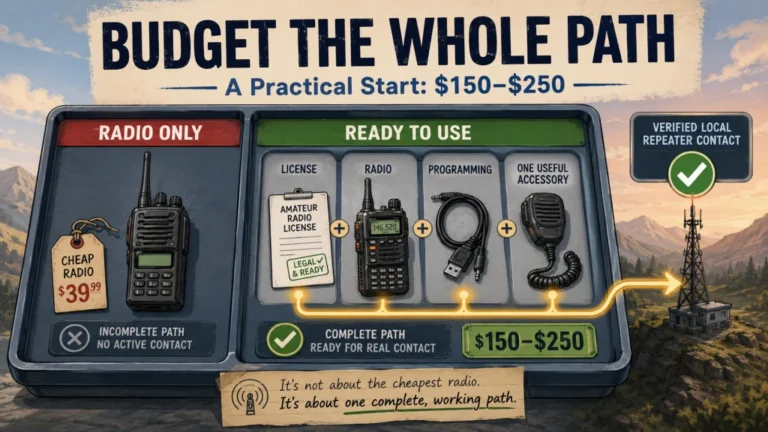
The total cost of starting ham radio depends on what you expect the station to do. As of July 2026, the equipment side of a listen-first or minimal operating path may begin around $30, while a complete HF station can exceed $1,000 once the radio, power supply, antenna system, feed line, mounting, and basic accessories are included. Licensing and any exam-session charges must be added separately. A first local VHF/UHF setup commonly fits near the $80 to $150 range, but that is a planning estimate, not a promise that every location or use case will fit it.
Start by choosing one activity, then price the entire path. Someone who wants to join a nearby repeater net may need a modest radio and a verified local signal path. Someone who wants reliable mobile coverage may need a vehicle installation and an external antenna. Someone aiming for HF communication must account for the station, antenna space, power, and a license goal that supports the intended bands.
- Minimal path: exam preparation, session charges if any, the FCC fee for a new license, and access to a working station through a club or another operator.
- Local personal station: a VHF/UHF radio, suitable antenna, charging or power arrangement, and any programming connection the chosen radio requires.
- Home or mobile station: the radio plus mounting, power wiring, feed line, antenna placement, and installation materials.
- HF path: the transceiver is only one part of the cost; power, antenna, feed line, grounding or bonding needs, and property limits can dominate the project.
The cheapest radio is not always the cheapest route if it cannot reach the system you plan to use. The most expensive radio is not automatically safer either, because a premium feature list does not fix poor antenna placement, blocked terrain, or an absent local communication plan. Use the full ham radio cost breakdown to build a budget around the activity rather than one advertised price.
Before committing money, make sure the activity itself fits you. The overview of what the hobby is really like helps separate operating, learning, public-service interest, and equipment experimentation before any of those paths become a purchase.

The BL-5RHL is a 7.4-volt 5200mAh lithium-ion battery pack for the BF-F8HP PRO and other radios that use the BL-5RH battery platform. It charges through USB-C from a standard 5-volt source and has an LED that indicates charging status. The pack fits the UV-5RM, UV-5G Plus, GM-5RH, and compatible BL-5RH models, but it does not fit BL-5 or UV-5R-style radios.
Check On AmazonIf you click this link and buy, we earn a commission at no additional cost to you.
Step 2: Choose a License Goal That Matches the Plan
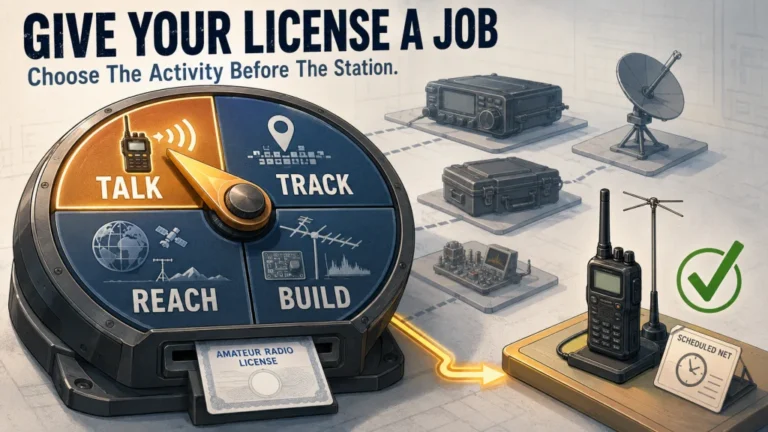
For most US beginners, Technician is the practical starting license because it opens the main local VHF and UHF paths used for repeaters, simplex communication, and many community activities. General becomes relevant when the plan includes broader HF privileges. The useful question is not which license sounds more impressive, but which privileges are required for the first activity you genuinely intend to pursue.
A beginner focused on local repeaters can earn Technician, get on the air, and decide later whether HF is worth the added study and equipment. A beginner already committed to HF may prepare for both Technician and General and attempt the additional element at the same session if that exam team offers it and the candidate is ready. Do not let the possibility of taking both exams turn a solid Technician plan into rushed preparation for two separate question pools.
The FCC currently charges a $35 application fee for a new amateur license. Ordinary operator-class upgrades and requests for a sequentially issued call sign are exempt from that FCC fee, although an exam team may charge its own session fee. The FCC fee for the first license is paid directly to the FCC after the application enters its payment process, not handed to the volunteer examiners as part of the test.
Use the Technician and General comparison to match privileges to your intended activity. For the complete licensing process, fees, and class boundaries, continue to the US ham radio license guide.
Step 3: Study the Current Pool and Confirm the Session
Once the license goal is set, study for the exam that will actually be administered. The current Technician question pool took effect on July 1, 2026, and remains valid through June 30, 2030. A study guide, app, video course, or practice-test site built around the previous Technician pool can leave you preparing for retired wording or missing revised material.
The Technician exam contains 35 questions, but passing practice tests is only part of exam readiness. You also need the correct registration process, an FCC Registration Number, acceptable identification, the session time, and the team’s own rules for walk-ins, remote testing, payment, retesting, and additional exam elements. Those details vary by session, so the local instructions override assumptions based on another team’s process.
Key point: Separate the three money questions. A study resource may cost money, the exam team may charge a session fee, and the FCC charges $35 for the new license application. They are different charges paid to different parties.
Another common misunderstanding is assuming that passing means you can transmit immediately. A new operator must wait until the FCC database shows the granted license and assigned call sign. That waiting period is also the right time to finalize the first contact plan instead of buying unrelated accessories to fill the gap.
For a realistic timeline from first study session to an active call sign, use the licensing timeline guide. It separates study time, exam scheduling, application processing, payment, and grant timing so one delay is not mistaken for the whole process.
Step 4: Choose the First Radio by Use Case
Only after the activity and license path are clear does equipment selection become efficient. The three broad starting points are handheld, mobile, and HF. They are not quality levels on one ladder; they solve different operating problems.
| Starting use | Radio type to consider | What must be verified first |
|---|---|---|
| Nearby repeaters, local nets, portable listening | Handheld VHF/UHF | Local repeater coverage, terrain, programming needs, and antenna limits |
| Vehicle communication or stronger local coverage | Mobile VHF/UHF | Power wiring, safe mounting, external antenna placement, and installation permission |
| Longer-distance HF activity | HF station | License privileges, antenna space, power, operating location, and total system cost |
A handheld can be the right first radio for a reachable local repeater, yet the wrong first radio for someone whose only goal is routine long-distance voice communication. Five watts and a short antenna do not turn a blocked indoor location into worldwide coverage. Likewise, an HF station is not a superior beginner choice merely because it costs more; it is useful when the license, antenna, space, and operating goal support it.
This is where a simple sentence can prevent a bad purchase: “My first radio must let me do _____ from _____.” Fill the first blank with one activity and the second with the real location. If you cannot complete that sentence, you are not ready to compare radios.
The checklist in what you need to begin operating covers the supporting pieces that a radio listing may omit. When the use case is settled, the radio selection guide can help compare equipment types without treating price as the main decision.
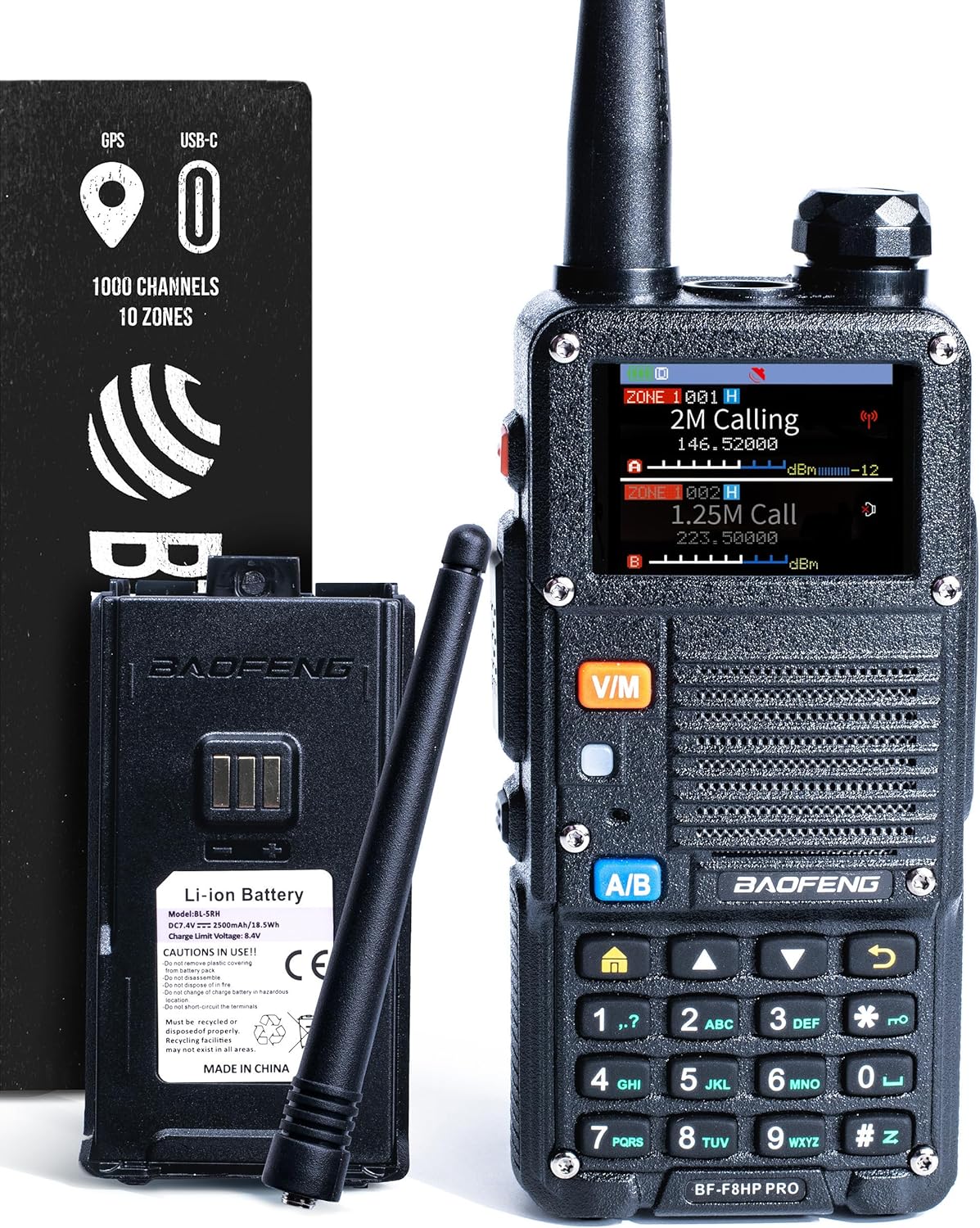
The BF-F8HP PRO is a tri-band amateur handheld for 2M, 1.25M, and 70CM operation, with up to 1000 programmable memories organized into 10 zones. It also receives aviation AM, NOAA weather, and FM broadcast signals, while built-in GPS adds location tools for field and travel use. USB-C charging and support for BTECH CPS and CHIRP make channel, tone, offset, zone, and scan-list setup easier once your operating plan is clear.
Check On AmazonIf you click this link and buy, we earn a commission at no additional cost to you.
Step 5: Plan the First Contact Before You Transmit
The exam proves that you met the licensing requirement. It does not automatically tell you which local repeater is active tonight, whether your radio can reach it from the kitchen, or how that net expects visitors to check in. A first contact becomes much easier when those questions are answered before the push-to-talk button is involved.
Choose one specific path. For a repeater contact, confirm the output frequency, transmit offset, access tone, operating status, and whether the system is open for general amateur use. Listen long enough to hear normal procedure. For a scheduled net, note the start time, the net name, and whether check-ins give only a call sign or include a name and location.
If no usable repeater or active group is close enough to reach, do not treat that as a reason to buy a more expensive handheld. Expand the search area, listen for local simplex activity, contact a regional group, or arrange a scheduled test with a licensed operator you know. An internet-linked path may also help when it is already supported by an active amateur system, but it should not be confused with proving a direct radio path from your location. The goal is still the same: identify one real station or system that will be available when you make the first call.
- Identify one reachable repeater, simplex frequency, or club station.
- Verify the channel information from a current local source.
- Program or enter the complete channel, then recall it to confirm it was saved.
- Listen before transmitting and learn the pace of the conversation.
- Prepare a simple first line using your call sign and a brief request to join.
I have met licensees who delayed their first transmission for months because they thought they needed a polished speech. They did not. They needed one active local path, a correctly configured radio, and permission to sound new for thirty seconds.
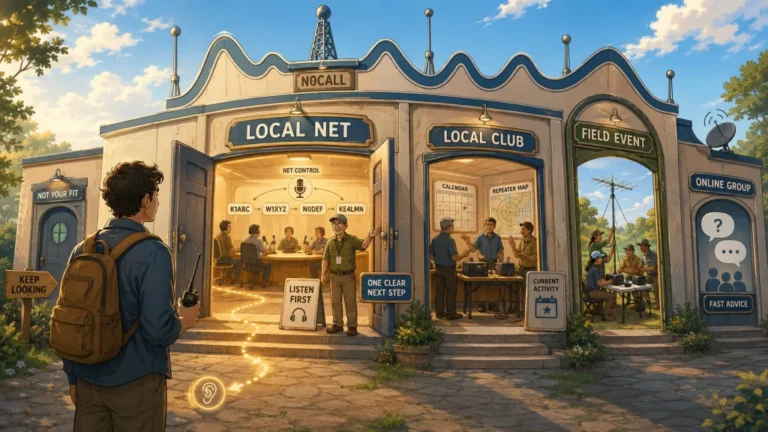
A local group can shorten that learning curve by confirming whether the repeater is active, hearing your signal, and showing the normal check-in routine. The guide to finding useful local radio groups explains how to look beyond a club name and find actual meetings, nets, exam support, and beginner operating help.

The BTECH PC03 uses a genuine FTDI chipset and a Kenwood K1-style connector for supported BTECH, BaoFeng, Kenwood, and other compatible radios. It works with CHIRP and BTECH programming software to enter channel names, tones, offsets, zones, and scan settings from a computer. Compatibility depends on the radio using the supported K1 programming connection, so verify the exact model before relying on the cable.
Check On AmazonIf you click this link and buy, we earn a commission at no additional cost to you.
Use This Readiness Check Before Moving Ahead
Getting started with ham radio does not require knowing every mode, band, or equipment feature. It requires enough clarity to prevent the next decision from being based on a guess. Before spending more money or adding another study goal, answer the five questions below in one sentence each.
- Purpose: What is the first activity I want to do?
- Location: Where will I normally operate, and what terrain or property limits matter?
- License: Which license privileges does that activity require?
- System: Who or what station do I expect to contact first?
- Budget: What is my total limit for licensing, radio, antenna, power, and necessary accessories?
If one answer is missing, return to that step rather than buying around the uncertainty. For example, “emergency use” is not yet a complete purpose because it does not identify the other prepared station, local system, power plan, or communication range. “Join the county weekly VHF net from home” is specific enough to guide the license, radio type, antenna decision, and first-contact practice.
Readers who are still choosing among local conversation, technical learning, outdoor use, preparedness, and longer-distance communication should review practical ways people use ham radio. That decision should come before a larger equipment budget, not after it.
Final Thoughts: Build One Working Path First
The goal is not to prepare for every corner of amateur radio before making a first contact. It is to build one legal, workable path that fits your location, budget, and actual reason for getting licensed.
I would rather see a new Technician make one comfortable local contact with a modest setup than own a shelf of radios with no verified path. Once that path works, future decisions can come from operating experience instead of advertising or guesswork.

The Nagoya NA-771 is a 15.6-inch VHF/UHF whip antenna for 144 and 430 MHz operation with an SMA-Female connector. It is intended for compatible BTECH and BaoFeng handheld radios, so connector fit should be confirmed before use. The 50-ohm flexible whip gives a compatible handheld a simple external antenna option without adding another radio to the setup.
Check On AmazonIf you click this link and buy, we earn a commission at no additional cost to you.
Explore More Getting-Started Guides
Each guide below expands one decision from the roadmap. Use the one that matches the step currently blocking you, rather than trying to solve licensing, equipment, cost, and first-contact planning all at once.
| Guide | What it helps with |
|---|---|
| Ham Radio Startup Costs | Builds a complete budget around local, mobile, or HF use instead of counting only the radio. |
| Technician or General License | Matches license privileges to local VHF/UHF activity and broader HF goals. |
| Ham Radio Licensing Timeline | Separates study, scheduling, exam, FCC payment, processing, and call-sign grant time. |
| What Beginners Need to Start | Identifies the supporting equipment and preparation that a radio purchase alone does not cover. |
| Finding Local Ham Radio Help | Shows how to locate active meetings, nets, exam support, and first-contact assistance nearby. |
Choose the guide for your current decision, complete that step, and then return to the roadmap. A finished decision is more useful than five half-finished research tabs.
FAQs
📻 What is the first thing I should do to start ham radio?
Choose one activity you want to do, such as joining a local repeater net or working toward HF communication. That purpose determines the useful license goal, realistic budget, and radio type.
💰 How much does it cost to get started with ham radio?
As of July 2026, a minimal path may begin around $30 before the FCC application fee, a practical local setup often falls near $80 to $150, and a complete HF station can exceed $1,000. The real total depends on the activity, antenna, power, installation, exam-session charge, and equipment already available to you.
📝 Should I take Technician and General at the same exam session?
Consider both only when you have prepared for both current question pools and want General privileges soon. Confirm that the exam team offers additional elements, and do not weaken solid Technician preparation merely to attempt a second exam.
🗓️ Which Technician question pool should I study?
For exams given from July 1, 2026, through June 30, 2030, use the 2026-2030 Technician question pool. Check that every study resource clearly states the pool dates before relying on it.
📡 Can a handheld radio talk around the world?
Do not assume it can. A handheld is mainly a local VHF/UHF tool, and its useful range depends heavily on terrain, antenna position, building loss, and access to a reachable repeater or linked system.
🎙️ What should I say on my first ham radio contact?
Use your call sign, say that you are a new operator, and briefly ask whether someone can confirm your signal. Listen first and follow the local repeater or net procedure rather than trying to memorize a long script.
🪪 Can I transmit as soon as I pass the exam?
A new applicant must wait until the FCC database shows the granted license and assigned call sign. Passing the exam starts the application process; it does not create immediate transmitting authority.