Getting on the air becomes much easier when you separate three decisions: whether the channel is free, whether the contact belongs on a repeater or simplex frequency, and which parts of the exchange are legally required. A first contact can be brief: identify, make the call, exchange a name and location if appropriate, then close cleanly. Local customs matter, but they are not all FCC rules. The steps below give a low-pressure path from listening to speaking, joining a net, and knowing what to check when nobody answers.
How to Get on Ham Radio Without Waiting for Confidence
Mic fright usually survives because a new operator is trying to remember rules, etiquette, radio settings, and a perfect script at the same time. The practical answer is to reduce the first transmission to one clear purpose. Decide whether you are calling through a repeater, calling another station directly, or checking into a scheduled net, then use the procedure for that situation.
I ask a newly licensed operator with a working channel to separate mandatory identification from local custom before worrying about sounding polished. The FCC does not require a rehearsed introduction, a particular greeting, or identification after every transmission. A repeater group or net may have its own preferred rhythm, but those conventions should make communication orderly, not make a beginner afraid to speak.
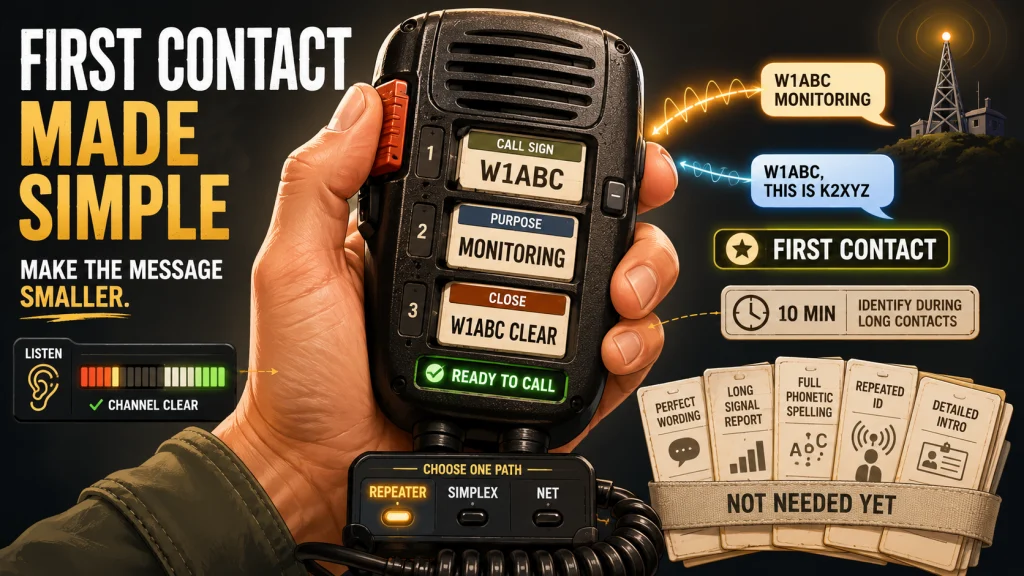
Field Note: When someone can hear a repeater but still has not transmitted, I have them write down three things before touching the push-to-talk button: the call sign they will use, the reason for the call, and the sentence that will close it. That small prompt removes most of the uncertainty without turning a normal contact into a memorized performance.
A shaky voice on the first transmission is normal, and trying to hide it usually makes the operator more tense. Keep the first call short, hold the microphone at a consistent distance, take one breath before pressing push-to-talk, and speak slightly slower than normal conversation. The other station needs clear identification and understandable audio, not a broadcast voice.
This assumes the radio already has a working channel and a suitable antenna connection. Programming, installation, and hardware setup belong in the complete ham radio setup path. Here, the goal is narrower: make a legal, understandable local voice contact and know what to do next.

The BAOFENG BF-F8HP is an 8-watt dual-band handheld supplied as a complete kit with a large battery. Amazon lists VHF coverage of 136-174 MHz and UHF coverage of 400-520 MHz for this exact model. Its handheld format gives a new operator one compact radio for practicing properly configured local repeater and simplex operation.
Check On AmazonIf you click this link and buy, we earn a commission at no additional cost to you.
Listen First, Then Choose Repeater or Simplex
Before transmitting, listen long enough to determine whether the frequency is available. A quiet moment does not always mean an unused channel. You may have tuned into a pause in a conversation, a net waiting for check-ins, emergency traffic, or a repeater that sends an identification or control signal between users.
On a repeater, listen for both sides of the exchange rather than keying up after hearing only one station. On simplex, the station you hear may be talking to someone outside your reception range. A brief pause after the current transmission gives the other station time to respond and leaves space for urgent traffic.
| Operating Path | Use It When | Confirm Before Calling |
|---|---|---|
| Local repeater | You need the repeater’s coverage and have the correct programmed channel | The repeater is active, the current exchange is finished, and no net is controlling the channel |
| Direct simplex | The other station is within direct radio range or the group has agreed on a simplex frequency | Transmit and receive use the same frequency, repeater shift is removed, and the frequency fits current local and national band plans |
| Scheduled net | You want a structured entry point with a net-control station directing check-ins | You have the correct schedule, frequency, repeater details, and check-in instructions |
The decision is not about which method is more advanced. A repeater solves a coverage problem, simplex removes the repeater from the path, and a net solves a social and procedural problem. Choose the path that matches the contact you are trying to make.
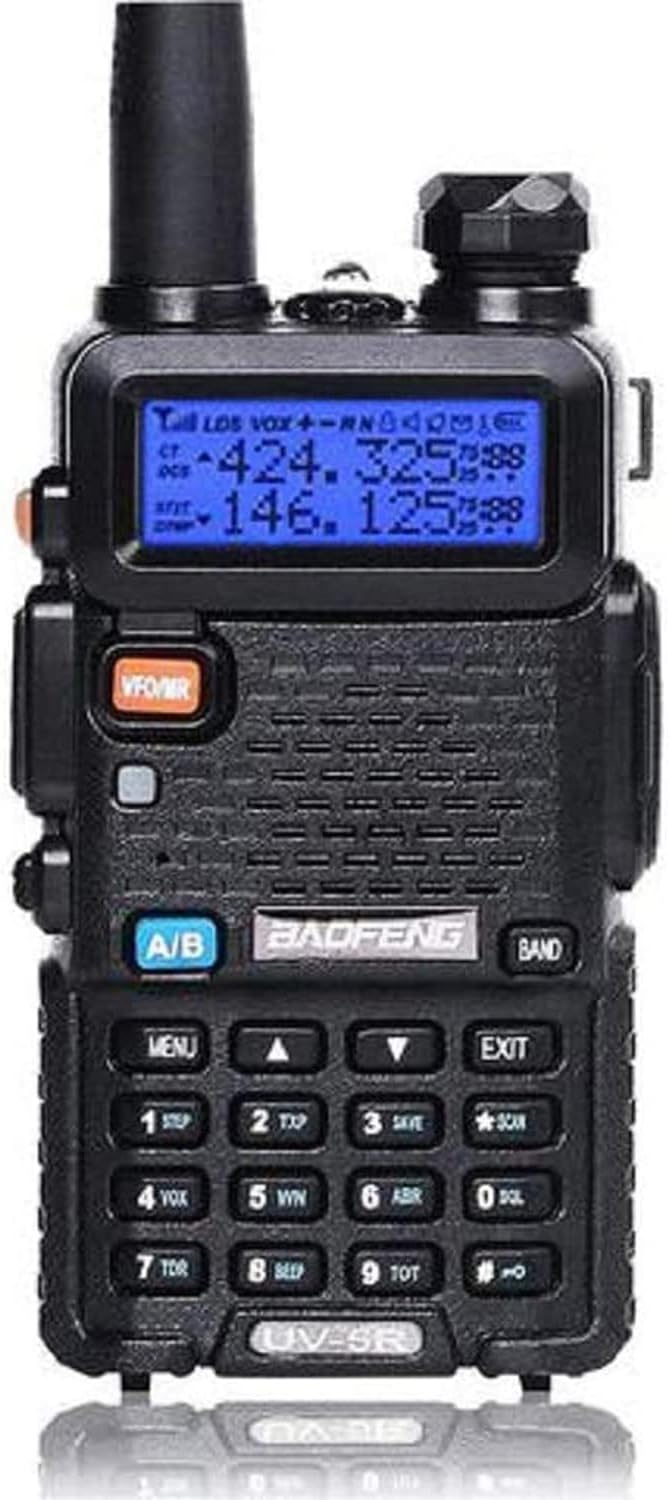
This UV-5R is a dual-band handheld listed for 144-148 MHz and 420-450 MHz operation with an included 1800mAh lithium-ion battery. Its compact format lets an operator carry one radio while comparing a correctly programmed repeater channel with an appropriate simplex frequency. That makes it directly useful for practicing the listen-first decision process described in this section.
Check On AmazonIf you click this link and buy, we earn a commission at no additional cost to you.
A Ham Radio First Contact Can Be Short
A practical operating procedure for a new ham does not need a long script. Start with either a brief monitoring call or a direct call to a known station. Once someone answers, acknowledge the response, exchange only the information that fits the conversation, and end with your call sign.
Research-based procedure: The examples below separate FCC identification from common local practice. Exact wording varies by repeater, club, and net, so listen to active operators and follow any announced instructions.
Option 1: Make a Brief Monitoring Call
On an otherwise quiet local repeater, a hypothetical operator might say, “W1ABC monitoring.” That tells listeners who is present without demanding an immediate response. If another operator answers, the conversation can move naturally to names, locations, or the reason for calling.
A monitoring call works best where local operators recognize it as an invitation to talk. It is less useful on an inactive repeater where nobody is listening, and it should not be repeated every few seconds. Make one clear call, wait, and try again later only if the channel remains free.
Option 2: Call a Known Station Directly
If you know the other call sign, lead with it so the intended station knows the call is for them: “K2XYZ, this is W1ABC.” After the station answers, give your name and location if they are relevant, then state the reason for the contact. Direct calls remove the ambiguity of a general monitoring announcement.
Close the exchange cleanly rather than letting both operators search for a final sentence. A simple “Thanks for the contact, W1ABC clear” identifies the station and makes it obvious that the frequency is available. The full first local contact sequence covers the exchange in more detail without requiring a canned conversation.

The BTECH QHM22 is an IP54-rated shoulder speaker microphone for radios using the Kenwood K1-style connection. Amazon lists compatibility with BAOFENG UV-5R and BF-F8HP models among other supported radios. A dedicated shoulder microphone gives the operator a consistent push-to-talk control and speaking position for short local voice contacts.
Check On AmazonIf you click this link and buy, we earn a commission at no additional cost to you.
Use Phonetics When They Improve Clarity
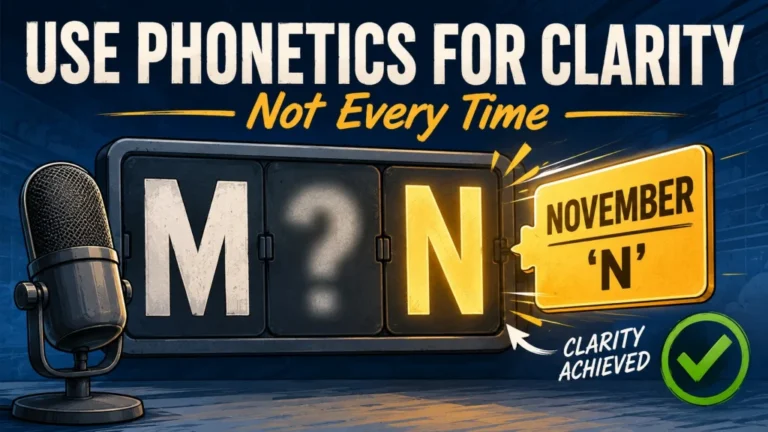
Phonetics are a tool for difficult letters, not a requirement to spell every sentence. They are most useful when a call sign is being copied through noise, when two letters sound alike, or when a net-control operator asks for a repeat. On a clear local signal, saying the call sign normally first often sounds more natural.
For example, if “W1ABC” is copied incorrectly, the operator can repeat it as “Whiskey One Alpha Bravo Charlie.” The standard alphabet gives the receiving station predictable words instead of improvised choices that may create another misunderstanding. The FCC encourages phonetic assistance for correct station identification, but the goal remains accurate copying.
The mistake is using phonetics as decoration. Spelling a name, location, and every ordinary word can make a strong signal harder to follow, not easier. Use the standard radio phonetic alphabet when the listener needs help, then return to normal speech.
Repeater Etiquette Is Mostly Timing and Awareness
A repeater is shared infrastructure, so good operating is less about formal language than leaving room for other users. Wait until the current exchange is clearly finished, pause briefly between transmissions, and avoid keying the transmitter only to test whether the repeater responds. A carrier or repeater tail proves very little about audio quality and can interrupt someone you cannot hear.
When joining an existing conversation, identify and wait to be acknowledged instead of entering mid-sentence. Local operators may use “comment,” a call sign, or another short phrase to request a turn. None of those words overrides emergency traffic, and local conventions vary, so listen before copying a habit from another repeater.
If genuine emergency traffic needs the frequency, say “emergency” with your call sign and state the need clearly when acknowledged. If you hear another station doing that, stop ordinary conversation and yield. More detailed repeater operating etiquette explains pauses, joining conversations, and local expectations without confusing them with federal identification rules.
A Beginner Net Gives the First Contact a Structure
A scheduled net can be the easiest answer for someone wondering how to talk on ham radio for the first time. Net control announces when stations may check in, keeps the order, and often asks for a predictable set of information. You do not have to create a conversation from an empty frequency.
Listen from the beginning because check-in categories differ. Some nets ask for emergency or priority traffic first, then mobile stations, visitors, new licensees, or general check-ins. Others collect call signs on one pass and return to each station for a name, location, or comment.
A hypothetical check-in might be as brief as “W1ABC, Alex in Springfield, no traffic,” but only when that matches the announced format. If net control asks for call signs only, give only the call sign. Following the requested format matters more than copying a script from a different net.
The beginner net check-in process shows how to find a schedule, listen for instructions, give a controlled response, and remain available if net control calls you again.
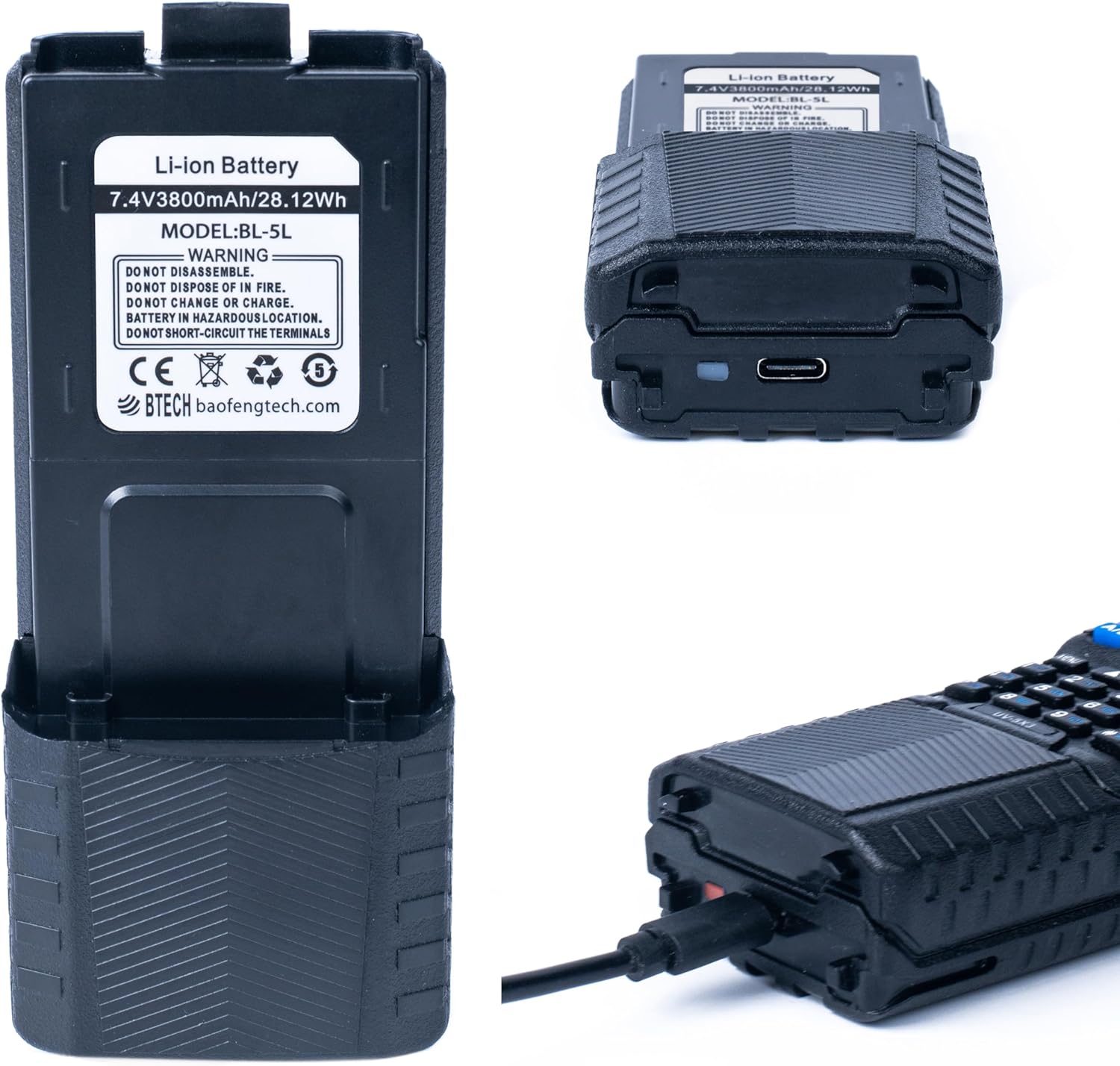
The BTECH BL-5L is a 3800mAh lithium-ion extended battery for UV-5X3, BF-F8HP, and UV-5R radio families. It is designed as a higher-capacity replacement in the BL-5 battery series. Extra battery capacity is useful for scheduled nets where an operator may listen from the beginning and remain available for later check-ins or return calls.
Check On AmazonIf you click this link and buy, we earn a commission at no additional cost to you.
Simplex Is Direct Radio-to-Radio Operation
Simplex removes the repeater from the communication path. Both stations transmit and receive on the same frequency, so terrain, buildings, antenna position, and distance have a more direct effect on whether the contact works. That can make simplex less predictable, but it also shows what the two stations can do without shared infrastructure.
Do not convert a repeater memory into simplex by guessing. Select a frequency permitted by current national and local band plans, confirm that it is not assigned to a repeater input or another incompatible use in your area, and remove the repeater shift so transmit and receive remain on the same frequency. Coordination practices vary by region, especially on VHF and UHF.
Research-based procedure: Agree on the simplex frequency before separating when possible. Then listen, identify, make the direct call, and move to a different suitable frequency if the chosen channel is already occupied.
A simple example is “K2XYZ, this is W1ABC on simplex.” If there is no answer, moving a few feet, stepping outside, or improving elevation can change the path more than immediately selecting maximum power. The simplex and repeater decision explains when each path is the more practical choice.

The Nagoya NA-771 is a 15.6-inch whip antenna tuned for VHF and UHF at 144 and 430 MHz. This exact version uses an SMA-Female connector and is listed for compatible BTECH and BaoFeng radios. Its handheld form is directly relevant to simplex operation, where antenna placement and the direct radio path can strongly affect whether another station hears the call.
Check On AmazonIf you click this link and buy, we earn a commission at no additional cost to you.
The Legal Identification Baseline Is Simpler Than Many Scripts
For a normal U.S. amateur station, the assigned call sign must be transmitted at the end of each communication and at least every ten minutes during a communication. That rule does not require the call sign after every transmission. Identifying more often may be useful in a busy group or required by a net’s procedure, but that is a practical convention rather than the basic ten-minute rule.
On voice, identification is made in English, and phonetics may be used to help another operator copy the call sign correctly. The station must not transmit unidentified communications or use a call sign it is not authorized to use. A first-contact script should therefore make identification easy to remember, not bury it inside unnecessary language.
- Required: Transmit the authorized call sign at the end of the communication.
- Required: Identify at least every ten minutes while a communication continues.
- Useful convention: Identify when entering a conversation so the other operators know who is requesting a turn.
- Not a universal rule: Repeating the call sign after every short transmission.
For a five-minute local exchange, identifying in the opening call and again at the close is easy and clear. For a longer conversation, watch the time and identify before ten minutes passes, then identify again when the communication ends. The exact conversational wording can vary without changing that legal baseline.

The ARRL Ham Radio License Manual 6th Edition is a Technician-class study guide that includes the amateur radio exam question pool. It is designed for operators preparing for their first U.S. amateur radio license and its required rule knowledge. Keeping the manual nearby gives a new operator a structured reference when separating legal identification requirements from local operating customs.
Check On AmazonIf you click this link and buy, we earn a commission at no additional cost to you.
Give Signal Reports That Help the Other Operator
On an FM repeater or local simplex contact, a forced “59” report often provides less information than plain language. Tell the other operator what can be acted on: whether the signal is full quieting, readable with light noise, breaking up, distorted, or carrying audio that is unusually low or loud. A useful report distinguishes radio-frequency strength from audio quality.
For example, “Your signal is readable but noisy, and the audio is clear” tells the station that the microphone level is acceptable while the radio path is marginal. “You are strong into the repeater, but your audio is low” points toward a speaking-distance or microphone-level issue rather than a coverage problem. Those reports help more than a number copied from HF operating habits.
Avoid diagnosing equipment from one brief transmission. A clipped word may come from weak coverage, moving behind a building, an antenna position, or someone beginning to speak before the repeater fully opens. Describe what you hear, ask for another transmission if needed, and let the other operator decide what to change.

This 2-pin shoulder microphone is listed for Baofeng UV-5R, BF-F8HP, UV-82HP, and additional compatible radios. The Amazon listing highlights clear audio, a reinforced cable, rugged construction, and a swivel clip. It is relevant when an operator is learning to separate radio-path strength from microphone and voice-audio quality in a useful signal report.
Check On AmazonIf you click this link and buy, we earn a commission at no additional cost to you.
No Reply Is a Decision Point, Not Proof the Radio Failed
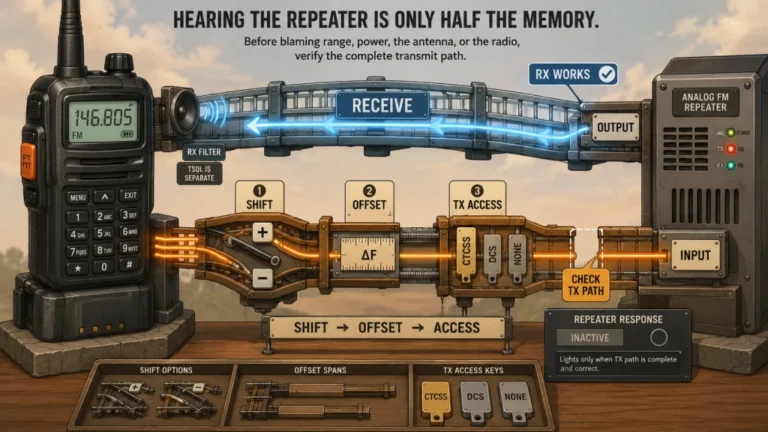
Silence after a call has several possible meanings. Nobody may be listening, the repeater may be quiet at that time, the signal path may be weak, or the programmed frequency, shift, access tone, or memory may be wrong. Increasing power before separating those possibilities can hide the real problem and drain the battery faster.
- Confirm that you are using the intended repeater or simplex memory.
- Listen for normal activity, repeater identification, or a scheduled net at a known active time.
- Make one clear call and wait long enough for a listener to respond.
- Change location or elevation safely before assuming the radio needs more power.
- Try a known station or scheduled net so inactivity is not confused with a configuration problem.
- Stop transmitting and verify the setup when the repeater never responds or the behavior is inconsistent.
That sequence separates an empty channel from a weak path and a setup error. It does not require opening the radio or changing every menu item. When basic checks do not explain the failure, use the ham radio troubleshooting steps instead of changing several variables at once.
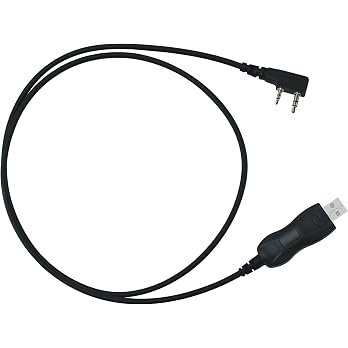
The BTECH PC03 is an FTDI USB programming cable for supported BTECH, BaoFeng, and Kenwood radios. Amazon lists compatibility with models including UV-5R, BF-F8HP, GMRS-V2, and UV-82HP. It is useful when a no-reply problem points back to the programmed memory, frequency shift, or access tone rather than transmit power.
Check On AmazonIf you click this link and buy, we earn a commission at no additional cost to you.
Build Confidence on One Local Path Before Expanding
A working first contact is not proof that every repeater, simplex path, or operating location will behave the same way. Repeat the successful path until the sequence feels ordinary: listen, identify, make the call, exchange useful information, and close. Consistency gives you a reference point when a later contact fails.
After local repeater and simplex operation feel comfortable, the next direction can follow your actual interest. HF voice introduces different band, propagation, and tuning decisions. Digital voice adds network and protocol choices. Those are separate operating paths, and learning them is easier when basic identification, listening, and turn-taking no longer consume all your attention.
The mistake is treating the first transmission as an audition for the entire hobby. It is only one contact on one working path. A short exchange with clear identification and reasonable timing is enough to move from owning a programmed radio to using it.

The ARRL General Class License Manual 10th Edition is a complete study guide for upgrading an amateur radio license. ARRL describes this edition as covering the General-class question pool and the privileges available with the upgrade. It fits this section because the article points toward HF voice as a next operating path after local repeater and simplex work feels routine.
Check On AmazonIf you click this link and buy, we earn a commission at no additional cost to you.
Final Thoughts: Make the First Contact Smaller
Start with a known working channel and one purpose. Listen first, choose repeater, simplex, or net, write down the opening and closing lines, then make a brief call. You do not need perfect radio vocabulary, an HF-style signal report, or a call sign after every transmission.
I would rather hear a new operator make a short, legal contact and ask one honest question than wait another month for a flawless script. When no one answers, diagnose the path instead of judging your operating ability. That is how a first transmission becomes a repeatable skill rather than a one-time test.
Explore More Local Operating Skills
Each operating situation becomes easier when its procedure is practiced separately. Use the resources below to work on the exact step that still feels uncertain.
| Operating Skill | What It Helps You Do |
|---|---|
| Make Your First Radio Contact | Move from the opening call through acknowledgment, a short exchange, and a clean close. |
| Use Phonetics for Clear Copy | Spell call signs accurately when noise or similar-sounding letters cause confusion. |
| Operate Courteously on Repeaters | Handle pauses, joining conversations, shared-channel timing, and emergency interruptions. |
| Check Into a Beginner Net | Follow net control, give the requested information, and complete a structured first check-in. |
| Choose Simplex or a Repeater | Match the operating path to distance, infrastructure, local practice, and the intended contact. |
Choose one skill, practice it on a known active path, and return to the others after the first procedure feels routine.

Ham Radio For Dummies is a broad beginner-oriented reference about amateur radio. The paperback edition provides a single general guide rather than a model-specific radio manual. It fits the Explore More section because that section sends the reader into several separate operating skills after the first local contact.
Check On AmazonIf you click this link and buy, we earn a commission at no additional cost to you.
FAQs
📻 What should I say the first time I use ham radio?
Use your call sign and make one clear request. On a quiet repeater, that may be a brief monitoring call; when calling a known station, say its call sign followed by yours. Exchange only what fits the contact, then identify at the close.
⏱️ Do I have to give my call sign after every transmission?
No. For normal U.S. amateur operation, identify at the end of the communication and at least every ten minutes during it. A net or local group may prefer more frequent identification for orderly operation.
🎙️ Can I call CQ on a repeater?
A brief call-sign announcement or monitoring call is more common on many local repeaters. Practices vary, so listen to the repeater and follow its local convention rather than assuming an HF calling style fits every system.
🔤 Do I need to use phonetics for my call sign?
Use phonetics when they help another operator copy the call sign correctly, especially through noise or when letters sound alike. On a clear signal, saying the call sign normally first is often sufficient.
📡 Why can I hear a repeater but nobody answers me?
The repeater may be inactive, your signal may not be reaching it, or the programmed shift or access tone may be wrong. Try a known active time or net, change location safely, and verify the setup before increasing power.
🗣️ Is a 59 signal report useful on local FM?
Plain language is usually more useful on an FM repeater or simplex contact. Report whether the station is clear, noisy, breaking up, distorted, or carrying low audio so the operator knows what part of the signal needs attention.
😬 Is it normal to feel nervous before my first transmission?
Yes. Write down your opening call and closing line, take one breath, and keep the first exchange short. Clear identification and understandable speech matter more than sounding completely relaxed.