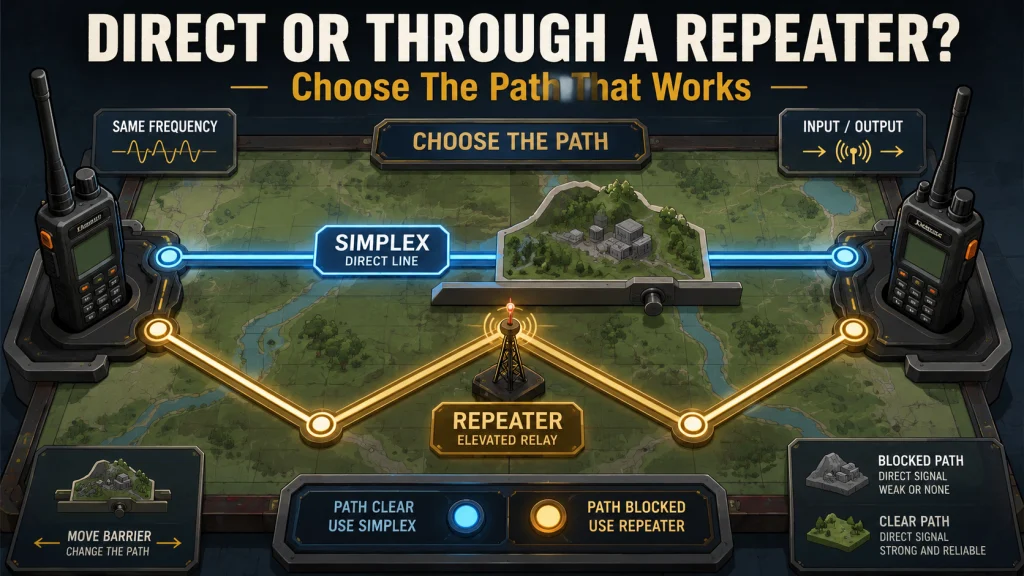
A repeater relays your signal through a well-positioned station, while simplex lets two amateur stations communicate directly on one frequency. Use a repeater when its coverage, activity, or elevation solves a path problem; use simplex when the stations can already hear each other, need a direct local channel, or want to move an extended conversation away from a busy repeater. A lawful first simplex contact requires an appropriate frequency, matching radio settings, clear station identification, and a realistic test of the actual path. The practical goal is not to declare one method better, but to know which signal path fits the contact you are trying to make.
Ham Radio Simplex vs Repeater Starts With the Signal Path
The practical difference between ham radio simplex and repeater operation is where the signal travels. On simplex, your station transmits directly to the other station, and both radios use the same frequency. Through a repeater, your radio transmits on the repeater input, the repeater receives that signal from a favorable location, and it retransmits on a different output frequency that both users monitor.
That difference changes what can go wrong. A repeater contact depends on correct input and output pairing, access settings, and the repeater being available. A simplex contact removes the repeater from the path, but it depends more directly on the two stations’ locations, antennas, receiver environments, and compatible radio settings.
When I explain this to a new Technician, I start with the path rather than the radio menu. Ask one question: can the two stations communicate directly from the places where they will actually operate? If the answer is uncertain, test simplex instead of assuming that wattage, distance, or a strong repeater signal has already answered it.
Scope: This article covers US VHF/UHF analog FM operation for beginner-to-intermediate licensees. It does not cover HF split operation, cross-band repeating, amateur satellites, automatic simplex nodes, or formal emergency tactical plans.

This handheld covers VHF, 1.25-meter, and UHF frequencies with 5-watt and 0.5-watt output settings. It provides 128 memory channels and supports all CTCSS and DCS tones. The Amazon listing describes customizable features and a comprehensive accessory bundle for the UV-5X3.
Check On AmazonIf you click this link and buy, we earn a commission at no additional cost to you.
What Simplex Means on VHF and UHF
Simplex means both stations take turns transmitting and receiving on the same frequency without a repeater between them. One operator presses push-to-talk, the other listens, and then they reverse roles. It is still two-way communication, but there is no elevated relay station extending or reshaping the path.
This is different from a repeater memory that displays one frequency while the radio silently applies a transmit offset. It is also different from full-duplex operation, where transmitting and receiving can occur at the same time, and from cross-band systems that receive in one band and retransmit in another. Those systems may look similar from the front panel, but they are not ordinary simplex FM.
| Operating Detail | Simplex | Repeater |
|---|---|---|
| Signal path | Station to station | Station to repeater to station |
| Transmit and receive frequency | The same frequency | A paired input and output |
| Infrastructure dependency | No repeater required | Repeater must be reachable and operating |
| Typical beginner mistake | Leaving a repeater shift or receive tone enabled | Entering the wrong offset or access tone |
| Calling style | A direct call or brief CQ is normal | Call a station or announce your call sign; CQ is generally unnecessary |
The table is a diagnostic tool, not a ranking. If a repeater reaches a station that simplex cannot, the repeater is doing exactly what it was built to do. If two nearby operators can communicate directly, simplex may be the cleaner path because it leaves the repeater available for stations that need it.

This shoulder microphone provides dual push-to-talk controls for compatible radios and works as a single-PTT mic with supported single-PTT models. Its IP54 construction is designed for resistance to shock, wind, dust, and splashes. The built-in 3.5 mm jack supports a listen-only earpiece.
Check On AmazonIf you click this link and buy, we earn a commission at no additional cost to you.
When a Repeater Is the Better Path
A repeater is usually the practical choice when direct coverage is weak or unknown and the repeater has a favorable site. Elevation can let it hear handheld and mobile stations that cannot hear each other through buildings, hills, or distance. A repeater also gives a new operator access to an established local community, scheduled nets, and stations that routinely monitor its output.
Use the repeater when its infrastructure solves a real problem. That may mean reaching an operator beyond your direct path, checking into a net, making an initial local contact, or coordinating across terrain that blocks station-to-station FM. Before relying on that path, confirm that the machine is current and suitable by finding active ham radio repeaters near you rather than loading an old frequency list and assuming every entry is still useful.
A repeater does add settings that simplex does not need. The radio may require the correct offset direction, offset amount, and access tone before the machine will respond. The separate guide to understanding repeater offsets and access tones explains that programming path without mixing it into a direct-frequency contact.
If your immediate goal is to overcome first-contact anxiety and join local activity, a repeater may still be the easiest starting point. The operating sequence in making your first ham radio contact covers the listening, calling, exchange, and closing habits that also carry over to simplex.
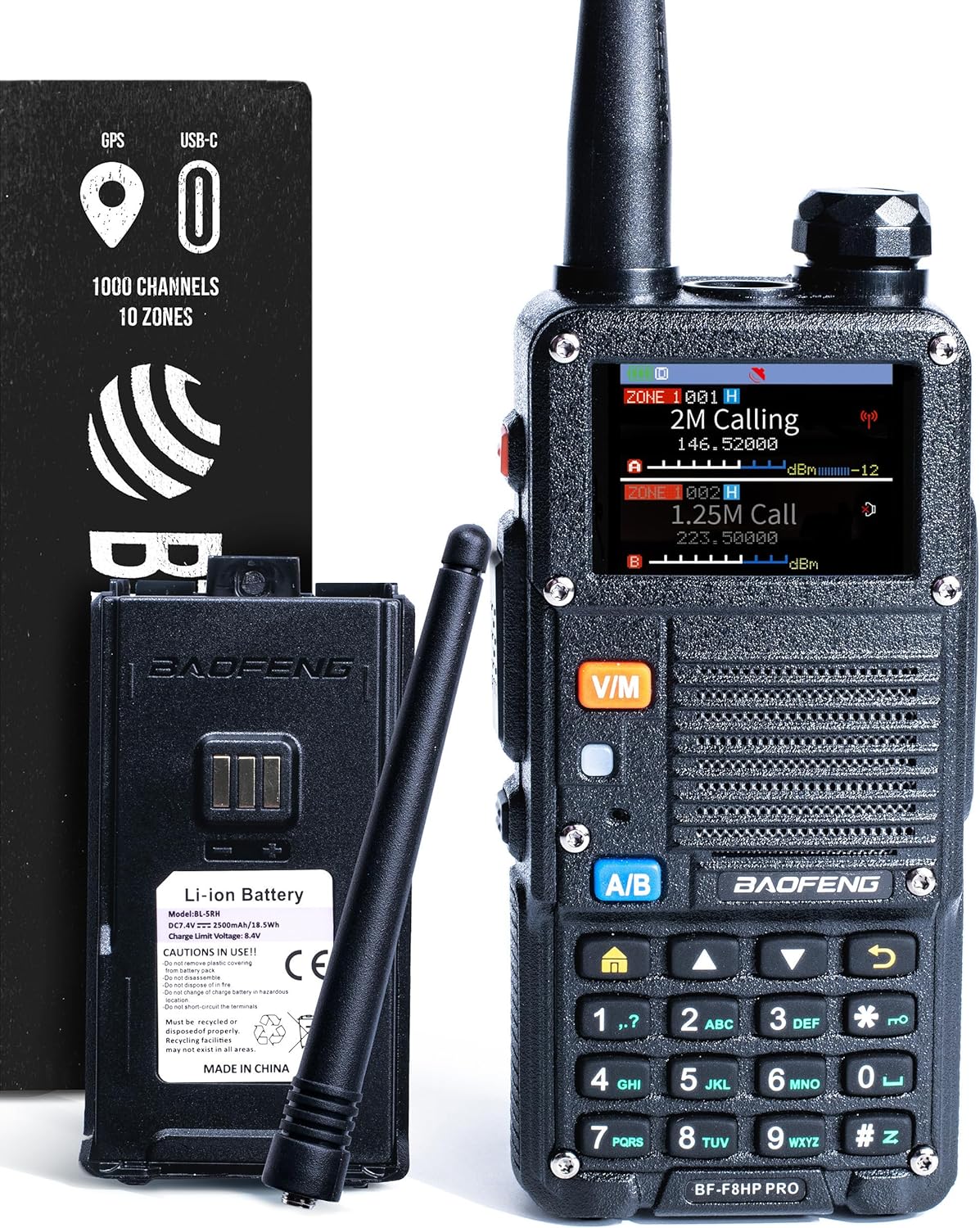
This tri-band handheld covers VHF, 1.25-meter, and UHF operation with up to 10-watt output and 1,000 channels. It includes GPS and NOAA weather features plus aviation, VHF, UHF, and 1.25-meter scanning. The radio uses an IP54-rated enclosure and a USB-C rechargeable battery.
Check On AmazonIf you click this link and buy, we earn a commission at no additional cost to you.
When Simplex Is the Better Path
Simplex is the better choice when both stations can already hear each other directly. Adding a repeater in that situation may create more setup, occupy shared infrastructure, and hide what the direct path can actually do. A short simplex test gives you information that a strong repeater signal cannot provide.
Direct operation also fits local group coordination, field testing, repeater congestion, and a planned fallback when infrastructure is unavailable. It can be courteous to move a long conversation away from a busy calling channel or repeater when the other station agrees and local practice supports the move. The key is to choose an appropriate simplex frequency before moving, not to jump to an arbitrary open-looking number.
Field Note: The first-contact hesitation I see after exam sessions is usually procedural. A new licensee may understand what an offset and tone are, yet still pause because they do not know whether to call a station, call CQ, or wait. Deciding the signal path and the opening line before pressing push-to-talk removes much of that uncertainty.
Simplex is therefore more than a backup mode. It teaches you how your station works without a relay site in the middle, which is useful when judging an antenna change, comparing operating locations, or learning where a handheld is dependable and where it is not.

This 15.6-inch whip is tuned for 144/430 MHz operation and uses an SMA-Female connector. Amazon lists 2.15 to 3 dBi gain, 50-ohm impedance, and a maximum input power of 10 watts. The antenna is omnidirectional and includes an antenna washer.
Check On AmazonIf you click this link and buy, we earn a commission at no additional cost to you.
Choose a Direct Frequency From Current Band Plans
In the United States, 146.520 MHz is recognized as the national 2-meter FM simplex calling frequency. It is a shared calling place, not a private channel and not a guarantee that the frequency will be clear in every area. Local activity, coordinated repeater inputs, temporary operations, and regional practices can change what is appropriate around you.
The ARRL band plan and local or regional plans are voluntary operating agreements that help amateurs avoid interfering with established activities. They are not the same thing as the FCC rules that authorize frequency privileges. Check both layers: confirm that your license class permits the operation, then use the current national and applicable local plan to choose an FM simplex segment or channel that fits local practice.
For a brief general call, 146.520 MHz may be the practical starting point when it is clear and locally appropriate. For an extended conversation, many operators move to another suitable simplex channel after agreeing on it. Do not publish one alternate frequency as universally correct, because channel spacing and local usage vary by region.
On the 70-centimeter band, 446.000 MHz is the national FM simplex frequency in the ARRL band plan. It can serve as the UHF starting point for a brief call, but nearby channel assignments are especially dependent on local coordination and regional practice. Check the applicable plan before choosing another 70-centimeter channel or settling into an extended conversation.
Key point: A direct simplex frequency is not chosen just because the display appears clear. It must be within your privileges, appropriate for the emission, consistent with the relevant band plans, and unused when you transmit.
How to Use Simplex Ham Radio Settings Correctly
Both radios must be on the same frequency and use compatible analog FM settings. Disable the repeater shift so the transmit frequency does not jump when you press push-to-talk. This matters most with memories copied from a repeater channel, because the display can look correct while the radio still transmits somewhere else.
Bandwidth or deviation settings also need to be compatible. A wide and narrow mismatch may produce low, distorted, or unusually loud audio rather than complete silence, depending on the radios. Use the radio manuals and local practice to set both stations consistently instead of guessing from labels that differ among manufacturers.
CTCSS and DCS are optional on ordinary simplex unless the group intentionally uses them. A transmit tone can open a receiver that is configured for tone squelch, while a receive-tone setting can hide every signal that does not carry the matching tone or code. These settings control squelch behavior; they do not encrypt the conversation, create privacy, or stop other receivers from hearing the audio.
- Set both stations to the same verified simplex frequency.
- Use compatible analog FM mode and bandwidth settings.
- Turn repeater shift, offset, and reverse functions off.
- Start without receive-tone squelch unless the group has agreed to use it.
- Confirm the antenna is connected and appropriate for the band.
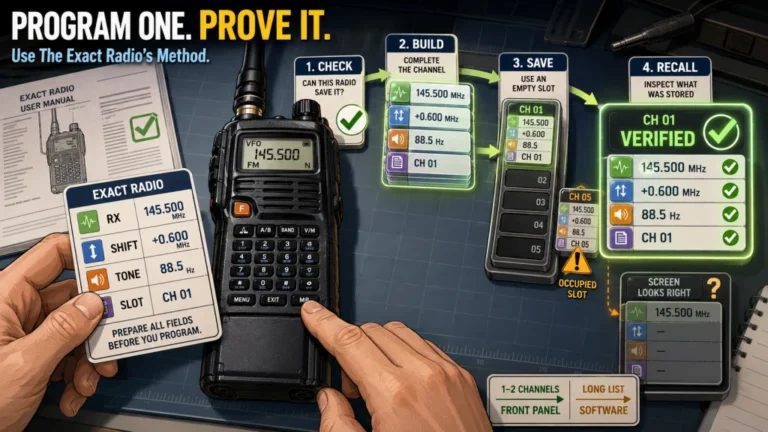
- Store and recall the memory once before relying on it away from the programming screen.
That last step catches a common setup failure: the operator edits a temporary frequency but never saves the corrected memory. A recalled memory is proof that the radio will return to the intended settings after a power cycle or channel change.

This programming cable uses a genuine FTDI FT232RL chipset for radio-to-computer communication. It supports CHIRP and many OEM programming applications for radios using the Kenwood K1 2-pin accessory connection. The USB-C cable is listed for use across Windows, macOS, and Linux systems.
Check On AmazonIf you click this link and buy, we earn a commission at no additional cost to you.
Make a Lawful First Simplex Contact
Before transmitting, listen long enough to understand whether the frequency is in use. Verify the band-plan segment, select only the power needed for the desired contact, and have your call sign ready. Your amateur license must be active, and the licensed control operator remains responsible for the station and must operate within the privileges of that operator license.
If a nonlicensee is present, do not hand over independent control of the transmitter. A nonlicensee may participate only under the supervision and responsibility of a qualified control operator when the communication is otherwise permitted. The licensed operator must remain at the control point and be able to ensure proper operation.
To call a known station, keep the opening short: “Their call sign, this is your call sign, are you monitoring?” For a general call on an appropriate simplex calling frequency, a brief “CQ two meters, CQ two meters, this is your call sign, listening” is normal. That differs from repeater practice, where calling CQ is generally unnecessary because users monitor a known repeater channel rather than tune across a simplex segment.
If someone answers, exchange call signs, signal readability, location if useful, and the reason for the call. For a longer conversation on a calling frequency, agree on another appropriate simplex channel and confirm it before moving. Identify with your assigned call sign at the end of the communication and at least every 10 minutes during a continuing communication.
Pro Tips: During a planned first simplex contact, arrange the test time and general location with a licensed partner, but do not prearrange the result. Start with a short exchange, confirm both directions, and then change only one condition if you want to learn what improves the path.
Simplex Range Has No Universal Mileage Number
A handheld, mobile, or home station does not have one fixed simplex range. Antenna height and pattern, terrain, buildings, foliage, antenna orientation, receiver noise, feedline loss, frequency, and transmitter power all shape the path. Two stations separated by a short distance can fail through dense structures or terrain, while a clear elevated path can work much farther with modest power.
Power is only one part of that system. Raising power may help a marginal outgoing signal, but it does not improve the other station’s transmitter, fix a noisy receiver location, clear a hill, or repair an antenna problem. I would rather see a new operator test the real path than repeat a mileage claim taken from a package or forum post.
Antenna changes should also solve a defined problem. Moving an antenna higher or into a clearer location may matter more than replacing one whip with another of uncertain fit. For a fixed station, the guide to planning a VHF/UHF home antenna explains the practical decisions without turning this simplex procedure into an installation article.
Warning: Do not treat a successful test from one location as proof of coverage everywhere nearby. A move behind a building, into a vehicle, down a slope, or inside a different room can change the path enough to require a different channel, antenna position, or repeater.

This magnetic-mount antenna is tuned for 144/430 MHz operation and uses PL-259 plus SMA-Female connectivity. Amazon lists a 20.27-inch antenna with 13 feet of RG-58A/U coax and a maximum input power of 80 watts. The package includes an SO-239 to SMA-Female adapter.
Check On AmazonIf you click this link and buy, we earn a commission at no additional cost to you.
Build a Local Simplex Coverage Map
A useful simplex ham radio test changes one variable at a time. Use a licensed partner, keep one station fixed, and record the frequency, power level, antenna, location, and readability in both directions. Signal bars alone are not enough; the real question is whether each operator can understand the other without repeated fills.
Start with the locations that matter in your routine, such as the home operating position, driveway, vehicle parking area, neighborhood meeting point, or a nearby elevated location. The examples are not universal test points. They are a way to replace vague range expectations with a map of paths you have actually verified.
| Test Step | Keep Fixed | Change | Record |
|---|---|---|---|
| Baseline | Frequency, radios, antennas | Nothing | Two-way readability and noise |
| Location test | Frequency, power, antennas | One station’s location | Where the path improves or fails |
| Power test | Locations, frequency, antennas | One power level | Lowest setting that maintains the contact |
| Antenna-position test | Frequency, power, locations | Height, orientation, or placement | Repeatable improvement or loss |
Preserve one known simplex fallback channel in the group’s plan only after everyone has confirmed that it is locally appropriate and programmed correctly. Retest it periodically, especially after changing radios, antennas, memories, operating locations, or local channel practices.

This field kit combines a weatherproof tactical notebook, a tan CORDURA fabric cover, and a weatherproof pen. The included notebook measures about 4.625 by 7.25 inches. Model 980T-KIT packages the notebook, protective cover, and pen as one field-writing set.
Check On AmazonIf you click this link and buy, we earn a commission at no additional cost to you.
When the First Simplex Contact Fails
Do not blame range first. My troubleshooting order starts with settings that can make two nearby radios appear unable to communicate. Confirm the actual transmit frequency, disable any shift, remove receive-tone squelch, verify compatible FM mode and bandwidth, and make sure the frequency is not occupied by a signal one radio hears better than the other.
Next, test the physical path. Move both operators into clear view at short distance, use known-good antennas, lower the squelch enough to hear weak audio, and confirm communication in both directions. If the radios work there, restore one original condition at a time until the failure returns.
| Symptom | Check First | Why It Matters |
|---|---|---|
| No response at close range | Transmit shift and actual TX frequency | One radio may still be transmitting on a repeater input |
| Signal indicator moves but no audio | Receive CTCSS or DCS | Tone squelch may be hiding an otherwise usable signal |
| Audio is very low or distorted | Bandwidth and microphone technique | Mode mismatch can affect audio without stopping RF reception |
| Only one direction works | Power, antenna, receiver noise, and each radio separately | The two ends of a path are not automatically equal |
| Works outdoors but not indoors | Building loss and antenna placement | The environment, not the channel memory, may be the limiting factor |
Once you know which branch failed, follow a repeatable process instead of changing several settings at once. The broader ham radio troubleshooting sequence helps separate programming, antenna, power, audio, and path problems when the quick checks do not resolve the issue.

This whip antenna is tuned for 144/430 MHz operation and uses an SMA-Female connector. Amazon lists 2.15 to 3.5 dBi gain, 50-ohm impedance, and a maximum input power of 10 watts. The antenna is omnidirectional and measures 16 inches in the technical specifications.
Check On AmazonIf you click this link and buy, we earn a commission at no additional cost to you.
Simplex Is a Useful Fallback, Not an Emergency Guarantee
Simplex can remain available when a repeater is congested, unreachable, offline, or unsupported by local power and network systems. That makes a verified direct channel useful, but only between stations that can actually reach each other. A saved memory and a successful test from months ago do not guarantee that the same path will work from a different building, vehicle, terrain position, or antenna setup.
A practical fallback plan needs licensed operators, an agreed channel that follows current local practice, compatible radio settings, periodic tests, and a clear understanding of the locations covered. It also needs another way to call for help when direct amateur communication does not reach the people or services required. I do not treat simplex, a repeater, or ownership of a radio as a substitute for that broader planning.
The ham radio emergency-preparedness overview puts this tool in the correct role alongside licensing, practice, power, reachable stations, and alternative communication methods. This article stops at the operating path and does not create a formal tactical communications plan.

This lithium-ion battery pack has a 5200mAh capacity and supports USB-C charging. Amazon lists compatibility with the BF-F8HP PRO, UV-5RM, UV-5G Plus, GM-5RH, and other radios using the BL-5RH battery standard. It does not fit BL-5 or UV-5R-style battery systems.
Check On AmazonIf you click this link and buy, we earn a commission at no additional cost to you.
Final Thoughts: Learn Both Paths and Test the One You Need
The repeater vs simplex decision becomes easier once you stop asking which method is universally better. Use a repeater when its site, activity, and coverage solve the contact problem. Use simplex when direct communication is practical, when you need to test the real station-to-station path, or when an agreed local channel provides a useful fallback.
Your next step is small: choose one licensed partner, verify one appropriate simplex frequency, remove the repeater settings, and complete one short two-way contact from the locations that matter. Then record what worked. That measured path is more useful than a guessed range figure, and it fits naturally into the larger process of getting on ham radio with a local plan.

This 8.25-inch whip antenna is tuned for 144/430 MHz operation and uses an SMA-Female connector. Amazon lists 2.15 dBi gain, 50-ohm impedance, and a maximum input power of 10 watts. The antenna is omnidirectional and includes an antenna washer.
Check On AmazonIf you click this link and buy, we earn a commission at no additional cost to you.
FAQs
These questions cover the settings and operating choices that most often block a first simplex contact. Local channel use can vary, so frequency answers should always be checked against current national and regional band plans.
Use the answers as a pre-transmit check, not as a replacement for your radio manual or the applicable FCC operating rules.
📻 What is simplex in ham radio?
Simplex is direct station-to-station communication on the same frequency without a repeater relaying the signal. The operators take turns transmitting and receiving.
📡 Do I use a repeater offset on simplex?
No. Both radios should transmit and receive on the same verified simplex frequency, so repeater shift and offset functions should be off.
🗣️ Can I call CQ on 2-meter FM simplex?
Yes. A brief CQ is normal on an appropriate simplex calling frequency. On a repeater, calling CQ is generally unnecessary; identify and call the station you want or announce that you are monitoring.
🎚️ Should I use CTCSS or DCS on simplex?
Use a tone or code only when the group has intentionally agreed on it. For an initial test, carrier squelch is easier to diagnose, and no tone setting provides privacy or encryption.
🗺️ How far will a simplex ham radio contact reach?
There is no universal mileage figure. Height, terrain, buildings, antennas, receiver noise, feedline, frequency, and power all change the path, so test the actual locations you plan to use.
🔇 Why can I see a signal but hear no simplex audio?
Check receive-tone squelch first. A mismatched CTCSS tone or DCS code can mute a signal that the receiver is otherwise detecting; bandwidth and audio settings are the next checks.
🆘 Is simplex reliable when a repeater is down?
It can be a useful direct fallback only where the stations have a verified path. Agree on the channel, test it periodically, keep the operators licensed and practiced, and maintain another way to request help.