A ham radio first contact on a local analog repeater can be as simple as giving your call sign, answering one station, exchanging names and general locations, and closing with your call sign. The words do not need to be perfect, and the examples below are patterns rather than required scripts. The part that matters is confirming the repeater is ready, listening before transmitting, identifying legally, and leaving the channel cleanly. By the end, you will know what to say from the first press of the push-to-talk button through the final sign-off.
A First Repeater Contact Needs Only Four Moves
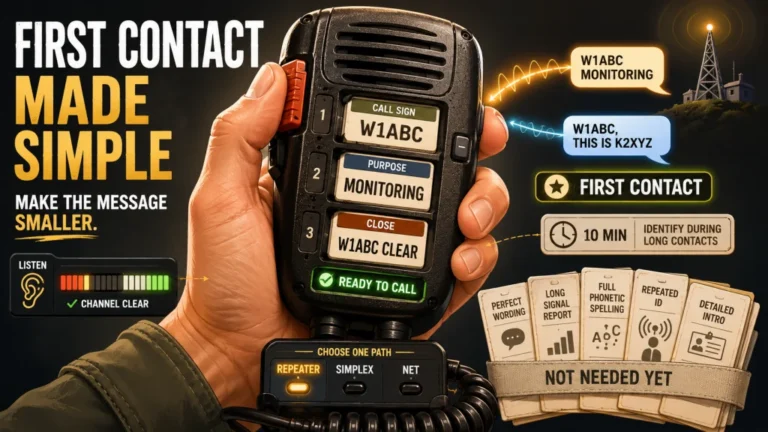
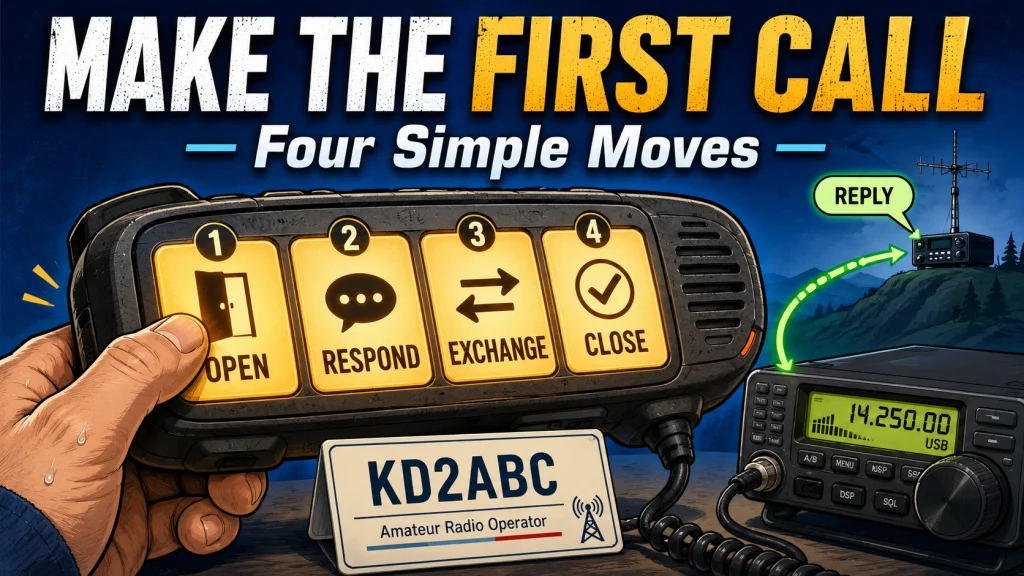
Your first ham radio transmission does not need a speech, a formal signal report, or a string of radio shorthand. On a quiet local repeater, the complete flow can be reduced to four moves: announce your call sign, recognize the station that answers, exchange a small amount of useful information, and close with your call sign. That is enough to create a valid, understandable contact.
After exam sessions, I have spoken with new licensees who understood repeater offsets and access tones on paper but still hesitated when the microphone was in their hand. The obstacle was not missing technical knowledge. They were trying to remember an imaginary perfect script instead of treating the contact like a short introduction between two people.
| Stage | What you need to accomplish | Simple example |
|---|---|---|
| Open | Identify yourself and show that you are available | “K1ABC monitoring.” |
| Respond | Acknowledge the station that answered | “W2XYZ, this is K1ABC. Thanks for coming back.” |
| Exchange | Give a name, general location, and one useful topic | “My name is Sam, and I am near Dayton. This is my first contact.” |
| Close | Thank the operator and transmit your call sign | “Thanks for the contact. K1ABC clear.” |
That four-part pattern is a useful safety rail, not a phrasebook you must follow word for word. Local habits vary, and a natural sentence is better than forcing unfamiliar jargon into the exchange. For the broader sequence that comes before and after this moment, use the guide to getting on ham radio after licensing.

The UV-5X3 is a handheld amateur radio covering VHF, 1.25-meter, and UHF bands. It provides programmable channels and a keypad for direct radio operation. A complete handheld gives a new operator the platform needed to practice the short repeater contact flow described in this section.
Check On AmazonIf you click this link and buy, we earn a commission at no additional cost to you.
Before Transmitting, Prove the Path Is Ready
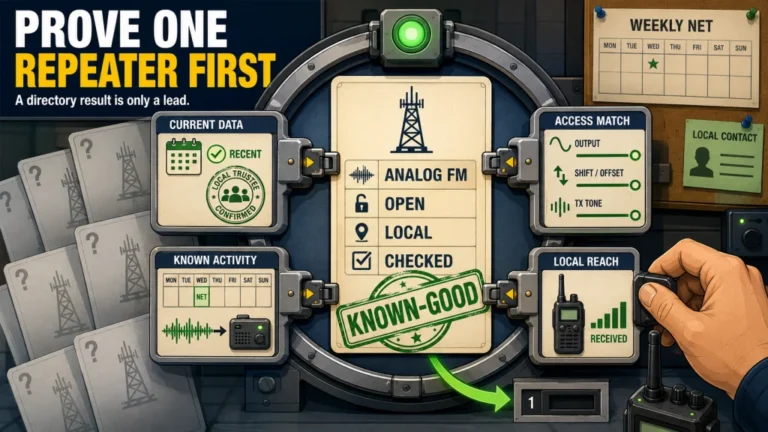
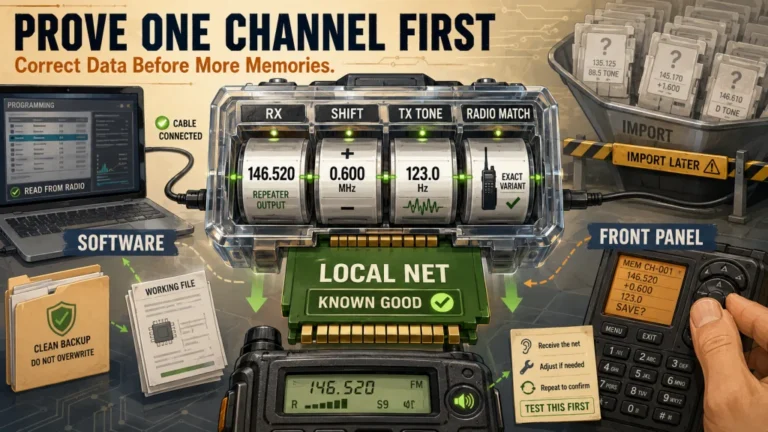
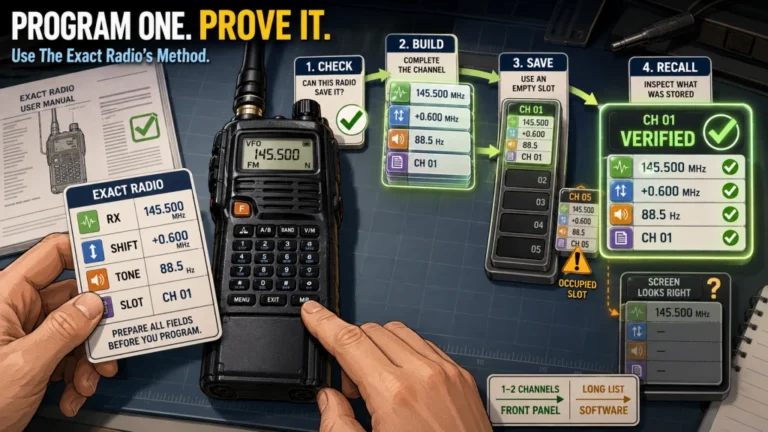
Mic fright gets blamed for many silent first attempts, but an unverified channel creates a different problem: you may speak correctly into a radio that is not reaching the repeater. Before making first contact on ham radio, confirm the memory contains the repeater output frequency, the correct transmit offset, and any required access tone. Then listen long enough to learn whether the channel is quiet, carrying a conversation, running a net, or being used for priority traffic.
Use the lowest power setting that still provides a clean path when your location and equipment make that practical. Low power is not a ritual, and it should not be used when it produces an unreliable signal. The decision rule is simple: use enough power for clear communication, not automatically the radio’s maximum setting and not an artificially weak setting that makes everyone struggle to copy you.
Research-based preparation: Complete this check before pressing push-to-talk:
- Confirm that your FCC-assigned call sign is active and written where you can see it.
- Verify the exact repeater channel, offset direction, offset amount, and access tone.
- Listen for ongoing activity and wait for a genuine opening.
- Set a practical power level for the path rather than choosing by habit.
- Hold the microphone at the distance recommended for your radio and speak in a normal voice.
This checklist separates a speaking problem from a radio-path problem. If you hear the repeater clearly but cannot activate it, repeating the same call louder will not correct the programming. The difference between simplex and repeater operation also matters here because a repeater memory requires transmit settings that a simplex channel does not.

The PC03 uses a genuine FTDI chipset and a Kenwood K1 two-pin radio connector for computer programming. It supports compatible BTECH and BaoFeng handheld families that use that interface. It is useful for loading and checking repeater frequencies, offsets, and access tones before transmitting.
Check On AmazonIf you click this link and buy, we earn a commission at no additional cost to you.
Opening Option 1: Make a Monitoring Call
When the repeater is quiet and you are open to speaking with anyone, transmit your assigned call sign followed by a plain word such as “monitoring” or “listening.” A complete opening might be, “K1ABC monitoring,” or, “This is K1ABC, listening.” Release the push-to-talk button and give other operators time to respond.
You may say the call sign phonetically when audio is weak, the characters are easy to confuse, or someone asks for clarification. It is not necessary to spell every call sign phonetically on every strong local contact. A written card showing your call sign and the standard words from the ham radio phonetic alphabet is more useful than inventing phonetics while nervous.
Field Note: A recurring hesitation among new licensees is the belief that an experienced operator will judge one awkward opening sentence. In practice, a clearly spoken call sign followed by “monitoring” communicates everything the repeater audience needs. The longer the prepared speech becomes, the easier it is to lose the call sign inside it.
Local wording is convention, not federal law. Some groups commonly use “monitoring,” others use “listening,” and some operators give only a call sign. Listen to local activity, choose a clear version that feels natural, and avoid calling CQ on a routine FM repeater unless the local operating practice specifically supports it.

The QHM22 is an IP54-rated remote speaker microphone for radios using the Kenwood K1 two-pin accessory connection. Its shoulder-mic layout puts push-to-talk and received audio within easy reach. That makes it a practical accessory for a short monitoring call while the handheld remains clipped or secured.
Check On AmazonIf you click this link and buy, we earn a commission at no additional cost to you.
Opening Option 2: Call a Known Station Directly
If you know which operator you want, say that station’s call sign first and then give yours. For example: “W2XYZ, this is K1ABC.” Putting the called station first tells everyone immediately that the transmission is directed rather than a general invitation.
Keep the first call short because the other operator may be away from the radio, scanning several channels, driving, or unable to answer. A long message addressed to someone who never heard the opening wastes airtime and leaves you unsure whether any part was received. Call once, release the button, and wait before trying again.
Direct calling is also different from joining a conversation already in progress. If two stations are talking, wait for a pause and give your call sign briefly rather than talking over either operator. The fuller rules for shared-channel behavior belong in the guide to local repeater etiquette, but the immediate rule is to listen first and avoid using emergency-sounding language for routine traffic.

The QHM07 combines an acoustic-tube earpiece, inline microphone, and push-to-talk control in one wired kit. Its Kenwood K1 two-pin connector is made for compatible BTECH, BaoFeng, Kenwood, and other supported radios. It lets an operator hear the called station privately and key a concise direct reply without handling the radio body each time.
Check On AmazonIf you click this link and buy, we earn a commission at no additional cost to you.
When Someone Responds, Build the Contact One Line at a Time
Once another operator answers, acknowledge that person’s call sign and give yours again if doing so improves clarity. Then offer your first name, a general location, and the fact that this is your first contact if you want the other operator to slow down or explain local practices. You do not need to give a street address, workplace, travel itinerary, or other precise personal information over an open radio channel.
A realistic response can sound like this: “W2XYZ, this is K1ABC. Thanks for answering. My name is Sam, I am near Dayton, and this is my first repeater contact.” That sentence gives the other operator several easy ways to continue. The response may be a welcome, a question about your location, or an audio report.
When you miss part of the call sign or name, ask for the missing information rather than pretending you copied it. Try, “I missed the suffix of your call sign. Please give it again phonetically,” or, “Please repeat your name.” Clear correction is normal radio operation, not a failed first QSO.
The best pace is one idea per transmission. Release the button after a short statement so the other station can answer and so anyone with urgent traffic has a chance to enter. A local FM conversation feels more natural when it alternates in small pieces rather than turning into two long monologues.

This wired surveillance-style headset uses an acoustic-tube earpiece, microphone, and push-to-talk control for two-way radio communication. Amazon lists compatibility with radios using a 2-pin Kenwood audio jack, including common UV-5R and BF-F8HP models. It supports the short back-and-forth exchanges in this section by keeping received audio and transmit control close to the operator.
Check On AmazonIf you click this link and buy, we earn a commission at no additional cost to you.
Keep the Useful Exchange Relevant to a Repeater Contact
A first contact needs enough substance to confirm two-way communication, but it does not need to imitate an HF contest exchange. Ask how your audio sounds through the repeater, not for a dramatic “five-nine” report that says little about whether your microphone level is low, distorted, noisy, or dropping out. Plain language produces more useful feedback.
Location is useful because terrain and distance can explain why a signal changes. Radio type, antenna, or power can also be discussed when they help answer a real question, but listing every accessory is not required. One focused question usually keeps the conversation moving better than trying to cover the entire station on the first transmission.
- “How does my audio sound through the repeater?”
- “Is my signal staying consistent, or am I dropping out?”
- “When is this repeater usually active?”
- “Is there a beginner-friendly net on this system?”
A scheduled net can be easier than an empty repeater because the net control station is actively expecting check-ins. The procedure is more structured than a casual call, so listen to one session before joining and use the separate guide to ham radio nets for beginners when you are ready for that next step.

The NA-771 is a 15.6-inch SMA-Female whip for VHF and UHF use around 144 and 430 MHz. Amazon lists up to 3 dBi gain for the dual-band antenna. It gives a new operator a concrete antenna setup to discuss when asking whether location or station configuration is affecting repeater audio.
Check On AmazonIf you click this link and buy, we earn a commission at no additional cost to you.
Know Which Call Sign Habits Are Law and Which Are Convention
FCC identification rules require an amateur station to transmit its assigned call sign at the end of each communication and at least every ten minutes during a communication. For a phone contact, the call sign can be spoken in English, and a phonetic alphabet may be used to improve correct identification. This legal requirement is separate from the local custom of identifying at the beginning.
Giving your call sign in the opening transmission is still the cleanest practice because it tells listeners who is transmitting and prevents an unanswered call from becoming an unidentified transmission. The distinction matters: “identify at the end and every ten minutes” is the rule, while “give your call sign at the start” is a practical operating habit that makes the exchange easier to follow.
Key point: The repeater’s automatic identification does not identify your station for you. You are responsible for transmitting your own assigned call sign during and at the end of your communication.
If a conversation runs longer than expected, do not wait for an exact ten-minute alarm before squeezing the call sign into a complicated sentence. Work it naturally into a transmission before the interval arrives, then identify again when the communication ends. You also do not need to repeat your call sign after every short sentence unless local circumstances make extra identification helpful.

These Rite in the Rain cards measure 3 by 5 inches and use weatherproof paper with a universal pattern. The selected green 991 pack contains 100 cards. One card can hold a call sign plus the end-of-contact and ten-minute identification reminder described in this section.
Check On AmazonIf you click this link and buy, we earn a commission at no additional cost to you.
Close the Contact Clearly Without Overcomplicating It
When you are ready to stop, thank the other operator, state that you are ending the contact, and give your assigned call sign. A clean closing might be, “Thanks for helping with my first contact. This is K1ABC, clear.” Another natural version is, “I appreciate the audio report. K1ABC signing off.”
The word “clear” is a common convention, not a required closing word. Your call sign is the legally important part. Do not add “clear” and then continue talking for several more transmissions, because the word has already told listeners that you are leaving the channel.
Before shutting the radio off, make sure the exchange is truly finished. The other operator may have asked a final question or may be trying to correct a copied call sign. A brief listening pause prevents you from cutting off the answer and gives the repeater time to return to normal idle operation.
Logging an ordinary local repeater contact is generally optional, but writing down the other call sign, date, repeater, and one useful note can help a new operator remember what worked. The purpose is not to turn a short local conversation into paperwork. It is to preserve enough detail to repeat the successful path later.
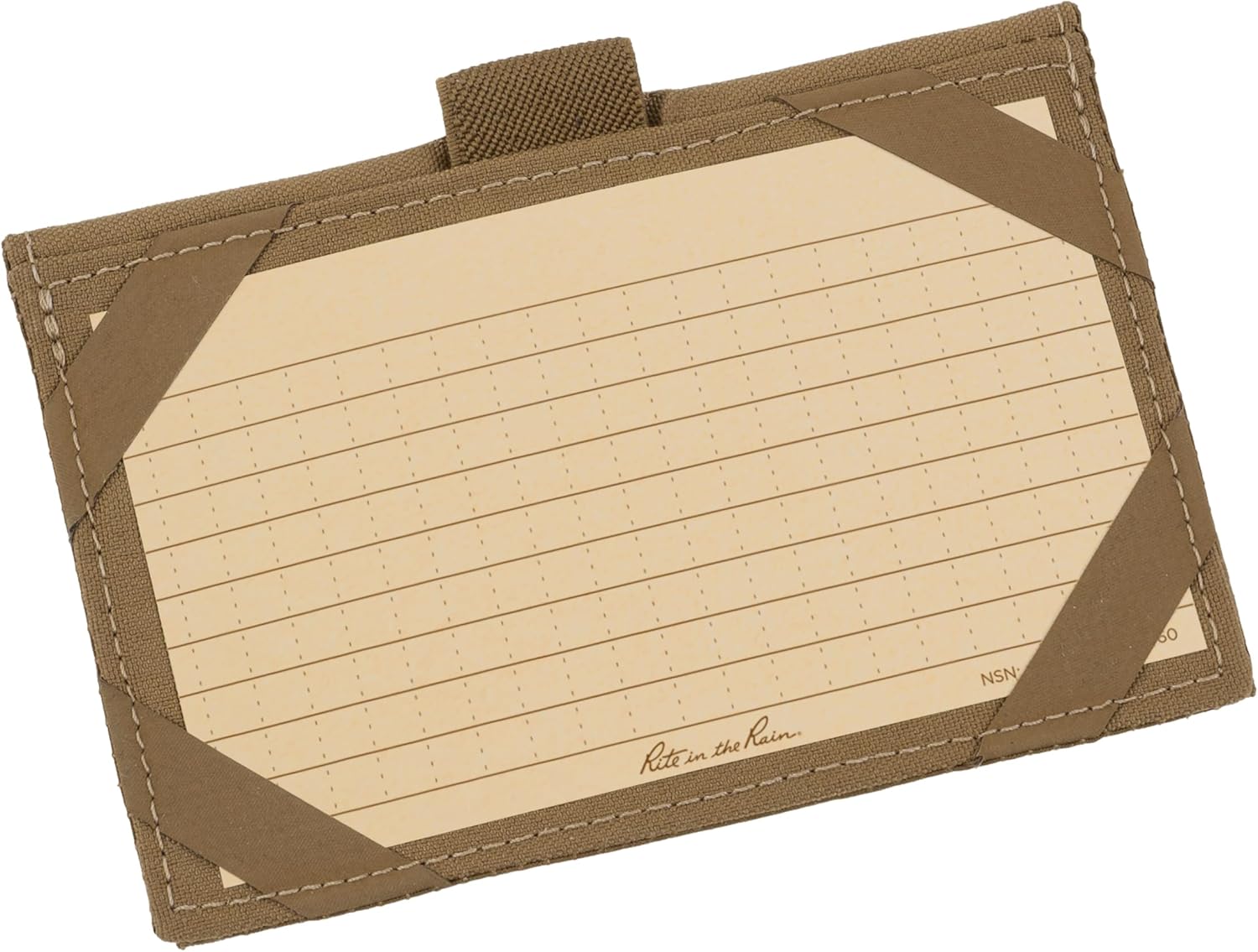
The C991T combines a tan CORDURA fabric wallet with 25 tan 3 by 5 inch weatherproof index cards. The compact card format gives an operator a durable place for short handwritten radio notes. It fits this section well because the article specifically suggests recording the other call sign, date, repeater, and one useful note after a contact.
Check On AmazonIf you click this link and buy, we earn a commission at no additional cost to you.
If Nobody Answers, Do Not Treat Silence as a Verdict
No response does not prove that your radio failed, your voice procedure was wrong, or the repeater is unusable. The channel may be quiet, listeners may be scanning and miss the call, local operators may be unavailable, or your signal may not be opening the repeater reliably. Those are different problems, and they require different next steps.
Wait before calling again instead of transmitting the same phrase every few seconds. Try during a known active period, listen for a scheduled net, or ask a local operator when the system is normally monitored. If you hear the repeater but never receive any indication that your transmission is reaching it, recheck programming and location before blaming the lack of conversation.
- Pause and make one later attempt rather than rapid repeated calls.
- Try a busier time of day or a published net time.
- Move to a better location if terrain or building loss may be blocking the path.
- Recheck the offset, tone, power level, and selected memory.
- Use a second receiver or another operator only when it can provide meaningful confirmation.
Avoid repeated unidentified “test” transmissions, whistles, or button taps. State your call sign and ask for a radio check when that is the actual purpose. When silence continues after the operating and timing checks, follow the ham radio troubleshooting process so you can separate programming, coverage, audio, and activity problems instead of changing everything at once.

The UT-72 is a 20-inch magnetic-mount VHF and UHF antenna for 144 and 430 MHz operation. It terminates in PL-259 and includes an SMA adapter for compatible BTECH and BaoFeng handheld radios. When silence may be a coverage problem, a vehicle-mounted antenna provides another practical station configuration to test after programming and timing have been rechecked.
Check On AmazonIf you click this link and buy, we earn a commission at no additional cost to you.
Final Thoughts: Make the Contact, Not the Perfect Performance
Your first repeater contact is not an oral exam. Prepare the channel, listen first, give your call sign, respond in plain English, and ask one useful question. A small card with your call sign and the four-part flow is enough support for most new operators.
I would rather hear a new licensee pause, correct a call sign, and continue calmly than hear a memorized script delivered without listening to the other station. The goal is two-way communication, not sounding experienced before you have had the chance to gain experience. Once the first exchange is complete, the second call usually feels much less complicated.

These 3 by 5 inch top-spiral notebooks use weatherproof paper and a universal page pattern. The selected black 735-3X variant is a three-pack with 100 pages per notebook. The compact format leaves room for a call sign and a four-step contact prompt without turning the first repeater conversation into a memorized script.
Check On AmazonIf you click this link and buy, we earn a commission at no additional cost to you.
FAQs
📻 What should I say for my first ham radio contact?
On a quiet repeater, say your assigned call sign followed by “monitoring” or “listening.” When someone answers, acknowledge that station, give your name and general location, and mention that it is your first contact if that would help.
🎙️ Do I call CQ on a local repeater?
CQ is generally not the local convention on an FM repeater. A call sign followed by “monitoring” or “listening” is clearer, although local practices can vary.
🔤 Must I say my call sign phonetically?
No. Use standard phonetics when the call sign is hard to copy, audio is weak, or the other operator asks for clarification. Plain speech is fine when the call sign is understood clearly.
⏱️ When am I legally required to identify?
Transmit your assigned call sign at the end of the communication and at least every ten minutes during it. Identifying in the opening call is also a good operating practice, even though the rule focuses on the interval and the end.
📡 What should I ask after someone answers?
Ask one useful question, such as how your audio sounds, whether your signal is dropping out, or when the repeater is usually active. A focused question gives the other operator an easy way to help.
🔇 What if nobody answers my first call?
Wait, try again at a more active time, and check for a scheduled net. If repeated attempts fail, verify the repeater settings and coverage before assuming the radio is defective.