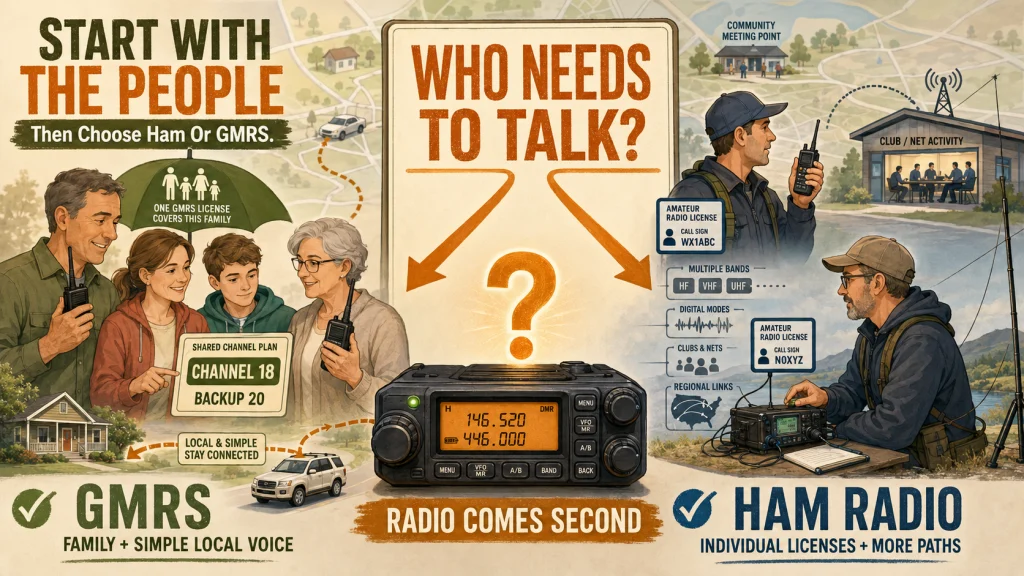
Ham radio and GMRS solve different communication problems even when both use handhelds, mobile radios, and repeaters. GMRS is usually the simpler choice for a family or local group that wants channelized voice communication without an exam, while ham radio fits the individual who wants multiple bands, more operating modes, experimentation, and a broader technical hobby. The right answer depends on who must transmit, whether each participant will get the required license, what repeaters and contacts exist locally, and whether the plan has been practiced. Neither service guarantees range, emergency contact, or rescue.
Ham Radio vs GMRS Starts With the People, Not the Radio
The most important question in a ham radio vs GMRS decision is not which service has more power or the more impressive radio. It is who must communicate. A system that works for one licensed hobbyist may fail as a family plan if nobody else is willing or legally able to transmit.
GMRS is built around straightforward UHF voice communication on a defined set of channels, including simplex and repeater operation. Ham radio gives licensed operators access to multiple bands, modes, technical experimentation, local club systems, and broader HF privileges as the operator advances beyond Technician. Those differences matter more than any universal claim that one service is better.
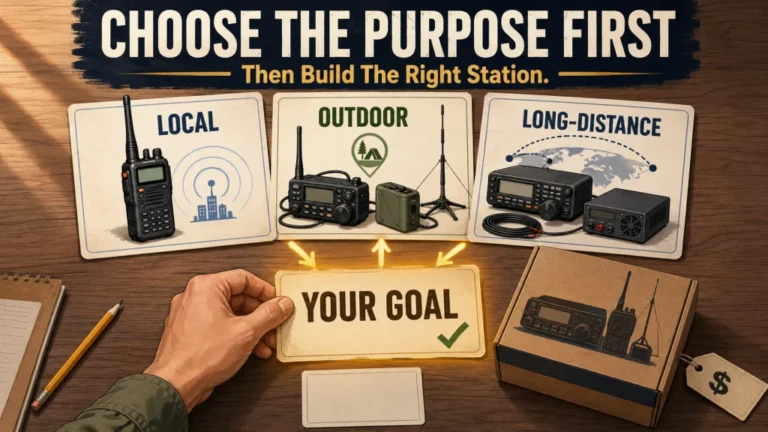
I would make this decision by naming the real use case first. A parent coordinating two vehicles on a family trip, an off-road group, a neighborhood preparedness team, and an individual who wants to explore HF are not asking the same question. They may all be looking at two-way radios, but the licensing burden, equipment rules, infrastructure, and expected contacts are different.
This guide covers the complete choice without becoming a licensing tutorial or product list. It is US-focused because other countries use different rules.
The Fast Answer by Real Use Case
A quick answer is possible when the communication group and operating goal are already clear. The table below is not a guarantee that the chosen service will work at a specific location. It identifies which system is more likely to fit before terrain, antennas, repeater access, and local activity are tested.
| Situation | Usually start with | Why |
|---|---|---|
| Immediate family members need simple local voice communication | GMRS | One individual license can authorize eligible immediate family members, and no written exam is required. |
| Friends or an off-road group want common channels | GMRS, if any participant outside the family license gets a separate license | The channelized format is easier to standardize, but one person’s license does not cover unrelated friends. |
| One person wants repeaters, digital modes, experimentation, and HF | Ham radio | The amateur service offers a much broader operating and learning path. |
| A neighborhood wants a simple local plan | Often GMRS, after a local path test | No exam lowers the participation barrier, but every operator must still be legally covered. |
| The goal is a daily technical hobby and contact with a wider radio community | Ham radio | Multiple bands, modes, clubs, nets, and station-building choices create more room to grow. |
| The plan is emergency backup for a mixed group | Possibly both, or neither alone | The best tool is the one participants can operate legally, power independently, and practice with before an outage. |
The words “usually” and “often” are doing real work here. A GMRS plan may be weak where no usable simplex path or accessible repeater exists. Ham radio may be a poor group tool when only one person is licensed and everyone else expects to transmit during a routine trip or planned exercise.
If the desired activity is still vague, review the practical uses for ham radio before comparing equipment. A service decision becomes much easier once you know whether the real destination is family coordination, local community contact, technical learning, or HF operation.
GMRS Licensing Is Simpler, but the Family Coverage Has Limits
GMRS requires an individual FCC license but no examination. The current application fee is $35, and the license term is 10 years. An eligible adult applies for the license and receives a GMRS call sign after the grant is issued.
The unusual advantage is family coverage. A GMRS individual license can authorize the licensee’s spouse, children, grandchildren, stepchildren, parents, grandparents, stepparents, brothers, sisters, aunts, uncles, nieces, nephews, and in-laws to operate GMRS stations. They do not each file a separate application merely because they transmit under the family license.
That rule does not cover friends, neighbors, employees, club members, or an unrelated convoy. A group of four friends cannot treat one member’s GMRS license as a blanket group authorization. Each person who is not covered by an eligible family license needs an individual GMRS license before transmitting.
Ham radio works differently. Each transmitting operator must hold the appropriate individual amateur license, except when operating under the direct control rules that apply to a properly supervised station. For ordinary independent use, one family member’s Technician license does not authorize a spouse, child, friend, or neighbor to take a separate radio and transmit on amateur frequencies.
The current FCC application fee for a new amateur license is also $35, and the license normally lasts 10 years. The larger difference is the exam. A new operator must pass the Technician examination before independently transmitting under the new amateur license, and broader HF access generally means later passing the General examination.
The complete ham radio license overview explains the three classes. Here, the key difference is that GMRS lowers the barrier for eligible family communication, while amateur privileges belong to each operator.
A Ham License Does Not Make an Amateur Radio Legal on GMRS
The most important equipment disclosure in this comparison is easy to state: GMRS transmission requires equipment certified for GMRS under Part 95E. Holding an amateur license does not authorize transmission on GMRS frequencies, and a technically wideband amateur transceiver is not automatically legal GMRS equipment.
That distinction separates technical capability from legal authority. A radio may be physically capable of producing a signal on a GMRS channel after modification or programming, but the ability to transmit there does not prove the transmitter has the required GMRS certification. The operator’s amateur call sign does not change the equipment rule.
The reverse assumption also causes trouble. A GMRS license does not authorize a GMRS radio to transmit on amateur bands merely because a frequency can be entered or unlocked. The service, license, frequency privileges, and equipment authorization have to match.
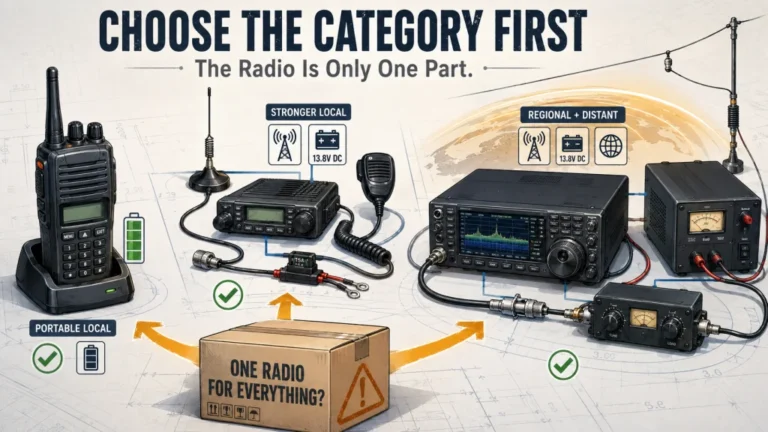
This is one reason I would choose the service before shopping. Starting with a radio that appears to “do everything” can create a legal mismatch before the family, group, or operating goal has even been defined.

The Midland GXT1000VP4 is a two-radio GMRS handheld set with 50 channels and 142 privacy codes. It includes NOAA weather functions and an SOS siren for additional utility in the field. The package uses rechargeable battery packs and a desktop charging setup, making it practical for shared family or group communication.
Check On AmazonIf you click this link and buy, we earn a commission at no additional cost to you.
GMRS Is a Channelized Voice Service, Ham Radio Is a Broader Operating System
GMRS uses a defined group of UHF channels in the 462 and 467 MHz ranges. Operators can communicate directly by simplex or use compatible repeaters where available and permitted. The service is well suited to practical local voice communication when everyone knows the channel, call-sign procedure, and fallback plan.
That structure is a strength when simplicity matters. A family can agree on a main channel, a backup channel, when to call, and what to do if no response is heard. An off-road group can use the same basic plan without every participant learning amateur band privileges, modes, and repeater conventions.
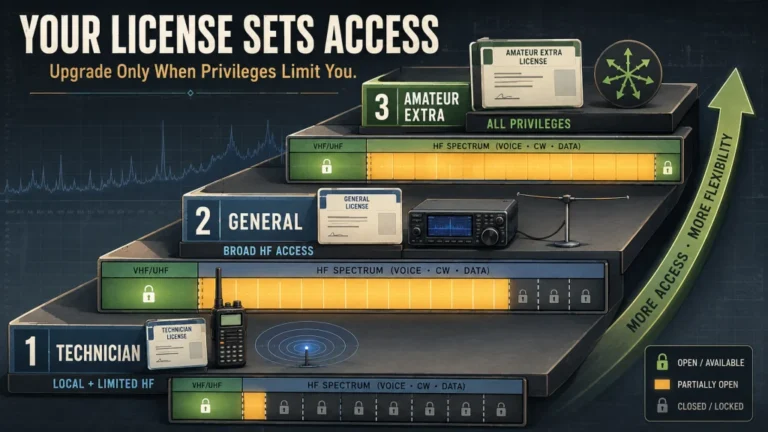
Ham radio is broader by design. A Technician can use extensive privileges at 50 MHz and above along with limited HF privileges. A General license opens broad HF voice and data access, and the amateur service supports analog voice, several digital modes, experimentation, club systems, repeaters, and contacts beyond a closed family group.
The trade-off is learning and participation. Ham radio becomes more useful when the operator understands the local systems, practices operating, and chooses equipment for a defined activity. It is not automatically the better service merely because it has more technical possibilities.
Field Note: At exam sessions, the radio-buying question often arrives before the candidate has decided who must transmit. In this comparison, that missing answer matters more than wattage because it determines whether one family license, several individual licenses, or an amateur exam for every participant is realistic.

The Yaesu FT-65R is a compact VHF/UHF dual-band FM handheld transceiver with selectable 5W, 2.5W, and 0.5W output. It comes with a 1950mAh Li-ion battery pack and a rapid charger. The radio also supports programmable quick-recall keys, scanning functions, CTCSS/DCS operation, and PC programming.
Check On AmazonIf you click this link and buy, we earn a commission at no additional cost to you.
Range Depends on the Path and Infrastructure, Not the Service Name
Neither GMRS nor ham radio has one honest mileage rating. UHF and VHF results change with antenna height, terrain, buildings, vegetation, vehicle placement, feedline loss, transmitter power, receiver quality, and the elevation of any repeater involved. A number printed on a package cannot describe every combination of those conditions.
For direct simplex communication, the path between antennas matters heavily. Two handhelds used from inside separate vehicles in a valley face a different problem from two mobile stations with outside antennas on open roads. A home antenna above the roofline creates another situation entirely.
Repeaters can extend useful coverage by receiving from an advantageous site and retransmitting the signal. The important question is not whether the service permits repeaters. Both do. The important questions are whether a suitable repeater exists, whether it can be reached from the required locations, whether access is open or permission-based, and whether the intended users know how to operate through it.
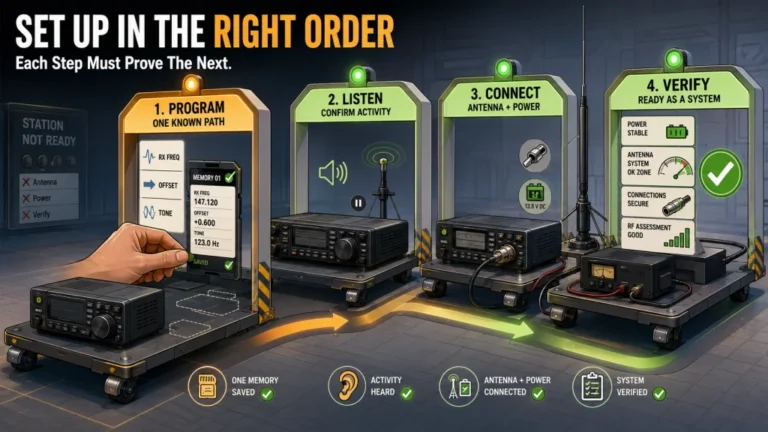
I would test the exact locations that matter: home, work, the trailhead, the vehicles, the neighborhood meeting point, or the family travel route. Listen first, confirm current repeater information, arrange a legal test contact, and identify the dead zones. A service that looks weaker in a national comparison may be stronger in one county because the local infrastructure is better.
Key point: Choose on verified local paths, not advertised distance. Antenna placement and repeater location can matter more than a modest difference in radio power.
The Family Decision Depends on Who Will Actually Participate
The practical GMRS advantage is not only that eligible family members can operate under one license. It is that the communication plan can include people who want a simple shared voice channel but have no interest in turning radio into a technical hobby. That can matter more than extra modes or frequency coverage.
Ham radio becomes the stronger family choice when the participants want to become operators in their own right. A licensed household may use local nets, club activity, digital modes, public-service training, and HF contacts that go beyond private family coordination. The added capability is useful only when the people involved are willing to earn and use it.
A mixed family can use both services without treating them as interchangeable. GMRS can provide the common family channel, while individually licensed amateur operators pursue wider contacts and technical activities. Each radio and transmission still has to remain within the correct service rules.
The decision should therefore be based on the least interested participant, not the most enthusiastic radio operator. A system that only one person understands is not yet a family communication system.
Off-Road and Neighborhood Plans Fail When Operation Is Not Standardized
After the licensing question is settled, an off-road group still needs every vehicle using the same channel, compatible tone settings, a known calling procedure, and a fallback when the lead and rear vehicles lose contact. A technically capable radio does not help when each participant has programmed it differently or nobody knows when to check in.
Vehicle placement also changes the result. A handheld used inside a metal vehicle, a mobile radio connected to an outside antenna, and a repeater path from elevated terrain are not equivalent setups. The group should test the front, middle, and rear positions on the routes that matter rather than assuming one successful driveway test proves the convoy will stay connected.
A neighborhood plan needs the same operational discipline. The households need a common channel or repeater, agreed check-in times, a simple relay plan for weak locations, and a way to maintain batteries. One advanced station can support the group, but it cannot replace radios and instructions the other households can actually use.
The broader question of how radio fits into a practiced backup plan is covered in the ham radio preparedness guide. The service comparison here should lead to repeatable communication, not equipment stored until the first difficult day.

The Midland MXT275 is a 15-watt MicroMobile GMRS radio built around a compact vehicle installation. It uses an integrated control microphone and includes a stock magnetic-mount antenna. The radio provides GMRS channels, eight repeater channels, channel scanning, programmable squelch, and NOAA weather scan and alert functions.
Check On AmazonIf you click this link and buy, we earn a commission at no additional cost to you.
Neither Service Guarantees Emergency Contact or Rescue
Ham radio and GMRS can both support an emergency communication plan, but neither creates guaranteed coverage. A working radio cannot force another station to be listening, make a blocked signal path disappear, keep a repeater powered, or summon public safety when no monitored link exists.
The right comparison is operational. Who will be at the other end? Which channel or frequency will be monitored? What is the calling schedule? Can every participant transmit legally? Is there independent power? What happens if the repeater fails? Which phone, satellite, or in-person backup remains available?
A useful emergency plan includes:
- A primary contact and at least one backup contact.
- A tested primary channel or repeater and a simplex fallback.
- Known check-in times rather than continuous hopeful calling.
- Radios that intended participants have already used.
- Charged batteries, realistic replacement-power options, and written instructions.
- A separate method for urgent rescue when phone or satellite coverage exists.
The list is service-neutral because reliability comes from the complete plan. GMRS may be easier for a family to practice together. Ham radio may connect a trained operator with local amateur resources or provide additional bands and modes. Those advantages are conditional, not guarantees.
Compare the Full Cost, Not Just the License Fee
Both new GMRS and amateur licenses currently carry a $35 FCC application fee and normally last 10 years. That makes the headline licensing cost look equal, but the total cost can diverge quickly based on the number of participants, equipment type, antennas, repeaters, programming, and power.
GMRS can be inexpensive for one eligible family because a single license may cover several operators. An unrelated group may need several licenses. Ham radio requires an individual license for each independent transmitting operator, and exam-session charges may be separate from the FCC fee and vary by testing organization or local team.
| Cost area | GMRS question | Ham radio question |
|---|---|---|
| Licensing | How many users are eligible under one family license, and how many unrelated users need their own? | How many participants will pass an individual exam and pay applicable exam-session and FCC charges? |
| Radio equipment | Is each transmitter certified for GMRS and suitable for handheld, vehicle, or base use? | Does the radio match the operator’s license privileges, bands, modes, and intended station? |
| Antenna and installation | Will handheld antennas suffice, or does the plan need vehicle or home antennas and feedline? | Does the use case require a local VHF/UHF antenna, an HF antenna system, or both? |
| Repeater access | Is the local repeater open, permission-based, supported by dues, or unavailable? | Which club or community systems are active, reachable, and appropriate for the intended use? |
| Power | How will handhelds, mobile units, or a base station run during the expected period? | Does the station need batteries, a DC supply, vehicle power, or a larger HF power plan? |
| Replacement and upkeep | How many batteries and chargers must be maintained across the family or group? | Which station parts, cables, interfaces, and batteries must remain ready? |
Build the cost around the first complete communication path. Count the transmitting participants, legal licenses, correct radios, antennas, power, and any repeater-access conditions. Leave optional features out until they solve a problem observed during actual use.
Choose GMRS, Choose Ham, Use Both, or Choose Neither
The final answer should be allowed to include four outcomes. Forcing every reader into ham radio or GMRS creates the partisan comparison this page is meant to avoid.
| Decision | Choose it when | Do not choose it merely because |
|---|---|---|
| Choose GMRS | The priority is simple local voice for eligible family members or a group willing to obtain no-exam licenses and use certified equipment. | Someone promised a universal mileage figure or claimed one license covers every friend and neighbor. |
| Choose ham radio | Each operator is willing to become licensed and the goal includes a broader hobby, multiple bands, digital modes, clubs, experimentation, or HF. | Ham is described as automatically more powerful, more reliable, or better in every emergency. |
| Use both | GMRS serves family or group coordination while individually licensed amateur operators pursue wider contacts and technical activities. | You expect one radio or one call sign to erase the legal boundary between services. |
| Choose neither | A phone, FRS, CB, satellite device, or another tool fits the actual distance, participants, infrastructure, and consequence better. | Owning a licensed radio feels more prepared even though no contact plan exists. |
Detailed comparisons with traditional radio services belong in the guide to ham radio and other radio services. Internet-linked and off-grid tools are covered in ham radio and modern alternatives, while receive-only choices belong in scanner and shortwave comparisons. Those paths keep this decision focused on transmitting legally through ham radio or GMRS.

The Yaesu FT-710AESS is a 100-watt HF and 6-meter SDR transceiver with DSP-based signal processing. It includes a built-in high-speed automatic antenna tuner, two USB ports, and a 4.3-inch color touch display. The package also includes a microphone, SP-40 external speaker, and DC power cable.
Check On AmazonIf you click this link and buy, we earn a commission at no additional cost to you.
Final Thoughts: Choose the Service the Whole Plan Can Support
GMRS is often the better practical service when eligible family members need simple local voice communication without an exam. Ham radio is the stronger fit when each operator is willing to earn an individual license and wants a broader technical hobby, more bands and modes, club systems, or HF.
I would choose based on the hardest participant to include, the exact locations that must connect, and the communication path that has been tested. Then I would use certified equipment for the selected service, practice a fallback, and refuse every promise of guaranteed range. The winner is not the service with the longest feature list. It is the service the intended people can operate legally and competently when the communication actually matters.
Explore More Communication Comparisons
The guides below separate questions that are often pulled into a ham-versus-GMRS discussion even though they involve different rules, infrastructure, or receive-only use. Choose the comparison that matches the alternative you are actually considering.
| Guide | What it helps with |
|---|---|
| Ham Radio and Traditional Radio Services | Compare amateur radio with channelized services such as CB and FRS without treating every two-way radio as interchangeable. |
| Ham Radio and Modern Off-Grid Tools | Evaluate internet-linked mesh tools, satellite communication, and newer alternatives against licensed amateur operation. |
| Scanners, Shortwave, and Ham Radio | Separate receive-only monitoring goals from two-way communication that requires transmitting privileges. |
Keeping the comparisons separate makes the final choice more honest because each tool is judged against the problem it was designed to solve.
FAQs
👨👩👧👦 Should I get GMRS or ham radio for my family?
GMRS is usually easier when eligible immediate family members need simple local voice communication because one individual license can cover them and no exam is required. Ham radio fits when each transmitting family member is willing to become licensed and wants broader operating choices.
📝 Does everyone need a license to use GMRS?
Everyone must be legally covered. One individual GMRS license covers the licensee and eligible immediate family members, but it does not cover unrelated friends, neighbors, or employees.
📻 Can I use a ham radio on GMRS channels?
Not merely because the radio can be programmed there or because you hold an amateur license. GMRS transmission requires equipment certified for GMRS under Part 95E.
💵 How much do GMRS and ham radio licenses cost?
The current FCC application fee for a new GMRS license and a new amateur license is $35, and each normally has a 10-year term. Amateur exam-session fees are separate and vary by testing organization or team.
🗼 Which service has better repeater coverage?
It depends on location. Check current systems, access conditions, activity, and reachability from the places that matter.
🚙 Is GMRS or ham radio better for off-roading?
GMRS often has the lower participation barrier for a group willing to obtain the required licenses and use common channels. Ham radio can work well when every transmitting participant is appropriately licensed and already uses amateur systems.
🆘 Is ham radio better than GMRS for emergencies?
Neither guarantees contact. Choose the legal, practiced system with known contacts, tested paths, independent power, and a separate backup.
🔄 Can I use ham radio and GMRS together?
Yes, for distinct roles. GMRS can serve eligible family or licensed group communication, while individually licensed amateur operators use ham radio for wider hobby and technical activities.