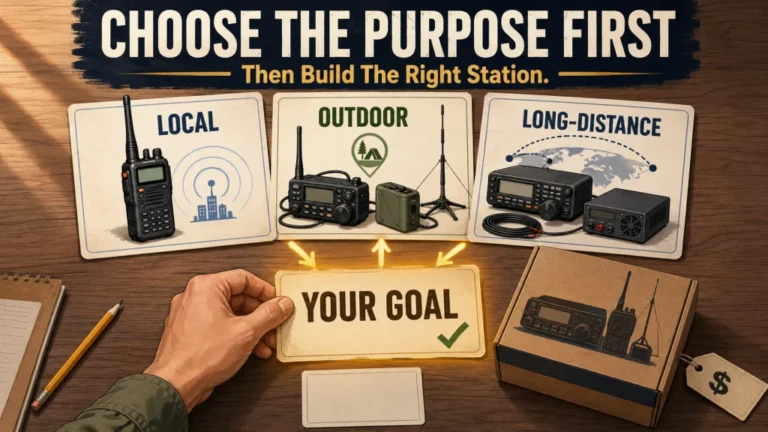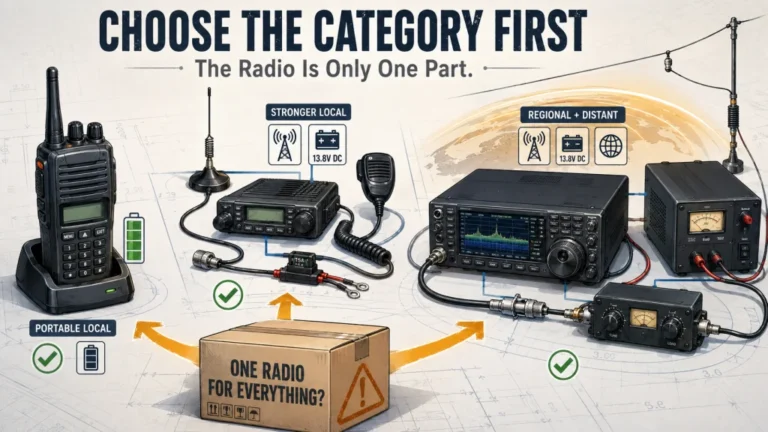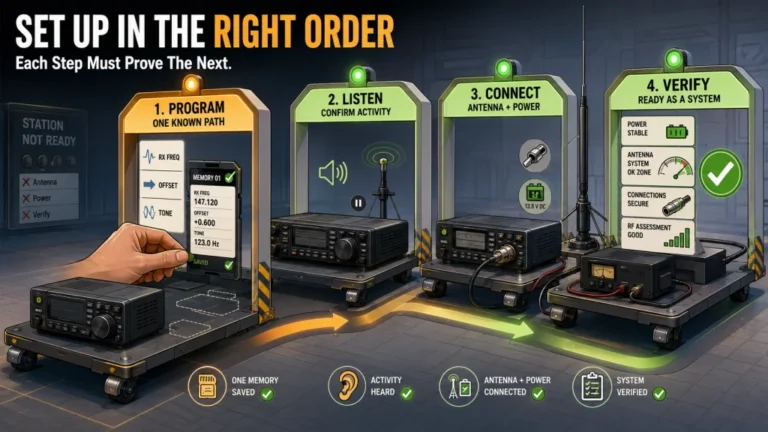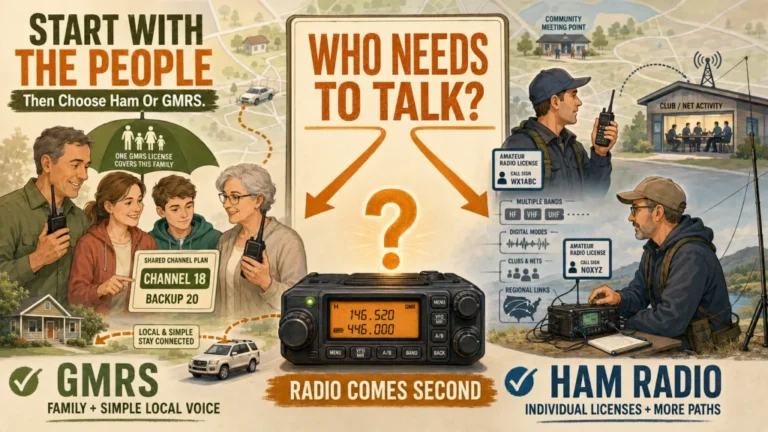
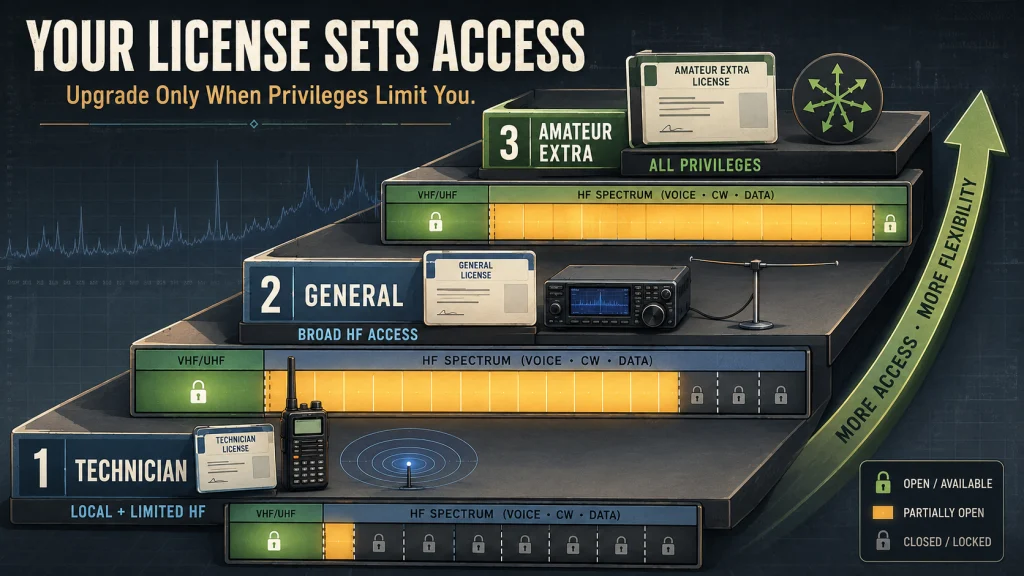
The FCC currently issues three amateur radio license classes: Technician, General, and Amateur Extra. Each class requires a separate written exam, and each step expands what you can legally do on the amateur bands rather than simply giving you a more impressive title. Technician is enough for most local VHF and UHF activity, General opens broad HF voice and data privileges, and Amateur Extra provides every available amateur privilege. Before taking any exam, you need an FCC Registration Number, and the licensing process also includes a current $35 FCC application fee for a new license.
How the Ham Radio License System Actually Works
A ham radio license in the United States is an FCC operator authorization that determines which amateur frequencies and modes you may use. The system has three current levels: Technician, General, and Amateur Extra. You enter through Technician, then add General and Extra privileges by passing the next exam element in order.
I often see beginners treat the three classes like basic, intermediate, and premium versions of the same license. That misses the practical point. The real difference is operating access. A Technician who wants to use local repeaters may already have everything needed, while a Technician who wants broad HF voice access will quickly run into privilege limits that make General the meaningful next step.
The FCC does not require Morse code for any current amateur license class. Each test is multiple choice and drawn from a publicly available question pool, so candidates can see every possible question before exam day. The current pools are the 2026–2030 Technician pool, the 2023–2027 General pool, and the 2024–2028 Amateur Extra pool.
This page gives the complete licensing map without turning into a detailed exam-day walkthrough, upgrade tutorial, or renewal guide. The purpose is to help you understand which class serves your intended operating path and where to go next once that decision is clear.
The Three Ham Radio License Levels
The cleanest way to compare the classes is to ignore prestige and look at what each one changes on the air. Technician creates the entry point, General removes most HF restrictions, and Amateur Extra fills in the remaining privilege gaps. Higher classes keep all privileges from the levels below them.
| License class | Exam | Main operating access | Best fit |
|---|---|---|---|
| Technician | 35 questions, 26 correct to pass | Full amateur privileges at 50 MHz and above, plus limited HF privileges | Local repeaters, nearby simplex contacts, many portable activities, and a first practical entry into the hobby |
| General | 35 questions, 26 correct to pass | Broad HF voice, CW, and data access while retaining all Technician privileges | Operators who want regular regional, national, or international HF activity |
| Amateur Extra | 50 questions, 37 correct to pass | All amateur privileges, including additional exclusive HF segments | Operators who want maximum frequency flexibility and fewer band-edge restrictions |
The table describes privileges, not guaranteed communication range. A Technician handheld does not automatically reach every repeater, and an HF station does not automatically produce international contacts. Terrain, propagation, antennas, station setup, local activity, and operator skill still decide what happens after the license gives you legal access.
That distinction matters when choosing how far to advance. The best license class is not automatically the highest one. It is the first class that supports what you genuinely want to do, with the option to upgrade later when your operating interests require more access.
Technician Is the Entry Point, Not a Trial License
Technician is a full FCC amateur operator license, not a temporary learner permit. It provides broad access to amateur bands at 50 MHz and above, which covers the VHF and UHF activity most beginners first encounter. That includes common local repeater conversations, direct simplex contacts, and many mobile or portable operating situations.
Technician also includes limited HF privileges, but those privileges are narrower than many new operators assume. The class offers CW access on portions of several HF bands and limited 10-meter voice and data segments. It should not be described as having no HF access, but it also should not be presented as the equivalent of broad General-class HF operation.
For example, a reader who wants to join a local weekly repeater net may have no immediate reason to rush beyond Technician. A reader whose main goal is regular voice contacts on 20 or 40 meters has a different path, because the desired activity points toward General privileges.
General Opens the Part of HF Most Beginners Expect
General is the class that makes broad HF operation practical for most US amateurs. It adds extensive voice, CW, and data privileges across the HF bands while preserving all Technician access. This is usually the point where the phrase “talking around the country or world” begins to match the operator’s legal frequency access more closely.
General does not guarantee long-distance results. An operator still needs a suitable radio, antenna, operating location, and an understanding of propagation. What the license changes is the legal ceiling: instead of being confined to the narrower Technician HF segments, the operator can use most amateur HF allocations.
I usually explain this distinction before discussing equipment. A new Technician who wants only local VHF communication may not need a General upgrade yet. Someone already planning an HF antenna and wanting regular activity across several bands should understand that General is part of the station plan, not an optional detail added afterward.
Amateur Extra Removes the Remaining Privilege Gaps
Amateur Extra grants every amateur operating privilege available under the US licensing system. It adds exclusive frequency segments within several HF bands and gives the operator more room to find an open frequency, especially when popular portions of a band are crowded.
The practical gain is flexibility rather than an entirely new hobby. Extra does not unlock a secret mode or make an antenna perform better. A General and an Extra operator can use many of the same bands and modes, but the Extra operator has access to additional slices of spectrum that remain unavailable to General licensees.
Extra also matters for Volunteer Examiner authority. A General-class operator may seek VEC accreditation and administer Technician examinations, but an accredited Amateur Extra may administer Technician, General, and Amateur Extra examinations. Holding a qualifying license is not enough by itself; the operator must also be accredited through a Volunteer Examiner Coordinator.

The ARRL Ham Radio License Manual 6th Edition is built for the Technician-class exam and the 2026 to 2030 question pool. The listing says it covers the 35-question multiple-choice exam and is designed for self-study or classroom use. It can also be used alongside ARRL online practice resources.
Check On AmazonIf you click this link and buy, we earn a commission at no additional cost to you.
You Must Pass the License Exams in Order
The amateur licensing structure is progressive. Element 2 is the Technician examination, Element 3 is General, and Element 4 is Amateur Extra. A candidate cannot skip Technician and take only the General exam to receive a General license, because the higher class requires credit for the lower elements as well.
That does not mean the process must take years. A prepared candidate may take more than one element at the same exam session. Someone who passes Technician can usually attempt General next, and a candidate who also passes General may attempt Amateur Extra, subject to the testing team’s session policies and available time.
- Pass Element 2 to qualify for Technician.
- Add Element 3 to qualify for General.
- Add Element 4 to qualify for Amateur Extra.
- Keep credit for a passed element through the documentation and time rules that apply to the exam result.
The fee arrangement for multiple attempts is not universal. VECs and local exam teams set their own examination charges and session procedures, so candidates should check the listing before assuming one payment covers every element or retake. That examination charge is separate from the FCC application fee.
A common mistake is studying for all three exams because taking them in one sitting sounds efficient, even when the candidate has no use for the higher privileges yet. Passing multiple elements on the same day can be sensible for someone who is genuinely prepared, but stopping at Technician is not an incomplete result. It is a valid license that can be upgraded when the operator’s interests justify the next exam.

The ARRL General Class License Manual 10th Edition is intended for the General class exam. It covers the exam pool used from July 1, 2023 through June 30, 2027. The material also covers basic electronics, communications, propagation, and topics connected with General-class HF operating privileges.
Check On AmazonIf you click this link and buy, we earn a commission at no additional cost to you.
What the Three Written Exams Have in Common
Technician and General each use 35 multiple-choice questions, with 26 correct answers required to pass. Amateur Extra uses 50 questions, with 37 correct answers required. Those passing scores are approximately 74 percent, although the useful numbers on exam day are 26 and 37 rather than the rounded percentage.
Every examination is assembled from the current public question pool for that element. The pools are much larger than the actual exams and are updated on a rotating schedule. Candidates should make sure their study material matches the pool in effect on the date of the examination, not merely the date printed on an old book or saved practice-test page.
The July 1, 2026 Technician pool change is a good example of why that check matters. A person testing in June 2026 studied from a different Technician pool than a person testing later in July. The format and passing score did not change, but the available questions did.
Public questions make the exam predictable, but memorizing answer letters without understanding the subject can create a second problem after licensing. I have met new operators who recognized repeater-offset questions on a test but still did not know which actual offset and access tone belonged in their radio. The exam proves the required knowledge level; getting comfortable on the air still takes practical application.
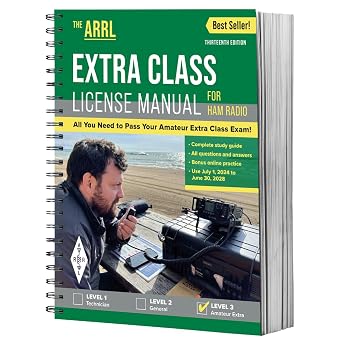
The ARRL Extra Class License Manual 13th Edition is designed for Amateur Extra exam preparation. This edition covers exams from July 1, 2024 through June 30, 2028. The manual is built around preparation for the 50-question multiple-choice Extra examination and the operating privileges available at this license level.
Check On AmazonIf you click this link and buy, we earn a commission at no additional cost to you.
Before the First Exam, Get Your FCC Registration Number
The FCC Registration Number, usually called an FRN, comes before the amateur exam. Candidates register through the FCC’s CORES system and receive a unique 10-digit number used on the license application. Exam applicants are expected to have that number before exam day.
The FRN question comes up at almost every session I run because beginners often confuse three different identifiers: an FCC account login, an FRN, and a future amateur call sign. They are not interchangeable. The account provides access to FCC systems, the FRN identifies the applicant in FCC transactions, and the call sign is assigned only after the license application is granted.
Field Note: Passing the Technician exam does not produce a call sign at the exam table. The exam team documents the successful element and the application moves through the VEC and FCC process. A first-time applicant should wait until the new license grant appears in the FCC database before transmitting independently under that license.
This overview stops at the role of the FRN because registration, choosing an exam session, preparing identification, and handling the application are separate tasks. The complete sequence belongs in the guide devoted to earning the first Technician license.
The License Lasts 10 Years, but Fees Depend on the Filing
An FCC amateur license is normally valid for 10 years. The expiration date applies to the station and operator grant, not to the exam result as a recurring requirement. You do not retake the Technician, General, or Amateur Extra exam every decade simply to keep an active license.
The current FCC application fee is $35 per application for a new amateur license, a renewal, a rule-waiver request, or a modification requesting a new vanity call sign. Ordinary operator-class upgrades, administrative updates such as an address or email change, and requests for a sequentially issued call sign are exempt from the FCC application fee.
Fee distinction: The FCC application fee and the exam-session charge are separate. The FCC fee is paid to the FCC when it applies. A VEC or local VE team may charge its own amount for preparing, processing, and administering the examination session.
This difference prevents two common misunderstandings. Passing General after Technician does not create another $35 FCC upgrade fee under the current schedule, although the exam team may still charge for the session. A renewal does carry the FCC fee even though no new exam is required.
Renewal timing, grace-period consequences, call sign changes, record updates, and license lookups are lifecycle questions rather than reasons to choose one license class over another. Those details are covered separately so this overview can stay focused on how the licensing system is organized.
Choose the License Level by the Activity You Want
The three classes make more sense when they are tied to an operating decision. Start by identifying the activity, then check the privileges it requires. Reversing that order can lead to studying for an advanced exam without a practical reason or buying equipment that cannot be used as intended under the license held.
Consider three common situations. Someone who wants to talk through reachable local repeaters can begin with Technician and gain experience before deciding whether HF matters. Someone who wants routine voice contacts across several HF bands should plan for General. Someone already active on HF who repeatedly encounters General-class band limits may find Amateur Extra worthwhile for the added operating space.
Budget does not decide the legal requirement. An expensive HF transceiver does not grant General privileges, and a low-cost handheld does not reduce the need for a Technician license when transmitting on amateur frequencies. The license class, equipment type, antenna, and use case have to agree with one another.
Key point: Do not upgrade merely because a higher class exists. Upgrade when the privileges you lack are blocking an activity you are prepared to pursue.
This approach also keeps the hobby manageable. Technician can be the destination for a local operator, General can remain sufficient for years of HF activity, and Amateur Extra can be a useful final step for someone who values complete frequency access. None of those paths is less legitimate because it stops at a different point.

The Yaesu FT-65R is a dual-band handheld transceiver listed for 144-148 MHz VHF and 440-450 MHz UHF operation. The Amazon listing specifies 200 channels and operation from a 7.4-volt lithium-ion battery. Its handheld format fits the local VHF and UHF operating use case discussed for new Technician-class operators.
Check On AmazonIf you click this link and buy, we earn a commission at no additional cost to you.
Final Thoughts: Understand the Privileges Before Planning the Exams
The FCC amateur system is simpler than it first appears: Technician establishes the license, General opens broad HF access, and Amateur Extra removes the remaining privilege restrictions. The exams must be passed in order, but they may be taken close together when the candidate is prepared and the session permits it.
I would decide what I want to do on the air before choosing how far to study. That single decision clarifies whether Technician is enough, whether General belongs in the immediate plan, or whether Amateur Extra offers a benefit I will actually use. The next step is not automatically another exam; it is the part of the licensing process that matches where you are now.
Explore the Ham Radio Licensing Process
The three guides below separate the stages that are easy to mix together. Use the first for earning an initial license, the second when existing privileges no longer cover your intended activity, and the third for maintaining an FCC record after the license has been issued.
| Guide | What it helps with |
|---|---|
| How to Get a Technician License | FRN registration, exam preparation, finding a session, application steps, and the path to an initial call sign. |
| Upgrading Your Ham Radio License | Deciding when General or Amateur Extra privileges justify another exam and how the upgrade process differs from a new application. |
| Managing Your Ham Radio License | Renewals, FCC record updates, call sign questions, license lookups, expiration, and other lifecycle tasks. |
Keeping these stages separate makes the system easier to use. You only need the guide that matches the next licensing decision in front of you.
FAQs
📻 What is the first ham radio license level?
Technician is the current entry-level FCC amateur license. It requires passing the 35-question Element 2 examination.
📡 Can a Technician license use HF frequencies?
Yes, but the privileges are limited. Technician operators have CW access on portions of several HF bands and limited voice and data privileges on 10 meters.
🌎 Which license is best for regular HF communication?
General is usually the practical target because it opens broad HF voice, CW, and data privileges across multiple bands. Actual contact range still depends on the station and propagation.
📝 Can I skip Technician and take the General exam?
You may take multiple elements at one session, but you must earn credit in order. A General license requires credit for both the Technician and General examination elements.
🔢 How many questions are on each license exam?
Technician and General each have 35 questions and require 26 correct answers. Amateur Extra has 50 questions and requires 37 correct answers.
🎵 Is Morse code required for a ham radio license?
No. The FCC does not require a Morse code examination for Technician, General, or Amateur Extra.
💳 How much is the FCC ham radio license fee?
The current FCC application fee is $35 for a new license and certain other filings, including renewals and vanity call sign requests. Ordinary operator-class upgrades are exempt, and exam-session charges are separate.
🗓️ How long does a ham radio license remain valid?
An FCC amateur license is normally valid for 10 years. Renewal does not require retaking the operator examination.