Upgrading from Technician to General is the largest practical license change for most US operators because it opens broad HF voice, CW, and data privileges. Amateur Extra adds the remaining frequency segments and the full set of operating privileges, but it is most useful when those narrower segments or higher-level examination work matter to you. An ordinary operator-class upgrade is exempt from the FCC’s $35 application fee, although the organization running the exam may charge its own session or retest fee. The right time to upgrade depends on what you want to do on the air, not how long you have held your current license.
What an Upgrade Changes, and What It Does Not
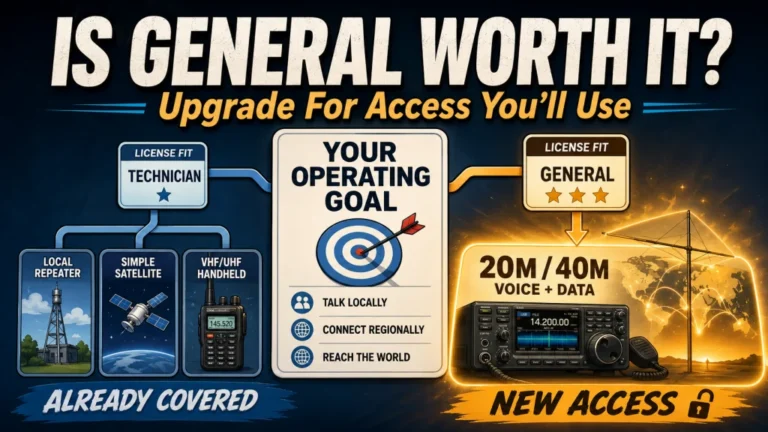
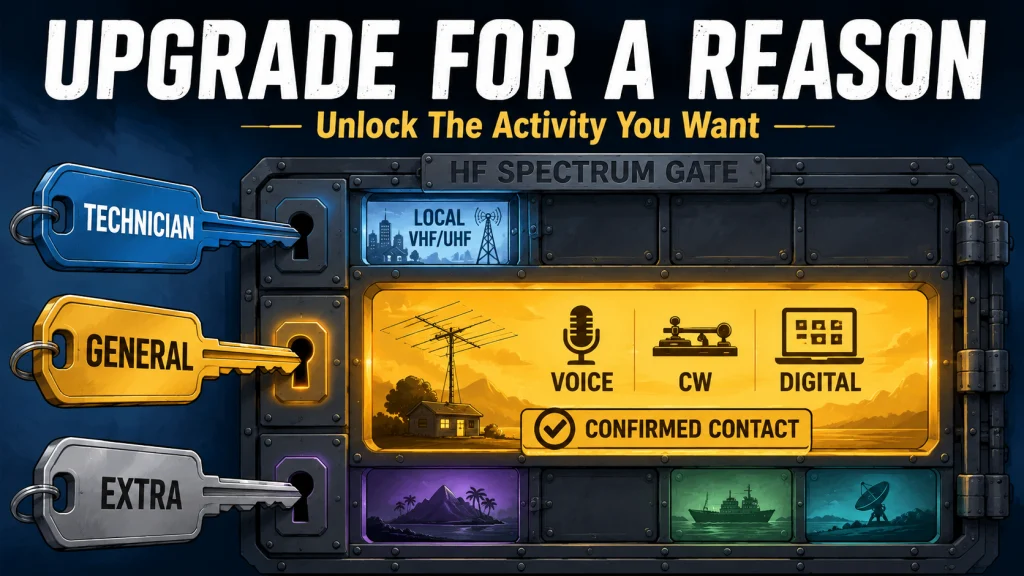
Upgrading your ham radio license is mainly a decision about operating privileges. A Technician license is strong for local VHF and UHF communication and includes limited HF privileges, while General opens most of the amateur HF spectrum to phone, CW, and data operation. Amateur Extra adds the remaining license-class segments. That progression can take you from a local repeater to contacts across the country or around the world, but the higher license does not guarantee those contacts.
HF results still depend on the band, time of day, propagation, antenna, noise level, station setup, and another operator being available. I have worked with new operators who treated the next exam as the missing piece, only to discover that they still had no operating goal or usable communication path. The license removes a regulatory limit. It does not choose the band, install the antenna, or turn an unused station into a working one.
This guide is for a licensed Technician deciding whether and how to move to General or Amateur Extra. Someone who has not earned the first license should start with getting a Technician license. For the wider structure of license classes and privileges, use the complete ham radio license guide. Renewal, address changes, and call sign requests are separate issues covered under ham radio license management.

This 25th-edition ARRL set is a four-volume reference covering antennas, transmission lines, and propagation. It is published for radio communications and is authored by ARRL Inc. The Amazon listing identifies the set as paperback.
Check On AmazonIf you click this link and buy, we earn a commission at no additional cost to you.
The General Upgrade Is the Largest Practical Jump
The move from Technician to General changes what you can do below 30 MHz. Technicians have all amateur privileges above 30 MHz, along with limited CW privileges on parts of 80, 40, and 15 meters and limited privileges on 10 meters. Technician RTTY and data privileges, including FT8, are limited to 28.000 through 28.300 MHz on the 10 meter band. A Technician license does not provide general FT8 or other data privileges on 20, 40, 80, or 15 meters.
General opens most HF privileges from 160 through 10 meters. In practice, this means access to the broad phone and data segments where much of ordinary HF activity occurs. A General can use common HF voice and digital operating areas that remain outside Technician privileges, subject to the band and emission limits that apply to each frequency. That is why General often feels less like a small promotion and more like a different version of the hobby.
| License class | Examination requirement | Practical change | Best reason to pursue it |
|---|---|---|---|
| Technician | Element 2, already credited to a current Technician | All amateur privileges above 30 MHz, plus limited HF privileges | Local repeaters, simplex, VHF and UHF data, and a limited introduction to HF |
| General | Element 3, 35 questions, 26 correct to pass | Most amateur HF frequency privileges and operating modes | Regular HF voice, CW, or data operation across several bands |
| Amateur Extra | Element 4, 50 questions, 37 correct to pass | All frequency privileges available to current US amateur licensees | Access to the remaining HF segments and eligibility to administer every exam element after accreditation |
The exam numbers are simple, but the operating difference is not just a larger list of frequencies. A Technician who only uses a local repeater may gain no immediate on-air benefit from General. A Technician who wants to use SSB on common HF bands, operate digital modes outside the limited 10 meter allocation, or build a dependable long-distance communication plan may gain a great deal.
Field Note: The mistake I watch for is treating the General exam as the goal instead of deciding what the new privileges will be used for. A candidate who can name the first band, mode, and operating activity they want to try usually has a much clearer reason to upgrade than someone who only says they want a higher license.
An ordinary operator-class modification is exempt from the FCC’s $35 application fee. The $35 fee still applies to a new license, renewal, rule waiver, or vanity call sign request. The examining organization may separately charge for the session, and its fee, retest policy, and payment method can vary, so confirm those details before test day.

This 10th-edition ARRL manual is a complete study guide for upgrading to a General Class ham radio license. It includes questions and answers for the General upgrade material. The Amazon listing identifies ARRL Inc. as the author and the book as spiral-bound.
Check On AmazonIf you click this link and buy, we earn a commission at no additional cost to you.
Is General Worth It for Your Situation?
General is worth pursuing when the operating activity you want is blocked by Technician privileges. That sounds obvious, but it is a better test than upgrading because other operators say you should. Start with the contact or activity, then work backward to the license class, station, antenna, and practice needed to make it possible.
For example, a Technician who is satisfied with local repeaters, simplex contacts, and VHF or UHF public-service activity can remain productive without upgrading. A different Technician may hear regular HF nets, want phone privileges on 40 or 20 meters, or want digital operation on several HF bands. In that case, General solves a real licensing limitation rather than adding a title that sits unused.
- Stay with Technician for now if your actual operating plan is local VHF or UHF and you have not yet used the privileges you already hold.
- Move toward General if broad HF voice, CW, or data access is the next activity you intend to practice.
- Upgrade before buying more equipment when the equipment decision depends on privileges you do not yet have. Passing first can prevent buying around the wrong use case.
- Delay the exam without abandoning the goal if antenna restrictions, local noise, time, or study capacity make HF unrealistic right now.
- Do not treat a higher class as an emergency guarantee. Reliable emergency communication requires a tested path, appropriate frequencies, trained operators, power, antennas, and scheduled practice.
The same logic applies to someone who wants General but does not own an HF station. You do not need to buy equipment before earning the license. Studying first can be the cleaner order because the material teaches frequency privileges, propagation, safety, antennas, and operating practices that should influence the eventual setup.
Cost is therefore not only the exam-session charge. The larger commitment may be the time required to learn HF operating and build a usable station within your property, budget, and noise conditions. If those conditions are uncertain, upgrading can still make sense, but the license should be viewed as permission to start the next stage, not proof that the next stage is complete.

This ARRL title focuses on understanding practical antennas and antenna design. The Amazon listing credits ARRL Inc. and Joel R. Hallas W1ZR as authors. The listed format is paperback.
Check On AmazonIf you click this link and buy, we earn a commission at no additional cost to you.
How to Study for General After Technician
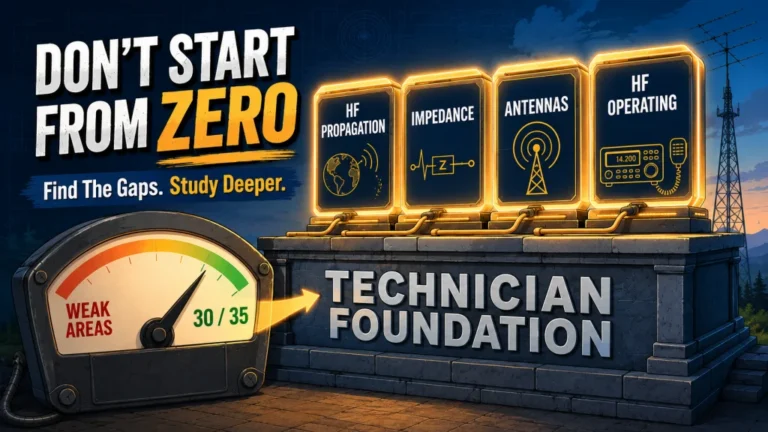
Studying for General after Technician is easier to organize when you stop treating it as a second version of the entry exam. Technician knowledge remains useful, but General places more weight on HF privileges, propagation, antennas, operating procedures, signal behavior, and circuit concepts. The fastest useful approach is to connect each topic to an operating decision instead of memorizing isolated answer letters.
Band privileges are the clearest example. Memorizing a frequency edge may help on the exam, but understanding why the edge matters prevents an illegal transmission later. The same is true for propagation. Knowing which layer or condition appears in a question is less valuable than understanding why a band that worked in daylight may go quiet after sunset while another becomes useful.
- Confirm that your study material matches the current General question pool and its latest errata.
- Take one diagnostic practice exam before studying so you can separate familiar Technician material from weak areas.
- Study by topic, then use practice questions to check understanding rather than learning the answer pattern alone.
- Keep a band-privilege chart beside the study material and practice identifying whether a proposed frequency and mode are permitted.
- Schedule the real exam after your practice scores remain comfortably above the 26-correct passing line across several attempts.
- Write down one first General-class activity so the study has a practical destination.
I have seen operators pass a license exam through strong question recognition and then hesitate when the same concept appears on a radio display or band chart. That does not mean question-pool study is wrong. It means the pool should be used as a map of what to learn, followed by enough practical interpretation to recognize the rule or concept outside the wording of one question.
Do not wait until every technical topic feels effortless. The exam measures a defined level of operating and technical knowledge, not engineering mastery. Aim for a safe passing margin and enough understanding to use the new privileges responsibly, then continue learning while operating.

This seventh-edition ARRL General Q&A is designed as a quick path to upgrading to a General Class ham radio license. Its question-and-answer focus supports targeted General exam review. The Amazon listing identifies ARRL Inc. as the author and the book as paperback.
Check On AmazonIf you click this link and buy, we earn a commission at no additional cost to you.
What Amateur Extra Adds Beyond General
Amateur Extra adds the frequency segments that remain unavailable to General operators. These are not entirely new bands. They are additional portions within several HF bands, including segments that can provide more room for phone, CW, or data operation. The practical value is highest for an operator who spends enough time on HF to encounter crowded conditions, band-edge limits, or activity concentrated inside Extra-only segments.
Extra also removes license-class questions from frequency selection, although every operator must still follow the band, mode, power, and identification rules. It does not create better propagation or improve the station by itself. A General with a well-planned antenna and good operating habits can make more effective contacts than an Extra with an unsuitable or unused setup.
The Element 4 examination contains 50 questions, and 37 correct answers are required to pass. The material goes deeper into rules, electrical principles, components, signals, antennas, propagation, and station practices. For many operators, the best time to study is after enough General-class operating has made those topics concrete, but there is no FCC rule requiring a waiting period between the two upgrades.
License class also affects which examinations an accredited Volunteer Examiner may administer. A General, Advanced, or Amateur Extra licensee may administer a Technician examination after VEC accreditation. Administering a General examination requires an Advanced or Amateur Extra license, and administering an Amateur Extra examination requires Amateur Extra. The higher class creates eligibility, but accreditation and the other FCC requirements still apply.
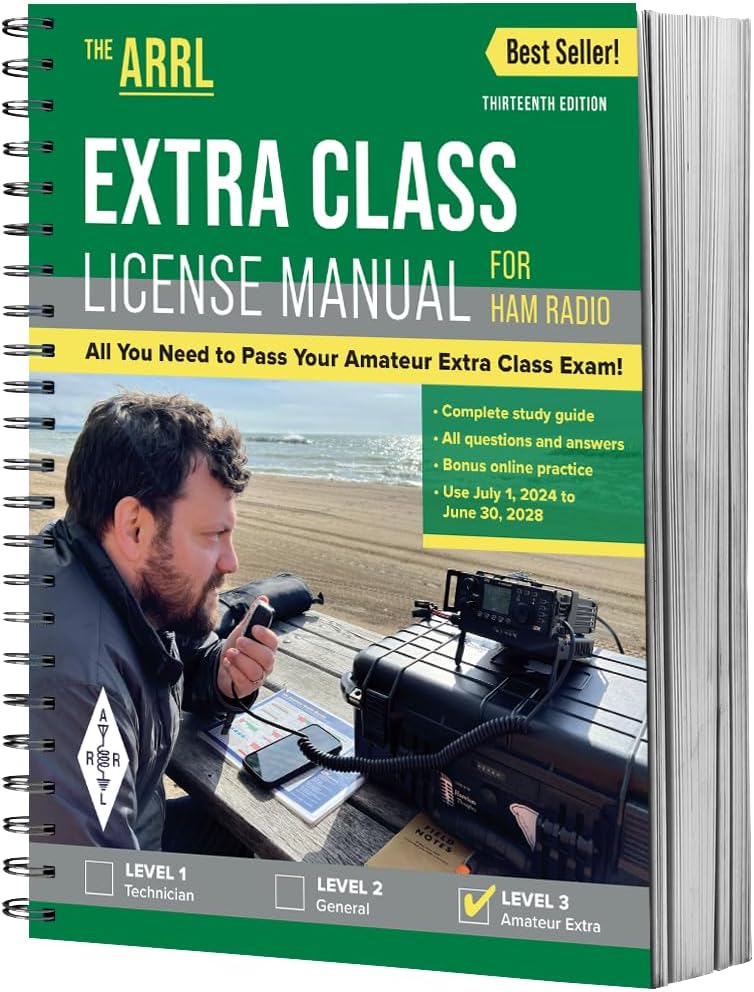
This 13th-edition ARRL manual is a complete study guide for the Amateur Extra license. Its listing describes exam questions and coverage of the privileges granted to Amateur Radio operators. The Amazon listing identifies ARRL Inc. as the author and the book as spiral-bound.
Check On AmazonIf you click this link and buy, we earn a commission at no additional cost to you.
Taking General and Extra at the Same Exam Session
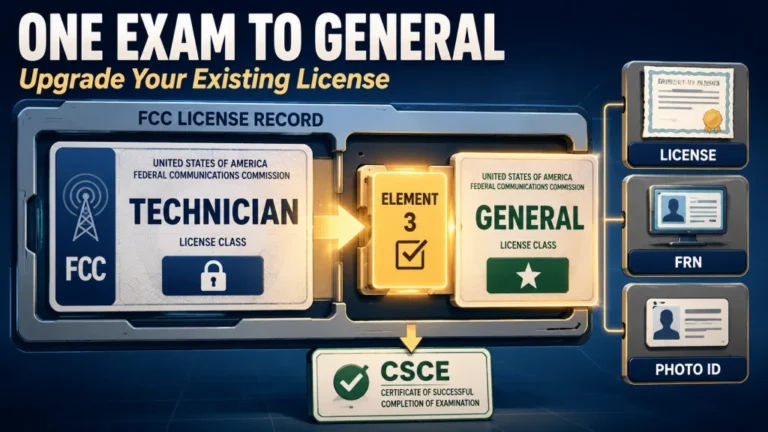
A current Technician receives Element 2 credit and does not retake the Technician exam to attempt General. After passing Element 3, the candidate can receive that credit and may be offered Element 4 at the same session. This makes a Technician-to-Extra result possible in one sitting, but the exams still have to be passed in sequence.
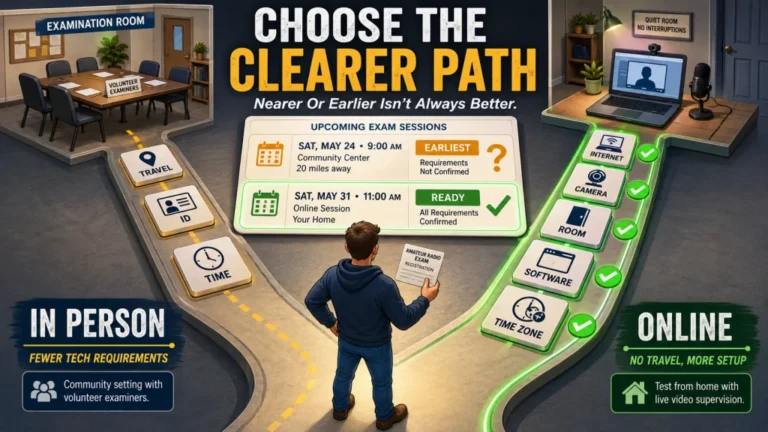
The FCC rules allow the element-credit path. The local details belong to the VEC and exam team. Some teams encourage candidates to continue after a pass, while others have limits based on time, staffing, remote-session procedures, retest rules, or fees. Do not assume that one advertised session charge includes unlimited attempts or every element.
- Tell the exam team in advance that you may attempt both General and Extra.
- Follow that team’s instructions for identification, FRN information, proof of your current license, and electronic or paper documents.
- Ask whether additional elements or same-session retests carry another charge.
- Confirm that you are studying the current question pools and the latest published errata.
- Keep the Certificate of Successful Completion of Examination issued after a passing element.
A CSCE provides exam-element credit for 365 days. When the upgrade application has been properly submitted through the exam process, the FCC rules allow the operator to use the higher privileges while the application is pending, subject to the CSCE time limit and final disposition. During that temporary period, the call sign must be followed by the appropriate indicator, such as /AG for a General upgrade or /AE for an Amateur Extra upgrade.
Once the FCC database shows the new class, the temporary indicator is no longer needed. Keep the CSCE until the license record is correct, and contact the examination organization promptly if the filing does not appear or contains an error. This is one reason the paperwork matters as much as the score sheet.

This sixth-edition ARRL Extra Q&A is designed as a quick study path to earning an Amateur Extra Class ham radio license. Its Q&A format is aimed at focused Extra exam preparation. The Amazon listing identifies ARRL Inc. as the author and the book as paperback.
Check On AmazonIf you click this link and buy, we earn a commission at no additional cost to you.
Final Thoughts: Upgrade for a Real Operating Reason
For most active Technicians, General is the upgrade that changes the operating possibilities most sharply because it opens broad HF privileges. Amateur Extra is a more targeted next step, valuable when you want every available frequency segment, deeper technical study, or eligibility to administer all exam elements after accreditation. Neither class is automatically necessary for someone whose needs are fully met by VHF, UHF, and limited Technician HF operation.
I would choose the next license class by naming the first activity it will unlock. If you can say, “I want to join this HF net,” “I want to use this digital mode on these permitted bands,” or “I want to remove the remaining HF segment limits,” the upgrade has a practical purpose. If the answer is only that a higher class sounds better, use the privileges you already have while you decide what you actually want to do next.

This ninth-edition license-preparation book covers FCC Element 4 for Amateur Extra and is labeled for the 2024-2028 period. The Amazon listing credits ARRL Inc., Gordon West WB6NOA, and Eric P. Nichols KL7AJ as authors. The listed format is paperback.
Check On AmazonIf you click this link and buy, we earn a commission at no additional cost to you.
Explore More License Upgrade Guides
The upgrade process becomes easier when the decision, study plan, examination, and post-exam steps are handled separately. Use the guide that matches the question currently stopping you rather than trying to solve every stage at once.
| Guide | What it helps with |
|---|---|
| Technician to General Upgrade Steps | Walks through eligibility, exam registration, passing Element 3, and handling the upgrade record. |
| Is a General License Worth It? | Matches the added HF privileges to specific operating goals, costs, and station limitations. |
| How to Study for General | Builds a study process around the current pool, practice exams, weak topics, and practical understanding. |
| Amateur Extra License Guide | Explains the remaining privileges, Element 4 difficulty, and when the final upgrade has real value. |
| Same-Day Ham Radio Testing | Explains sequential elements, exam credit, fees, retests, CSCE handling, and team-specific policies. |
Start with the decision guide if you are unsure whether to proceed. Move to the study or testing guide once the new privileges clearly support an activity you intend to use.

This 11th-edition license-preparation book covers FCC Element 3 for General Class and is labeled for the 2023-2027 period. The Amazon listing credits ARRL Inc., Gordon West WB6NOA, and Eric P. Nichols KL7AJ as authors. The listed format is paperback.
Check On AmazonIf you click this link and buy, we earn a commission at no additional cost to you.
FAQs
💰 Does the FCC charge $35 to upgrade from Technician to General?
No. An ordinary operator-class upgrade is exempt from the FCC’s $35 application fee. The exam organization may charge a separate session or retest fee, so check its policy before registering.
📝 Do I have to retake the Technician exam before General?
No. A current Technician receives credit for Element 2 and takes the 35-question General exam, Element 3. Older or expired license situations can follow different element-credit rules, so provide the exam team with the documentation it requests.
📻 Can I use General privileges immediately after passing?
You may use the higher privileges while the properly submitted application is pending if you hold the valid CSCE. Identify with your call sign followed by /AG until the FCC database shows General.
🎓 Can I take General and Extra on the same day?
Yes, if you pass the required elements in sequence and the exam team can continue testing. Session time, additional-element fees, and retest policies are set by the VEC or team, so confirm them in advance.
🌐 Is General worth getting if I do not own an HF radio?
It can be. Earning the license before choosing a station lets the new knowledge and privileges guide your setup, but the upgrade has the most value when you have a realistic HF activity and antenna plan.
💻 Can a Technician use FT8 on 20 or 40 meters?
No. Technician RTTY and data privileges, including FT8, are limited to 28.000 through 28.300 MHz on 10 meters. General provides data privileges in permitted segments on several additional HF bands.
🔤 Does upgrading automatically change my call sign?
No. A class upgrade changes the privileges attached to your license record, not necessarily the assigned call sign. Sequential or vanity call sign requests are separate licensing actions with their own rules and possible fees.