Ham radio same-day testing can let you attempt Technician and General, or General and Amateur Extra, during one VE session. The FCC rules allow credit for elements you already hold or recently passed, but the coordinating VEC and local VE team decide whether the session has enough time, staffing, exam versions, and remote-testing capacity for additional attempts. Passing one element is not erased because you fail the next one. Before registering, confirm the team’s exam sequence, fees, retest policy, time limit, and how to declare that you want more than one element.

Same-Day Testing Is Possible, but the Session Controls the Details
Ham radio same-day testing is a normal option at many US exam sessions, not a special exception that requires separate FCC permission. A candidate with no element credit normally starts with Technician. After that element is graded as a pass, the VE team may offer General, followed by Amateur Extra if General is also passed and the session permits another exam.
The word may matters. FCC rules establish the examination and credit framework, but they do not require every team to provide unlimited time, unlimited retests, or every element at every session. An in-person team may have a room reservation ending at noon, while a remote team may have another candidate waiting for the next video slot. The practical answer therefore comes from the specific session listing and the team running it.
Field Note: The same-day problem I see most often starts before the first question appears. A candidate prepares for two elements but registers for only one and assumes the team will automatically have time for the second. Telling the team in advance is a small step that can determine whether the second exam is available at all.
This article covers only the mechanics of taking consecutive elements in one session. It does not replace a class-specific study plan or explain how to locate an exam team. For the broader path from one operator class to the next, use the guide to upgrading a ham radio license.

The C920x records Full HD 1080p video at 30 fps and uses autofocus with automatic light correction. Two built-in microphones capture stereo audio for video calls. It connects over USB and supports Windows, macOS, Chrome OS, and common video-calling applications.
Check On AmazonIf you click this link and buy, we earn a commission at no additional cost to you.
How FCC Element Credit Makes the Sequence Work
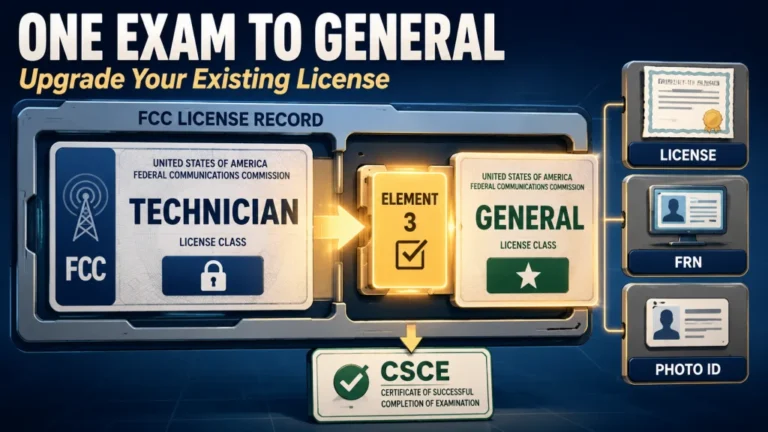
The three current written exam levels are identified as Element 2 for Technician, Element 3 for General, and Element 4 for Amateur Extra. You do not repeat an element for which you already have valid credit. A current Technician license normally gives Element 2 credit, so that license holder begins with General. A current General license holder begins with Amateur Extra.
A Certificate of Successful Completion of Examination, usually called a CSCE, can also document element credit. Under the current FCC rule, the VE team must recognize an element shown on a CSCE when it was passed within the previous 365 days. That matters when the passed element is not yet reflected in the FCC database or when a later exam is taken through another team.
| Your documented credit | First element normally attempted | What may follow after a pass |
|---|---|---|
| No license or element credit | Element 2, Technician | Element 3, then Element 4 if each prior element is passed |
| Current Technician or valid Element 2 credit | Element 3, General | Element 4 if General is passed |
| Current General, or valid Element 2 and Element 3 credit | Element 4, Amateur Extra | No higher current operator class |
The sequence is about earned credit, not about which test feels easier or which license name the candidate prefers. Someone without Technician credit cannot skip directly to General and receive a General license.
You also do not have to repeat lower elements merely because you earned the credit at an earlier session. For example, a candidate who can document valid Element 2 and Element 3 credit may begin with Amateur Extra at a later VE session, even if those elements were passed through another team. Bring the current license record or unexpired CSCE documentation requested by the new team, because technical eligibility does not replace proof at check-in.
The complete US ham radio license path explains how the classes and operating privileges fit together beyond the exam room.
Confirm These Rules Before Registering
A session that advertises all three license classes may still have limits on how many elements one candidate can attempt. Read the full registration page instead of relying on a short calendar listing. If the answer is missing, contact the team before paying or reserving a remote slot.
Ask specific logistical questions. A vague message such as “Can I upgrade?” may not tell the team that you plan to take two exams. State the credit you already hold, the elements you want to attempt, and whether you may want a retest after a failed attempt.
- Does this session offer every element I plan to take?
- How should I indicate multiple-element intent during registration?
- Does the listed session fee cover one attempt at each consecutive element?
- Is a same-element retest allowed, and does it require another fee?
- Is there a firm session or per-candidate time limit?
- For remote testing, what room, camera, device, and screen-sharing rules apply?
- What proof of existing credit must I bring or upload?
Those questions separate FCC rules from local procedure. The VE team cannot change the required element sequence or manufacture credit that is not documented, but it can limit candidate count, session length, retests, and additional elements based on its coordinating VEC procedures and available resources.

The Brio 101 provides Full HD 1080p video with automatic light correction. It includes a built-in microphone and an integrated privacy shutter. The USB-A webcam is listed as compatible with Microsoft Teams, Google Meet, Zoom, and other meeting platforms.
Check On AmazonIf you click this link and buy, we earn a commission at no additional cost to you.
What Happens During a Multiple-Exam Session
At check-in, the team verifies identity, FRN information, and any existing license or CSCE needed for element credit. Tell the team again that you intend to attempt the next element after a pass. Registration systems are useful, but a direct confirmation prevents your second exam from becoming a surprise after the first one is graded.
The VEs grade each completed element before moving you forward. If you pass Technician, you can be offered General under the session’s policy. If you pass General, you can be offered Amateur Extra. You are not taking three tests at once, and the team does not need to wait until the end to determine whether you qualify for the next element.
Remote sessions add another practical layer. The team may need to inspect the testing room again, confirm that no unauthorized material is present, or keep the candidate within a scheduled video window. None of those procedures changes the element credit, but they can change whether a second or third attempt fits into that particular appointment.

The C960 provides 1080p video with a 90-degree field of view and fixed focus. It has two built-in microphones and includes USB Type-A connectivity with an A-to-C adapter. The camera is plug-and-play and is listed for Zoom, Teams, FaceTime, YouTube, and Google Meet.
Check On AmazonIf you click this link and buy, we earn a commission at no additional cost to you.
What Happens If You Pass One Element and Fail the Next?
The successful element remains successful. Failing General after passing Technician does not cancel the Technician pass. Failing Amateur Extra after passing General does not cancel the General pass. The VE team issues the appropriate documentation and submits the successful license action according to its VEC procedures.
For a brand-new candidate who passes Technician and then fails General, the result is normally a new Technician application. For an existing Technician who passes General and then fails Amateur Extra, the result is normally a General upgrade. The failed higher element simply produces no credit unless the team allows another attempt and the candidate later passes it.
Key point: A CSCE showing a passed element is valid for element credit for 365 days. Keep the document until the FCC record correctly reflects the result, and bring it to any later session if the credit is not visible in the licensing database.
A same-element retest is different from moving to the next element. The team must use a different question set, and its VEC policy may require another exam fee. Some sessions allow a retest when time and another exam form are available; others do not. Never build the day’s plan around an assumed immediate retest.

This accordion organizer has eight pockets and included labels for separating documents. Its polypropylene construction fits A4 and letter-size papers, with a snap closure to hold contents in place. The 13 x 10 x 0.7-inch folder is designed to slip into backpacks, laptop bags, or file cabinets.
Check On AmazonIf you click this link and buy, we earn a commission at no additional cost to you.
How Same-Day Exam Fees and the FCC Fee Work
There are two separate charges to understand: the exam-session charge and the FCC application fee. A VEC or VE team may collect an examination reimbursement fee for administering and processing the exams. That amount and what it covers depend on the coordinating VEC and session policy.
The published ARRL VEC exam fee for 2026 is $15. Under its current policy, that fee covers one attempt at each needed element during the session, while a retest of the same failed element requires another fee. Other VECs and teams may charge a different amount, waive fees for certain candidates, or use a different retest policy, so verify the current session listing before paying.
| Same-day outcome | FCC application result | FCC application fee |
|---|---|---|
| New candidate passes Technician only | New Technician license application | $35 |
| New candidate passes Technician and General | One new application reflecting General | $35 |
| New candidate passes all three elements | One new application reflecting Amateur Extra | $35 |
| Current Technician passes General | Ordinary operator-class upgrade | Exempt |
| Current General passes Amateur Extra | Ordinary operator-class upgrade | Exempt |
| Candidate fails every attempted element | No successful license application from the exams | No FCC application fee |
The current $35 FCC application fee applies to a new amateur license. Ordinary operator-class upgrades are exempt, and the FCC fee is separate from what the exam team charges. A new candidate who passes multiple elements in one session does not pay a separate FCC fee for each class because the VEC submits one application reflecting the highest class earned.
Do not take extra elements only because you think the session creates a guaranteed fee shortcut. The team may charge for a retest, and a rushed second exam can consume time without producing useful credit. The financial advantage is secondary to being ready for the privileges and material of the next class.
Who Should Take Technician and General the Same Day?
A same-day attempt makes sense when you are already passing current-pool practice exams for both elements with a comfortable margin and can explain what the General upgrade changes for your operating plans. One lucky practice score is not much evidence. Look for repeatable results across several fresh exams, including days when you are tired or working under a time limit.
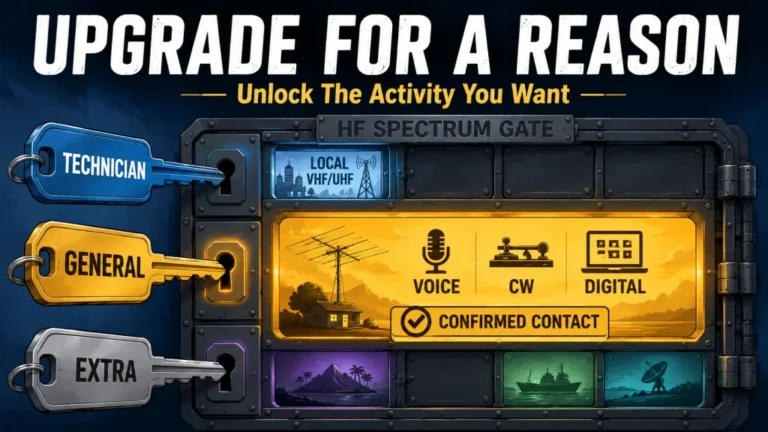
The second requirement is purpose. General opens substantially broader HF operating privileges, so a candidate planning to use HF may have a clear reason to continue after Technician. Someone whose immediate goal is only a local VHF or UHF repeater can still attempt General, but saving a future trip is not a good substitute for understanding the material.
If General is the planned second element, finish the actual preparation before exam day rather than trying to absorb another question pool during the break. The guide to studying for the General license covers that preparation separately. This article is about what happens after you arrive ready, not how to compress two courses into one night.
I usually frame the decision this way: take the next element because you are prepared to pass it and know why its privileges matter. Do not take it merely because a VE has placed another exam in front of you. There is no penalty for stopping after a successful element and returning later with better preparation.

The BF-F8HP is a dual-band handheld radio covering 136-174 MHz VHF and 400-520 MHz UHF with selectable 1-watt, 4-watt, and 8-watt power levels. The kit includes a battery, dual-band antenna, desktop charger, belt clip, wrist strap, earpiece, and user manual. The listing also notes a V-85 high-gain antenna and BTECH support.
Check On AmazonIf you click this link and buy, we earn a commission at no additional cost to you.
Same-Day Testing Checklist
Use this as a go or no-go check before committing to multiple elements. The goal is not to create more paperwork. It is to make sure the exam team’s policy, your documented credit, and your preparation all point in the same direction.
- I verified that the session offers every element I want to attempt.
- I told the team in advance that I plan to take multiple elements.
- I know whether the fee covers one attempt per element or only one exam.
- I know the team’s same-element retest rule and additional fee.
- I have my FRN, identification, current license, and any needed CSCE.
- I am consistently passing the current question pool for each planned element.
- I understand the session time limit and remote-testing requirements.
- I know which license class will be submitted if I pass one exam but fail the next.
- I am prepared to pay the FCC fee if the result creates a new license application.
If any answer is unknown, resolve it before the session. A five-minute email to the team is easier than discovering after a Technician pass that the General exam was not included in your appointment or that a retest requires a new payment.
Final Thoughts: Treat the Second Exam as a Plan, Not a Bonus
Taking multiple ham radio exams in one session can be efficient, and the FCC credit rules protect an element you pass even when the next one does not go your way. The part candidates need to control is logistics: confirm the available elements, declare your intent, bring proof of credit, understand the fee structure, and know the session’s limits before test day.
I would rather see a candidate leave with one solid pass than rush into a second exam solely because it is available. When your practice results and operating goal support the next class, take the opportunity. When they do not, keep the earned credit and return prepared.
FAQs
Same-day exam questions often sound simple until fees, element credit, and team policy overlap. These answers cover the practical points to confirm before the session.
Policies can differ among VECs and individual teams, especially for retests, remote appointments, and time limits. Use the session’s written instructions as the final word on those local details.
📝 Can I take Technician and General on the same day?
Yes, when the session offers both elements and its policy allows the additional exam. You must pass Technician or already hold valid Element 2 credit before General can count toward a license.
📚 Can I take all three ham radio exams in one session?
Yes, some sessions allow Technician, General, and Amateur Extra in sequence. You must pass each required lower element before receiving credit toward the next license class, and the team must have enough time and resources.
✅ What happens if I pass Technician but fail General?
Your Technician pass remains valid and can produce a Technician license application. The failed General attempt does not cancel the lower element or force you to retake Technician.
📄 How long is a ham radio CSCE valid?
A CSCE provides element credit for an exam passed within the previous 365 days. Keep it until the successful element is correctly reflected in the FCC record.
💵 Do I pay the $35 FCC fee for each exam?
No. The fee applies per qualifying application, not per exam element. A new candidate who passes multiple elements at one session normally has one application submitted at the highest class earned, while ordinary class upgrades are FCC-fee exempt.
🪪 Can I start with Amateur Extra if I already passed Technician and General elsewhere?
Yes, when you can document valid Element 2 and Element 3 credit. Bring the license record or unexpired CSCEs required by the team so it can verify that you are eligible to attempt Element 4 without repeating the lower exams.
🔁 Can I retake a failed element immediately?
Possibly, but the team must permit it, have another question set, and have enough time. A separate exam fee may apply, so confirm the retest policy before the session.
💻 Are multiple exams allowed in a remote session?
Many remote teams allow them, but appointment length, room inspection, equipment rules, and candidate scheduling vary. Declare every planned element when registering rather than asking only after the first pass.
🎯 Should I try General just because I passed Technician?
Only when you prepared for the current General pool and understand why you want the added privileges. Passing Technician is not evidence by itself that you are ready for the next element.