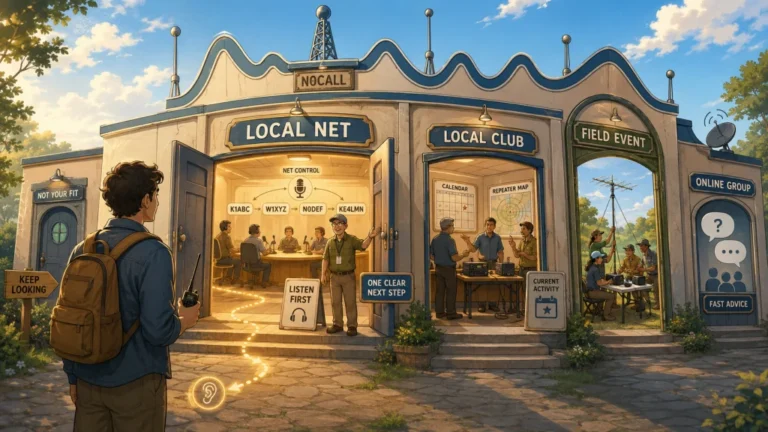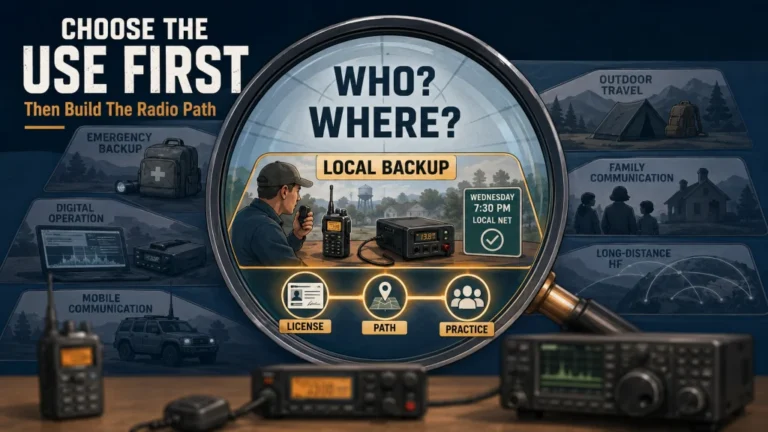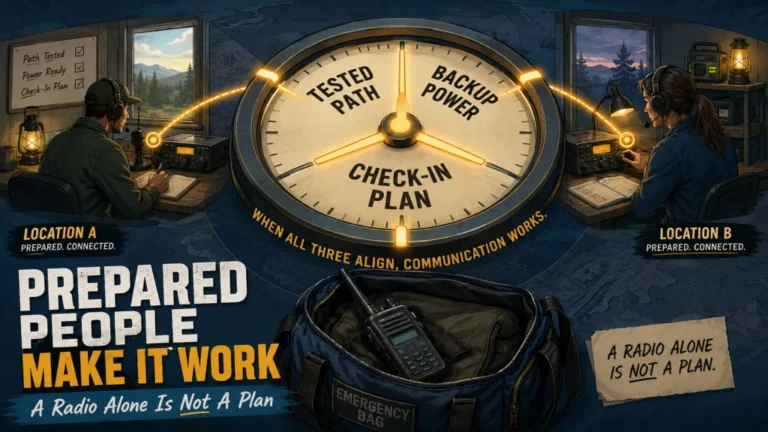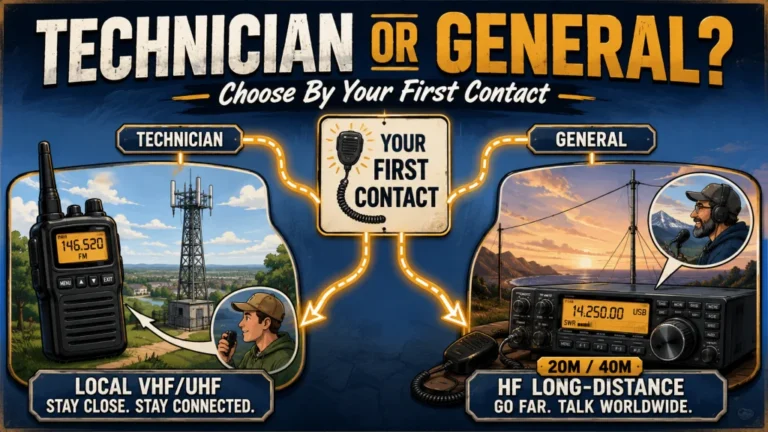
A local club can turn a new license from a piece of paperwork into an actual operating path. The right group can help you identify active repeaters, hear how a net works, meet operators who understand local terrain, and find exam-session or mentoring information without assuming that every club offers the same experience. Start with the ARRL locator, verify the club’s current calendar and net details, listen before attending, and judge the group by whether it helps you take a practical next step. This article focuses on local clubs and their on-air activity, not license study or online-only communities.

Why a Local Club Can Be the Fastest Route Onto the Air
Finding a nearby ham radio club is often one of the most useful moves a new licensee can make after the exam. A license gives you legal privileges, but it does not tell you which repeater is active on Tuesday night, whether the published access tone is still current, or how local operators normally check into a net. A useful club connects those details into one working path.
At exam sessions, I see the same practical gap after a pass: the new operator is ready to move forward but has no local frequency, no net time, and no person to ask whether the radio is programmed correctly. The equipment may be fine. The missing piece is often local context, which is why a nearby operator can solve in ten minutes what feels like a radio problem for several weeks.
Club membership is not required to enjoy amateur radio, and a club is not automatically the right fit simply because it is close. What matters is whether the group helps with the next real action, such as confirming one repeater, demonstrating one setup, introducing one net, or explaining where local exam sessions are posted. Readers who are still building the basic sequence can use this how to get started with ham radio guide to place the club step in the larger process.
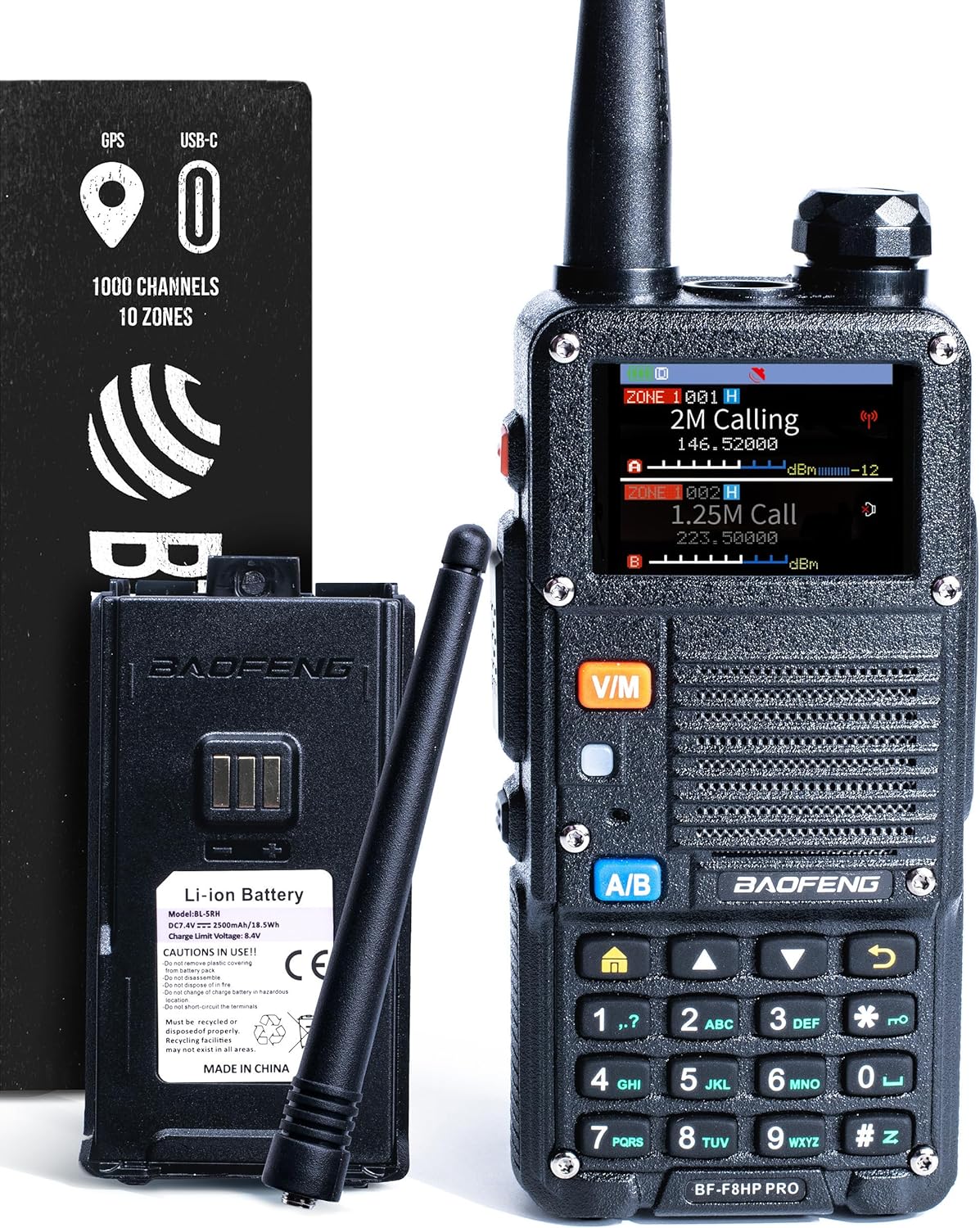
The BAOFENG BF-F8HP PRO is a tri-band handheld covering VHF, 1.25-meter, and UHF amateur operation, with 1,000 channels and built-in GPS. Its feature set also includes IP54 protection and USB-C battery charging. It gives a new operator a portable radio that can use the local repeater and net information supplied by an active club.
Check On AmazonIf you click this link and buy, we earn a commission at no additional cost to you.
How to Find a Ham Radio Club Without Guessing
The best starting point in the United States is the ARRL affiliated club locator. Search by ZIP code first and leave unrelated search fields blank, then widen the distance if the first results are too narrow. The results can show a club’s city, call sign, areas of interest, services offered, and a link to the club’s own site.
Treat the locator as a discovery tool, not proof that every detail is current. Club records are maintained by volunteers, meeting locations change, and a repeater or net may move before every directory is updated. Open the linked club website, calendar, or contact page and confirm the next meeting date before driving across town.
A practical search sequence looks like this:
- Search the ARRL locator by ZIP code and note every club within a realistic driving distance.
- Open each club’s current website or calendar and confirm its next meeting, repeater information, and net schedule.
- Look for services that match your immediate need, such as mentoring, repeater access, on-air bulletins, demonstrations, or license test sessions.
- Listen to the listed repeater or net before attending, when the information is available.
- Contact the club if the calendar is stale, the meeting location is unclear, or visitors are not mentioned.
This process separates a nearby listing from an active local ham radio club. Distance matters, but a group twenty minutes farther away may be more useful if it has a current calendar, a welcoming net, and activities that match what you actually want to do.

The BTECH UV-PRO is an app-connected dual-band VHF/UHF handheld designed for fast setup through the BTECH UV app. The listing also documents Bluetooth HFP audio and GPS/location functions. That combination makes it useful for listening to and organizing confirmed local channels after a club search identifies active repeaters and nets.
Check On AmazonIf you click this link and buy, we earn a commission at no additional cost to you.
Use a Five-Part Fit Check Before You Join
The nearest club is not always the best club, and one disappointing meeting does not represent the whole hobby. Volunteer groups develop different personalities, operating interests, and levels of organization. Your goal is not to find a perfect group. It is to find one that gives a beginner a clear way to participate.
| What to check | Useful sign | Reason to keep looking |
|---|---|---|
| Current activity | A recent calendar, newsletter, net notice, or meeting update | The last visible update is old and no contact responds |
| Beginner access | Visitors are welcome and someone answers practical questions | New operators are ignored or expected to know local procedures already |
| Operating match | The club supports at least one activity you want to try | Every activity is outside your interests or current license privileges |
| On-air path | A repeater, net, event, or scheduled operating activity is clearly identified | The club meets, but offers no practical route to operating |
| Culture | Questions are answered respectfully and different experience levels can participate | Meetings are dominated by conflict, gatekeeping, or unrelated arguments |
Use this table to decide which groups deserve a closer look before you spend an evening driving to a meeting. A current calendar and a clear on-air path are stronger signals than a polished home page, while an unanswered contact address or years-old schedule is a reason to verify the club before investing more time.
What Usually Happens at a Ham Radio Club Meeting
Meeting formats vary, so check the specific calendar before you arrive. A general-interest group may open with short club business, move into announcements about nets or events, and then feature a technical presentation, equipment demonstration, project report, or question period. A repeater association may spend more time on system maintenance, while a public-service group may focus on exercises and event staffing.
The formal agenda is only part of the value. The useful beginner conversation often happens before the meeting, during a break, or after the program, when you can ask a focused question such as, “Which repeater should I program first from my neighborhood?” That is easier for someone to answer than a broad request to teach you everything about radio.
Field Note: The new licensees who remain stuck usually do not need a long lecture. They need one confirmed local path: the correct repeater output, offset, access tone, net time, and a person who can tell them what to expect when they transmit.
Bring your call sign if it has been issued, but you do not need to arrive with an expensive station or advanced knowledge. A notebook and one clear goal are more useful. Ask what the club is doing during the next month, then choose the smallest activity that puts you near an operating radio.

The BTECH QHM22 is an IP54 weatherproof speaker microphone built for radios using the Kenwood K1 accessory connection, including listed BAOFENG UV-5R and BF-F8HP models. It is designed as a shoulder microphone for handheld-radio operation. The accessory provides an external mic and speaker for club activities or demonstrations when used with a compatible radio.
Check On AmazonIf you click this link and buy, we earn a commission at no additional cost to you.
Find the Net Schedule Before You Attend
Many clubs run a recurring check-in net on a local repeater, commonly weekly or every other week, although schedules and formats vary. The current net time may appear in the club calendar, repeater page, newsletter, social page, or ARRL listing description. Confirm the time zone, frequency, offset, and access tone before assuming an old post is still valid.
Listening first gives you a low-risk preview of the club. You can hear whether net control explains the procedure, whether new check-ins are acknowledged, how long the net lasts, and what kind of information is exchanged. You also learn whether your radio can receive the repeater clearly from the location where you plan to operate.
When you are ready to transmit, a scheduled net is usually easier than calling on a quiet repeater with no idea who is listening. Wait for net control to request check-ins, use your assigned call sign, and add a short note that you are new if the format allows it. A simple check-in can be: “This is [your call sign], first time checking in, no traffic.” Follow the controller’s instructions rather than forcing a memorized script into a different net format.
Key point: A net does not guarantee a long conversation or immediate mentoring. Its value is that it gives you a known time, known frequency, clear turn-taking, and an operator whose job is to manage check-ins.
After the net, note whether someone welcomed you, whether the instructions were clear, and whether the activity matched your interests. That evidence is more useful than assuming a club is active because it owns a repeater.

The BTECH UV-5X3 is a tri-band amateur handheld supporting VHF, 1.25-meter, and UHF operation. The current listing includes USB-C charging and an accessory bundle. It gives a licensed operator a portable radio for using the confirmed repeater and net information described in this section.
Check On AmazonIf you click this link and buy, we earn a commission at no additional cost to you.
A Practical Plan for Your First Meeting
Joining a ham radio club as a beginner works better when you arrive with a specific next step. You do not need to impress anyone with technical vocabulary. Tell the person greeting visitors what license you hold, what you have tried, and what you want to accomplish during the next few weeks.
Use this compact first-visit plan:
- Confirm the date, location, visitor policy, and whether the meeting is in person, remote, or hybrid.
- Arrive early enough to introduce yourself before the formal agenda begins.
- State one operating goal, such as checking into a local net or programming one reachable repeater.
- Ask which club activity is best for observing equipment in actual use.
- Leave with one name, one frequency, one scheduled activity, and one next action.
The last line is the test. A friendly evening can still leave you inactive if nothing connects to the radio at home. A productive meeting gives you a small task you can complete, not merely a list of everything experienced operators know. The broader beginner ham radio roadmap can help you place that first local contact within the rest of your operating plan.

The BTECH PC03 uses an FTDI-based USB connection and is listed for compatible BTECH, BAOFENG, and Kenwood radios, including UV-5R, BF-F8HP, GMRS-V2, and UV-82HP models. Amazon lists it as plug and play with no driver needed. It is useful when a first club meeting leaves you with confirmed repeater information and a compatible handheld that still needs programming.
Check On AmazonIf you click this link and buy, we earn a commission at no additional cost to you.
When There Is No Useful Local Club, Use EchoLink as a Bridge
Some readers live far from an active group, cannot attend evening meetings, or find that the only nearby club does not match their needs. EchoLink for licensed amateur operators can connect a validated call sign to participating stations, links, and repeaters through the internet. In single-user operation, a licensed operator can use a computer or supported device without attaching a radio to that computer.
This can let you hear or join an eligible net outside your immediate area, but it is not a substitute for checking the rules and culture of that specific net. Not every repeater is linked, not every net accepts remote check-ins, and internet audio does not teach you how your own antenna and local terrain behave. Use it to practice orderly check-ins and meet operators while continuing to look for a local path.
The distinction matters because this article is about local connection, not building an online-only social network. EchoLink is most useful here as temporary scaffolding: it lets you participate while you search for a nearby repeater, event, mentor, or group that can help with the physical station you actually operate.
The Club and Exam-Session Connection
Some clubs host or support Volunteer Examiner sessions, but this is not universal. A club listing may identify license test sessions as a service, and the club calendar should show whether upcoming dates are active. This can be useful before or after licensing because the same local group may know where exams are held, what identification the session requires, and how candidates receive team-specific instructions.
Serving as a VE is a separate step from belonging to a club. Under the FCC rules, an administering VE must be accredited by the coordinating VEC, be at least 18 years old, hold the required license class, and serve on a qualifying team of at least three VEs. License class limits which examination elements the VE may administer.
| VE license class | Exams the VE may administer after accreditation |
|---|---|
| General | Technician |
| Advanced | Technician and General |
| Amateur Extra | Technician, General, and Amateur Extra |
Do not assume that attending a club meeting makes someone a VE or that every accredited VE can administer every exam element. Accreditation, license class, the coordinating VEC, and the session team all matter. For a new ham, the practical takeaway is simpler: a club that supports exam sessions may offer a direct connection between getting licensed and learning what to do next.
Final Thoughts: Find Activity, Not Just an Organization
A good club can make local amateur radio understandable because it connects frequencies, people, schedules, and equipment to the place where you live. That does not mean every club will be active, beginner-friendly, or relevant to your interests. Verify the calendar, listen to the net, attend once, and judge the group by the next action it helps you complete.
I would rather see a new licensee leave one meeting with a confirmed repeater and a net time than leave with a stack of brochures and no plan to transmit. Find the group that helps you use the privileges you already earned. If no nearby group does that, use a remote bridge temporarily and keep looking for a better local fit.
FAQs
📍 How do I find an amateur radio club near me?
Search the ARRL club locator by ZIP code, then open each club’s current website or calendar. Confirm the next meeting, visitor policy, repeater information, and net schedule before attending.
📻 Can I listen to a club net before joining?
Yes, receiving amateur radio transmissions does not require a ham license. Verify the repeater output frequency and net time, then listen to learn the check-in order and local operating style.
🎙️ What should I say on my first club net?
Wait for net control to request check-ins, give your assigned call sign, and briefly say that it is your first check-in if the format allows it. Follow the controller’s instructions because each net may use a different sequence.
🤝 Do I have to join a club to use ham radio?
No. A club is optional, but a useful one can shorten the path to local repeater knowledge, mentoring, scheduled nets, demonstrations, and exam-session information.
🗓️ What happens at a local ham radio club meeting?
Common meetings include brief organization business, activity announcements, a presentation or demonstration, and time for questions. Check the specific calendar because formats differ widely.
💻 Can I use EchoLink when no club is nearby?
A licensed operator with a validated call sign can use EchoLink to connect to participating stations and repeaters through the internet. Treat it as a bridge because it does not replace learning how your local radio, antenna, and terrain perform.
📝 Do ham radio clubs offer license exams?
Some clubs host or support VE sessions, while others do not. Check the club’s current calendar and follow the specific session’s registration and identification instructions.