Ham radio for emergency preparedness is useful when it connects licensed operators who have already tested their local paths, backup power, and check-in procedures. It can move voice and limited data when phone and internet systems fail or become overloaded, but it cannot guarantee that 911, a hospital, or a rescue team is listening. The practical value comes from preparation before the event, not from storing an unfamiliar radio in a bag. This article explains where amateur radio fits, where it does not, and how to build a realistic communication plan around it.

Hurricane Helene Showed What Ham Radio Can Really Do
In the days after Hurricane Helene struck western North Carolina in late September 2024, and into October, amateur radio operators supported communications around rescue activity, helicopter supply flights, welfare messages, and recovery work. Cell service, internet access, electrical power, and roads were disrupted across the region. For several days in some locations, radio was one of the few remaining ways to pass information between equipped people.
That is the strongest case for ham radio emergency communications, but it is also easy to misunderstand. The radios did not create aircraft, supplies, trained responders, or an emergency management system. They connected people who already had operating skills, working stations, known procedures, and someone prepared to receive the message.
The honest answer is that amateur radio can provide an independent communication path, not an automatic rescue service. That distinction matters whether the threat is a hurricane, wildfire, winter storm, or earthquake. It also matters to anyone evaluating ham radio in an SHTF scenario. Readers who want the broader picture can compare these emergency roles with other practical uses of ham radio, but emergency value always depends on preparation before the normal systems fail.

The BAOFENG BF-F8HP is an 8-watt dual-band handheld covering 136-174 MHz VHF and 400-520 MHz UHF. It is sold as a full kit with a larger battery for portable operation. Its VHF/UHF format fits the kind of practiced, working station that must already be in place before emergency traffic needs to move.
Check On AmazonIf you click this link and buy, we earn a commission at no additional cost to you.
What Ham Radio for Disaster Preparedness Can Provide
Amateur radio is most useful when ordinary communication is unavailable, overloaded, or too fragile for the situation. A local VHF or UHF path can support voice contact across a neighborhood, town, or region, either directly between stations or through a working repeater. Some prepared operators can also pass short digital messages, forms, or email-style traffic through radio systems when normal internet service is unavailable.
The second advantage is organization. A trained net gives stations a shared place to listen, a clear order for checking in, and a method for relaying traffic without everyone transmitting at once. This does not require every household to join a formal response group, but it does require people to know which frequency or repeater will be used, when someone will be listening, and how urgent traffic should be stated.
| Capability | What it can provide | What can break the path |
|---|---|---|
| Local voice | Direct or repeater-assisted contact between licensed operators | Terrain, distance, antenna position, interference, or no listening station |
| Message relay | A way to move information through intermediate operators | No agreed net, unclear message handling, or missing operators |
| Limited data | Short written traffic when voice is inefficient or internet is down | Equipment compatibility, weak paths, congestion, or lack of practice |
| Longer-distance HF | Communication beyond the local area without depending on one local repeater | Propagation, antenna limitations, noise, license privileges, and operator skill |
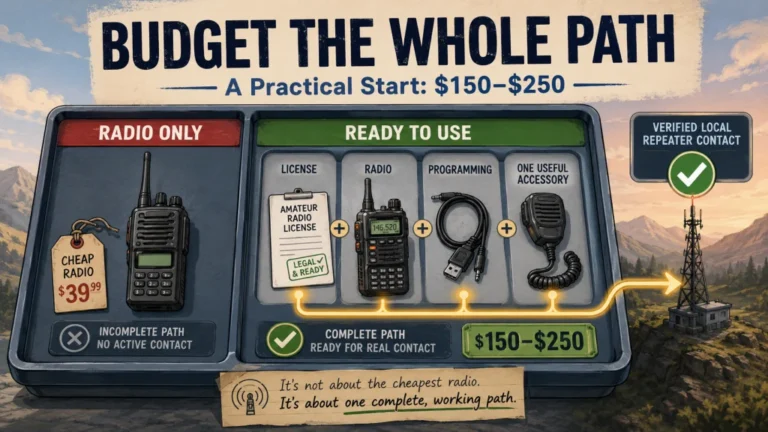
The table shows why buying a radio is only the beginning. Every useful path still needs an operator at both ends, enough power, a suitable antenna, a legal frequency, and a plan for when contact should occur. Remove any one of those pieces and the radio may produce nothing more useful than static.

The BaoFeng UV-82HP is a handheld two-way radio covering 136-174 MHz VHF and 400-520 MHz UHF. Its portable dual-band format supports local amateur use without depending on a fixed base station. That makes it a practical fit for the simplex and repeater communication paths described in this section.
Check On AmazonIf you click this link and buy, we earn a commission at no additional cost to you.
What Ham Radio Does Not Provide
Ham radio is not a replacement for 911. Reaching a local repeater does not mean a dispatcher, paramedic, sheriff, hospital, or emergency manager is monitoring it. Another amateur may be able to relay a request, but that depends on someone hearing the call, understanding the location, and having a working route to the appropriate service.
It is also not private communication. Amateur transmissions can be heard by other people with suitable receiving equipment, and FCC rules generally prohibit messages encoded for the purpose of hiding their meaning. That makes ham radio useful for status reports and logistical traffic, but a poor place for sensitive medical details, financial information, access codes, or anything else that should not be public.
- No automatic location: the radio usually does not send rescuers your position unless you transmit a clear, accurate location through a supported system.
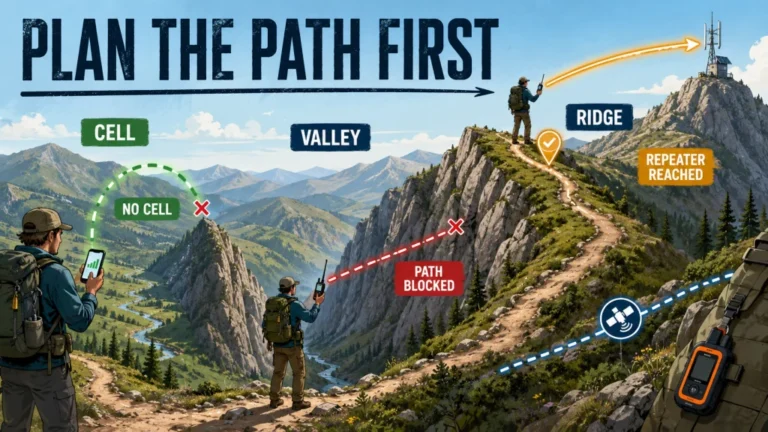
- No universal coverage: hills, buildings, valleys, distance, antenna placement, and failed repeaters can block communication.
- No guaranteed listener: a clear signal is useless when nobody is monitoring the frequency at that time.
- No automatic power resilience: a station connected only to household electricity may stop when the grid fails.
- No substitute for other tools: it does not replace emergency calling, a personal locator beacon, a satellite messenger, a weather radio, evacuation planning, food, water, medication, or family procedures.
Use amateur radio as one layer in a larger plan. A weather radio receives official warnings without requiring anyone nearby to answer. A personal locator beacon or suitable satellite device can be the better choice when a lone traveler needs a distress path with location delivery. Ham radio becomes stronger when it complements those tools rather than pretending to replace them.

The Midland ER310 receives AM, FM, and NOAA weather broadcasts and includes NOAA Weather Scan plus alert functions. It uses multiple power sources and includes an SOS emergency flashlight. It complements ham radio by providing receive-only weather information without depending on another amateur operator to answer.
Check On AmazonIf you click this link and buy, we earn a commission at no additional cost to you.
Why Licensing Matters for Ham Radio Emergency Use
The sentence I hear from some emergency-minded beginners is, “I will transmit without a license only when the disaster is serious.” That approach focuses on the final button press and ignores everything that makes the transmission useful. Before an emergency, an unlicensed person cannot legally build normal operating experience by making routine amateur contacts, testing repeaters, joining local nets, or learning how their signal behaves from home, work, and evacuation routes.
FCC amateur rules contain narrow provisions for immediate safety-of-life and property situations when normal communication systems are unavailable. They are not a blanket permission slip for routine unlicensed operation during storms, outages, public warnings, or general preparedness concerns. Building a plan around an exceptional last resort leaves the operator with no tested frequency, no practiced procedure, no known coverage, and often no one expecting the call.
Field Note: The new licensees I see get on the air within the first month are usually the ones who found a local net before buying a second radio. Emergency readiness follows the same pattern. Practice and local relationships matter more than collecting extra equipment that has never been used on the air.
A license turns preparation into something you can rehearse legally. You can confirm whether a repeater is active, learn how long your backup power lasts, practice giving a location without rambling, and discover that a radio which works upstairs may fail in the basement. Those ordinary tests are where most emergency value is created.

The BTECH UV-PRO is an IP67 dual-band VHF/UHF radio with GPS, APRS, Bluetooth, text messaging, NOAA weather alerts, and USB-C charging. It supports the local radio work an amateur can legally practice before an emergency, rather than leaving the first transmission for a crisis. Regular use with known repeaters and contacts helps turn those licensed privileges into a tested communication path.
Check On AmazonIf you click this link and buy, we earn a commission at no additional cost to you.
Build a Communication Plan That Works Without Guessing
A useful plan should fit on one page and tell every legal operator what to do without relying on memory. Start with the people and locations that must stay connected, then choose radio paths that have already been tested from those places. A frequency list copied from the internet is not a plan unless someone in your area uses it and your station can reach them.
Write down the following decisions before buying more equipment:
- Who communicates: list the licensed operators, their call signs, and the locations each person may use.
- Primary path: name the tested repeater or simplex frequency, including any required offset, access tone, or operating note.
- Backup path: choose a second tested route that does not depend on exactly the same repeater, antenna location, or power source.
- Check-in schedule: set specific times or event triggers so nobody has to monitor continuously.
- Power strategy: record how each station will operate during an outage and how batteries will be recharged without the grid.
- No-contact action: decide how long to keep trying, when to move to the backup path, and what non-radio action follows if contact still fails.
The no-contact step is the part many plans omit. A family member should not remain in a dangerous location indefinitely because a scheduled radio check-in failed. The radio plan must lead to a safe action, such as moving to an agreed location, using another communication service, contacting a designated person, or following the household evacuation plan.
Prepper communities sometimes use informal timing mnemonics such as a 3-3-3 approach. A mnemonic can help a particular group remember its own schedule, but it is not an FCC rule or a universal amateur radio standard. Write the actual times, frequencies, and actions into your plan so another operator does not have to know the same internet shorthand.

Rite in the Rain No. 935 is a 3-by-5-inch weatherproof top-spiral notebook with a green cover and Universal page pattern. Its compact format is suited to keeping written radio notes with an emergency kit or station. It gives operators a dedicated place to record call signs, tested frequencies, backup paths, check-in times, and no-contact actions from the communication plan in this section.
Check On AmazonIf you click this link and buy, we earn a commission at no additional cost to you.
Technician or General: Match the License to the Intended Path
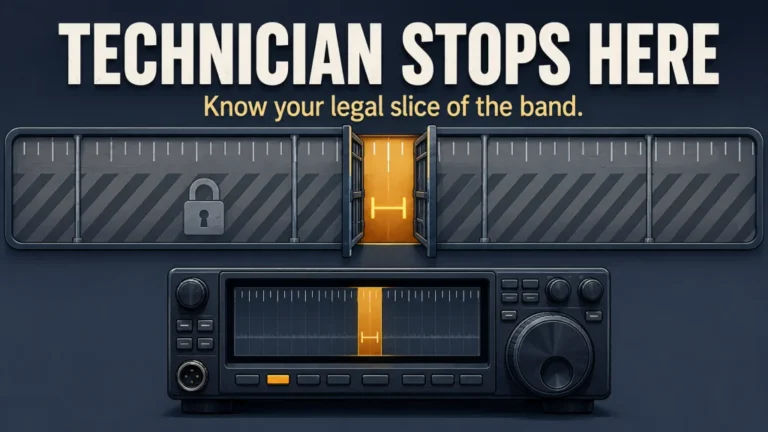
For most local emergency communication, the Technician license is the practical starting point. It provides amateur privileges above 30 MHz, including the VHF and UHF bands commonly used for local repeaters and direct station-to-station contact. That is enough to build a serious neighborhood, community, or regional plan when the operators, coverage, and power arrangements are in place.
Technician privileges below 30 MHz are limited. Technician RTTY and data privileges, including FT8, are limited to 28.000 through 28.300 MHz on the 10-meter band, and the license does not provide general FT8 or data privileges on 20, 40, 80, or 15 meters. Technicians also have limited CW privileges on parts of 80, 40, and 15 meters, plus CW and SSB voice privileges on part of 10 meters. Those privileges can be useful, but they are not the same as broad HF access.
| License class | Practical emergency role | Main limitation |
|---|---|---|
| Technician | Local and regional VHF/UHF communication through simplex paths and repeaters | Limited HF privileges and continued dependence on local path conditions |
| General | Broader HF voice and data options for reaching beyond the local area | Still depends on antenna, propagation, noise, power, and operating skill |
General is the practical target when the plan genuinely requires multiple HF bands for longer-distance communication after local infrastructure is lost. It does not guarantee a cross-country contact, because HF changes with time, propagation, antenna setup, and noise. It gives the operator more legal paths to test and more options when one band is not cooperating.
Do not upgrade only because “emergency radio” sounds more capable on HF. First define who must answer and from how far away. The broader beginner path into ham radio can help you place licensing, operating privileges, and practice in the right order before equipment decisions take over.

The Xiegu G90 is a 20-watt HF SDR transceiver supporting SSB, CW, AM, and FM with a built-in automatic antenna tuner. Its HF capability directly matches the broader longer-distance operating paths that become practical with General-class privileges. The radio still depends on a suitable antenna, propagation, power, and operator skill, which mirrors the limits emphasized in this section.
Check On AmazonIf you click this link and buy, we earn a commission at no additional cost to you.
Test the Whole Path, Not Just the Radio
A radio turning on is not a successful emergency test. The test is complete only when the intended operator can reach the intended person from the intended location using the planned power source. That means testing from the basement, vehicle, workplace, evacuation route, or temporary shelter instead of assuming a contact made from the backyard proves every location will work.
Change one condition at a time when a path fails. Try a better antenna position, move outdoors, use the backup repeater, attempt simplex with a nearby station, or switch to an authorized HF path if the operators hold the required privileges. This turns a vague “radio range” problem into a specific decision about terrain, infrastructure, power, or license class.
Key Point: The most valuable emergency test ends with a written change to the plan. If a repeater is inactive, a battery is weak, or a location is blocked, replace the assumption before the emergency rather than adding more equipment and hoping.
Once the mission, legal operators, and tested paths are clear, equipment can be selected around those requirements. Use a guide to choose ham radio equipment by use case rather than treating the widest frequency range or highest advertised power as proof of emergency value.
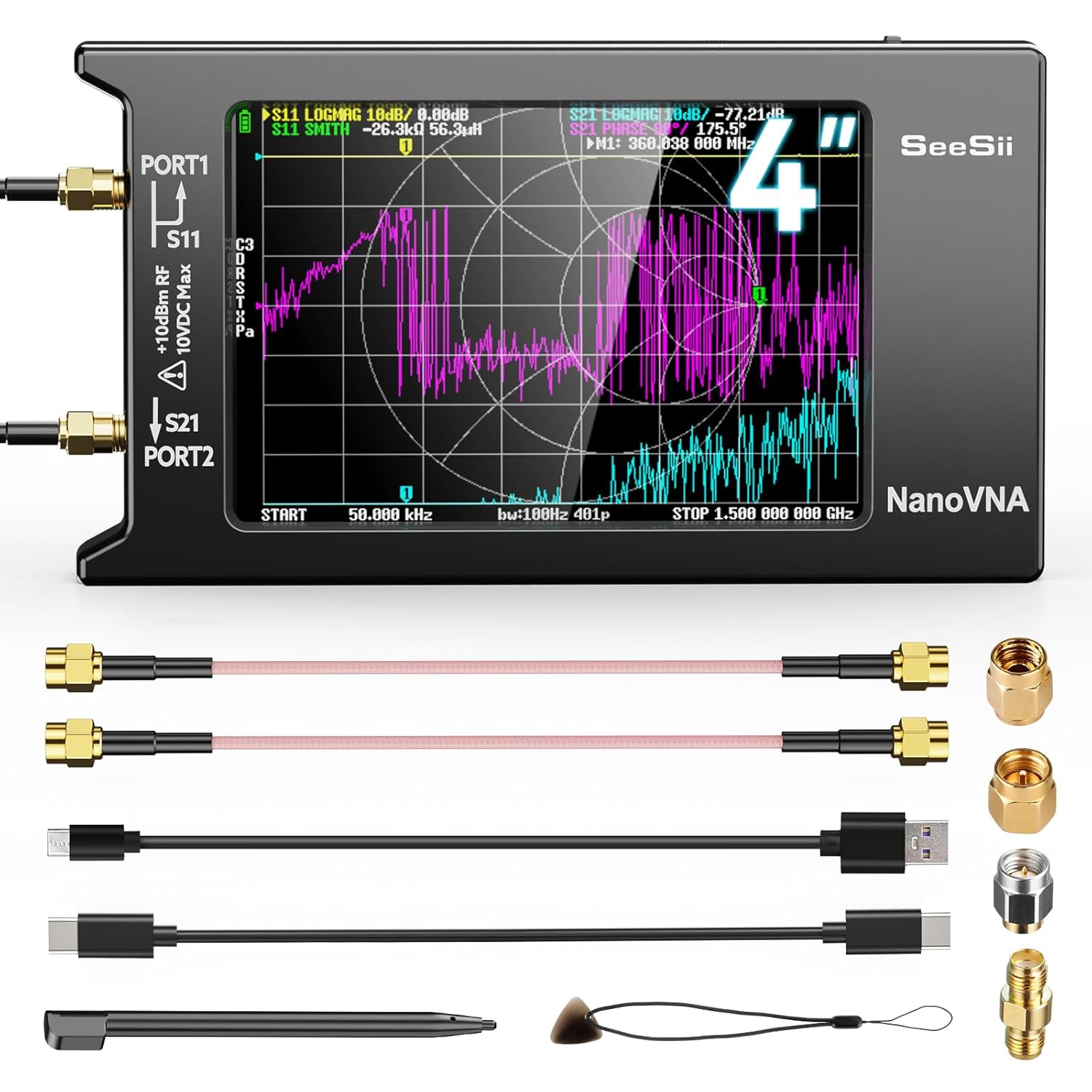
The SEESII NanoVNA-H4 is a vector network analyzer with a 4-inch touch screen and a 9 kHz to 1.5 GHz measurement range. It measures S-parameters, standing-wave ratio, phase, delay, and displays a Smith chart for RF and antenna work. Those measurements help an operator test antenna and feed-line behavior when troubleshooting the complete communication path instead of checking only whether the radio turns on.
Check On AmazonIf you click this link and buy, we earn a commission at no additional cost to you.
Final Thoughts: Prepared Operators Make the Radio Useful
Ham radio can keep information moving when ordinary systems are damaged, overloaded, or unavailable. Hurricane Helene showed the value of independent radio links, trained operators, organized traffic, and stations that could continue working under difficult conditions. It also showed why the useful unit is not a radio by itself, but a complete path connecting people who know what to do.
Start with one realistic communication outcome. Get the license that covers that path, find the people who will answer, test primary and backup routes, plan for lost power, and decide what happens when radio contact fails. That preparation is less dramatic than buying an “emergency” radio, but it is what turns amateur radio from an object in a bag into a working part of a household plan.
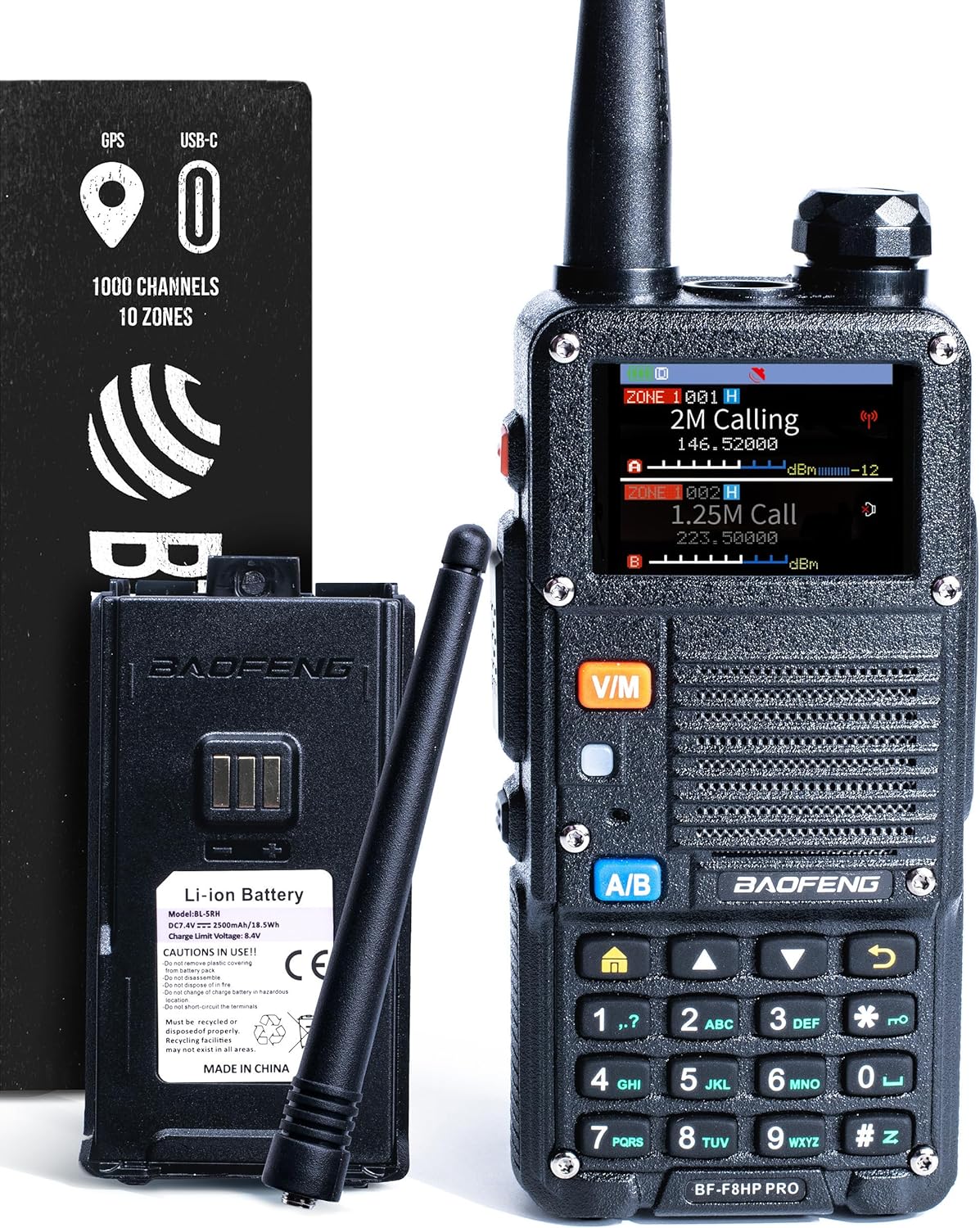
The BAOFENG BF-F8HP PRO is a 10-watt tri-band handheld with 1000 channel memories, GPS, NOAA weather reception, aviation-band scanning, and USB-C charging. It also carries an IP54 ruggedness rating for portable use. Its broad feature set is most useful when it is integrated into tested primary and backup paths with practiced operators, which is the central point of this final section.
Check On AmazonIf you click this link and buy, we earn a commission at no additional cost to you.
FAQs
📻 Can ham radio contact 911 during a disaster?
Not directly or reliably in every area. Another operator may be able to relay an emergency request, but that depends on someone hearing you and having a working path to public safety. Use normal emergency calling whenever it is available.
🪪 Do I need a license to prepare with ham radio?
You need the appropriate amateur license to make normal transmissions and practice before an emergency. Receiving is generally allowed without an amateur license, but listening alone does not teach you whether your transmitting path works. The license is what lets you test the plan legally.
🚨 Can an unlicensed person transmit in a life-threatening emergency?
FCC rules include exceptional provisions for immediate safety-of-life or property situations when normal communication systems are unavailable. That is a narrow last resort, not permission for routine unlicensed testing or general disaster traffic. Do not build an emergency plan around an exception you cannot practice.
📡 Is a Technician license enough for emergency communication?
It is enough for many local VHF and UHF plans, including repeater and simplex communication. If the plan requires broader HF voice or data options for longer distances, General privileges are usually the more practical fit. Coverage still depends on the station and conditions.
🌐 Will ham radio still work if local repeaters fail?
It may work through direct simplex contact, another repeater, a portable relay arrangement, or an authorized HF path. None of those alternatives is automatic. Test a backup that does not depend on the same tower and power system as the primary path.
🔒 Are ham radio emergency messages private?
No. Other people can monitor amateur frequencies, and messages generally cannot be encoded to hide their meaning. Keep sensitive personal, medical, financial, and security details off the air whenever possible.