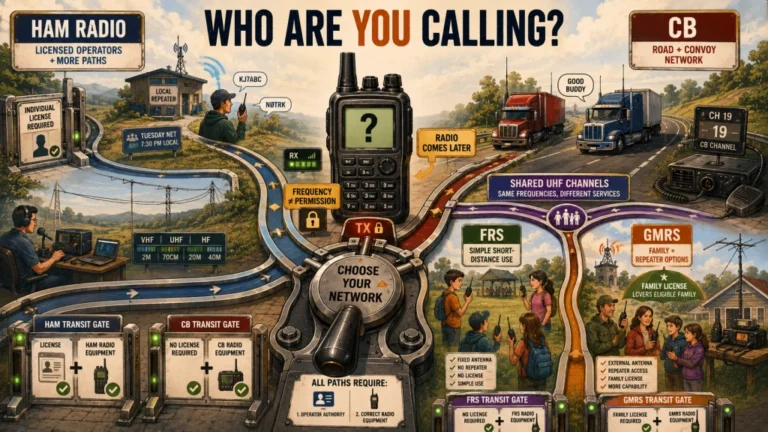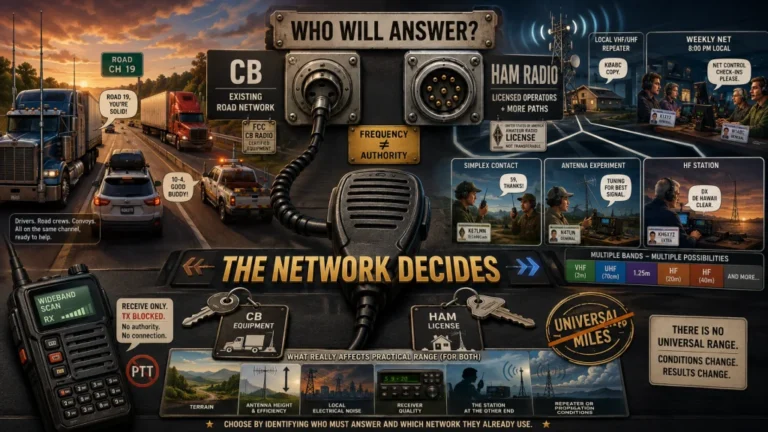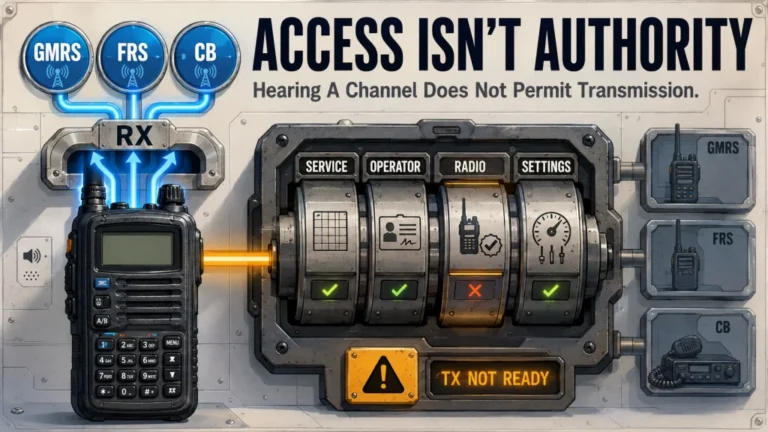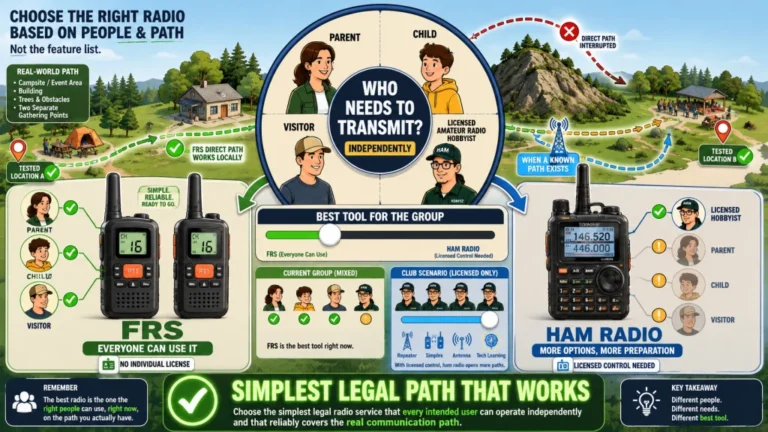
A ham radio may receive some police, fire, aircraft, weather, marine, railroad, business, or public-works traffic, but frequency coverage alone does not prove that the audio will be useful. Four conditions must agree: the radio must tune the frequency, support the modulation or digital format, follow the way the channels are organized, and encounter a transmission that is not encrypted. A basic analog amateur handheld may work well for a conventional clear channel yet fail completely on a trunked digital system operating inside its advertised receive range. The practical answer starts with identifying the exact local system, then auditing the radio against that system and the law where it will be used.

Can a Ham Radio Listen to Police? Start With Four Gates
The answer can be yes, no, or only partly. When someone asks me whether a ham radio can listen to police, I do not begin with the widest receive range printed in a specification sheet. I begin with the local radio system, because a receiver that lands on the correct frequency can still produce silence, noise, fragments of a conversation, or audio that is impossible to follow.
A useful signal has to pass four separate gates. Treating those gates as one question is the mistake that causes most bad purchases and frustrating programming sessions.
- Frequency: The exact radio must cover the channel without a blocked receive segment.
- Mode or format: The receiver must support the signal’s modulation or digital voice format.
- Channel system: The receiver must be able to follow conventional channels or the applicable trunked system.
- Encryption: The communication must be clear rather than encrypted.
If one gate fails, changing the antenna or adding more memories does not solve the underlying mismatch. This is why the first task is not programming a radio. It is identifying what the local agency, airport, weather transmitter, railroad, marina, or public-works department actually uses.

HomePatrol-2 is a color-touchscreen digital scanner built for location-based monitoring. It supports APCO P25 Phase I and II along with conventional and supported trunked systems. S.A.M.E. weather alerts and a U.S. and Canada radio-system database help match the receiver to the service being monitored.
Check On AmazonIf you click this link and buy, we earn a commission at no additional cost to you.
Audit the Exact Radio, Not the Product Category
Two devices sold as dual-band amateur handhelds can have very different receive capabilities. One may cover a broad span outside the amateur bands, another may block portions of that span, and a third may tune the frequency but support only analog FM. The words “wideband receive” are therefore a starting point, not a compatibility result.
I use the following audit before treating any radio as a monitoring tool. The exact manual matters more than assumptions based on the front panel or antenna connector.
| Radio item | What to verify | Why it matters |
|---|---|---|
| Receive range | Exact covered segments and any blocked frequencies | The display may accept a number the receiver cannot actually use. |
| Modes and digital formats | AM, FM, narrow FM, and any supported digital voice formats | Correct frequency with the wrong mode does not produce correct audio. |
| Step size and bandwidth | Channel spacing and selectable receive bandwidth | Poor alignment can weaken or distort reception. |
| Scan behavior | Scan speed, delay, priority behavior, and memory capacity | A slow amateur-radio scan can miss short calls across many channels. |
| System support | Conventional only, trunk tracking, talkgroup support, and site support | A trunked conversation can move among system channels. |
| Antenna fit | Whether the antenna performs reasonably near the intended receive band | An antenna optimized for amateur bands may be inefficient elsewhere. |
Field Note: I treat a receive-range claim as permission to investigate, not proof that the radio will monitor the service. The useful question is always whether the whole signal path matches, from the local system through the receiver and antenna.
This audit also prevents a common false conclusion. Hearing one conventional channel does not prove the radio can follow the agency’s main system, and hearing a digital burst does not mean the receiver contains the codec needed to turn that burst into voice.

The BCT15X is a base/mobile analog scanner with 9,000 channels. TrunkTracker III handles supported analog trunked systems, while Close Call RF Capture detects nearby transmissions. Location-based scanning and service searches make its exact capabilities easier to compare with a local system.
Check On AmazonIf you click this link and buy, we earn a commission at no additional cost to you.
Police and Fire Reception Depends on the Local System
Police and fire communications are not one nationwide technical format. A local agency may use a conventional analog channel, a conventional digital channel, a trunked digital system, a mixture of those paths, or encrypted talkgroups on part or all of the system. That is why a basic analog amateur handheld may receive a clear dispatch channel in one county and hear nothing useful in the next.
Trunking creates a second problem beyond digital voice. Instead of assigning one permanent voice frequency to one department, a trunked system coordinates users through a control channel and places conversations on available system channels. A receiver that merely scans listed frequencies may catch fragments but fail to keep one talkgroup together as a continuous conversation.
Simulcast can make the result more complicated. Multiple synchronized transmitter sites can deliver the same signal at slightly different times to one location, which may distort reception on a device that is not designed to handle that condition well. A strong signal meter does not guarantee clean digital audio.
Warning: Encryption is a firm boundary. An encrypted talkgroup is not a weak signal, missing antenna feature, or programming problem, and this article does not provide methods to defeat it.
For a deeper equipment-role comparison, use the ham radio and scanner comparison. It explains why an amateur transceiver and a purpose-built scanner can overlap in frequency coverage while serving different jobs.

The SDS100 is a True I/Q digital handheld scanner. It is designed for improved digital performance in weak-signal and simulcast areas. Its JIS 4 weather-resistant construction is built for more rugged portable monitoring.
Check On AmazonIf you click this link and buy, we earn a commission at no additional cost to you.
Can a Ham Radio Listen to Aircraft?
Civil aviation voice in the VHF airband commonly uses AM between 118.000 and 136.975 MHz. A radio may display an aircraft frequency yet still receive it poorly if the receiver supports only FM or handles AM as an afterthought. The mode line in the manual matters as much as the frequency line.
Aircraft reception also depends on which side of the conversation is physically reachable. An aircraft at altitude may be heard over a wide area because it has a clear path, while a ground controller can be difficult or impossible to hear behind terrain, buildings, or distance. That difference is propagation, not proof that the channel is one-way.
Step size, bandwidth, scan speed, antenna efficiency, and local radio noise can all affect the result. I would test one known civil airband channel in AM before building a large memory bank, then confirm that speech sounds natural rather than distorted or unusually weak.
Receiving civil aviation voice does not authorize transmission. An amateur license does not grant operating privileges in the aeronautical service, and the push-to-talk control should remain completely out of the process.
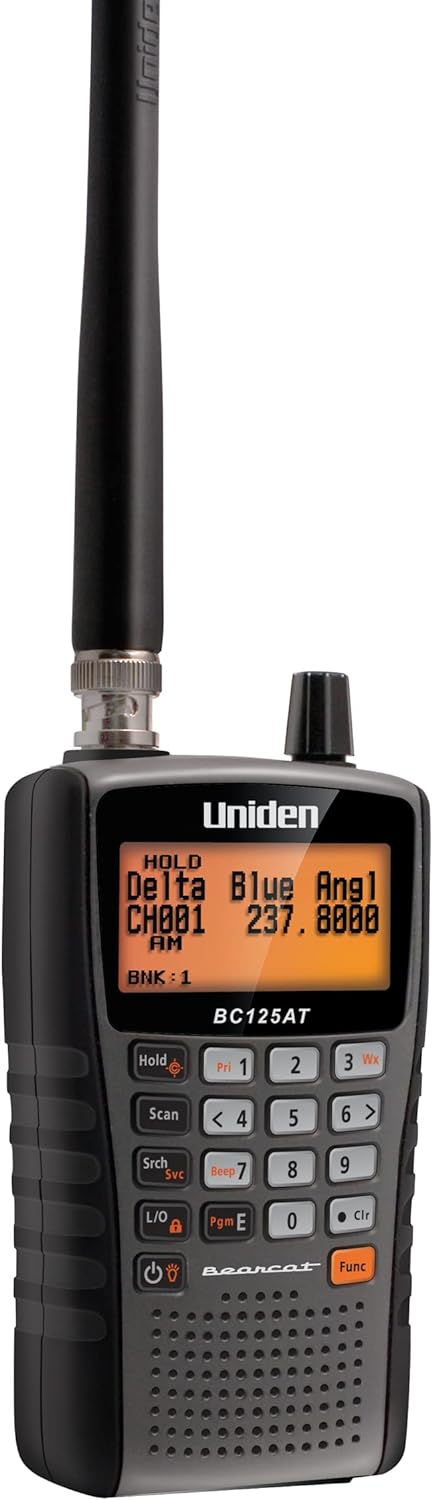
The BC125AT is a handheld analog scanner with 500 alpha-tagged channels. Close Call RF Capture and PC programming support organized monitoring. Its listed service coverage includes aviation, marine, railroad, racing, and non-digital public-safety channels.
Check On AmazonIf you click this link and buy, we earn a commission at no additional cost to you.
Can a Ham Radio Listen to Weather Broadcasts?
Many amateur radios can receive NOAA Weather Radio, but the exact model still has to cover the seven dedicated channels from 162.400 through 162.550 MHz and support the applicable narrowband FM reception. When those pieces match and a transmitter is reachable, the continuous voice broadcast is usually simpler to monitor than a trunked public-safety system.
Voice reception is not the same as automatic warning capability. A radio that plays a weather channel may not remain in a dedicated alert state, decode Specific Area Message Encoding, filter alerts for a selected area, or wake itself reliably when a warning is transmitted. Those are separate features that must be verified rather than inferred from receive coverage.
| Weather function | What it means |
|---|---|
| Weather-channel reception | The radio can tune and play a NOAA Weather Radio voice broadcast. |
| Alert-tone response | The device may react to the standard warning alert tone. |
| SAME decoding | The receiver can use coded location and event information when supported. |
| Automatic warning behavior | The radio can remain ready and notify the user without manual channel monitoring. |
A handheld used casually for weather listening is therefore not automatically a substitute for a dedicated warning receiver. For emergency planning, separate the job of hearing a broadcast from the job of delivering a dependable unattended alert.

The WR120B is a dedicated NOAA emergency weather alert radio with localized programming. S.A.M.E. technology targets alerts to selected counties instead of treating weather reception as simple continuous listening. Its trilingual display, alarm clock, and selectable alert tone add unattended warning functions beyond basic weather-channel audio.
Check On AmazonIf you click this link and buy, we earn a commission at no additional cost to you.
Marine, Railroad, Business, and Public-Works Channels Need the Same Test
Marine, railroad, business, transit, school, utility, and public-works systems do not share one universal monitoring pattern. Their channel plans, bandwidths, site layouts, and operating roles vary, so a receiver that is useful for one local service may be a poor fit for another.
Start with the service and locality, not a generic online frequency list. A channel assignment can change, a department can migrate to a different system, and a listed frequency may be a control channel, an input, a data path, an inactive legacy channel, or only one site in a larger network.
Key point: Identify what a listed channel actually does before judging the radio. A current voice channel, a system control channel, and an old inactive assignment may appear equally valid in a list while producing completely different results.
This is also where the broader guide to choosing between ham radio, scanners, and shortwave becomes useful. The device should follow the listening or communication job instead of being chosen by the longest frequency range on a sales page.

The BC355N is a 300-channel base/mobile analog scanner with pre-programmed service search bands. Close Call RF Capture helps find nearby transmissions without building every channel manually. Its listed services include NOAA weather, aviation, marine, railroad, and non-digital emergency communications.
Check On AmazonIf you click this link and buy, we earn a commission at no additional cost to you.
Why a Ham Radio Police Scanner Setup Has Limits
An amateur transceiver is designed first for amateur communication. Receiving outside the amateur bands may be helpful, but scan speed, trunk tracking, talkgroup organization, database support, alert functions, supported digital formats, and simulcast performance are not guaranteed priorities. A purpose-built scanner is designed around monitoring workflows instead.
That does not make a scanner universally better. For a known conventional analog channel, a compatible ham radio may be entirely adequate. The difference becomes meaningful when the target system changes channels dynamically, uses a supported digital voice format, contains many talkgroups, or requires faster and more organized scanning.
Neither device can make encrypted traffic available. A scanner also cannot compensate for a poor antenna location, an unreachable transmitter, severe local interference, an unsupported system, or a legal restriction on how and where it is used.
Choose the equipment by the job. The guide to choosing the right ham radio by job is the better next step when two-way amateur communication remains the main goal and outside-band listening is only a secondary feature.

The BCD436HP is a handheld digital scanner with HomePatrol database programming. TrunkTracker V supports compatible trunked systems, and the radio includes S.A.M.E. emergency and weather alerting. Its U.S. and Canada coverage and simple programming are aimed at organized multi-service monitoring.
Check On AmazonIf you click this link and buy, we earn a commission at no additional cost to you.
Reception, Privacy, and Local Law Are Separate Questions
Federal law contains exceptions for certain radio communications that are readily accessible to the general public, including qualifying police, fire, marine, aeronautical, amateur, citizens-band, and GMRS communications. That does not create a blanket permission for every signal, every device, every location, or every use of what is heard. Scrambled and encrypted communications sit outside the ordinary clear-radio assumption, and cellular interception is not part of this article.
State and local rules can add restrictions, especially for a scanner or receiver used in a vehicle, carried in certain places, used while committing a crime, or used to assist unlawful activity. Recording and disclosing communications can raise separate legal questions. A venue, workplace, airport facility, school, courthouse, or private property owner may also prohibit receiver use even when possession of the equipment is otherwise lawful.
Legal check: Before mobile or public use, check the current law for the state and locality where the receiver will be used. Do not rely on a nationwide forum answer, an old summary page, or the fact that a radio can technically tune the signal.
The safest operating boundary is simple: monitor only communications you are legally permitted to receive, do not attempt to defeat privacy measures, do not use information to interfere with public-safety work, and do not publish sensitive operational details merely because they were heard over the air.
Keep Non-Amateur Memories Receive-Only
Receiving a frequency and transmitting on it are different legal and technical acts. An amateur license authorizes operation only within the applicable amateur privileges and rules. It does not authorize transmission on police, fire, aviation, marine, railroad, business, weather, or other non-amateur channels.
When the radio supports it, store non-amateur channels as receive-only memories or apply transmit inhibit. Then verify the result from the actual radio, not only from programming software. Pressing push-to-talk briefly to see what happens is not a valid test on a frequency where you have no authority to transmit.
- Confirm the memory is marked receive-only or transmit-inhibited.
- Check that transmit frequency and offset fields cannot create an unintended path.
- Verify behavior using the exact radio manual and a safe test procedure.
- Keep non-amateur memories separated from ordinary amateur transmit memories.
- Recheck the lockout after cloning, importing, resetting, or editing the channel file.
The guide to programming receive-only memories safely provides the broader programming path. Model-specific menus differ, so no single button sequence should be assumed to work on every radio.

The WS1040 is a handheld digital scanner with P25 Phase I and multi-system trunking support. It includes S.A.M.E. weather alerts and PC programming for organized receive lists. Whistler states that its scanners are strictly receivers and do not have the ability to transmit.
Check On AmazonIf you click this link and buy, we earn a commission at no additional cost to you.
Use This Decision Tree Before Buying or Programming
A yes-or-no answer is not enough for a high-risk monitoring decision. Work through the system in order, and stop when a gate fails. That prevents an antenna purchase from being used to solve a mode problem or a programming change from being used to solve encryption.
- Name the exact local service or agency. Avoid assuming that every police, fire, airport, or public-works channel uses the same system.
- Identify the current frequency or system band. Confirm the information is current and local.
- Identify the modulation or digital voice format. Frequency coverage without mode support is insufficient.
- Determine whether the channel is conventional or trunked. For trunking, identify the system type, site, and talkgroup structure.
- Check encryption status. Stop if the desired traffic is encrypted.
- Audit the exact receiver. Verify receive range, blocked segments, modes, trunking, codecs, scan behavior, and memory controls.
- Evaluate the antenna and location. Confirm that the signal is reachable and the antenna is suitable for the intended band.
- Check applicable law and venue rules. Pay special attention to mobile use, recording, disclosure, and prohibited purposes.
- Apply transmit lockout. Treat every non-amateur memory as receive-only.
If the target is a clear conventional analog channel, a compatible amateur radio may be enough. If the target is a supported trunked digital system, a scanner may fit better. If the target is encrypted, neither choice provides a lawful technical path to the audio.
Emergency preparedness adds another distinction: listening does not create a return communication path. The guide to choosing an emergency communication radio explains why the people who must answer, the operating authorization, local infrastructure, power plan, and practiced procedure matter more than passive receive coverage.

The BCD996P2 is a base/mobile digital TrunkTracker V scanner with 25,000 dynamically allocated channels. It supports APCO P25 Phase I and II along with several trunked system types. Close Call RF Capture and location-based scanning support a structured system-first monitoring setup.
Check On AmazonIf you click this link and buy, we earn a commission at no additional cost to you.
Final Thoughts: Identify the System Before Judging the Radio
A ham radio can receive some non-amateur services, but there is no honest universal answer based only on frequency coverage. Police and fire may be conventional, trunked, digital, simulcast, clear, or encrypted. Civil airband requires suitable AM reception, while NOAA Weather Radio voice reception remains different from dedicated alert and SAME features.
I would make the local-system profile first and inspect the radio second. That order reveals whether the real limitation is frequency, mode, trunking, digital format, encryption, antenna performance, or law. It also keeps receive capability separate from transmit authority, which is the boundary that should never be left to assumption.

The BCD536HP is a base/mobile digital Phase 2 scanner with HomePatrol database programming. TrunkTracker V and location-based setup help organize compatible public-safety and other radio systems. S.A.M.E. emergency and weather alerts plus Wi-Fi expand the monitoring workflow beyond basic frequency scanning.
Check On AmazonIf you click this link and buy, we earn a commission at no additional cost to you.
FAQs
🚓 Can any dual-band ham radio receive police channels?
No. The exact radio must cover the frequency and support the local mode, digital format, and channel system. Encrypted talkgroups cannot be made available by choosing a wider-band amateur radio.
🚒 Can a ham radio listen to the fire department?
It may receive a conventional clear fire channel when the frequency and mode are supported. A trunked digital or encrypted fire system may require a compatible scanner or may not be monitorable at all.
✈️ Why do aircraft signals sound wrong on my radio?
Civil VHF aviation voice commonly uses AM. A receiver set to FM, or one with weak AM performance, may produce distorted or poor audio even when it tunes the correct frequency.
🌦️ Is receiving NOAA Weather Radio the same as having weather alerts?
No. Voice reception, alert-tone response, SAME decoding, and automatic warning behavior are separate capabilities. Verify each required feature in the exact radio documentation.
🔐 Can a scanner or ham radio decode encrypted police traffic?
No. Encryption is not a reception-quality problem or a feature gap that a consumer scanner or amateur radio can lawfully solve.
🚗 Is it legal to use a police scanner in a vehicle?
The answer depends on current state and local law, the user’s status, the purpose, and the location. Check the law where the receiver will be used before operating it in a vehicle.
📡 Does a better antenna make a digital system compatible?
No. An antenna may improve signal delivery, but it cannot add an unsupported digital codec, trunk tracking, or decryption. Diagnose compatibility before changing the antenna.
🔇 How do I prevent accidental transmission on a receive channel?
Use receive-only memory or transmit inhibit when the radio supports it, then verify the setting on the radio itself. Never test by transmitting on a channel where you lack authorization.