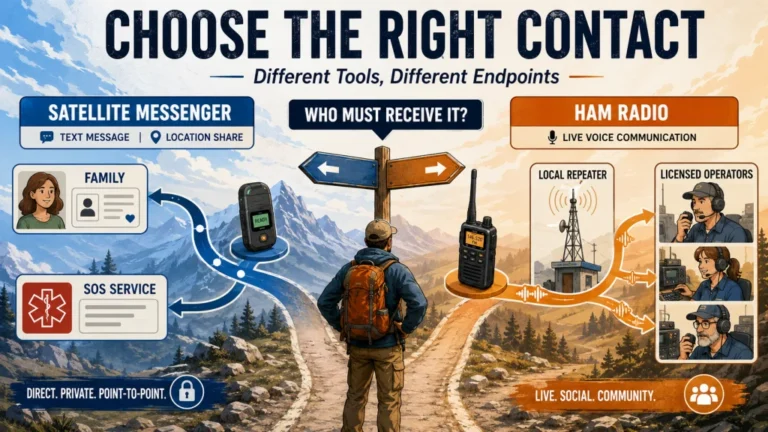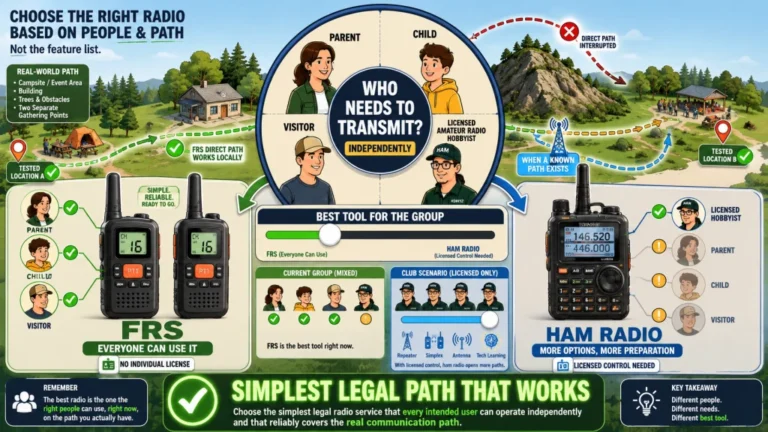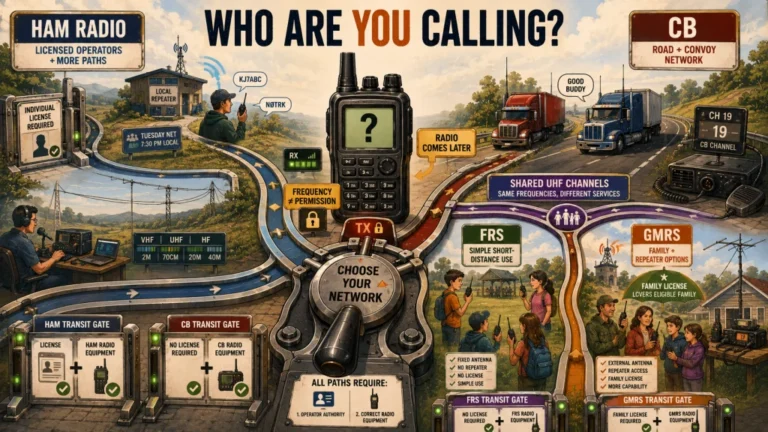
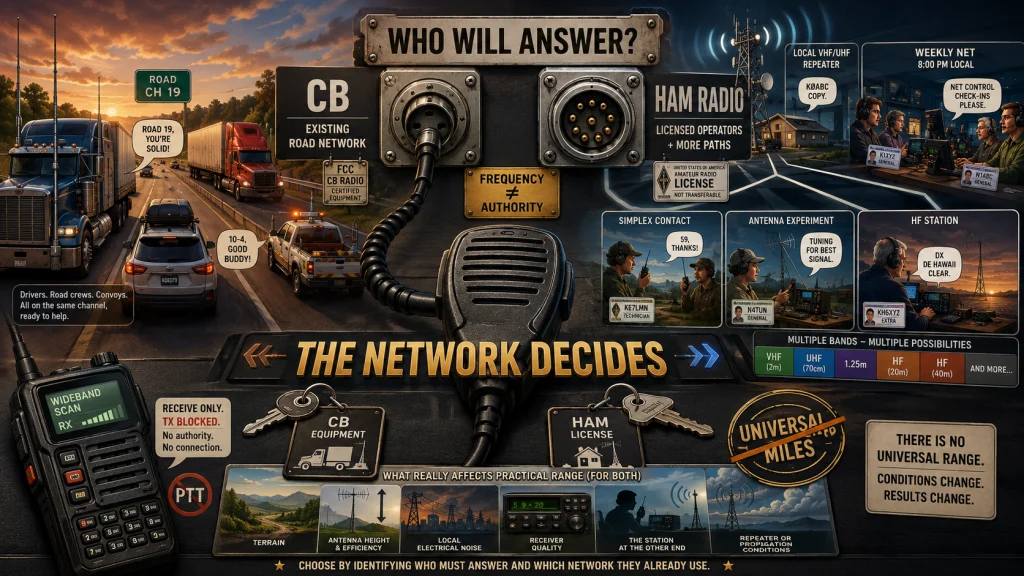
CB can be the better choice when the people you need to reach already use CB for highway, convoy, work-group, or local road communication. Ham radio is the stronger platform when you want a technical hobby, access to multiple bands and modes, local repeaters, organized nets, or broader HF operating privileges. Neither service has a universal range advantage because the path, antenna, terrain, noise, operating mode, and active community all change the result. Choose the existing network first, then confirm the license, legal equipment, antenna, and operating plan that fit it.
Ham Radio vs CB Radio Starts With the People You Need to Reach
The most useful answer to ham radio vs CB radio is conditional. CB is often the direct answer when truck drivers, road travelers, an off-road group, or a work crew already monitors an agreed CB channel. Amateur radio is usually the better fit when the goal is learning radio, using repeaters, trying different bands and modes, joining local nets, or building toward broader HF operation.
This comparison covers legal U.S. operation under the current CB and Amateur Radio Service rules. It does not cover GMRS or FRS in depth, commercial radio systems, illegal amplified CB operation, or a step-by-step equipment installation. For a wider view of the available services, start with the traditional radio service comparison.
The first question I ask in beginner radio conversations is not how many watts a radio has. I ask who is supposed to answer. A technically flexible amateur station cannot reach a convoy that only listens to CB, and a CB station does not provide access to the amateur repeaters and nets a licensed operator wants to join.
Field Note: The common mistake is choosing the radio first and trying to invent a use for it afterward. Start with the people, route, and operating goal. The correct service usually becomes much easier to identify.
That order guides the rest of the comparison. Legal access, equipment freedom, antenna performance, and range only become useful after the communication network is known.
CB and Ham Radio Use Different Legal Models
CB is licensed by rule in the United States. An eligible person does not file an individual CB license application or pass an examination, but that does not make CB rule-free. The operator must use a CB transmitter certified for the service, stay within the permitted channels, modes, power limits, and operating rules, and avoid modifications that invalidate the equipment authorization.
Amateur transmission requires an individual FCC license, and operating privileges depend on license class. After the VEC submits the successful application, the applicant follows the FCC payment instructions, pays the current $35 application fee, and waits until the call sign appears in ULS before transmitting. Exam-session charges are separate and depend on the Volunteer Examiner team.
| Decision factor | CB Radio Service | Amateur Radio Service |
|---|---|---|
| Operating authority | Licensed by rule when the operator and station comply with Part 95 | Individual FCC license required under Part 97 |
| Entry barrier | No individual application or examination | Examination, application processing, and a call sign before transmitting |
| Frequency structure | 40 shared channels from 26.965 through 27.405 MHz | Multiple amateur allocations, with privileges determined by license class |
| Repeaters | No normal CB repeater system | Repeaters are widely used on authorized amateur bands |
| Transmitting equipment | FCC-certified CB transmitter required | Broader equipment and station-building freedom, with the licensee responsible for compliant emissions |
| Best starting question | Does the road or group already use CB? | Do I want amateur activity, learning, multiple bands, or repeaters? |
The practical trade-off is access versus flexibility. CB removes the exam and individual-license step by placing tighter controls on the service and equipment. Amateur radio requires more preparation from every transmitting participant, but it gives a licensed operator far more room to choose bands, modes, antennas, station types, and operating activities.
Forty CB Channels Are Not the Same as Amateur Bands
CB uses 40 shared channels around 27 MHz. Current rules allow AM, FM, and single sideband voice within defined technical limits. The maximum carrier power is 4 watts on AM or FM, while SSB is limited to 12 watts peak envelope power. Those figures describe legal transmitter limits, not guaranteed communication distance.
Amateur radio is organized around frequency bands rather than one fixed set of consumer channels. The operator may use only the frequencies and emission types allowed by the license class and current band rules. That structure supports local simplex communication, repeater operation, voice, permitted digital modes, technical experimentation, and HF contacts when the operator holds the appropriate privileges.
This is why the question “ham radio or CB?” cannot be answered by counting channels. CB offers an immediately recognizable shared road-oriented service. Amateur radio offers a larger operating environment, but the operator must learn where activity occurs, identify correctly, and use the privileges granted by the license rather than treating every available frequency as open.
Key point: CB gives you a defined channel system. Amateur radio gives you a licensed operating framework. One is not merely a smaller version of the other.
Once that distinction is clear, advertised channel counts stop driving the decision. The useful comparison becomes access to people, legal operating options, and the path each station can realistically support.

The Uniden Bearcat 980SSB is a 40-channel CB radio with upper and lower single sideband operation. It includes a customizable seven-color display and integrated SWR antenna calibration. NOAA weather alerts, RF gain, mic gain, a frequency counter, and noise reduction controls are also built into the radio.
Check On AmazonIf you click this link and buy, we earn a commission at no additional cost to you.
The Installed Community Can Matter More Than Technical Capability
A radio service becomes useful when the intended contacts are present. If a trucking route, road crew, or convoy already coordinates on CB, choosing CB preserves access to that network. A ham license does not move those users onto an amateur frequency, and an amateur transceiver does not become a legal CB transmitter just because it can tune near 27 MHz.
The reverse is also true. If a town has active amateur repeaters, scheduled local nets, and licensed operators who regularly monitor them, amateur radio may provide a dependable social and operating structure that CB does not offer there. Local activity varies, so the useful pre-purchase research is listening, checking local repeater and club activity, and asking the actual group what service and channel plan it uses.
Off-road groups are a good example of why the network comes first. One group may have standardized on CB because every vehicle already carries it. Another may use amateur radio because the drivers are licensed and rely on local simplex frequencies or repeaters. The terrain does not decide the service by itself. The group’s existing standard and the legal status of every operator are part of the path.
For a vehicle-centered amateur setup, the guide to ham radio in cars and trucks explains the station factors that matter after the group has already chosen amateur radio. That decision should come after confirming the network, not before it.
Range Comes From the Whole Path, Not the Service Name
There is no honest universal mileage number for either service. Practical range changes with terrain, antenna efficiency and height, installation quality, local noise, receiver performance, the other station, and whether changing ionospheric conditions are helping or disrupting the path. A range claim that ignores those conditions is advertising, not a communication plan.
CB’s position near 27 MHz creates a real antenna trade-off. An efficient quarter-wave antenna is physically long, so vehicle installations often use shortened designs that need a sound mount, adequate ground-plane or counterpoise conditions, careful routing, and proper adjustment. A poor vehicle antenna can waste more performance than a small difference in transmitter power could recover.
Amateur radio covers many bands, so it does not have one propagation profile. A local VHF or UHF repeater path behaves differently from a direct HF contact. Repeater location can overcome some local terrain, while HF communication depends on the band, time, antenna, propagation, noise, and the operator’s privileges. Calling ham radio “longer range” without naming the band and path hides the part that makes the contact possible.
SSB also needs context. Its legal 12-watt PEP limit can improve CB voice efficiency compared with ordinary AM under suitable conditions, but it does not produce guaranteed mileage and it only helps when the other station uses a compatible sideband. The same principle applies to amateur modes: a technically efficient mode does not create a contact unless both stations share the frequency, mode, timing, and operating plan.
Warning: Do not build a safety plan around a fixed-distance claim, skip conditions, or an assumption that another operator will always be listening. Test the actual route with the installed antennas, legal power, normal vehicle noise, and the people expected to participate.
Readers whose main goal is reaching beyond a local road group should separate the service decision from the propagation decision. The guide to long-distance amateur radio communication explains why band access, antenna, and operating conditions matter more than a generic range label.
Equipment Freedom Is a Major Difference
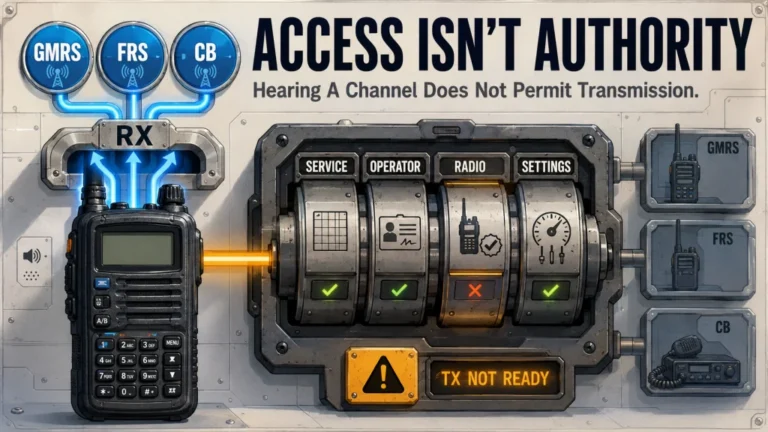
CB operation requires a transmitter certified for CB. Using an amateur or other non-CB transmitter on CB channels is not authorized merely because the radio can generate the frequency. External RF power amplifiers are prohibited for CB operation, and the rules do not create a normal exception for an operator who wants more range.
Legal CB stations can still be improved within the rules. Antenna choice, mounting, feed line, interference control, electrical bonding, and adjustment can make a meaningful difference. For a fixed CB antenna, the current height rule generally limits the transmitting antenna to 60 feet above ground or 20 feet above the highest point of the building or tree on which it is mounted, whichever is higher, along with applicable air-navigation requirements.
Amateur operators have broader freedom to assemble, modify, and experiment with stations, but that freedom carries responsibility. The control operator must stay within authorized bands and modes, use the minimum power necessary for the communication, control unwanted emissions, and correct harmful interference. “Amateur equipment” does not mean unrestricted equipment.
The distinction matters most when a radio is marketed with wide transmit coverage or easy modification. Receiving a frequency is one question. Generating it is another. Holding the proper operator authority and using equipment permitted for that service are separate requirements that still have to be satisfied.

The Cobra 29 LTD Classic provides all 40 CB channels with selectable AM and FM operation and 4 watts of output. Its controls include RF gain and squelch adjustment. The radio also incorporates SWR calibration and an antenna warning indicator, useful features when installing and checking a vehicle CB antenna system.
Check On AmazonIf you click this link and buy, we earn a commission at no additional cost to you.
CB Is Often Task-Oriented, While Ham Radio Can Become the Hobby
CB communication is usually channelized and practical. Operators coordinate vehicles, exchange road information, contact nearby stations, or use an agreed channel for a group. That directness is a strength when the entire goal is to reach people already using the service without requiring them to study for an individual license.
Amateur radio often begins with a practical goal and expands into the activity itself. A licensed operator may use local repeaters, call on simplex, check into nets, learn HF operation, try authorized digital modes, improve antennas, or participate in organized operating events. Contesting and advanced DX operation exist, but they are outside the beginner-to-intermediate decision covered here.
The difference is not that CB users cannot enjoy radio or that every amateur operator wants a workshop full of equipment. The difference is how much room each service provides for expansion. CB remains focused on its 40-channel voice environment. Amateur radio can support a much broader learning path when the operator wants that responsibility and complexity.
This distinction can save money as well as time. Someone who only needs an existing highway channel may gain nothing from studying for amateur privileges they do not plan to use. Someone who wants repeaters, multiple bands, antenna experimentation, and future HF access may outgrow CB even if it solves one short-term road need.

The Yaesu FT-65R is a compact VHF/UHF dual-band FM amateur handheld with selectable 5W, 2.5W, and 0.5W output levels. It comes with a 1950mAh lithium-ion battery pack and rapid charger. The radio also provides programmable scanning, CTCSS and DCS operation, weather alert scanning, quick-recall keys, and PC programming support.
Check On AmazonIf you click this link and buy, we earn a commission at no additional cost to you.
Use This Decision Order Before Choosing
The cleanest decision path begins with the communication job, not the radio catalog. Work through the questions in order. A later answer should not override an earlier network requirement unless the people involved are willing to change services together.
- Identify the required contacts. Name the drivers, group members, local operators, or road users you expect to reach.
- Confirm their active service. Find out what they monitor now, not what they might buy later.
- Define the operating environment. Note highways, valleys, wooded trails, urban noise, fixed locations, and moving vehicles.
- Confirm legal access. Decide whether every participant can and will obtain an amateur license or whether license-by-rule CB access is necessary.
- Choose compliant equipment. Technical frequency coverage does not replace service certification or operator authority.
- Plan and test the antenna path. Installation and terrain must be evaluated with the real stations at both ends.
After those questions, the choice is usually clear. If the essential contacts already use CB and no-exam access is part of the requirement, choose CB. If the goal is a broader technical and operating hobby with licensed participants, multiple bands, repeaters, and future HF options, choose ham radio.
Use both only when each service connects you to a different documented network. A driver might need CB for highway traffic and amateur radio for a local net, but owning two services should solve two real communication jobs. It should not be the default conclusion when one legal, well-planned station would do everything required.
Choose CB When Immediate Network Access Is the Main Goal
CB is the stronger choice when the people you must contact already use it, especially for trucking, highway information, convoys, road crews, and established groups with an agreed channel. It is also the practical answer when requiring every participant to pass an amateur examination would prevent the group from using the system at all.
The limitation should be accepted at the same time as the convenience. CB does not provide amateur repeaters, multiple amateur bands, or broad station experimentation. The legal transmitter power is fixed by service rules, and performance depends heavily on the antenna and actual path rather than an illegal amplifier or a promised mileage figure.
CB is not the automatic choice for every vehicle. It is the choice when CB activity is relevant to the route or group. If nobody you need to reach monitors CB, the lack of an examination does not create a useful network.
Choose Ham Radio When You Want a Broader Operating Platform
Ham radio is the stronger answer when the user wants more than one practical channel network. Local repeaters, simplex contacts, organized nets, multiple bands, technical learning, antenna experimentation, and HF operation under the appropriate privileges all give the service room to grow with the operator.
That flexibility is not instant access. Every person transmitting must have the proper authority, and a new operator still needs a local plan for frequencies, repeaters, antennas, and operating procedure. A license creates legal privileges. It does not guarantee that a repeater is active, an HF band is open, or another operator will answer.
Readers who are comparing the wider licensing, family-use, and infrastructure trade-offs should use the complete ham radio and GMRS guide. This article stays focused on the different decision between the amateur operating environment and CB’s established 27 MHz channel community.

The Yaesu FT-710AESS is a 100-watt HF and 6-meter SDR amateur transceiver. It includes a built-in high-speed automatic antenna tuner and DSP-based signal processing. A 4.3-inch color touch display, two USB ports, an SD memory card slot, microphone, and SP-40 external speaker are included in the platform.
Check On AmazonIf you click this link and buy, we earn a commission at no additional cost to you.
Final Thoughts: Pick the Network, Then Build the Path
CB is not an inferior answer when the highway, convoy, or work group you need is already there. Ham radio is not automatically better because it offers more bands, modes, power possibilities, and technical freedom. A service is useful only when it legally connects the right operators through a path that works in the real environment.
Start with the people you need to reach. Choose CB for an existing CB community and immediate license-by-rule access. Choose ham radio for licensed participation in a broader technical and operating activity. Use both only when each one has a separate job, then test the installed stations instead of trusting a service name or a distance printed on a box.
FAQs
These answers address the legal, range, and use-case questions that most often change the decision between CB and amateur radio.
🚚 Is CB or ham radio better for truck drivers?
CB is usually the more direct choice when the driver wants access to road users and trucking activity already on CB. Ham radio makes more sense when the driver is licensed and wants amateur repeaters, nets, or contacts outside that CB network.
🪪 Do I need a license to use CB radio?
The United States does not require an individual CB license application or examination for eligible operators. Operation is authorized by rule only while the operator uses compliant equipment and follows the CB rules.
📻 Can a ham radio transmit on CB channels?
Not merely because it can tune or be modified to those frequencies. CB transmission requires equipment authorized for CB, and the rules specifically prohibit using a non-CB transmitter to communicate on CB channels.
📡 Which has longer range, CB or ham radio?
Neither service has one universal range. The result depends on the specific amateur band or CB mode, antenna, terrain, noise, propagation, station at the other end, and any repeater involved.
⚡ Can I legally add an amplifier to a CB radio?
No. External RF power amplifiers are prohibited for CB operation, and the legal transmitter limits remain 4 watts carrier power for AM or FM and 12 watts PEP for SSB.
🛣️ Is CB still useful for road trips?
It can be useful when travelers, truckers, or the convoy on that route actively use CB. Test local activity and the installed vehicle antennas rather than assuming the service will be busy or cover a fixed distance everywhere.
🧰 Is ham radio better for experimenting with antennas and equipment?
Yes, amateur radio provides much broader station-building and experimentation privileges. The licensed control operator remains responsible for band limits, permitted emissions, minimum necessary power, interference, and the technical quality of the station.
🔄 Should I install both CB and ham radio?
Only when each service connects you to a separate network you genuinely use. Installing both without two defined communication jobs adds equipment and antenna complexity without guaranteeing better contact.
The fastest way to decide is to write down the people who must answer and the service they already monitor. That answer is more useful than comparing wattage or advertised range.