Ham radio can cross thousands of miles without a satellite subscription or a working internet or cellular network, but it does not provide a guaranteed mileage setting. Long-distance results come mainly from HF signals interacting with the ionosphere, and the usable path changes with the band, time, solar conditions, antenna, local noise, power, mode, and operator judgment. For practical access to the main worldwide HF bands, a General Class license is the realistic target. By the end, you will know why HF behaves differently from local VHF/UHF, what equipment is required, where FT8 fits, and what range to expect without believing marketing promises.

Why Long-Distance Ham Radio Works Without a Network
Using ham radio for long-distance communication works because an HF signal can leave your antenna at an upward angle, interact with ionized layers high above Earth, and return hundreds or thousands of miles away. That makes communication possible beyond the horizon without depending on a cellular tower, internet connection, commercial satellite account, or functioning public network. The catch is that the ionosphere is a changing path, not a fixed relay station.
I tell new operators to separate two ideas that often get mixed together: worldwide capability and on-demand certainty. A properly licensed HF station can reach another continent, but it cannot force a particular country to be available at a particular minute. The same station may produce a strong regional contact in the morning, hear another continent in the afternoon, and find a nearly empty band after a solar disturbance.
This article explains the mechanism, license level, equipment categories, digital option, and realistic range. It does not recommend individual radio models, teach contact procedures, or turn ionospheric science into an engineering course. Readers still deciding where this use fits can compare it with other practical ways people use ham radio before committing to an HF station.

The 101st edition is a comprehensive reference for radio electronics and wireless technology. Its 1,280 pages cover subjects including radio fundamentals, transmission lines, station assembly, antennas, and propagation modeling. The softcover edition gives operators a broad technical reference for understanding the complete RF path behind long-distance communication.
Check On AmazonIf you click this link and buy, we earn a commission at no additional cost to you.
The Signal Does Not Travel in One Straight Line
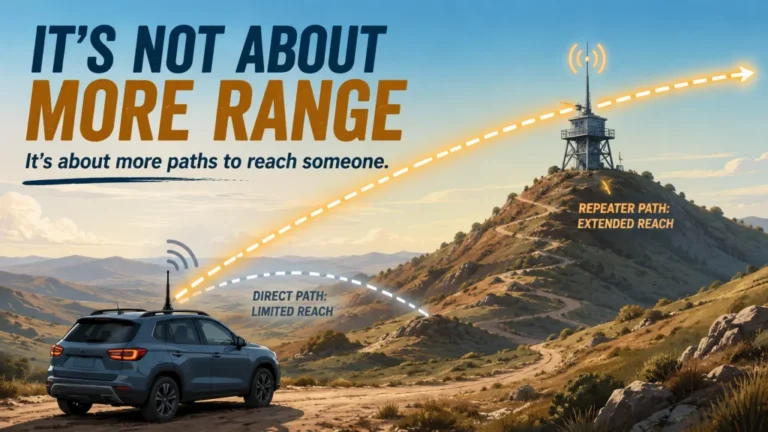
VHF and UHF communication is usually dominated by line of sight. A handheld or mobile signal may reach a nearby operator directly, or it may reach a local repeater on a high building or mountain. Height and terrain matter because those frequencies usually keep traveling outward instead of returning to Earth through ordinary ionospheric propagation.
HF behaves differently. When the frequency, launch angle, and ionospheric conditions line up, the signal is refracted back toward Earth. It can land beyond the normal horizon, rise again after reflecting from the ground or ocean, and repeat the process in multiple hops. That is why a modest home station can sometimes reach another continent while a higher-power VHF handheld cannot reach the next county from behind a ridge.
| Path | What usually controls it | Practical expectation |
|---|---|---|
| VHF/UHF direct | Terrain, antenna height, buildings, and line of sight | Local communication, with distance improving when both antennas have a clearer path |
| VHF/UHF through a repeater | Your path to the repeater and the repeater’s location | Wider local or regional coverage, but it depends on outside infrastructure |
| HF skywave | Frequency, time, ionosphere, antenna, noise, mode, and path direction | Regional, national, or international contacts without a network relay |
There are unusual VHF openings, including sporadic-E and other enhanced propagation, but they are exceptions rather than a dependable beginner plan. If the goal is routine long-distance work without linking through a networked repeater, HF is the relevant path.

This book introduces practical antenna concepts for radio operators. It covers dipoles, impedance, transmission lines, HF and VHF Yagis, loops, and antenna measurements. An introduction to antenna modeling helps connect signal-path theory with real antenna selection and evaluation.
Check On AmazonIf you click this link and buy, we earn a commission at no additional cost to you.
Six Variables Change the Answer From Hour to Hour
The phrase “long range” makes radio sound like a flashlight with a distance rating. HF is closer to choosing a route through changing weather. The radio creates the signal, but the path decides where that signal can be heard.
- Frequency: A band that supports a 500-mile regional path may skip over nearby stations, while another band may open to a different continent.
- Time and season: Daylight changes ionization, and seasonal noise or darkness can make lower bands more or less useful.
- Solar and geomagnetic conditions: Solar activity can improve some higher HF paths, while flares and geomagnetic disturbances can weaken or disrupt others.
- Antenna: Resonance, height, orientation, efficiency, and takeoff angle can matter more than another step up in transmitter power.
- Power and mode: More power can improve signal strength, but a narrow digital signal can be decoded under conditions where ordinary voice is difficult.
- Noise and operator judgment: A low local noise floor, correct band choice, and patience often decide whether a weak signal is usable.
Solar conditions also change over a cycle that averages about 11 years. Near solar maximum, stronger ionization can make higher HF bands such as 10 and 15 meters open more often and support longer paths for more of the day. Near solar minimum, those openings are usually less frequent, so operators rely more heavily on lower bands, favorable times, and patient band selection. A favorable phase still does not override a geomagnetic disturbance, local noise, or an inefficient antenna.
These variables work together. For example, 100 watts into a compromised indoor antenna in a noisy building may perform worse than 20 watts into an efficient outdoor wire at a quieter site. The useful question is not only how much power the radio makes, but how much of that power reaches the intended path and how weak a signal the receiving station can copy.
Field Note: The question I hear most right after an exam session is what radio to buy. For long-distance work, I first separate the license, band, and antenna from the radio itself, because an expensive transceiver cannot open frequencies the license does not authorize or repair a poor signal path.
That is the central decision rule for this entire subject: improve the complete path instead of treating the radio body as the range control.

This vector network analyzer covers 9 kHz to 1.5 GHz and uses a 4-inch touch screen. It can display SWR, S-parameters, Smith charts, and TDR measurements. Those tools help an operator evaluate antenna and feed-line behavior instead of treating transmitter power as the only range variable.
Check On AmazonIf you click this link and buy, we earn a commission at no additional cost to you.
General Class Is the Practical License Target
A Technician license is enough for broad VHF and UHF privileges and includes limited HF privileges, but it does not provide the main set of bands and segments most people expect when they imagine regular worldwide voice and digital communication. For that use case, General Class is the practical target. Amateur Extra adds more frequency access, but it is not required to begin making international HF contacts.
The 20-meter band, around 14 MHz, is often the first general-purpose worldwide band a new General operator explores. It can support long paths during ordinary conditions and is frequently active during the day and into the evening, although location, season, and solar conditions can move the best opening elsewhere. Access to the useful General portions of 20 meters is one reason the upgrade changes the station plan more than many beginners expect.
Technician HF limit: As of July 2026, Technician RTTY and data privileges, including FT8, are limited to 28.000 through 28.300 MHz on the 10-meter band. A Technician license does not provide general FT8 or data privileges on 20, 40, 80, or 15 meters. Technicians also have limited CW privileges on several lower HF bands and voice privileges on part of 10 meters, so worldwide contacts are possible when those paths cooperate, but the access is narrower than General.
A new operator attracted mainly by repeaters may reasonably start with Technician and learn locally. Someone whose main goal is regular HF voice or digital operation should plan for General from the beginning instead of buying a station around privileges they do not yet have. The broader beginner path into ham radio helps place that license decision before the equipment purchase.

This 10th-edition study guide is built for upgrading to the General Class amateur radio license. It includes the General exam question pool with answers and explanatory study material. The edition covers the current General question pool used for examinations through June 30, 2027.
Check On AmazonIf you click this link and buy, we earn a commission at no additional cost to you.
The Required Station Is More Than an HF Radio
The minimum functional station has an HF transceiver, a suitable source of power, feed line, and an HF antenna that works on the intended band. Digital modes add a computer and an audio or data connection when those functions are not already integrated. A tuner may help match some antenna systems, but it does not turn any random piece of wire into an efficient long-distance antenna.
As a mid-2026 planning figure, a new entry-level HF transceiver can begin around $500, but the complete station price is higher after the power source, feed line, connectors, support hardware, and antenna are included. A simple resonant wire dipole can sometimes be built for under $30 when the operator already has suitable feed line and safe supports. That low antenna cost is real, but only when the property can accommodate the wire length, height, and orientation.
There is no single best radio for every long-distance station. The useful choice is the one that covers the authorized bands, supports the intended mode, fits the available antenna space, and leaves enough budget to make the antenna and feed line work. Spending the entire budget on the radio and improvising the rest is one of the easiest ways to create a station that looks capable on paper but struggles on the air.
This is also why a modest radio with a well-installed wire antenna can outperform a premium radio connected to an inefficient indoor compromise. The antenna does not need to be visually impressive, but it must be appropriate for the frequency and real installation site.

This regulated switching supply provides fixed 14.1 VDC for radio equipment. It is rated for 25 amps continuous output and 30 amps surge output. Front Powerpole connectors and rear binding posts provide practical DC connection options for a desktop amateur station.
Check On AmazonIf you click this link and buy, we earn a commission at no additional cost to you.
FT8 Shows Why Power Alone Does Not Define Range
FT8 is a narrow digital mode designed to exchange structured information when signals are too weak for comfortable voice communication. Because the receiving software can decode signals below the level a person would normally understand by ear, FT8 can produce long-distance contacts with much lower power than many beginners expect. It is not a shortcut around licensing, propagation, or antenna physics, but it uses the available signal efficiently.
A 5-watt signal from the United States can be decoded in Europe on a good band day when the path, timing, antenna, and noise level cooperate. That example proves possibility, not a guaranteed result. The same 5 watts may fail on the same route later because the band closes, local noise rises, the antenna favors another direction, or the receiving station is no longer listening.
FT8 also changes what “communication” feels like. It is a two-way amateur contact, but the exchange is short and highly structured rather than a voice conversation. Someone who wants to talk at length should judge the station by voice performance as well; someone interested in propagation, weak-signal work, and confirming distant paths may find the digital mode especially useful.
For broad access to FT8 on the primary worldwide HF bands, General Class remains the practical license level. Technician operators must stay inside their authorized 10-meter data segment, even when software displays activity elsewhere.

This third-edition guide explains how to build and operate an HF digital station. It covers FT8 and FT4 along with WSPR, RTTY, VARA, Winlink Express, JS8Call, and other digital modes. Its station hardware and software guidance fits readers learning how weak-signal digital operation works in practice.
Check On AmazonIf you click this link and buy, we earn a commission at no additional cost to you.
How Far Can Ham Radio Reach in Real Situations?
The honest answer is anywhere from nearby to across an ocean, depending on the path available at that moment. A fixed mileage number hides the part that matters most: HF often skips over some distances while serving others. A station may hear a contact 2,000 miles away while a station 200 miles away is too close for that band and too far for ground-wave coverage.
| Scenario | What can make it work | What can prevent it |
|---|---|---|
| Across town | Direct VHF/UHF, a local repeater, or suitable local HF coverage | Terrain, buildings, an unsuitable HF skip distance, or no repeater path |
| Across a region | A lower HF band and antenna angle that return the signal within the region | Daylight absorption, noise, antenna height, or choosing a band that skips too far |
| Across the country | A useful HF opening, suitable antenna orientation, manageable noise, and the correct band for the time | A closed path, poor orientation, high noise, or expecting one band to work all day |
| Across an ocean | Multi-hop ionospheric propagation, a favorable direction and time, and an efficient signal | Geomagnetic disturbance, weak ionization, local interference, or an antenna that wastes most of the transmitted energy |
Worldwide ham radio communication is therefore a capability, not a service-level guarantee. A well-matched station creates more usable opportunities, and experience helps an operator recognize which band and time are worth trying. Neither one can command the ionosphere to provide a path that does not exist.

The 25th edition covers antenna theory, design, construction, transmission lines, and propagation. It includes practical guidance for selecting, building, testing, and installing antenna systems across amateur bands. Its propagation and antenna-system material helps explain why usable range changes with band, path, antenna type, and installation.
Check On AmazonIf you click this link and buy, we earn a commission at no additional cost to you.
Use This Decision Path Before Spending Money
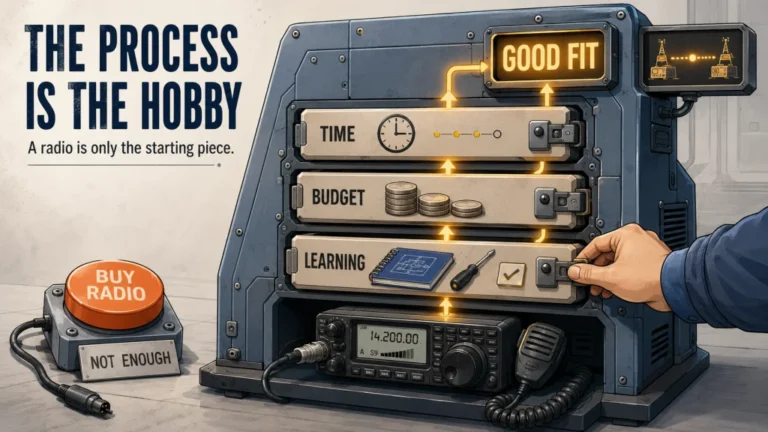
A long-distance station should be designed backward from the contact you want to make. Start with the communication outcome, then confirm the license, band access, antenna space, operating mode, and total station budget. This prevents a radio purchase from becoming the decision that controls everything else.
- Name the outcome: Decide whether you want regional emergency communication, casual domestic contacts, international voice, or weak-signal digital contacts.
- Match the license: Plan for General if the goal includes routine use of the main worldwide HF bands.
- Inspect the site: Measure the available span, identify safe supports, check rental or HOA limits, and consider the local electrical noise level.
- Choose voice, digital, or both: Voice usually needs a stronger readable signal, while FT8 can confirm paths at much lower signal levels.
- Budget for the entire path: Include power, feed line, antenna materials, mounting, grounding and bonding needs, and any digital interface.
- Accept changing conditions: Build for several useful bands instead of demanding one frequency reach every destination at every hour.
Property restriction: PRB-1 concerns state and local land-use regulation. It does not preempt private HOA covenants, CC&Rs, condominium rules, or rental agreements, so confirm what space you are authorized to use before planning wire length or supports.
Once those answers are clear, the radio becomes easier to choose because it is filling a defined role rather than promising vague range. The next step is choosing an HF radio setup that leaves enough budget and space for the rest of the station.

This second-edition guide covers grounding and bonding for home, portable, and mobile amateur stations. It addresses AC safety, lightning protection, and RF management as separate station-design concerns. The material also applies to towers and outdoor antennas, making it useful while planning the complete station site.
Check On AmazonIf you click this link and buy, we earn a commission at no additional cost to you.
Final Thoughts: Build the Path, Not a Mileage Number
Start by naming the result you actually want: regional HF coverage, international voice contacts, or weak-signal digital contacts. That answer determines which privileges, bands, antenna space, and operating mode matter, and it prevents a vague promise of “more range” from controlling the purchase.
I would make the General license and a workable HF antenna the first two commitments, then set a complete-station budget before choosing the transceiver. A reader who can answer those three questions has a practical path forward: Am I authorized for the bands I need, can I install an antenna that serves them, and have I funded the whole signal path rather than only the radio?

The HF-009 is a portable vertical antenna covering 5 to 50 MHz, from 60 meters through 6 meters. Its collapsible design uses a tunable loading coil, telescopic whip, ground spike, and three radial wires for field deployment. The antenna supports up to 100 watts CW and 150 watts PEP SSB, giving a concrete example of a workable multiband HF antenna system.
Check On AmazonIf you click this link and buy, we earn a commission at no additional cost to you.
FAQs
🌎 How far can ham radio reach?
It can reach locally, regionally, nationally, or across an ocean. The result depends on the band, time, ionosphere, antenna, noise, power, and mode, so there is no guaranteed mileage figure.
📜 Can a Technician license make worldwide contacts?
Yes, but through limited HF privileges, especially when 10 meters is open or through authorized CW segments. General Class is the practical target for routine access to the primary worldwide voice and digital bands.
📡 Is 20 meters always the best long-distance band?
No. Twenty meters is a consistent and active worldwide band, but the best band changes with time, season, solar conditions, direction, and distance. Lower or higher bands may provide the better path at a given moment.
⚡ How much power is needed for long-distance HF?
There is no single minimum. Five watts can cross an ocean with an efficient digital mode and favorable conditions, while voice may need more signal margin. Antenna efficiency, noise, and band choice often matter as much as transmitter power.
📱 Can a handheld radio reach another country?
A typical VHF/UHF handheld is mainly a local radio unless it connects through repeater or internet-linked infrastructure. Exceptional propagation can produce longer direct paths, but it is not the normal plan for international communication.
💻 Does FT8 require the internet?
The radio contact itself travels over the air and does not require the internet. Accurate computer time is important, and internet tools can help with time synchronization, spotting, or logging, but they are not the RF communication path.