Ham radio is worth pursuing when you enjoy learning how a system works, solving small setup problems, and building a skill over time. The license can remain useful for 10 years, the equipment commitment can scale from modest to substantial, and the hobby can operate independently of cellular or internet service when both stations have a workable radio path. The trade-off is real: passing the exam does not program the radio, create local activity, or tell you which part of the hobby will hold your interest. By the end, you should know whether the likely time, cost, uncertainty, and social effort fit the kind of hobby you want.
Is Ham Radio Worth the Time and Money?
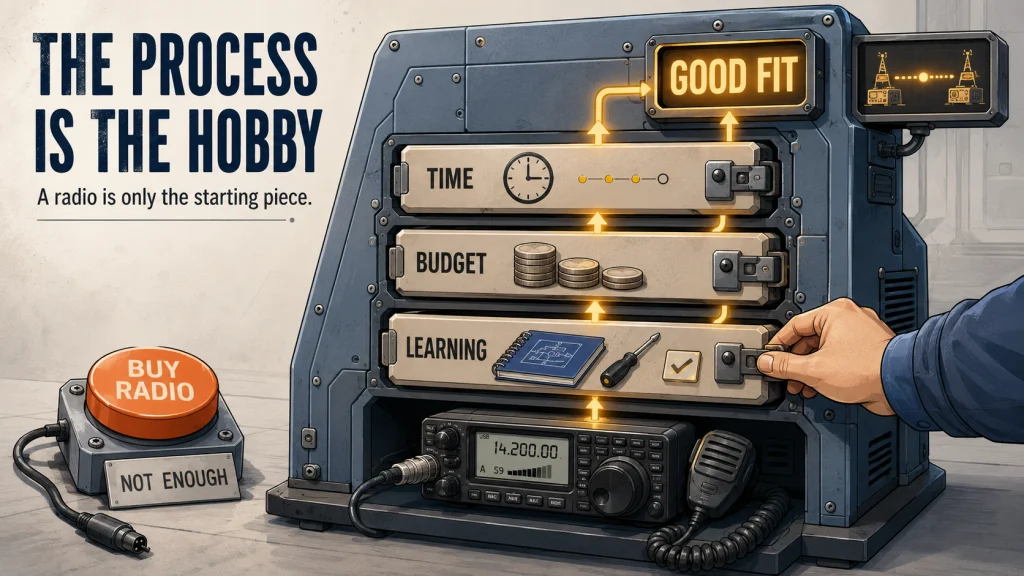
So, is ham radio a good hobby? Yes, for someone who values the process of making communication work, not just the final conversation. You study enough rules and radio basics to earn operating privileges, assemble a station that fits a real use case, learn how local or long-distance activity works, and improve the weak part of the path when the first attempt falls short.
That makes it different from a hobby that delivers an immediate, predictable result as soon as you buy the equipment. A radio may turn on perfectly and still hear nothing useful because the wrong channel is programmed, the nearest repeater is quiet, the antenna is poorly placed, or nobody else is active at that time. The reward comes from understanding which condition matters and correcting it.
This assessment is limited to the time, cost, learning curve, and long-term value of the hobby for a US beginner. It is not a catalog of every possible activity, an equipment selection article, or a detailed licensing walkthrough. For the broader experience, start with what ham radio is like as a hobby.
What Ham Radio Does Better Than Many Hobbies
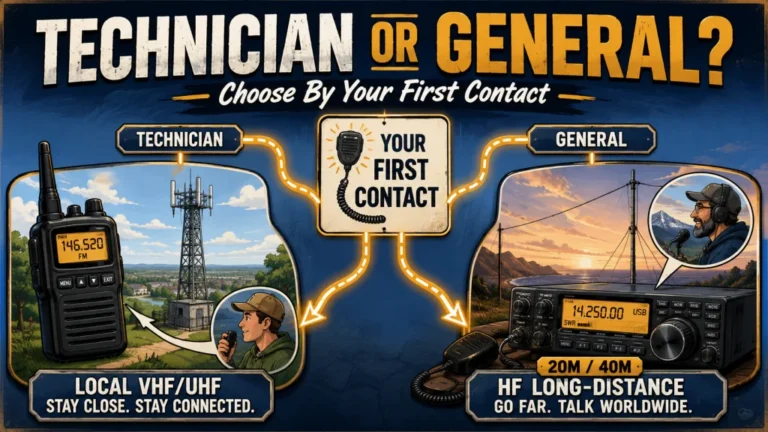
Its biggest strength is that the hobby can grow without requiring you to replace everything at once. A new Technician may begin with local voice communication, later improve the antenna or move to a higher-power station, and eventually study for broader privileges if long-distance operating becomes the goal. Each step adds a new problem to solve rather than making the earlier learning useless.
It also combines technical practice with human contact. You can learn programming, feed line losses, antenna placement, operating procedure, and propagation, then test that knowledge with another person instead of only reading about it. Amateur radio also has an international structure, with national organizations represented across more than 160 countries and separate territories, so the community is much larger than the activity you hear on one local frequency.
A US amateur license is normally granted for 10 years. That long term lowers the pressure to master everything quickly, but renewal is not automatically free. As of July 2026, the FCC application fee is $35 for a new license, renewal, rule waiver, or a modification requesting a new vanity call sign; ordinary operator-class upgrades and sequential call sign requests are exempt, and any VE or VEC exam-session charge is separate and can vary.
Key point: The license gives you durable access to the hobby, but its value comes from the activity and station you build around it. Ten years of permission is useful only when you have a reason to turn the radio on.
The mentoring tradition is another genuine advantage. A local operator can often identify a wrong offset, missing access tone, poor antenna location, or unfamiliar net procedure faster than a beginner can diagnose it alone. That help is valuable because the most discouraging problems are usually small enough to fix but hard to recognize the first time.

The Xiegu G90 is a portable HF transceiver with up to 20W of RF output. It has a built-in wide-range automatic antenna tuner and a detachable display unit. The color LCD provides a spectrum display with waterfall for viewing nearby signal activity.
Check On AmazonIf you click this link and buy, we earn a commission at no additional cost to you.
What the Hobby Does Poorly
The entry barrier is real. The Technician exam is a 35-question test, and it is learnable with free study materials, but learning the question pool still takes focused effort. More importantly, the exam checks rules, safety, operating knowledge, and basic technical concepts; it does not walk you through the exact buttons, software, cables, local repeater data, or antenna placement your station will require.
I see the gap immediately after exam sessions. A candidate will pass and ask what radio to buy before asking what activity they want to try or what local system they can reach. That order feels efficient, but it often creates a mismatched purchase followed by a silent radio and the impression that the hobby has nothing happening.
Local VHF and UHF activity can also be uneven. One area may have scheduled nets, commuting traffic, public-service groups, and active repeaters, while another has long quiet periods. A beginner who judges the entire hobby by scanning one handheld from inside the house can mistake a local coverage or timing problem for proof that amateur radio is dead.
The deeper drawback is uncertainty. Contacts depend on location, terrain, antenna performance, operating time, propagation, and whether another prepared station is available. Anyone who wants guaranteed access, polished onboarding, and an immediate result every time may find that uncertainty irritating rather than interesting.
The Real Time Commitment Comes in Three Stages
The exam is only the first stage. For many motivated adults, one or two focused weekends is a reasonable planning estimate for Technician study using free lessons and repeated practice exams. Someone comfortable with basic electronics may move faster, while a reader new to frequency, electrical safety, and radio procedure may need a steadier schedule.
The second stage is turning the license into a working path. Budget at least a separate day to confirm your call sign, learn the controls of the exact radio, enter one known local channel, check the antenna and power arrangement, listen first, and make a controlled attempt. That can take longer when programming instructions are unclear or the nearest useful system is not reachable from inside the home.
| Stage | Reasonable planning estimate | What changes the estimate |
|---|---|---|
| Prepare for Technician | One to two focused weekends for many adults | Technical background, study method, and practice-exam consistency |
| Build one working local path | One dedicated setup day | Radio interface, programming method, local coverage, and antenna location |
| Find a lasting activity | Several weeks to a few months | Local participation, schedule, interests, and willingness to try more than one format |
The third stage is the one promotional introductions often skip. Finding the activity that keeps you involved may take weeks or months because local nets, portable operating, technical experiments, long-distance contacts, and emergency-preparedness practice offer very different rewards. The first activity you try does not have to become the reason you stay.
For readers asking whether ham radio is worth learning, this is the fairest comparison with other hobbies: the first successful contact can happen quickly, but confidence develops through repetition. The time cost is not endless study. It is a series of small tasks that gradually remove uncertainty from your station.

The ARRL Ham Radio License Manual 6th Edition is designed for Technician-class exam preparation. It covers amateur radio rules, radio fundamentals, antennas, equipment, operating regulations, licensing regulations, and radio safety. The book includes the complete Technician question pool for exams beginning July 1, 2026.
Check On AmazonIf you click this link and buy, we earn a commission at no additional cost to you.
What a Realistic Ham Radio Budget Looks Like
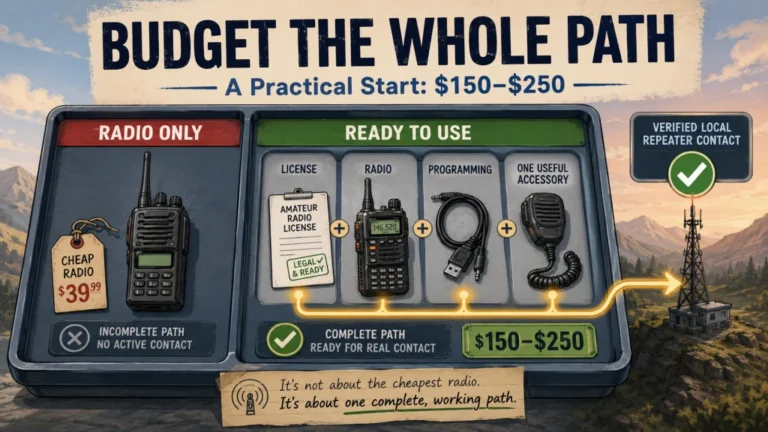
Using July 2026 retail pricing as a planning snapshot, an entry-level usable local setup can fall around $80 to $150. A more capable local, home, or mobile setup often lands around $400 to $800 once the radio, power, antenna, feed line, mounting, and programming needs are counted. An HF station capable of making worldwide contacts can begin around $600 and commonly reach $1,500 before optional upgrades, although worldwide communication is never guaranteed by the purchase alone.
Those ranges are more useful than quoting the cheapest radio price because the radio is only one part of the working path. A low-cost handheld may be enough when a strong local repeater covers your area, but the same radio can be frustrating in a low spot behind buildings. Likewise, an HF transceiver without a suitable antenna, power source, feed line, space, and operating privileges is not yet a worldwide station.
| Planning level | Typical July 2026 range | What the budget is trying to accomplish | Main limitation |
|---|---|---|---|
| Local trial setup | $80 to $150 | Reach one confirmed local communication path | Coverage and indoor antenna placement may limit results |
| Stronger local or home setup | $400 to $800 | Add useful power, a better-positioned antenna, and a more complete installation | Installation quality matters as much as the radio |
| Practical HF station | $600 to $1,500 | Operate on eligible HF bands with a complete basic station | License privileges, antenna space, noise, and propagation control the outcome |
A buyer should also separate required costs from optional expansion. The FCC application fee and any exam-session fee belong in the entry calculation, while extra batteries, elaborate mounting, test equipment, digital interfaces, club dues, and travel are use-case expenses. They may become worthwhile later, but they should not be presented as the minimum price of joining the hobby.
The first-year budget is not the whole ownership cost. Batteries age, connectors and feed line may eventually need replacement, portable activities can add travel costs, and changing interests may lead to a different antenna or radio type. Those expenses follow the activity rather than arriving all at once, so a beginner can delay them until the hobby has proved its value.
That is the practical balance: a larger budget can remove certain equipment limits, but it cannot create interest, local activity, or a routine. A $100 setup connected to one active local net may deliver more value than a $1,000 station that the owner does not know how to use.

The Icom IC-V86 is a portable 2-meter FM handheld covering 144 to 148 MHz. Amazon lists 7W of RF output and a 2250mAh Li-Ion battery pack. The listing also identifies 207 channels and water-resistant construction.
Check On AmazonIf you click this link and buy, we earn a commission at no additional cost to you.
What Helps People Stay Active
The new operators who keep using their licenses usually have a specific reason to get on the air. I treat this as an observed pattern, not a universal statistic. The reason may be a weekly net, portable operating, emergency-preparedness practice, learning antennas, meeting local operators, or working toward broader license privileges.
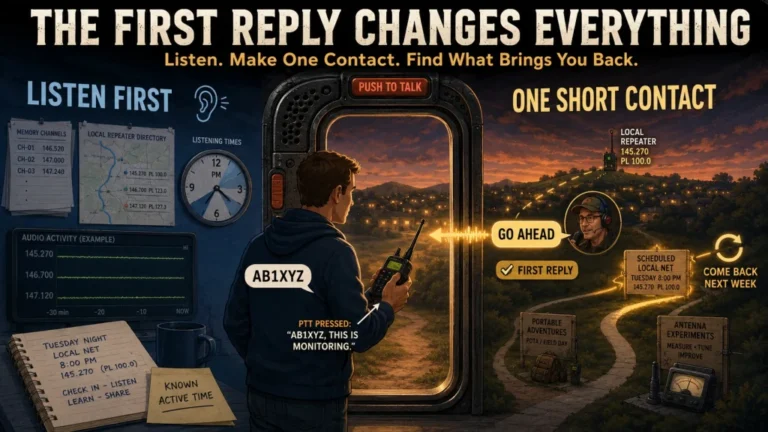
Consistency matters more than variety at the beginning. Pick one recurring time when activity is likely, keep the same programmed channel and operating position, and repeat the process until listening, identifying the station, and making a brief call stop feeling unfamiliar. Changing the radio, channel, antenna location, and operating time after every quiet attempt makes it impossible to know which variable caused the result.
- Choose one activity: Give the radio a job that can be attempted within the next two weeks.
- Meet at least one local operator: A short programming or coverage check can prevent hours of guessing.
- Use a scheduled net: A known time removes the uncertainty of listening to an empty channel.
- Improve the antenna path before replacing the radio: Height, location, feed line, and terrain often matter more than another feature list.
- Repeat the same basic operation: Familiarity grows faster when the first few sessions use a proven channel and procedure.
This checklist works because it converts the hobby from open-ended exploration into a small routine. It does not require committing to one operating style forever. It only creates enough success to decide whether the learning process feels rewarding.
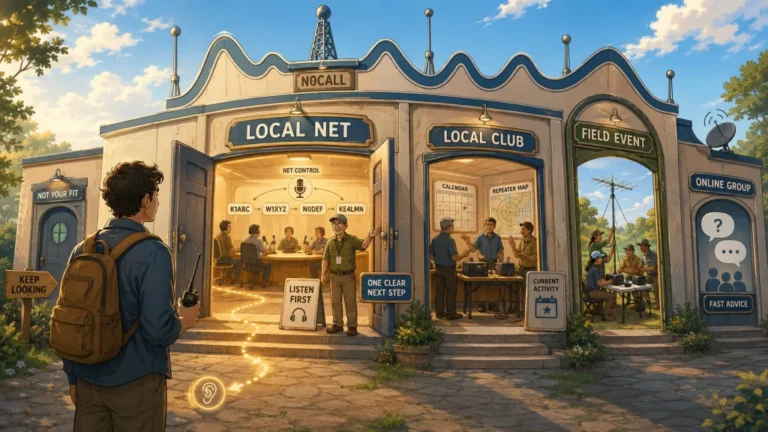
The mentoring piece matters here, but the right community is not automatically the nearest club. Some groups focus on technical projects, some on public service, some on casual conversation, and some are not very active. Try the activity and the people together; a poor fit with one group is not a verdict on the entire hobby.
Why Some New Licenses Go Unused
A license can sit unused even when the person enjoyed studying for it. The exam provides a clear target, a score, and a finish line; operating provides a radio with unfamiliar menus, uncertain local activity, and no automatic next assignment. That change from structured progress to self-directed practice catches many beginners off guard.
Setup friction is one cause. A missing repeater tone, reversed offset, unsaved memory, poor antenna position, or incompatible cable can produce silence without making the error obvious. A new operator may interpret that silence as personal failure when the problem is one incorrect field or one unsuitable operating location.
Mismatched equipment is another cause, but the mismatch is usually about purpose rather than price. Someone who wants dependable local community contact may buy for long-distance features, while someone fascinated by international communication may begin with a local-only path and quickly feel boxed in. The equipment can work exactly as designed and still fail the owner’s expectation.
Field Note: I have watched new licensees delay their first transmission because they did not know the check-in phrasing for a local net. The radio was programmed and the signal was available, but uncertainty about what to say became the last barrier. Listening to one full net and writing down a simple check-in line often solves more than another equipment purchase.
Quiet local channels complete the pattern. If your area has little activity at the hours you are available, staying interested may require a different band, schedule, activity, or operating location. That is a real disadvantage compared with hobbies that do not depend on another participant, but it is also why one silent evening is weak evidence for a long-term decision.
A Simple Fit Test Before You Commit
An honest ham radio hobby review should test the reader, not just praise the technology. The best fit is someone who enjoys learning through small experiments, can tolerate an imperfect first result, and finds satisfaction in improving a communication path. Technical experience helps, but patience and curiosity matter more at the beginning.
The hobby may be a poor fit when the desired outcome is instant, private, always-available communication with specific family members who have no interest in becoming licensed or learning radio procedure. It may also disappoint someone who dislikes troubleshooting, scheduled participation, or talking with unfamiliar people. Ham radio can support practical communication, but it is not a replacement for every consumer service.
The people most likely to regret starting are not necessarily those with small budgets or no technical background. The larger mismatch is expecting the purchase itself to provide the experience, refusing to schedule time around real activity, or wanting every attempt to produce a predictable result. Recognizing that mismatch before the exam is more useful than forcing enthusiasm after the license arrives.
| Your preference | Likely fit | Reason |
|---|---|---|
| You enjoy learning systems and fixing small setup problems | Strong | The process itself provides part of the reward |
| You want a social hobby with both local and international possibilities | Potentially strong | Results depend on finding active people and a suitable operating path |
| You want guaranteed communication with no infrastructure and no preparation | Weak | Independent radio still requires power, compatible stations, practice, and a viable path |
| You enjoy a clear learning goal but dislike open-ended exploration | Mixed | The exam is structured, while long-term participation is self-directed |
| You can spend $80 to $150 and several focused weekends before judging it | Reasonable trial | That budget and time can test one real local use case without a major commitment |
Use the final row as a practical trial rule, not a promise of success. Confirm local activity before buying, study for the entry license, build one complete communication path, and use it several times. If the process feels satisfying even when the result is imperfect, the hobby is probably a better fit than the first contact alone can show.
For a wider decision framework, read how beginners should approach ham radio. It places licensing, equipment, antennas, and first operating steps in the correct order without assuming that one route fits every reader.

The RTL-SDR Blog V4 is an RX-only software-defined radio using an R828D tuner and RTL2832U. It tunes from 500 kHz to 1.7 GHz and includes a multipurpose dipole antenna kit. The included portable antenna kit is intended for VHF/UHF terrestrial and satellite reception.
Check On AmazonIf you click this link and buy, we earn a commission at no additional cost to you.
Final Thoughts: Choose the Learning Process, Not the Radio
Make the decision from a controlled trial, not from an equipment catalog or one exciting exam result. Verify local activity before spending heavily, build one complete communication path, and repeat one activity several times. The useful signal is not whether every contact succeeds, but whether you enjoy understanding what changed and trying again.
If that process holds your attention, the hobby can keep expanding for years without requiring you to pursue every band or operating style. If the waiting, troubleshooting, and dependence on other prepared stations feel like obstacles rather than part of the appeal, walking away after a modest trial is a sensible conclusion, not a failure. When you are ready to turn the decision into action, follow the first practical steps into ham radio so the license, station, and intended activity develop together.
FAQs
These questions cover the points that usually determine whether the hobby feels rewarding or frustrating. The useful answer is rarely just yes or no; it depends on what kind of effort and result you expect.
📻 Is ham radio worth learning if I already have a smartphone?
Yes, when you want to understand radio communication, build technical skill, or operate without depending on cellular and internet networks. It is not better than a smartphone for ordinary convenience, and it still requires compatible stations, power, practice, and a workable signal path.
💰 Is ham radio an expensive hobby?
It can be modest or expensive depending on the activity. A realistic local trial may fit within $80 to $150, while stronger local installations and HF stations cost more because the antenna, power, feed line, and installation matter along with the radio.
⏱️ How long does it take to get started in ham radio?
Many adults can prepare for the Technician exam in one or two focused weekends, then need another dedicated day to set up and test one communication path. Finding the activity that holds your interest may take several weeks or a few months.
🧠 Should I get into ham radio if I am not technical?
You do not need an electronics background, but you should be willing to learn basic rules, controls, and troubleshooting. Curiosity and patience usually matter more than arriving with technical experience.
📡 Can ham radio still be enjoyable if local repeaters are quiet?
Possibly, but do not assume that scanning randomly represents all local activity. Check scheduled nets, other operating times, simplex activity, and whether your antenna location can reach the systems listed for your area.
🪪 Why do some people earn a license and never use it?
The common barriers are setup friction, quiet local channels, equipment that does not match the intended activity, and uncertainty about what to do or say first. The license supplies permission, but it does not supply a routine.
The best test is practical: choose one activity, confirm one usable path, and repeat it enough times to separate normal beginner friction from a genuine lack of interest.