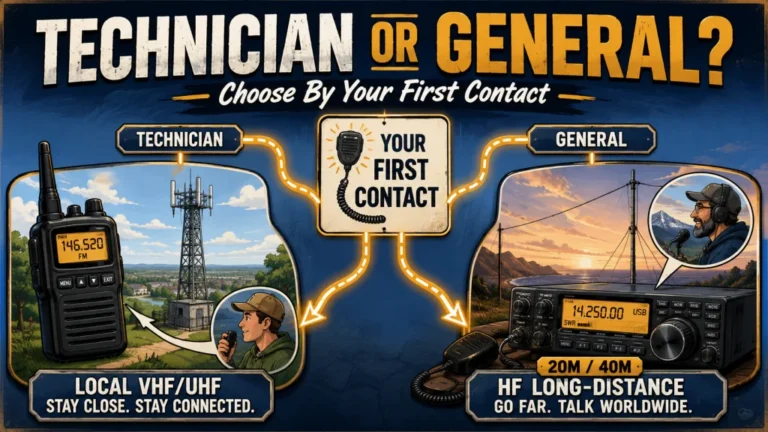
A ham radio can connect you with local operators, carry digital position and message data, support trained public-service communication, reach other countries, work through satellites, and become a platform for technical experimentation. A Technician license already opens a broad range of VHF, UHF, and limited HF activities, while a General license makes the commonly used HF voice and data bands far more accessible. The useful question is not how many activities exist, but which one gives you a reason to turn the radio on regularly. This guide separates beginner-friendly options from activities that require broader license privileges, more training, or a more involved station.
What Can You Do With a Ham Radio?
What can you do with a ham radio once the license is active? Much more than talking through a local repeater, although that is where many new operators begin. You can join scheduled nets, communicate directly over simplex, exchange digital data, volunteer with organized public-service groups, make long-distance HF contacts, work through satellites, listen for the International Space Station, and build parts of your own station.
The question I hear after license exams is often, “What radio should I buy?” The better question comes one step earlier: what do you want the license to let you do? A handheld chosen for local repeaters serves a different goal from an HF station built for international contacts, and neither is automatically the better version of the hobby.
This article maps the major ham radio activities without turning each one into a setup tutorial or equipment list. The goal is to help you identify a direction before you spend money, upgrade your license, or assume that every interesting activity requires an advanced station.
A Practical Map of Ham Radio Activities
Most lists of ham radio uses mix simple local communication with highly specialized activities and present them as though they require the same license, equipment, and preparation. They do not. A better map separates what your license permits from what your station and experience can realistically support.
| Activity | Typical license path | What changes the difficulty |
|---|---|---|
| Local repeaters, nets, and simplex | Technician | Local coverage, terrain, antenna position, and knowing local operating customs |
| APRS and VHF/UHF digital communication | Technician | Compatible modes, local infrastructure, programming, and network availability |
| Portable and field operation | Technician or General, depending on bands and modes | Location, antenna deployment, available power, weather, and how much equipment must be carried |
| Organized emergency and public-service communication | Technician may be sufficient for many local roles | Registration, training, drills, served-agency procedures, and local activation plans |
| Broad HF voice and data activity | General is the practical threshold | Band conditions, antenna limits, noise, operating skill, and available privileges |
| Amateur satellites and ISS-related activity | Many VHF/UHF activities are available to Technicians | Active passes, current operating status, frequency coordination, timing, and antenna control |
| Antenna projects, kits, and radio experimentation | Depends on whether you transmit and where | Technical depth, test equipment, safety, and the limits of the project |
The license class is only one filter. A Technician with a clear local goal can be more active than a General who upgraded without deciding what to do next. Use the table to identify an activity first, then learn the privilege, station, and training requirements for that activity rather than buying equipment in the hope that a use case appears later.
Local Communication Is the Most Direct Starting Point
Local VHF and UHF operation is usually the least complicated way to become active after earning a Technician license. Repeaters receive a signal on one frequency and retransmit it from a better location, often giving operators broader coverage than direct radio-to-radio communication would provide. Actual coverage depends on terrain, antenna height, building obstruction, repeater location, and whether the system can hear your signal clearly.
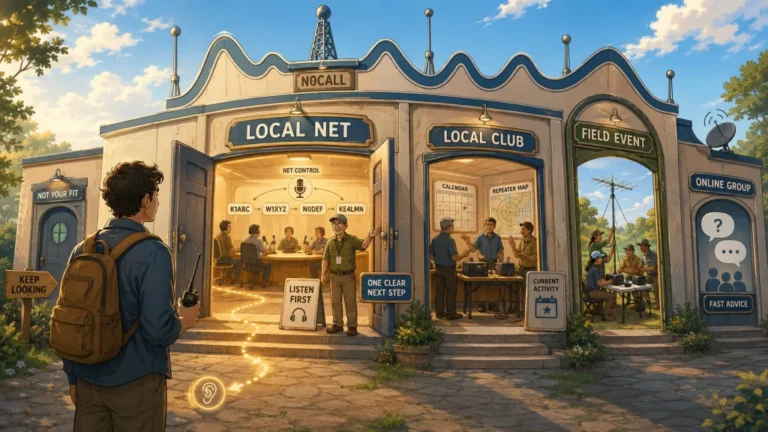
Scheduled local nets give that coverage a purpose. Some nets are informal check-ins, while others focus on weather, technical discussion, community events, or operator training. A net can remove the hardest part of a first contact because it gives you a known time, frequency, and check-in structure instead of leaving you to call into an empty channel and wonder whether anyone is listening.
Simplex Shows What Your Station Can Do Without Infrastructure
Simplex communication means two stations use the same frequency without a repeater in the middle. The range may be short between handheld radios at ground level, but it can improve sharply when one station has a better antenna position or greater elevation. This is why a distance claim on a radio box tells you far less than the actual terrain between the two operators.
Simplex is useful for nearby events, hiking groups, neighborhood communication, testing antennas, and learning how location changes a signal. It also teaches an important limitation early: a radio that reaches a repeater from one spot may not reach another handheld a few miles away. Repeater access and direct range are different questions.
Portable and Field Operation Turn Location Into Part of the Activity
Some operators take a station to a park, trail, campsite, summit, or temporary event site rather than operating only from home. Programs such as Parks on the Air and Summits on the Air give this style of operation a shared activity framework, but the basic appeal is simpler: you set up in a new location, make contacts, and learn how terrain, antenna placement, power, and weather affect the station.
Portable operation can involve local VHF/UHF contacts or broader HF activity, so the relevant license privileges depend on the bands and modes being used. It is beginner-accessible when the goal and setup stay modest, but it can become a deeper challenge when low weight, limited power, fast deployment, or difficult terrain matter. For someone who enjoys hiking, travel, or practical station setup, the location can become as important as the conversation.
Staying with local repeaters, nets, simplex, or portable operation is not an incomplete version of amateur radio. For an operator who wants regular conversation, community connection, or practical short-range communication, these may remain the most useful things to do with ham radio long after the license exam is over.

The Icom IC-V86 is a portable 2-meter FM handheld covering 144 to 148 MHz. Amazon lists 7W RF output, 207 channels, and a 2250mAh Li-Ion battery pack. The listing also identifies the radio as water resistant.
Check On AmazonIf you click this link and buy, we earn a commission at no additional cost to you.
Emergency Communication Requires More Than a Call Sign
Ham radio can support communication when normal systems are overloaded, unavailable, or unsuitable for a specific local task. That possibility attracts many beginners, but the license itself does not make someone an emergency communicator. Useful participation comes from learning the local plan, practicing message handling, understanding activation procedures, and working within the expectations of the organization or agency being served.
ARES and RACES are often mentioned together, but they are not interchangeable names for the same program. ARES is an ARRL-sponsored volunteer structure that can support public-service and emergency communication before, during, and after an incident. RACES is a government-managed civil preparedness framework operating under specific FCC rules and the direction of the responsible civil defense organization.
The Real Entry Point Is Local Training
The same licensed operators may participate in both programs in some communities, which is one reason beginners confuse them. Their roles, activation authority, registration, and operating procedures can still differ. A local emergency coordinator or emergency-management office determines what preparation is expected in that area.
In practice, a new operator is more useful after joining exercises and regular nets than after buying equipment labeled for emergencies. Training may include message forms, net discipline, deployment procedures, safety rules, and agency-specific requirements. The correct next step is to find the local group and ask how it trains, not to assume that owning a radio creates an operational role.
Key point: Before choosing equipment for emergency use, ask the local group which bands, power arrangements, message formats, and deployment conditions it actually trains for. Those requirements can differ from the setup a beginner would choose for ordinary local conversation.
This gives a beginner a realistic path: listen to the local public-service net, learn the terminology, attend a meeting or exercise, and decide whether the structured responsibility fits the reason you entered the hobby. Equipment decisions make more sense after those expectations are known.
Digital Modes Change What a Radio Can Carry
Voice is only one kind of amateur communication. Digital modes can carry short messages, position information, station status, images, telemetry, or computer-encoded contacts. Some rely mainly on direct radio links, while others use repeaters, gateways, or internet-connected infrastructure as part of the path.
APRS is a common VHF/UHF example. Operators may use it to share position, status, brief messages, weather information, or event data. Its usefulness depends on local coverage and the exact path available, so seeing APRS activity in another region does not guarantee that the same setup will work identically where you live.
License Class Matters Most When Digital Activity Moves to HF
A Technician license supports many VHF and UHF digital activities, subject to the applicable band and mode rules. On HF, the boundary is narrower. Technician RTTY and data privileges, including FT8, are limited to 28.000 through 28.300 MHz on the 10-meter band.
A General license opens commonly used HF data segments on additional bands, making digital contacts less dependent on whether 10 meters happens to be open. General privileges are broad, but they do not include every frequency segment available to Amateur Extra licensees. The operator still has to verify the band edge and mode privilege before transmitting.
The practical difference is not that Technician digital operation is uninteresting. It is that Technician activity is concentrated in VHF/UHF and a limited HF window, while General gives you more bands and more chances to find workable propagation. Upgrade because the activity you want requires that access, not because an unused license class feels unfinished.

The Yaesu FT-70DR is a 144/430 MHz dual-band handheld transceiver with up to 5W output. It supports conventional analog FM operation and Yaesu C4FM digital communication. Its Automatic Mode Select function can detect whether a received signal is C4FM digital or analog FM and select the corresponding receive mode.
Check On AmazonIf you click this link and buy, we earn a commission at no additional cost to you.
General Privileges Open the Broader HF Hobby
HF communication is where amateur radio can move from local coverage to contacts across states, countries, and continents. Signals may travel through the ionosphere rather than depending on a nearby repeater. That makes HF capable of remarkable distances, but it also makes results dependent on band conditions, time of day, season, solar activity, local noise, antenna performance, and operating skill.
A Technician can make some HF contacts through limited CW privileges and the authorized voice and data portions of 10 meters. A General license is the practical threshold for broad HF voice and data activity because it provides operating privileges across the commonly used amateur HF bands. That difference is why General matters to someone whose real goal is regular long-distance communication rather than occasional access when one band is favorable.
DXing and Contesting Use the Same Bands for Different Goals
DXing means seeking contacts with distant or uncommon locations. The appeal may be collecting countries, working a rare station, testing a modest station under good conditions, or learning how propagation changes. It does not require every operator to build a competition-grade station, although stronger antennas and more advanced operating methods can expand what is possible.
Contesting is more structured. Operators try to make contacts under a defined set of rules during a fixed period, often exchanging a short piece of information and logging each contact. Some people enjoy the pace and measurable challenge, while others prefer longer conversations, technical nets, or casual contacts.
This distinction matters when deciding whether HF sounds appealing. Wanting to speak with an operator in another country is not the same as wanting to chase rare locations or spend a weekend making rapid contest contacts. The band may be the same, but the experience can feel entirely different.

The Xiegu G90 is an HF transceiver with RF output up to 20W. Amazon lists SSB, CW, AM, and FM modes together with a built-in automatic antenna tuner. The product is identified as model G90 and uses an SO-239 antenna socket.
Check On AmazonIf you click this link and buy, we earn a commission at no additional cost to you.
Satellites and the ISS Put Timing Ahead of Distance
Amateur satellites can relay voice or digital signals between stations while the satellite is above the horizon. Many VHF and UHF satellite activities are available with Technician privileges, which surprises people who assume space communication must require the highest license class. The harder part is often not the exam privilege but tracking the pass, using the correct uplink and downlink, accounting for changing geometry, and completing a contact during a short window.
A satellite is not a repeater fixed on a tower. It moves quickly, may be active only in certain modes, and can be unavailable because of operational changes. Current pass predictions and operating status matter more than a static frequency list copied from an old article.
Contacting the ISS Is Possible, but It Is Not an On-Demand Activity
The International Space Station carries amateur radio equipment that may support voice, cross-band repeater operation, packet activity, or image transmissions depending on what is active at the time. Licensed operators can sometimes communicate through the station or hear special transmissions during a suitable pass. Casual voice contact with a crew member is possible but uncommon and depends on crew availability, station status, orbit, and timing.
Scheduled educational contacts are coordinated events with preparation and support, not an open appointment system for individual operators. For most beginners, receiving an ISS transmission or making a contact through an active space-based repeater is a more realistic first goal than speaking directly with an astronaut.
At the far end of unusual ham radio activities is Earth-Moon-Earth communication, where signals are reflected from the Moon. EME is an advanced example of what the amateur service can support, not a sensible expectation for a first station. It belongs on the map because it shows the hobby’s technical range, but it should not distort what a beginner needs to get started.
You Can Build and Experiment Without Making It Your Whole Hobby
Some operators are drawn less to conversation and more to understanding how a signal is created, carried, received, and measured. Amateur radio allows room for building antennas, assembling basic kits, experimenting with interfaces, studying propagation, and using software-defined radio tools to view or receive signals. A person can enjoy one of these activities without becoming an equipment designer or repair technician.
Antenna projects are often the most accessible technical entry point because a simple change in length, placement, or feed method can produce an observable result. The useful lesson is not that homemade equipment is automatically better. It is that the amateur service lets you test ideas, compare results, and understand why one station works differently from another.
Kits and Software-Defined Radio Serve Different Kinds of Curiosity
A basic kit can teach component identification, soldering, and signal flow, but assembling a kit is not required to be a legitimate operator. Software-defined radio can make the spectrum visible and help a learner recognize signals, bandwidth, and activity patterns. Receiving alone may not require an amateur license, while transmitting must remain within the operator’s privileges and the applicable equipment rules.
This article is not turning those subjects into construction or engineering guides. The decision point is simpler: do you want radio mainly as a communication tool, or do you want the station itself to become the project? That answer changes how much technical depth you are likely to enjoy.
Note: Building and experimentation can start small. A first project should teach one clear concept rather than combine a new antenna, unfamiliar software, custom wiring, and an untested operating mode into one difficult troubleshooting problem.
The best technical projects produce feedback you can understand. That may be a cleaner received signal, a successful local contact, a visible change on a spectrum display, or a measured difference between two antenna positions.

The RTL-SDR Blog V4 is a receive-only software-defined radio using an RTL2832U ADC and R828D tuner. It tunes from 500 kHz to 1.7 GHz and includes a portable VHF/UHF dipole antenna kit. Amazon states that the included kit can be used for terrestrial and satellite reception.
Check On AmazonIf you click this link and buy, we earn a commission at no additional cost to you.
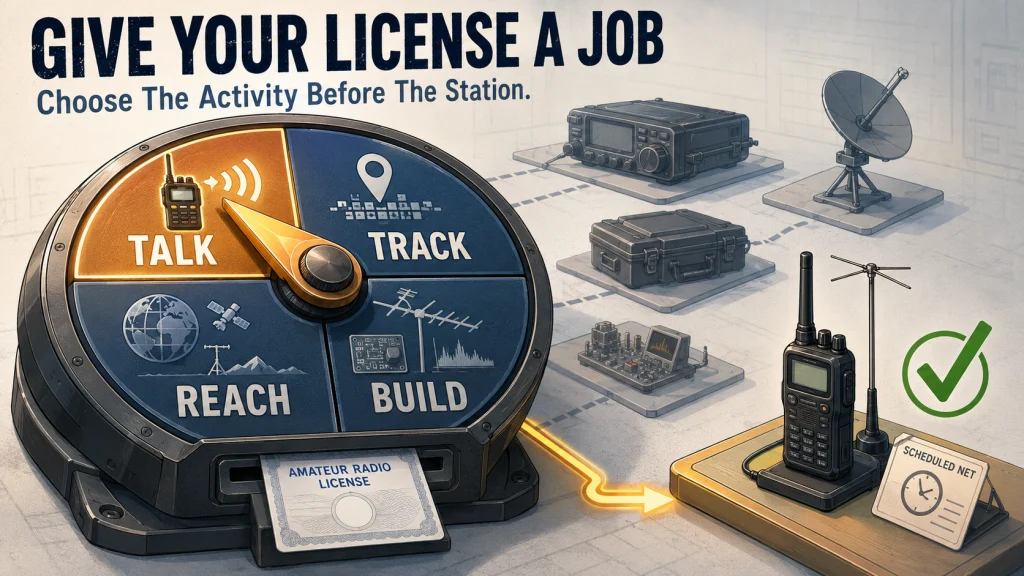
Choose the Activity Before You Choose the Station
The long list of possibilities becomes manageable when you sort it by the experience you want. Someone looking for regular local conversation does not need the same plan as someone interested in digital tracking, public service, international HF contacts, satellites, or electronics. Buying for the broadest possible future can leave a beginner with a complicated station and no clear reason to use it.
Use the following decision path before comparing equipment or planning an upgrade:
- For local conversation: Find active repeaters and nets in your area, then confirm that you can participate from the places where you expect to operate.
- For direct short-range communication: Learn what simplex can realistically do in your terrain and whether the people you want to reach are licensed and prepared.
- For public service: Contact the local organization first and learn its training, registration, and equipment expectations.
- For digital activity: Decide whether you want local VHF/UHF data or broader HF data, then match that goal to your license privileges.
- For international contacts: Treat General as the practical license goal and evaluate whether your location can support an HF antenna.
- For satellites or the ISS: Start by learning pass timing and receiving signals before assuming you need a complex transmitting station.
- For portable or field operation: Decide where you want to operate, how far you will carry the station, and whether your goal is local VHF/UHF or broader HF activity.
- For technical experimentation: Choose one measurable project and keep the first setup simple enough to diagnose.
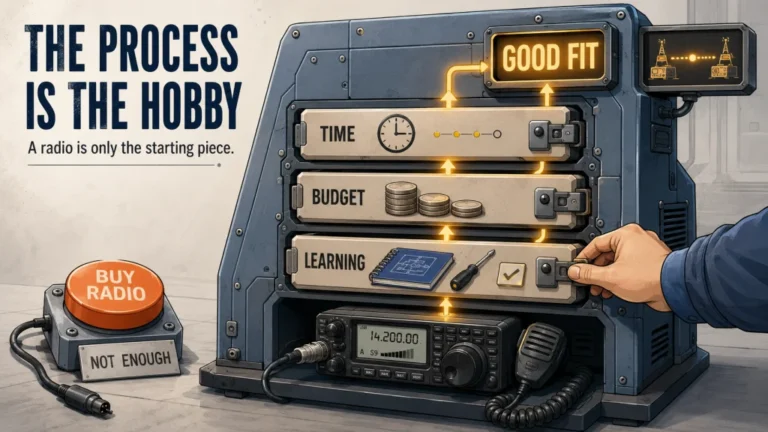
The mistake I see around new licensees is not a lack of enthusiasm. It is committing to equipment before identifying the activity that will keep the license in use. A clear purpose tells you when a modest setup is enough and which capabilities actually matter when you begin comparing equipment.
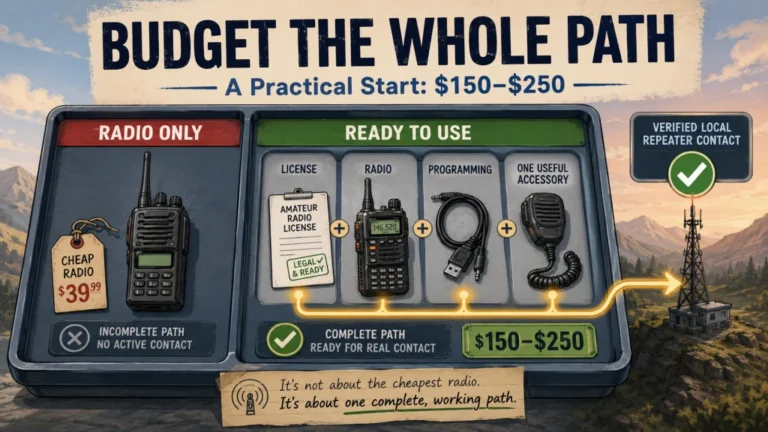
Once the activity is clear, choosing a station becomes much simpler. A radio, antenna, power arrangement, or accessory can then be judged against a real task instead of an impressive feature list, which creates a natural next step from interest to a practical buying decision.
For a broader view of the culture, time commitment, and learning curve, read about whether ham radio fits your interests. The practical uses of ham radio can help connect these activities to real situations, while the beginner path into amateur radio explains the larger sequence from interest to licensing and getting on the air.
Final Thoughts: Give the License a Job to Do
The full scope of amateur radio runs from a scheduled local net to a signal moving through space, but you do not need to pursue all of it. A Technician license already supports meaningful local communication, digital activity, public-service training, and many satellite opportunities. General becomes valuable when your interest moves toward the broader HF voice and data bands.
Start with one activity that sounds useful or genuinely interesting, then learn what that activity requires. Once those requirements are clear, compare equipment by how well it supports that job, not by how many unrelated features it includes. A license with a purpose and a station matched to that purpose is far more likely to stay in use.
FAQs
📻 What do most beginners do first with a ham radio?
Many beginners start by listening to local VHF or UHF repeaters, programming one known system, and joining a scheduled net. That gives them a predictable place to make a first contact and learn local operating habits.
🪪 Do I need a General license to enjoy ham radio?
No. A Technician license supports extensive VHF and UHF activity, local repeaters, simplex, many digital modes, and many amateur satellite activities. General is most useful when you want broad access to the commonly used HF voice and data bands.
💻 Can a Technician use FT8?
Yes, but Technician RTTY and data privileges, including FT8, are limited to 28.000 through 28.300 MHz on the 10-meter band. A General license opens commonly used data segments on additional HF bands.
🚨 Does a ham license qualify me for emergency communication work?
The license permits you to operate, but it does not replace local registration, training, drills, or served-agency procedures. Contact the local ARES leadership or emergency-management organization to learn its actual participation requirements.
🛰️ Can a Technician contact amateur satellites?
Many VHF and UHF satellite activities are available with Technician privileges. Success still depends on an active satellite, a suitable pass, correct frequencies and modes, and a station that can follow the moving signal.
🧑🚀 Can I talk directly to an astronaut on the ISS?
It is possible, but casual crew contacts are uncommon and cannot be scheduled by an individual operator. Receiving ISS transmissions or communicating through an active repeater or packet system is usually a more realistic first space-radio goal.
🎧 Can I listen to ham radio before getting licensed?
Yes, you can listen without an amateur license. Listening to local repeaters, HF activity, or satellite passes is a practical way to learn which part of the hobby interests you before you transmit.