Ham radio as a hobby is less like buying one gadget and more like choosing a direction you want to explore. One operator may spend an evening listening to a local repeater, another may join a scheduled net, and someone else may take a compact station outdoors or experiment with an antenna. The hobby fits people who enjoy learning by doing, solving small technical problems, and communicating without expecting every session to be immediately exciting. By the end of this guide, you should know what the experience feels like, why people stay with it, and whether its mix of radio, experimentation, and community fits your life.
What Ham Radio as a Hobby Feels Like in Real Life
Ham radio is hard to explain to someone who has never used it because it is several activities sharing the same airwaves. It can be a technical hobby, a communication platform, a public-service tool, and a social space, but no operator has to pursue all four. The most useful way to judge it is not to ask whether ham radio sounds impressive. Ask whether one part of the experience sounds interesting enough that you would want to try it more than once.
A normal session can be quiet and simple. You might turn on a radio, monitor a nearby repeater, hear nothing for ten minutes, and then catch a local conversation or a scheduled net. On another day, the radio may be the smallest part of the activity because you spend more time adjusting an antenna, checking a programming setting, or finding a better operating location. That uneven rhythm is not a defect. It is the difference between an active hobby and an on-demand communication service.
I have seen new licensees assume that passing the exam will immediately reveal what they should do next. It does not. The exam gives you permission and a base of knowledge, while the hobby begins when you choose a real activity and work through the small practical barriers around it. This article stays at that decision level. It does not review radios, break down costs, teach the full licensing process, or promise that amateur radio will replace ordinary communication.
If you are still building the larger picture, the complete beginner path into ham radio connects this experience to licensing, equipment, setup, and realistic expectations. For now, the central question is simpler: what would you enjoy doing when the radio is switched on?

The Yaesu FT-60R is a dual-band VHF/UHF amateur handheld for 2 meter and 70 centimeter operation. Amazon lists 5W output, CTCSS/DCS, DTMF, scanning, and 1,000 memory channels. The package includes a battery, charger, antenna, and belt clip.
Check On AmazonIf you click this link and buy, we earn a commission at no additional cost to you.
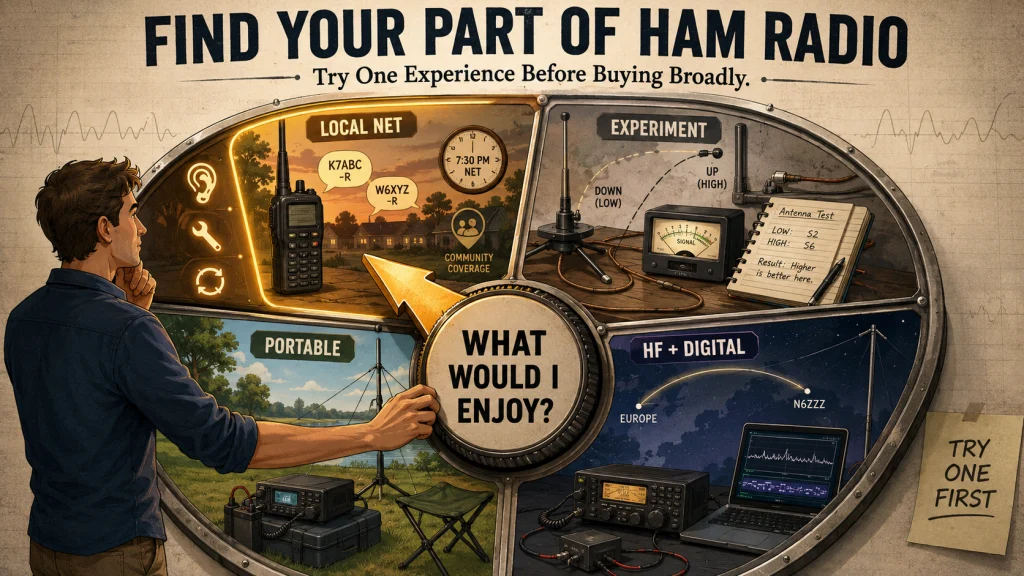
Choose One Experience Before You Choose Equipment
The biggest beginner mistake is treating the radio as the hobby. A handheld, a mobile unit, and an HF station do not create interchangeable experiences. A handheld may make sense for nearby repeaters and casual portable use, while an HF setup serves someone who wants longer-distance contacts and is willing to learn more about antennas and changing band conditions. Buying first and deciding later often leaves a new operator with a working radio that does not lead anywhere they care to go.
Field Note: The equipment question often comes before the activity question at exam sessions. A new licensee asks what radio to buy, but has not yet decided whether the goal is a local net, portable operation, technical experimentation, or eventually working HF. I usually bring the conversation back to the destination because the radio should serve the experience, not define it.
A useful first choice does not need to become your permanent identity in the hobby. It only needs to give you a clear first experiment. Someone curious about local communication can find a nearby repeater and listen to a net. Someone drawn to outdoor operating can visit a public event or watch an experienced operator set up a temporary station. Someone interested in signals and computers can learn what a digital mode does before building an entire station around it.
- Local conversation: Listen to a repeater or scheduled net and notice whether the pace and topics appeal to you.
- Technical problem-solving: Learn how antenna position, terrain, programming, and operating settings change what you can hear.
- Portable activity: Observe or try a temporary setup away from a permanent home station.
- Longer-distance operation: Explore what HF involves, including wider privileges, more antenna planning, and variable conditions.
- Digital experimentation: See how a computer and radio can exchange weak signals without assuming digital operation removes the need to understand the station.
This list is a decision filter, not a shopping list. Pick the line that sounds most like an experience you would willingly practice, then learn what license privileges, equipment, and setup support it. That sequence prevents the common situation where the beginner owns a capable radio but still has no reason to turn it on.
There Is No Universal Weekly Ham Radio Routine
Some hobbies have a predictable session: you run a route, play a match, or complete a lesson. Ham radio changes with location, license class, local activity, equipment, propagation, and the operator’s mood. One person may check into the same local net each week. Another may ignore voice conversations and spend an afternoon improving an antenna. A third may operate only when traveling or when a public event gives the activity a clear purpose.
That flexibility can be a strength for an adult with an irregular schedule, but it can also make the hobby feel directionless. Nothing forces you to practice, and the air does not produce an interesting contact on demand. The people who enjoy it usually accept that part of the reward comes from preparation, discovery, and gradual improvement rather than constant entertainment.
Listening Is a Real Part of the Hobby
Beginners sometimes think a radio session only counts when they transmit. Listening teaches you how a repeater sounds, when a net meets, how operators identify, and whether the local culture is formal or casual. It also lets you separate two different problems: a quiet area and an incorrectly configured radio can sound exactly the same until you verify frequencies, tones, antenna position, and schedule.
A new operator who listens with a purpose is not avoiding the hobby. Listening helps verify that the radio is receiving the expected system, reveals when activity normally occurs, and shows whether the local operating style is appealing. The limit is simple: once you can explain what you are hearing and why, move to a different test, such as checking coverage from another location or visiting a public operating event. The first check-in belongs to the community side of the hobby, where procedure and welcome matter as much as signal strength.
Projects Can Matter More Than Conversations
Not everyone stays because they love long conversations. Some operators enjoy the chain of small technical questions: Why can I hear the repeater from one room but not another? Why did moving an antenna higher change the signal more than adding power? Why does an HF band sound active at one time and empty later? Each answer creates another experiment.
This is where ham radio differs from a device that either works or does not. Your station, location, license privileges, and operating skill interact. A modest setup used with a clear purpose can teach more than a complicated station assembled before the owner knows what to test.

The RTL-SDR Blog V4 bundle includes an R828D and RTL2832U software-defined radio dongle with a multipurpose dipole antenna kit. The dongle tunes from 500 kHz to 1.7 GHz and is receive-only. The included portable VHF/UHF dipole kit is designed for terrestrial and satellite reception.
Check On AmazonIf you click this link and buy, we earn a commission at no additional cost to you.
Is Ham Radio Still Relevant in 2026?
Ham radio is not relevant because it competes with a smartphone on convenience. Phones are better for reaching a specific person quickly, sharing media, and expecting a connection with almost no technical preparation. Amateur radio remains relevant because it offers something different: licensed access to radio spectrum for communication, self-training, and technical experimentation, with activities that can work locally, over long distances, or from temporary locations.
The current numbers show a large licensed base, but they need careful interpretation. ARRL’s count from FCC public data reported 732,565 active individual amateur licenses through July 16, 2026. That figure tells us the service is not empty or disappearing, but it does not reveal how often each license holder operates, whether a license is being actively used, or what modes are popular in a particular town.
Event participation gives a second, still limited, indicator. The finalized 2025 ARRL Field Day report counted 4,369 entries representing 31,785 participants. That is evidence of organized activity across many communities, not proof that every repeater is busy or that every new operator will find an active group nearby. National totals and local experience answer different questions.
Before deciding that ham radio is either booming or dead, check the layer that matters to you. A person interested in local FM should investigate nearby repeaters and nets. Someone interested in HF should look at the activity available within their license privileges and antenna situation. The guide to practical ways people use ham radio separates these paths without pretending they require the same station or produce the same experience.
What You Can Do Without Trying to Do Everything
The range of activities is one reason beginners struggle to picture the hobby. Local FM conversations, scheduled nets, antenna experiments, portable operation, digital weak-signal modes, HF contacts, public-service practice, and satellite contacts can all sit under the same name. They do not share one learning curve, one equipment path, or one definition of a successful evening.
A local repeater contact may involve finding the correct frequency and tone, listening for a break, identifying with your call sign, and having a short conversation. Portable operation adds setup, power, weather, and location decisions. HF introduces changing propagation and more antenna planning. Digital weak-signal activity combines radio setup with software and timing. Satellite work adds pass prediction and fast-moving geometry. The common thread is not the hardware. It is learning how a radio system behaves under real conditions.
The practical move is to choose a narrow starting lane and let experience create the next question. Someone who enjoys a weekly net may later improve a home antenna. Someone who enjoys outdoor setup may become curious about longer-distance portable contacts. Someone fascinated by decoding signals may decide that voice conversation was never the main attraction.
For a fuller map of the possibilities, what you can do with a ham radio explains the major activity paths in more detail. The point here is not to sample every corner before committing. It is to find one corner that makes the effort of getting licensed and learning the station feel worthwhile.

The Xiegu G90 is a portable HF transceiver with up to 20W of RF output. It includes a detachable display unit and a built-in wide-range automatic antenna tuner. The radio also provides a color LCD spectrum display for viewing signal activity across the displayed bandwidth.
Check On AmazonIf you click this link and buy, we earn a commission at no additional cost to you.
Why Do People Do Ham Radio When Phones Are Easier?
People stay for different combinations of challenge, independence, curiosity, and community. A phone hides almost the entire communication system. Ham radio exposes enough of that system for the operator to influence the result. Antenna placement, frequency, terrain, propagation, programming, operating procedure, and license privileges all matter, which means success feels earned rather than automatic.
For some people, the contact itself is the reward. For others, the contact is proof that the station and decisions worked. A two-minute exchange from a temporary location can be satisfying because it confirms that the antenna, power source, frequency choice, and operating technique came together. Another operator may care more about helping with an event, joining a familiar net, or improving a weak signal than collecting distant contacts.
An Amateur Radio Hobby for Adults Who Like Learning by Doing
For adults who enjoy skills that can deepen without constant competition, amateur radio offers an unusually open-ended learning path. You can remain a casual local operator, or you can keep adding technical understanding over years. There is always another mode, band, operating style, or station problem to explore, but none of those additions are mandatory.
The same openness can overwhelm someone who wants a clear finish line. Ham radio has milestones, such as earning a license, making a first contact, or improving an antenna, but the hobby itself is never completed. That makes it rewarding for a curious tinkerer and frustrating for a person who only enjoys activities with fixed rules and predictable outcomes.
Is Ham Radio a Good Hobby for You?
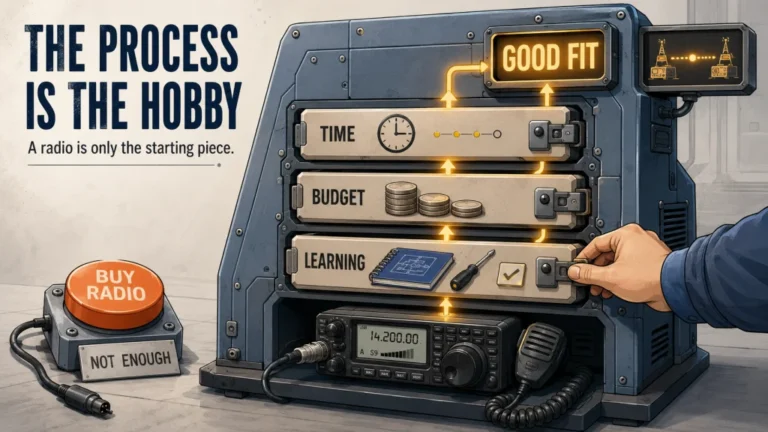
Ham radio is a good fit when you enjoy the process between intention and result. You decide whom or what you want to hear, choose a suitable operating path, prepare the station, and adjust when conditions do not cooperate. It is a weaker fit if you mainly want guaranteed communication, instant social activity, or a device that works the same way everywhere without study.
Compared with technical hobbies built around a fixed project or course, ham radio is less predictable and more dependent on location. Photography, model building, and computer-based projects can usually be practiced on demand once the basic tools are available. Radio adds licensing, spectrum rules, antenna constraints, other operators, and changing signal conditions. That extra friction is either part of the appeal or a reason to choose a different hobby.
| Decision factor | How ham radio differs from many technical hobbies | When that difference works for you |
|---|---|---|
| Time | A session can be brief, but setup, listening, and troubleshooting do not follow a fixed lesson schedule. | You like a hobby that can pause for weeks and still offer a clear next experiment. |
| Learning curve | The entry license starts the process, but no single course completes it; operating, antennas, and propagation keep adding layers. | You prefer learning through use rather than reaching one permanent finish line. |
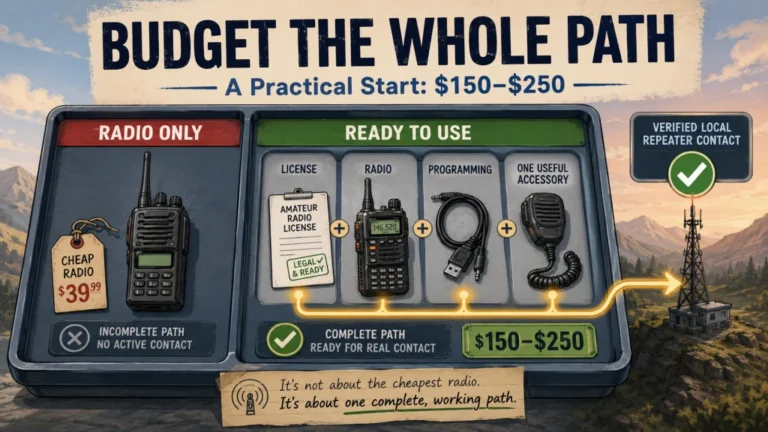
| Spending pattern | There is no universal starter package because local repeater use, portable operation, and HF lead in different directions. | You can support one chosen activity first instead of preparing for every possible future interest. |
| Space and location | Terrain, antenna options, and nearby activity affect results more than they do in most desk-based hobbies. | You are willing to adapt the activity to the space and conditions you actually have. |
| Predictability | Signals, local activity, terrain, and propagation can change the result from one session to the next. | You find uncertain conditions interesting rather than annoying. |
Support one activity before preparing for every future interest. Local nets, portable operation, and HF ask different things of the operator and station. Keeping the first goal narrow makes the comparison useful without turning this overview into a buying or cost guide.
A more focused comparison of the learning curve, commitment, and trade-offs is available in whether ham radio is a good hobby. Use that question to test your expectations, not to search for a universal verdict.
The Community Can Open the Hobby or Quietly Close It
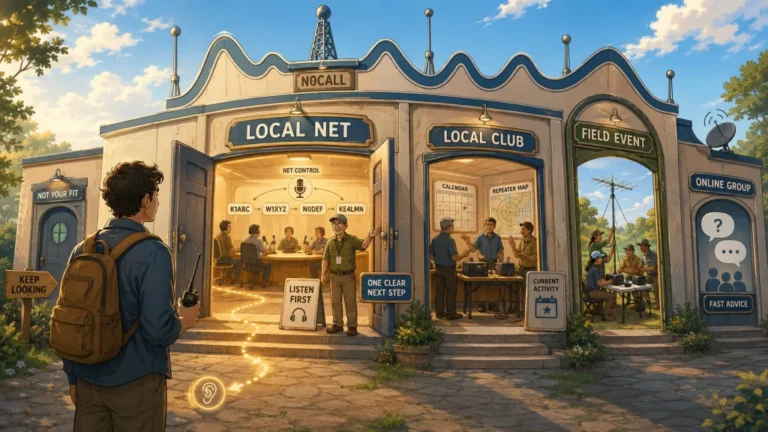
Local clubs, repeater groups, scheduled nets, public operating events, and online communities can shorten the distance between passing an exam and doing something meaningful. A helpful operator can explain a confusing tone setting, demonstrate a portable antenna, or tell you which local net welcomes new check-ins. That kind of context is difficult to get from a manual because the answer depends on the systems and habits in your area.
The culture is not identical everywhere. Some groups are deliberate about welcoming beginners. Others assume new operators already understand procedures, or they center their activity on interests that may not appeal to you. One quiet repeater or one uncomfortable meeting is not a complete sample of amateur radio, but it is still useful evidence about that particular group.
I have watched new licensees hesitate over a first net because they do not know the check-in phrasing, even when the radio is programmed correctly. The barrier looks technical from the outside, but the solution is often social and procedural: listen to one full net, note how the control operator invites check-ins, prepare one sentence, and transmit at the next opportunity. Confidence usually grows after the procedure stops feeling mysterious.
The guide to the ham radio community and local culture explains where these groups form and how to evaluate whether one fits you. Look for a community that supports the activity you chose, rather than joining the nearest group and assuming its version of the hobby is the only one.
A Simple Decision Path Before You Commit
You do not need to understand every license privilege or station component before deciding whether the hobby deserves a closer look. You need one realistic activity, one way to observe it, and one honest reaction to the experience. This keeps the decision grounded in what operators do rather than what equipment advertising promises.
- Name one experience: local net, portable setup, antenna experiment, HF contact, digital signal work, or another clearly defined activity.
- Check whether it exists near you: local repeaters, clubs, scheduled events, and operating conditions can change what is practical.
- Observe before buying broadly: listen, attend an event, or ask an operator to demonstrate the activity.
- Identify the real barrier: licensing, location, antenna restrictions, equipment, confidence, or lack of local activity.
- Choose the smallest next step: study for the needed license, join one net, visit one event, or plan one basic station around that activity.
This path also reveals when ham radio is not the best answer. If you need guaranteed person-to-person communication, have no interest in learning operating rules, or dislike uncertain signal conditions, another service may fit better. Rejecting the hobby for the right reason is more useful than buying equipment and discovering the mismatch later.

The ARRL Ham Radio License Manual 6th Edition is built for the Technician-class exam and the 2026 to 2030 question pool. The listing says it covers the 35-question multiple-choice exam and is designed for self-study or classroom use. It can also be used alongside ARRL online practice resources.
Check On AmazonIf you click this link and buy, we earn a commission at no additional cost to you.
Final Thoughts: Let the Experience Justify the Radio
Ham radio is worth exploring when one of its real activities attracts you, not when the equipment merely looks capable. The hobby can be social or solitary, casual or technical, local or long-distance. Its flexibility is the advantage, but only after you choose a direction. Without that choice, the same flexibility feels like confusion.
Start by naming one experience you would like to try and finding the smallest legitimate way to observe or participate in it. Once that answer is clear, the next steps become much easier to sequence. The guide on how to get started with ham radio takes that interest into licensing, planning, and a practical first setup without asking you to buy for every possible future path.
Explore the Ham Radio Experience in More Detail
The broad picture becomes more useful when you separate daily experience, current participation, possible activities, personal fit, and community. These guides let you examine the part that matters most before you commit time or money.
| Guide | What it helps with |
|---|---|
| What Ham Radio Is Really Like | Shows what operators do during ordinary sessions and why the experience varies by location and interest. |
| Is Ham Radio Still Popular? | Separates license totals, visible activity, local participation, and misleading claims that the hobby is either dead or booming everywhere. |
| What You Can Do With Ham Radio | Maps the major operating paths so you can choose an experience before choosing equipment. |
| Is Ham Radio a Good Hobby? | Tests the hobby against your available time, learning preferences, expectations, and tolerance for uncertain conditions. |
| Inside the Ham Radio Community | Explains clubs, nets, online groups, and the cultural differences that shape a beginner’s first experience. |
Use the guide that matches your biggest uncertainty, then return to the decision path with a more specific first activity in mind.
FAQs
📻 What do people normally do with ham radio for fun?
Common activities include local repeater conversations, scheduled nets, antenna experiments, portable operating, HF contacts, and digital modes. You do not need to pursue all of them. Pick one experience that matches your interests and available space.
⏱️ Is the ham radio hobby worth it if I only have a few hours a month?
It can be, especially if you choose an activity that does not require constant practice or a permanent station. The hobby becomes a poor fit when limited time is combined with an expectation of instant, guaranteed contacts every time you turn on the radio.
🎧 Can I try ham radio by listening before I get licensed?
You can listen to amateur frequencies without an amateur license, but transmitting requires the appropriate license and compliance with the operating rules. Listening to local nets and repeater traffic is a practical way to judge whether that part of the hobby interests you.
🧠 Do I need to be good at electronics to enjoy the hobby?
No, but you should be willing to learn basic radio concepts and operating rules. Some paths stay mostly conversational, while antenna work, HF, and digital modes add more technical depth as your interest grows.
🏠 Can I enjoy ham radio without a large home antenna?
Yes, depending on the activity you choose, your location, and local coverage. Portable operation and some local VHF/UHF activities can reduce the need for a large permanent antenna, while many HF goals still require more careful antenna planning.
🤝 Do I have to join a club or talk to strangers?
No. Clubs and nets can make the learning process easier, but technical experiments, listening, digital operation, and some portable activities can be pursued independently. Choose how social you want the hobby to become.