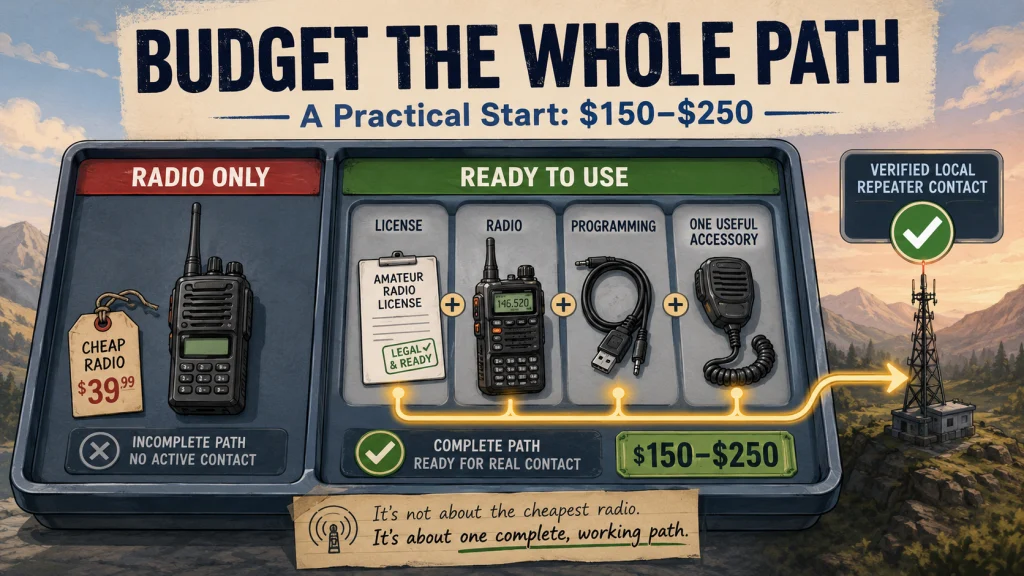
A usable Technician setup can start at about $85 when free study materials, a $15 exam session, the $35 FCC application fee, and a basic handheld all line up. Most beginners should plan on $150 to $250 so the budget can include study help, programming, and one or two accessories that solve a real operating need. Mobile, emergency, and HF stations cost more because the radio is only one part of the system. The right budget depends on the communication path you intend to use, not on how many features can fit into the shopping cart.
How Much Does Ham Radio Cost to Get Started?
How much does ham radio cost in the United States? As of July 2026, the lowest realistic total is around $85: free study resources, a $15 ARRL VEC exam session, the $35 FCC fee for a new license, and an entry-level handheld near $35. That is a working minimum only when local VHF or UHF activity exists, the radio can reach it, and no extra cable or antenna is needed.
A more useful ham radio startup cost is $150 to $250. That range leaves room for a better-matched radio, optional paid study material, a programming cable, and an antenna or power accessory that fixes a defined limitation. The ceiling is effectively unlimited, but a beginner does not need a room full of equipment to make a first contact.
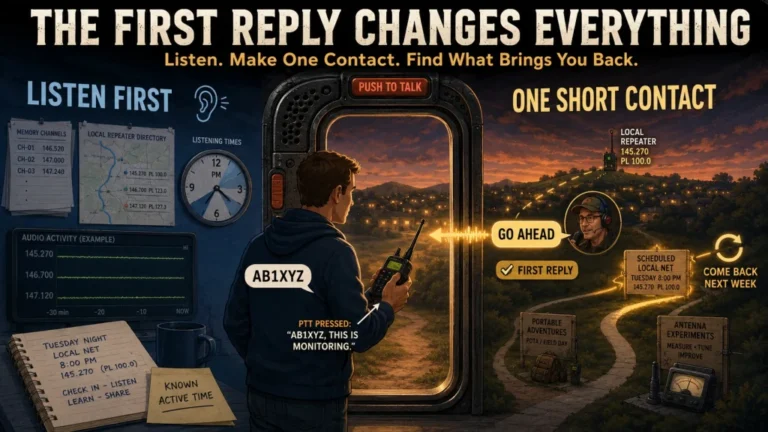
When someone asks how much to get into ham radio, I first separate the radio from the complete communication path. I have seen new licensees buy a handheld before checking whether a local repeater is active, then assume the hobby requires a more expensive radio when the real problem is programming, terrain, or antenna position. Cost makes more sense after the intended activity is clear.
This article covers realistic US beginner costs for licensing, local handheld use, a 13.8V home station, vehicle operation, emergency preparation, and a first HF station. It does not recommend specific products, explain the entire licensing process, or provide installation instructions. Readers still deciding what the hobby includes should begin with the broader ham radio guide for beginners.
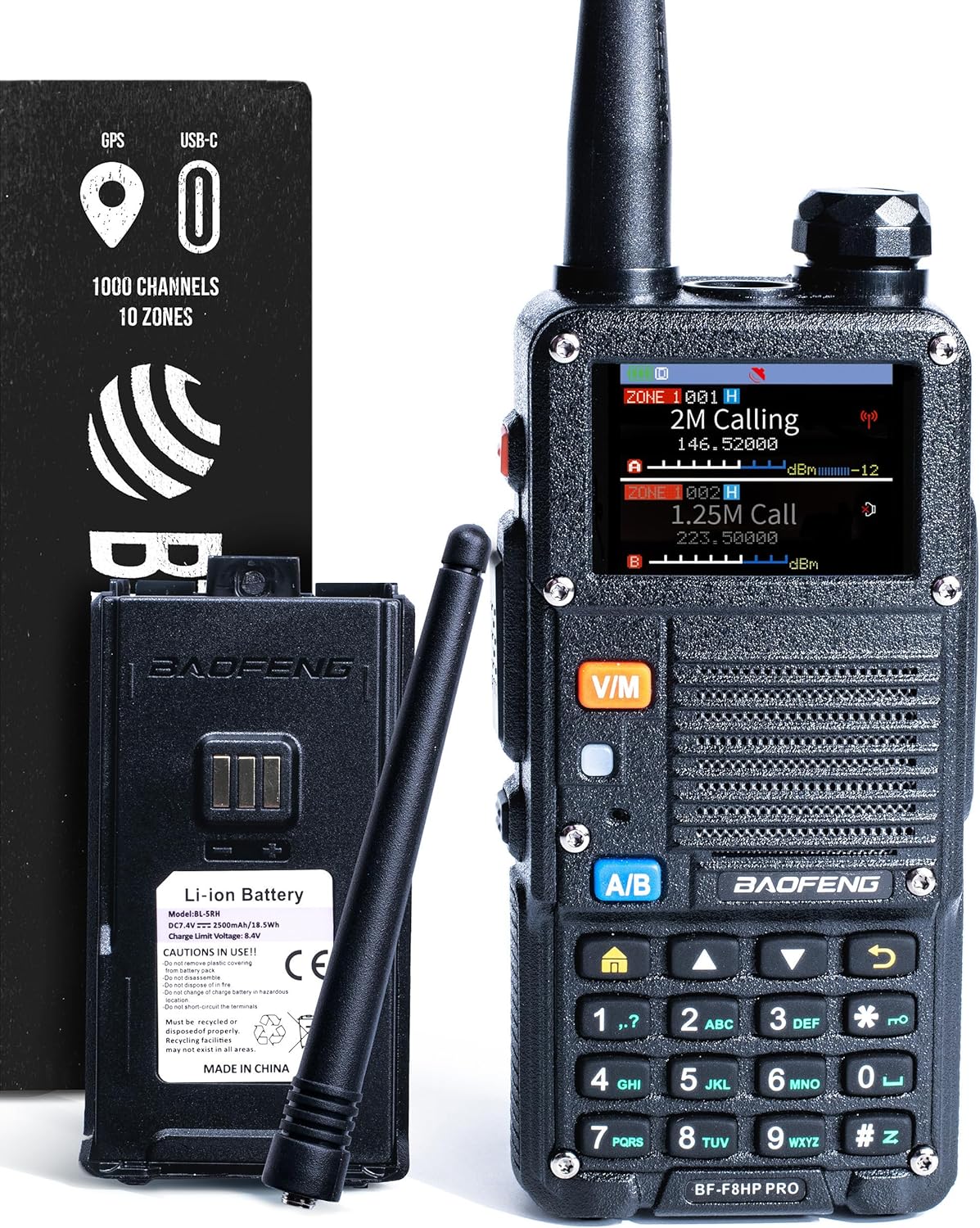
The BAOFENG BF-F8HP PRO is a tri-band handheld with up to 10 watts of transmit power and 1,000 channels. It includes GPS and NOAA weather features plus a USB-C rechargeable battery. Its IP54-rated enclosure gives a beginner one portable radio with room to grow beyond basic local VHF and UHF operation.
Check On AmazonIf you click this link and buy, we earn a commission at no additional cost to you.
Separate the FCC Fee From the Exam Fee
The licensing cost has two separate parts. The FCC currently charges $35 for a new amateur license application. The exam session is administered through a Volunteer Examiner Coordinator, and that organization or local team may charge its own fee to cover examination expenses.
For 2026, an ARRL VEC exam session costs $15 for an adult candidate. Other VECs and local teams may use a different fee or offer a free session, so the candidate should confirm the amount with the specific session rather than assuming every test costs the same. If the session fee is $15, the exam and new-license application total $50 before study materials or equipment.
| Licensing action | Current FCC application fee | What to budget separately |
|---|---|---|
| New Technician license | $35 | Any VEC exam-session fee and optional study materials |
| Ordinary operator-class upgrade | No FCC application fee | The exam session may still charge its normal testing fee |
| Sequential call-sign request | No FCC application fee | Usually no separate equipment cost |
| License renewal | $35 under the current fee schedule | No exam is required for an ordinary timely renewal |
| New vanity call-sign request | $35 under the current fee schedule | No guarantee that the requested call sign will be available |
The amateur license term is ten years, so there is no annual licensing bill. Still, it is inaccurate to call renewal permanently free. The current $35 fee applies when the renewal application is filed, unless the FCC changes the schedule or the applicant qualifies for an exemption.
Study cost is optional. Free question pools, practice tests, videos, and community classes can reduce it to zero. A printed manual, structured course, or instructor-led class can add roughly $15 to $100 or more, but paying for study help is a convenience decision, not a requirement for the license itself.
A Beginner Ham Radio Budget Works Better by Scenario
The cost of the ham radio hobby changes sharply when the activity changes. A handheld used through a nearby repeater does not need the same antenna, power supply, feed line, or mounting hardware as a home HF station. One average price therefore hides the decision the reader is trying to make.
The ranges below are planning estimates checked against US retail pricing in July 2026. Sales, used equipment, tax, shipping, antenna restrictions, installation labor, and equipment already owned can move the total. Treat each range as a budget envelope, not a promised checkout price.
| Starting scenario | Realistic total | What the total assumes |
|---|---|---|
| Bare-minimum local repeater setup | About $85 to $130 | Free study, new-license fee, low or modest exam fee, basic handheld, no required upgrade |
| Practical first Technician setup | About $150 to $250 | License costs, suitable handheld, programming solution, and one useful accessory |
| Home VHF/UHF station | About $250 to $650 | Mobile-style radio, 13.8V supply, antenna, coax, and basic test or mounting items |
| Vehicle mobile station | About $250 to $700 | Radio, antenna system, fused power wiring, mount, coax, and small installation parts, before paid labor |
| Emergency-preparedness setup | About $200 to $700 | Radio plus independent power, antenna options, protected storage, and practice |
| First broad-coverage HF station | About $900 to $3,000 or more | HF radio, power, antenna and feed line, support hardware, safety provisions, and optional accessories |
The cheapest scenario is not automatically the best value. It works only when the local communication path is strong enough for a handheld and the radio can be programmed correctly. If the intended contact requires a vehicle antenna, a higher antenna at home, or broad HF privileges, spending less on the wrong category delays the real station rather than saving money.

The Yaesu FT-65R is a dual-band VHF and UHF handheld rated for up to 5 watts. It uses a 1,950mAh lithium-ion battery and offers selectable 5, 2.5, and 0.5 watt output levels. The radio also includes weather alert reception and can be PC programmed with the optional SCU-35 cable.
Check On AmazonIf you click this link and buy, we earn a commission at no additional cost to you.
What the Main Equipment Tiers Actually Buy
A basic dual-band handheld for local VHF and UHF commonly falls around $30 to $80. That price can be enough for listening, local simplex at short range, and repeater use where coverage is favorable. It does not guarantee that the stock antenna will work well inside a building, from a low area, or behind difficult terrain.
A more usable first setup often places $80 to $150 into the radio and the first improvement that solves a known problem. That might be a compatible programming cable, a better-positioned antenna, an extra battery, or a charging arrangement. The rule is to buy the accessory because it removes a limitation, not because every beginner checklist includes it.
A VHF/UHF mobile radio body often starts around $130 and can run past $300 before the antenna, mount, coax, wiring, and installation pieces are included. The extra transmit power and better vehicle antenna can improve a marginal path, but the finished system matters more than the faceplate price. A mobile radio used at home also needs a suitable 13.8V power source.
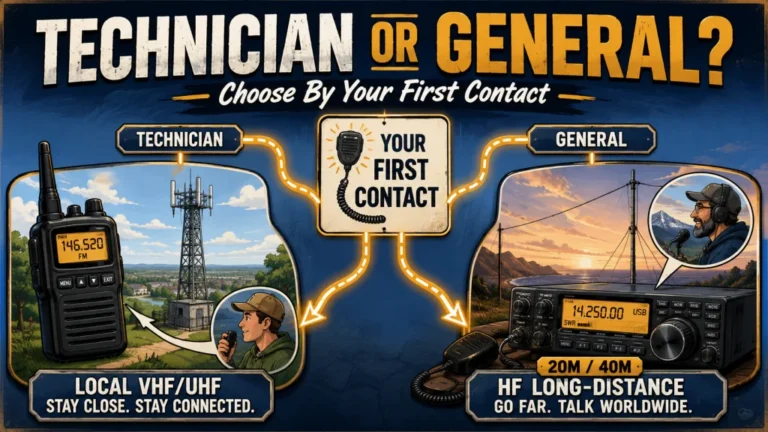
An HF transceiver suitable for broad voice and data operation commonly falls around $500 to $1,500 before the rest of the station. A General license is the practical target for broad access to the major HF bands, although Technician operators do have limited HF privileges. Buying an HF radio before understanding those privilege limits can leave most of the dial unavailable for the activity the buyer expected.
Key point: Compare complete paths, not radio prices. A $50 handheld that reaches an active local repeater may be more useful on day one than a $1,000 HF radio with no antenna, no power supply, and no operating privileges for the intended frequencies.

The BAOFENG BF-F8HP is a dual-band handheld with selectable 1, 4, and 8 watt power levels. It includes a 2,000mAh lithium-ion battery and the V-85 dual-band antenna. The radio also maintains accessory compatibility with earlier UV-5R accessories, which makes its equipment tier easier to understand as part of a larger handheld ecosystem.
Check On AmazonIf you click this link and buy, we earn a commission at no additional cost to you.

The BTECH PC03 uses an FTDI USB interface for programming supported BTECH, BaoFeng, and Kenwood-style radios. Amazon lists compatibility including UV-5R, BF-F8HP, GMRS-V2, and UV-82HP models. It gives a compatible handheld a direct USB programming connection for computer-based setup.
Check On AmazonIf you click this link and buy, we earn a commission at no additional cost to you.
The Most Common Beginner Path Costs $150 to $250
A practical beginner path begins with free study resources, the actual exam fee for the chosen session, the $35 new-license application fee, and one radio matched to a verified local use. The next purchase should solve the first obstacle discovered during programming or listening. This prevents the budget from being consumed by accessories that never leave the drawer.
For example, assume a $15 exam, the $35 FCC fee, a $60 to $100 handheld, and $10 to $40 for programming or power accessories. The total lands around $120 to $190 before optional paid study material. Add a printed guide or a more useful antenna arrangement, and the common $150 to $250 range becomes realistic without turning the setup into a collection.
Field Note: The first purchase question I hear from new licensees is often about the radio, but the more useful question is whether they have identified a local repeater, net, or simplex contact. Without that path, a larger budget usually buys more features rather than more operating.
Use the step-by-step process for getting started with ham radio to identify the license, local activity, first operating goal, and equipment category in the right order. The budget becomes much easier once the reader knows what the first successful contact should look like.

The Nagoya NA-771 is a 15.6-inch VHF and UHF whip antenna tuned around 144 and 430 MHz. This listing uses an SMA-Female connector and is intended for compatible BTECH and BaoFeng handhelds. It fits the beginner path when the first useful improvement is an external handheld antenna rather than another radio.
Check On AmazonIf you click this link and buy, we earn a commission at no additional cost to you.
Emergency Preparation Requires More Than a Radio
An emergency-preparedness budget must include power, antenna placement, protected storage, programming, and practice. A handheld that works from the kitchen table during normal conditions may fail from a low shelter, inside a vehicle, or after its only battery is exhausted. The added cost should address those failure points in the order most likely to matter locally.
A basic emergency setup might add an extra battery or independent power bank, a vehicle charging option, a compact external antenna, weather-resistant storage, and printed channel information. Those additions can move a simple $85 station toward $200 to $400. A more independent setup with larger batteries, vehicle or portable antennas, charging hardware, and multiple communication paths can reach $500 to $700 or more.
- Verify which local repeaters, nets, and simplex channels are actually used.
- Program and test the radio before storing it.
- Measure how long the available batteries support realistic receive and transmit use.
- Practice from the locations where the radio would be needed.
- Keep phone, local alert, family-plan, and non-ham backup options available.
Equipment does not guarantee contact, and an amateur radio should not be treated as a replacement for a phone, satellite messenger, local emergency plan, or official alert system. Terrain, damaged infrastructure, operator availability, licensing, and channel discipline still determine whether the path works. Training time is part of the real emergency cost even when no money changes hands.

The BTECH UV-PRO is an IP67-rated dual-band VHF and UHF handheld with built-in GPS and APRS functions. It supports NOAA weather alerts, Bluetooth features, and USB-C charging with its rechargeable battery. Those features make it a relevant emergency-preparedness radio when weather awareness, location tools, and flexible charging are part of the communication plan.
Check On AmazonIf you click this link and buy, we earn a commission at no additional cost to you.
The HF Path Is a Station Budget, Not a Radio Budget
The HF radio is often the largest single purchase, but it may represent only half of the usable station. A realistic first HF plan includes the transceiver, a power supply or battery system, antenna, feed line, support or mounting hardware, grounding and lightning considerations, and any tuner or digital interface the operating plan truly requires.
A radio around $500 to $1,500 can lead to a total station near $900 at the low end when the antenna is simple, support already exists, and no optional interface is needed. A more flexible home installation can reach $1,500 to $3,000 or more after better feed line, supports, weatherproofing, safety hardware, test equipment, and installation constraints are included. That spread is why one fixed HF total is misleading.
| HF station component | Planning range | Condition that changes the cost |
|---|---|---|
| HF transceiver | About $500 to $1,500 | Output power, operating modes, filtering, interface features, and new versus used condition |
| 13.8V power | About $100 to $300 | Required continuous current, battery capability, noise performance, and portability |
| Antenna and feed line | About $100 to $600 or more | Band coverage, available space, feed-line length, support height, and weather exposure |
| Support and safety hardware | About $50 to $500 or more | Existing trees or structures, grounding plan, lightning protection, roof access, and local requirements |
| Optional tuner or interface | $0 to $400 or more | Antenna match, built-in radio features, chosen modes, and computer integration |
Privilege level is part of the financial decision. Technician licensees have limited HF privileges, but General opens most HF bands and modes used for routine nationwide and worldwide contacts. An ordinary upgrade does not carry the FCC application fee, although the exam session may charge its normal testing fee.
Housing rules can change the station before any equipment is purchased. PRB-1 applies to state and local land-use regulation, but it does not preempt private HOA covenants, CC&Rs, or rental agreements. Check those restrictions before budgeting for a permanent outdoor antenna, tower, roof mount, or professional installation.
Ongoing Costs Are Low, but They Are Not Always Zero
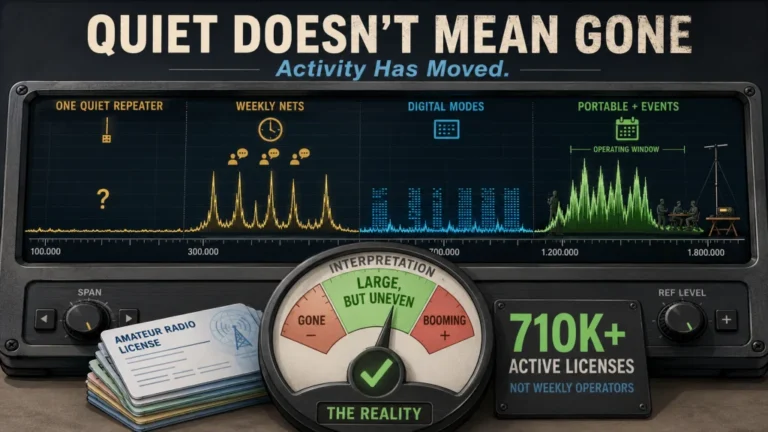
Ham radio has no required monthly subscription, bandwidth bill, or per-contact charge. Analog repeater and simplex use normally continue without a service fee, and many Internet-linked amateur systems do not charge the operator for network access. An Internet-dependent setup can still rely on home broadband, mobile data, or hotspot hardware that the operator already pays for.
The license lasts ten years, and the current FCC renewal fee is $35 rather than an annual charge. Equipment expenses are less predictable: batteries wear out, coax and outdoor connectors weather, vehicle installations loosen, and antennas can be damaged. A small maintenance reserve is sensible, especially for vehicle, portable, and outdoor stations that expose cables, connectors, batteries, and mounts to wear.
| Cost area | Year 1 | Year 2 and later |
|---|---|---|
| License and exam | New-license FCC fee, any exam-session fee, and optional study material | No routine annual fee; the current renewal fee applies when the ten-year license term ends |
| Core equipment | Radio, power, antenna, feed line, programming, and mounting needed for the first activity | Usually no repeat purchase unless the operating goal changes or equipment fails |
| Maintenance | Usually limited to small installation parts and setup corrections | Occasional batteries, weathered connectors, damaged coax, loose mounts, or antenna repairs |
| Expansion | Best delayed until the first station has been used and its limits are clear | Optional new bands, portable capability, digital interfaces, or a second operating location |
The table shows why ham radio is usually front-loaded rather than subscription-driven. The largest bill comes when the communication path is built; later spending is mostly maintenance or a deliberate move into a different activity. A Year 2 purchase should therefore answer a limitation discovered through use, not repeat the Year 1 shopping list.
Used equipment can reduce the first purchase and may retain meaningful resale value when it is current, supported, complete, and in good condition. That does not make every used radio a bargain. Missing cables, unavailable batteries, obsolete programming software, modifications, or uncertain repair history can erase the discount.
Clubs, loaner programs, shared test equipment, and supervised operating events can reduce costs without lowering the learning value. Borrowing an SWR meter for one antenna check is different from borrowing the radio needed every week. Spend first on the equipment that must remain available for the chosen activity.
Build the Budget Around One Successful Activity
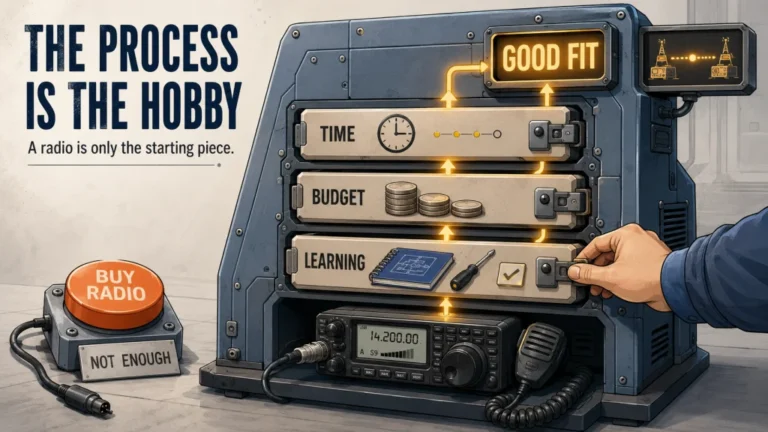
A beginner budget should name the activity before naming the equipment. “Talk through a local repeater from home” produces a different list from “communicate between vehicles,” “support a family emergency plan,” or “make HF contacts across the country.” The activity determines the license privilege, radio type, antenna, power, and accessories.
Use this order before spending:
- Choose one operating goal. Define who you expect to contact, from where, and on which type of system.
- Confirm the license privilege. Do not budget for an activity the current license does not support.
- Verify the communication path. Check local repeater activity, terrain, antenna limits, or the available HF space.
- Price the complete station. Include power, antenna, feed line, programming, mounts, and safety items.
- Separate required from optional. Buy what enables the first contact before convenience features.
- Reserve 10 to 20 percent. Small adapters, shipping, tax, connectors, and replacement parts often appear late.
This framework also shows when the lowest budget is false economy. If a $35 handheld cannot reach the intended repeater from the operating location, another $35 handheld is unlikely to solve the problem. The next dollar should go toward diagnosis, antenna position, a different radio category, or a different communication path.
Once the activity and total budget are defined, the guide to choosing the right ham radio can narrow the equipment category without turning this cost overview into a product list. Compare radios only after the complete station fits the budget.
Final Thoughts: Let the First Month Shape the Second Purchase
Build only enough station to complete one defined activity, then use it for several weeks before expanding. That first period reveals whether the real limitation is coverage, programming, power, antenna position, operating confidence, or simply a lack of active local contacts.
I would keep the remaining budget unspent until that limitation is visible. The second purchase is usually more useful when it corrects something the operator has actually experienced rather than something a generic starter list predicted.
FAQs
💵 Can I start ham radio for less than $100?
Yes, when free study resources, a low-cost exam session, the $35 FCC fee, and a basic handheld are enough for an active local repeater. Confirm coverage and programming needs first, because an antenna or cable can move the total above $100.
📝 How much does a Technician license cost?
The FCC currently charges $35 for a new license application. The exam fee is separate: an ARRL VEC adult session costs $15 in 2026, while other sessions may charge a different amount or nothing.
📡 Does ham radio have a monthly fee?
No required monthly service or bandwidth fee applies to ordinary amateur operation. Internet-linked features may depend on broadband, mobile data, or optional hardware that has its own cost.
🔋 What is the cheapest usable beginner setup?
A basic dual-band handheld can be enough when a reachable local repeater is active and the radio is correctly programmed. A practical total is usually $85 to $150 including licensing, with $150 to $250 providing more room for study and useful accessories.
🚗 How much does a mobile ham radio setup cost?
Plan on roughly $250 to $700 for the radio, antenna, mount, coax, fused wiring, and small installation parts. Professional labor, difficult vehicle routing, or premium control features can raise the total.
🌐 Do I need a General license before buying an HF radio?
A Technician can use limited HF privileges, so ownership is not restricted to General licensees. General is the practical target for broad access to the major HF bands and modes that most buyers expect from a full HF station.
♻️ Is used ham radio equipment a good way to save money?
It can be, especially when the equipment is supported, complete, and testable. Price missing cables, batteries, programming support, and possible repair needs before assuming the used option is cheaper.