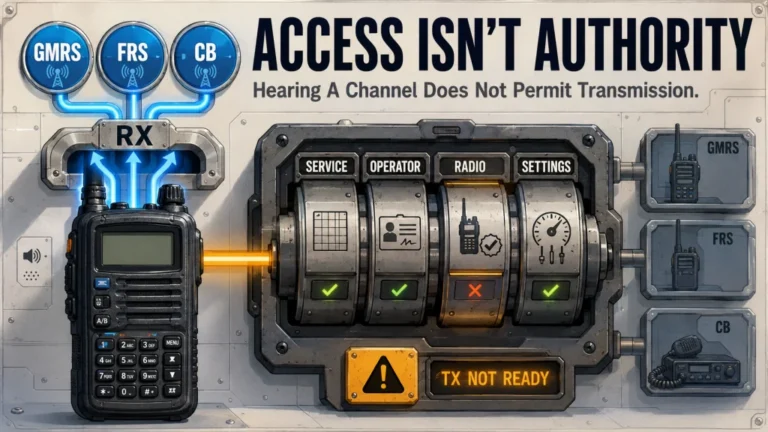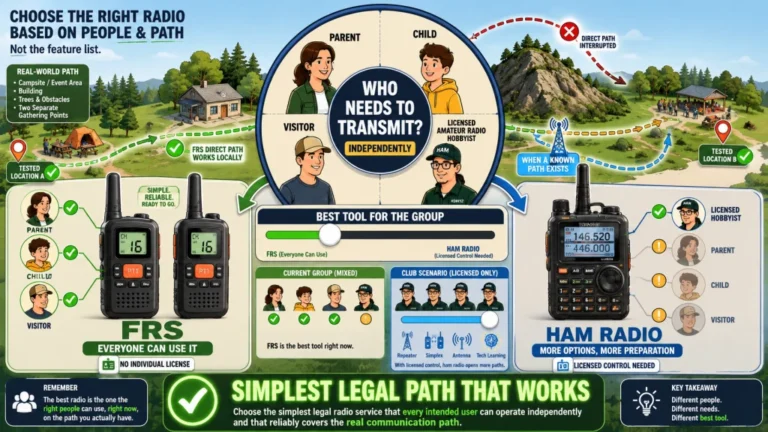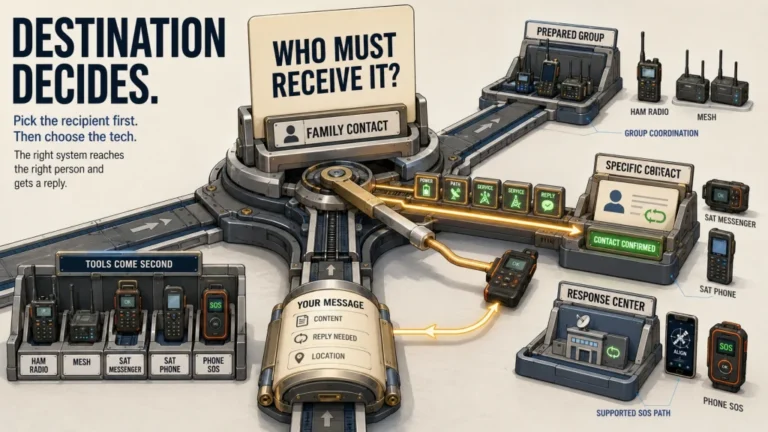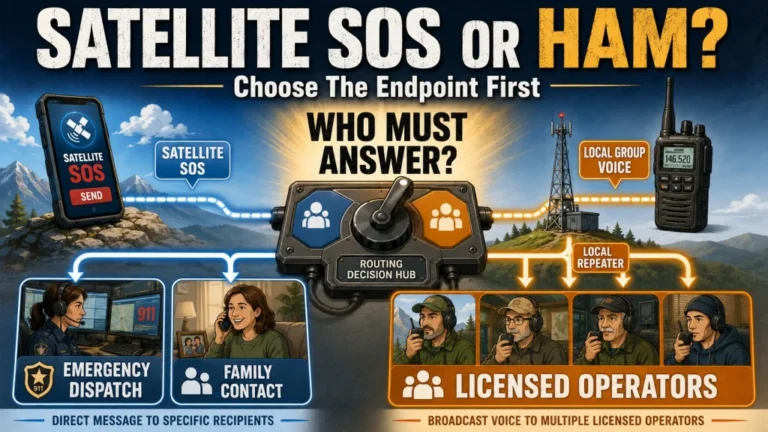
Ham radio and a dedicated satellite messenger solve different communication problems. A satellite messenger is designed to send location-linked messages to specific contacts and provide an interactive SOS path through a commercial service, while ham radio connects a licensed operator with reachable repeaters, simplex partners, nets, or HF stations. Choose the messenger when specific-contact text, tracking, and a tested SOS workflow are the priority; choose ham radio when local group voice, amateur networks, and regular radio use are the goal. Carry both only when each system has a defined job and both are activated, tested, powered, and assigned to someone who knows how to use them.
Ham Radio vs Satellite Messenger Starts With Who You Need to Reach
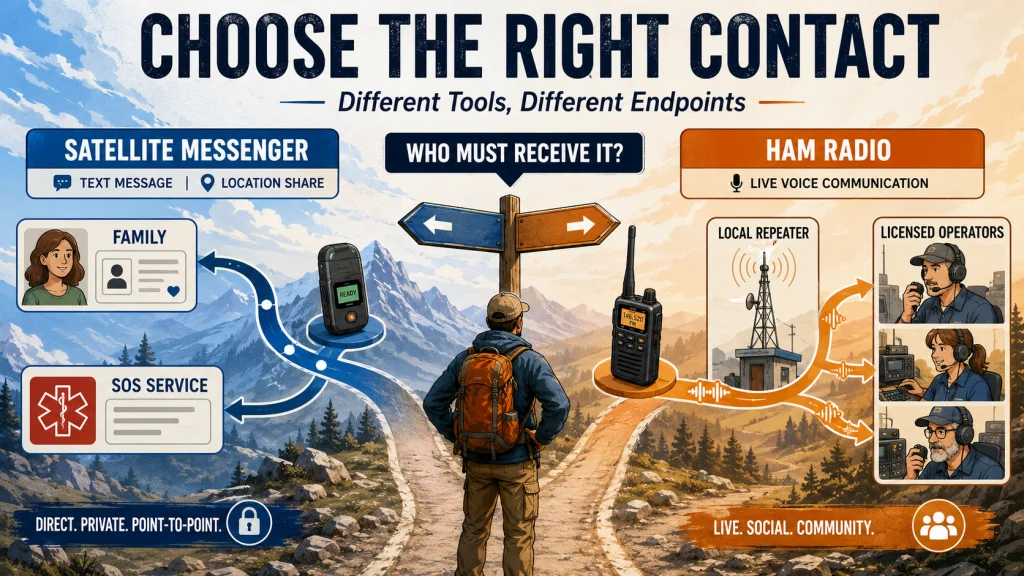
The most useful way to compare ham radio vs satellite messenger is not by asking which signal travels farther. Start with the intended recipient. A dedicated satellite messenger is built to move short messages, check-ins, locations, and SOS information through a provider network to people or services selected in advance.
Ham radio works differently. It connects a licensed operator to another reachable amateur station, which may be a local repeater user, a simplex partner, a scheduled net, or an HF operator. That can create flexible local and regional communication, but it does not automatically create a private text path to a family member who does not hold a license or monitor amateur radio.
Key point: The messenger starts with a named recipient or response service. Ham radio starts with an available radio path and another prepared operator. If the communication plan cannot identify the person, group, or service expected at the other end, neither device category is ready.
This article covers dedicated satellite communicators used for two-way messaging, tracking, and interactive SOS. It does not cover full satellite voice phones, which are addressed in the satellite phone comparison, or satellite features built only into a smartphone, which require the separate smartphone satellite SOS comparison. For the wider decision among off-grid communication methods, start with the modern communication alternatives guide.

ZOLEO provides two-way satellite messaging through the Iridium network and works with its mobile app for texts and email. It includes check-in, GPS location sharing, weather support, and an SOS function tied to a monitoring workflow. The ZL1000 is IP68 rated and its rechargeable battery is specified for more than 200 hours under the stated check interval.
Check On AmazonIf you click this link and buy, we earn a commission at no additional cost to you.
A Satellite Communicator and Ham Radio Have Different Core Jobs
Comparisons such as inReach vs ham radio often collapse several separate questions into one. The better approach is to compare the job, recipient, network, and failure points side by side. That exposes why one system may be the clear choice for a solo traveler while the other is more useful for a trained local group.
| Decision factor | Dedicated satellite messenger | Ham radio |
|---|---|---|
| Primary communication | Short two-way messages, check-ins, tracking, location sharing, and interactive SOS | Live amateur voice or data with reachable licensed stations |
| Typical recipient | Known phone, email, app, tracking follower, or response center | Repeater users, simplex partners, net participants, or HF operators |
| Access requirement | Activated account, eligible service plan, supported region, and satellite path | Appropriate amateur license, legal privileges, programmed radio path, and another operator |
| Best fit | Specific-contact communication beyond cellular coverage | Local group voice, amateur community access, public-service practice, and radio activity |
| Main uncertainty | Sky obstruction, message delay, account status, plan limits, and response time | Terrain, antenna, repeater status, operator availability, propagation, and skill |
| Privacy model | Provider-routed account communication subject to service terms | Amateur transmissions are generally open to reception and must follow Part 97 rules |
A messenger is not simply a tiny ham radio that uses satellites, and ham radio is not a subscription-free version of a commercial SOS service. The systems have different recipients, infrastructure, legal conditions, and operating expectations. Treating them as interchangeable is the fastest way to build a plan with no dependable endpoint.

Garmin inReach Mini 2 supports two-way satellite messaging, interactive SOS, location sharing, and weather over the Iridium network with an active subscription. TracBack routing and a digital compass add navigation functions directly to the device. Garmin specifies up to 14 days of battery life in default 10-minute tracking mode.
Check On AmazonIf you click this link and buy, we earn a commission at no additional cost to you.
The Contact Model Changes the Entire Decision
With a satellite messenger, the user normally enters or verifies contacts before the trip. A routine check-in can go to a spouse, coworker, trip leader, or other named recipient. Tracking can provide a follower with location updates, and an SOS can begin a two-way exchange with a response coordination service when the exact device, account, service plan, coverage conditions, and jurisdiction support it.
That structure is valuable when the requirement is, “I need this particular person to receive my status.” The recipient may answer through a phone number, email route, provider app, or another compatible device, depending on the service. The user does not have to hope that an unknown operator is monitoring the right radio channel at the right moment.
Ham radio is stronger when the requirement is group access rather than named-recipient messaging. A local repeater can connect several operators in a community, a simplex frequency can support nearby partners, and a scheduled net can provide an organized time and procedure for checking in. HF can reach farther under suitable conditions, but propagation, frequency choice, antenna, license privileges, and active operators still determine whether a useful contact happens.
There is also a privacy distinction. Amateur radio should not be treated as a confidential family messaging service, and US amateur rules prohibit messages encoded for the purpose of obscuring their meaning, subject to limited rule exceptions. A family member who is not licensed cannot simply use an amateur transmitter for routine trip updates because the radio can technically reach the frequency.
Compare Functions, Not Marketing Checkboxes
A current satellite messenger may support two-way text, preset or check-in messages, location sharing, live tracking, weather requests, and interactive SOS. Some newer devices and plans also support photo or voice-message features, often through a paired phone and provider app. Those newer functions must be verified against the exact device, current software, selected plan, recipient workflow, and region rather than assumed from the category name.
Ham radio usually provides immediate live voice when a working path and listening operator are available. That makes it useful for a local group coordinating changing conditions, several vehicles traveling together, a community net, or regular amateur activity. One transmission can be heard by multiple nearby stations without creating a separate commercial account for each recipient.
- Specific text recipient: the satellite messenger has the clearer fit.
- Automatic location trail: use a messenger plan and device that explicitly support the required tracking interval.
- Interactive SOS coordination: use a currently activated service with a tested SOS workflow and valid jurisdiction coverage.
- Local group voice: ham radio is useful when the operators, frequencies, coverage, and procedures have been verified.
- Weather information: a messenger may request provider weather data, while ham operators may receive public forecasts or exchange observations, but neither replaces sound weather judgment.
- Private routine messages: do not treat ordinary amateur radio as a confidential replacement for provider-routed messaging.
The presence of a feature on a sales page does not prove that it works in the planned workflow. A photo feature that needs a paired phone is different from a function available directly on the communicator. Tracking that consumes paid points is different from tracking included in the selected tier. The usable feature is the one that has been activated, tested, and understood before the trip.
A Satellite Messenger Has a Longer Setup Chain Than the SOS Button Suggests
A dedicated messenger depends on more than a charged battery and a view of the sky. The account must be created, the device must be activated, the correct service state must be in effect, contacts must be entered correctly, and any required app pairing or software update should be completed while normal internet access is still available. Some functions may work directly on the device, while others depend on a paired phone.
Satellite access also depends on the environment. Deep canyons, dense overhead cover, tall buildings, vehicle roofs, and other obstructions can delay or prevent a transmission until the device gains a usable view of the sky. A message may remain queued rather than disappearing, but queued is not the same as delivered.
| Dependency | What to verify before departure |
|---|---|
| Account and activation | The account is accessible and satellite functions are active now, not scheduled for later |
| Subscription state | SOS, messaging, tracking, weather, and overage rules for the selected tier |
| Contacts | Phone numbers, email addresses, app users, emergency contacts, and tracking permissions |
| Device and phone | Firmware, app version, pairing, login, offline operation, and direct-device controls |
| Coverage and law | Provider coverage, destination jurisdiction, service restrictions, and permitted device use |
| Power | Battery condition, charging cable, backup power, temperature effects, and trip duration |
Warning: Do not assume that suspending a subscription preserves full SOS access. Suspension, reactivation, activation fees, and emergency availability vary by provider and plan. Verify the account status by sending a routine test before relying on the device.
The most important satellite test is not seeing a battery icon. It is sending a real message from an outdoor location, confirming receipt, receiving a reply, and making sure the person at home understands what each check-in means.

ACR Bivy Stick turns a compatible phone into a two-way Iridium satellite communicator for messaging beyond cellular coverage. It supports SOS, GPS location sharing, check-ins, weather reports, and offline maps through the Bivy app. A dedicated phone number and email make it useful when the communication plan depends on reaching named contacts.
Check On AmazonIf you click this link and buy, we earn a commission at no additional cost to you.
Ham Radio Replaces the Subscription With Operator and Path Dependencies
Ham radio may not require a monthly network subscription, but it is not dependency-free. The transmitting operator needs the appropriate license and privileges. The radio needs the correct frequency, offset, tone, mode, and power arrangement, while the antenna and terrain must support the path to another active station.
A repeater listing is only a lead until it is tested from the intended operating location. The repeater may be silent, temporarily unavailable, restricted, differently configured, or unreachable from a low spot. Simplex needs another prepared operator within a workable path, and HF adds changing propagation, band conditions, antenna requirements, and greater operating skill.
Field Note: I treat a saved channel as unproven until the radio has reached the intended station from the place where it will actually be used. Correct numbers on a display do not confirm antenna performance, repeater status, terrain clearance, or the presence of anyone listening.
- Confirm that every transmitting user is properly licensed for the planned amateur operation.
- Program and recall each channel before the trip rather than entering it under pressure.
- Test the repeater or simplex path from the actual trailhead, home, vehicle, or work area when practical.
- Know the net schedule, call sign procedure, backup frequency, and expected operator at the other end.
- Carry enough battery capacity for monitoring as well as transmitting.
- Use an antenna and placement that match the band, radio, terrain, and operating location.
Ham radio can function without the public internet or a commercial messaging subscription, which is valuable when local operators have prepared together. It still depends on people, practice, power, and a workable RF path. The broader guide to using ham radio for preparedness explains how those pieces must form a complete plan rather than a collection of radios.

Yaesu FT-65R is a compact dual-band VHF/UHF handheld transceiver for licensed amateur operation. The U.S. version covers 144 to 148 MHz and 430 to 450 MHz transmit ranges with selectable 5, 2.5, and 0.5 watt power levels. Its 200-channel memory supports a preprogrammed repeater or simplex plan that can be tested before field use.
Check On AmazonIf you click this link and buy, we earn a commission at no additional cost to you.
Neither System Guarantees Delivery, a Reply, or Rescue
A satellite message can be delayed by sky obstruction, device orientation, network conditions, or the time required to acquire a satellite. Delivery to a contact does not guarantee that the contact is awake, has connectivity, understands the message, or knows what action to take. An interactive SOS adds a coordination workflow, but local responder availability, weather, terrain, access, jurisdiction, and the facts of the incident still affect the outcome.
Ham radio has a different uncertainty pattern. Voice may be immediate when the repeater is working and another operator answers, or there may be complete silence. HF can provide useful long-distance communication under suitable conditions, but propagation is variable and the intended recipient may not be listening on the chosen band or frequency.
US amateur rules allow broad use of available radiocommunication means for immediate safety of life and protection of property when normal systems are unavailable. That emergency provision is important, but it is not a substitute for licensing, normal preparation, trained contacts, or a tested communication plan before the emergency.
Compare Current Operating Cost, Not One Purchase Price
A frozen one-year total becomes unreliable quickly because satellite service plans, activation charges, included messages, overages, suspension rules, and device capabilities can change. Calculate the cost for the exact trip pattern at the time of purchase. A person using a messenger every month has a different cost than someone activating it for one seasonal trip, and a low monthly tier can become expensive if tracking points or message overages are used heavily.
For the satellite side, record the device price, activation charge, monthly tier, minimum commitment, included messages, tracking allowance, weather charges, overages, suspension terms, reactivation costs, and any phone or app requirements. Confirm whether photo or voice messages are supported by the exact device and whether they are included, metered, or unavailable.
For ham radio, include exam-session charges if the chosen team has them, the current $35 FCC application fee for a new license, radio equipment, antenna, feed line, batteries, charging, mounting, and any installation work. The $35 FCC fee also applies to renewals, rule-waiver requests, and vanity call-sign requests. Ordinary operator-class upgrades and sequential call-sign requests are exempt, while VE or VEC exam-session charges are separate and may still apply. A station with no subscription can cost more upfront if it needs vehicle wiring, a home antenna, or a complete HF installation.
| Cost question | Satellite messenger | Ham radio |
|---|---|---|
| Upfront | Device, activation, accessories, and possible paired-phone requirement | Exam, FCC application, radio, antenna, power, and installation |
| Recurring | Plan, messages, tracking, weather, overages, or reactivation | No network subscription for ordinary amateur operation, but batteries, maintenance, and upgrades remain |
| Hidden variable | Plan limits and whether suspension keeps any emergency function | Whether the station can actually reach an active local or HF path |
| Value test | Can it reach the named contact and SOS workflow required? | Can it reach the trained operator or network required? |
The fair comparison is cost per required capability, not cost per device. Paying a recurring fee can be reasonable when the job is specific-contact satellite messaging. Avoiding a fee is not a saving if the radio path does not reach anyone who can receive and act on the message.
Choose the System From the Required Outcome
The right choice becomes clearer when it is attached to a real trip rather than an abstract feature list. These examples are decision patterns, not guarantees, because terrain, contacts, licensing, service status, and the route still change the answer.
| User situation | Likely priority | Why |
|---|---|---|
| Solo traveler beyond cellular coverage | Satellite messenger first | Named contacts, location sharing, scheduled check-ins, and an interactive SOS path matter more than local group voice. |
| Family camping near roads and developed areas | Depends on the contact plan | A messenger fits family updates beyond cell service; ham radio adds value only when licensed partners or a tested local system are part of the trip. |
| Multi-vehicle off-road group | Ham radio for group voice, messenger for outside contact | Live coordination and specific-contact satellite messaging are separate jobs, so both may be justified. |
Field Note: The beginner mistake I see is treating a handheld as an emergency plan before identifying anyone who will be listening. The radio may be correctly programmed and fully charged, yet still have no useful path from the route. I ask who is expected at the other end before discussing equipment features.
For outdoor use, planning ham radio for hiking and camping covers the terrain and partner questions behind the radio path. When equipment selection becomes necessary, the emergency radio selection framework keeps the purchase tied to a verified communication job.
Carry Both Only When Each Device Has a Separate Assignment
Redundancy is useful when the systems fail differently, but carrying two devices without assigning jobs creates extra weight and false confidence. A practical two-system plan might use the satellite messenger for family check-ins, tracking, and SOS coordination, while ham radio supports voice with a trip partner, local repeater users, or an organized amateur net.
Write down who carries each device, who keeps the paired phone, who monitors battery state, and who knows the activation and SOS procedure. If the group separates, decide which person keeps the messenger and whether the remaining radio operators still have a reachable path. Do not place every communication function in one backpack and call it redundancy.
- Messenger assignment: named recipients, check-in schedule, tracking interval, late-contact procedure, and SOS use.
- Ham assignment: operators, call signs, primary channel, backup channel, net time, and coverage limits.
- Power assignment: charging cables, compatible battery packs, cold-weather protection, and who checks remaining capacity.
- Separation plan: which device follows which person and how the group communicates after splitting.
- Failure trigger: how long to wait before moving outdoors, trying a backup path, returning, or escalating the plan.
The strongest redundancy comes from different networks plus different people who understand them. Two untested devices with dead accounts or unverified frequencies are not two communication systems.
Complete the Communication Test Before the Trip
The final test should reproduce the real workflow as closely as practical. A satellite messenger test must include a sent message, confirmed receipt, a reply, and a check that tracking permissions work for the intended follower. A ham test must include the intended operating location or a realistic substitute, the programmed channel, the actual antenna, and another operator who confirms the signal.
Do not activate, update, pair, or program critical functions for the first time at the trailhead. Complete account recovery, contact edits, firmware updates, app logins, frequency verification, and printed backups while normal internet and power are available.
- Activate the messenger and confirm the current subscription state.
- Update the device and any required phone app.
- Pair the phone, then verify which functions still work if the phone fails.
- Send a routine satellite test outdoors and receive a reply.
- Verify emergency contacts, tracking followers, and late-check-in instructions.
- Review the provider SOS process without triggering a real emergency alert.
- Confirm destination coverage, jurisdiction rules, and service limitations.
- Program and recall the ham frequencies, offsets, tones, and modes.
- Test the intended repeater, simplex partner, or net from a relevant location.
- Print frequencies, call signs, contact instructions, and backup procedures.
- Carry protected charging cables and enough power for the planned duration plus delay.
The trip is not ready because both devices turn on. It is ready when each complete path has produced a successful test and the people at both ends know what to do next.

BTECH UV-PRO is an app-connected dual-band VHF/UHF handheld with onboard GPS, APRS, Bluetooth, and NOAA alert monitoring. The BTECH UV app supports channel management, CSV workflows, and firmware updates before a trip, while core radio and GPS functions remain on the handheld. Its removable 2600 mAh battery supports direct USB-C charging for field power planning.
Check On AmazonIf you click this link and buy, we earn a commission at no additional cost to you.
Final Thoughts: Choose the Contact Path Before the Device
There is no universal winner between ham radio and a satellite messenger because they do not promise the same connection. The messenger is usually the better fit for specific-contact text, tracking, and interactive SOS through a current commercial service. Ham radio is the better fit for licensed group voice, local amateur networks, regular operating, and communication plans built around prepared radio partners.
I would not count either system as emergency-ready until the full path has been tested from both ends. Define who must receive the message, how they will receive it, what conditions can block it, and what happens when no reply arrives. The device choice becomes much clearer once those four answers are written down.
FAQs
🛰️ Should I choose ham radio or a satellite messenger for hiking?
Choose a satellite messenger when you need text, tracking, or SOS communication with named contacts beyond cell coverage. Choose ham radio when you have a tested path to licensed partners, local repeaters, or scheduled nets. Some trips justify both.
🆘 Does a satellite messenger guarantee rescue?
No. An interactive SOS can connect you with a response coordination process, but transmission conditions, location accuracy, local resources, weather, terrain, jurisdiction, and incident details affect the outcome.
📻 Can ham radio replace a satellite messenger?
Only when your actual requirement is communication with reachable amateur operators. It does not automatically provide private text to family, automatic tracking, or a commercial SOS response workflow.
💳 Does a satellite communicator work without a subscription?
Do not assume satellite messaging, tracking, weather, or SOS remains available without an active eligible service state. Check the exact provider, device, plan, suspension rules, and destination before departure.
🌲 Will a satellite messenger work under trees or in a canyon?
Obstructed sky can delay or prevent satellite communication. Move to the most open safe location available, orient the device as instructed, and allow time for queued messages to transmit.
🔐 Are ham radio conversations private?
No. Amateur transmissions can generally be received by other listeners, and US rules prohibit encoding messages for the purpose of obscuring their meaning except where the rules specifically allow it. Do not send sensitive personal details as though the channel were private.
🔋 Which system has the better battery life?
It depends on the exact device, temperature, tracking interval, transmit use, receive time, phone pairing, and battery condition. Compare the real operating profile and carry tested backup power rather than relying on an advertised maximum.
👥 Is carrying both unnecessary duplication?
Not when each system has a separate job. A messenger can handle named-contact satellite communication while ham radio supports local amateur voice, but both must be tested and assigned to capable users.