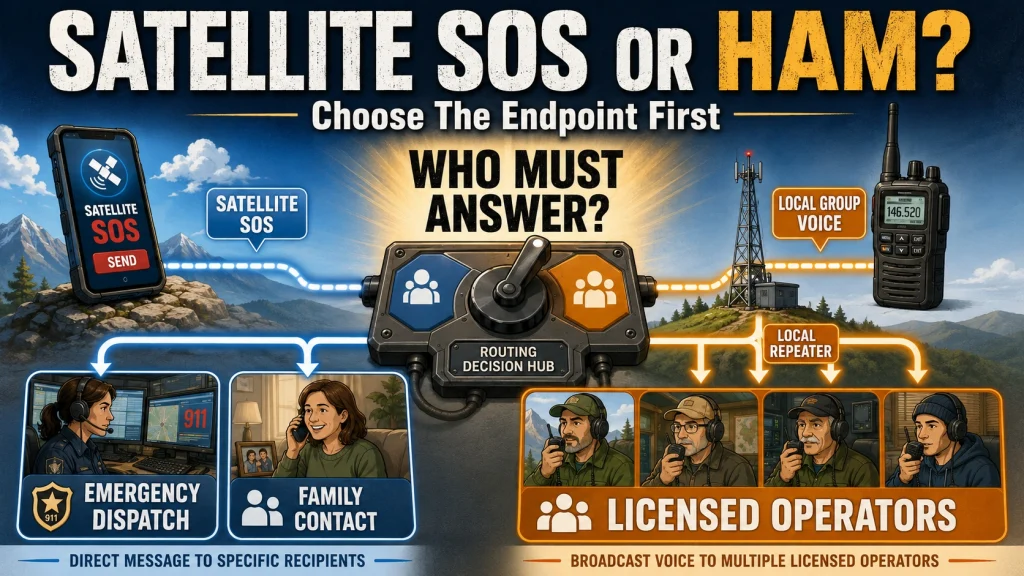
A supported smartphone satellite feature can add a valuable emergency or messaging path when cellular and Wi-Fi service disappear, but it does not replace every job ham radio can perform. The right comparison depends on the exact phone feature, who must receive the message, where the service works, and whether you need private contact, local group voice, or access to emergency responders. Use the phone feature when it covers the exact trip and communication job, add a dedicated satellite device when you need a separate rugged tracking and SOS path, and add ham radio when practiced local or amateur communication is part of the plan. Do not assume that one satellite icon means universal coverage, unlimited messaging, or guaranteed rescue.
Start With the Recipient, Not the Technology
A satellite feature on a supported phone can be an excellent backup, especially when the job is sending an emergency report or a short message from outside cellular coverage. It is still a phone-based service with device, software, carrier, region, account, and satellite-view requirements. Ham radio is a licensed radio service that can support local voice, repeaters, simplex communication, organized nets, HF contacts, and digital modes, but it does not automatically route a distress call to a rescue center.
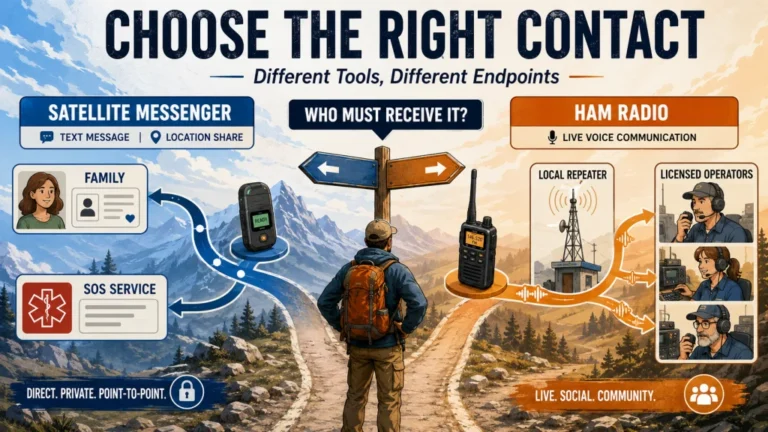
I use one question before comparing them: who must answer? If the answer is a public-safety dispatcher or a named family member, a supported satellite feature may provide the cleaner path. If the answer is a local group of licensed operators, a neighborhood net, or another amateur station on a known frequency, ham radio may do a job the phone feature was never designed to do.
Key point: Smartphone satellite service and ham radio overlap only at the broad idea of communicating without normal cellular coverage. Their endpoints, workflows, legal requirements, and failure modes are different.
This comparison covers smartphone-based satellite features only. It does not treat a dedicated messenger or a satellite phone as the same product, and it does not assume that every phone maker, model, carrier, country, or service term works alike. For the wider decision framework, see my guide to comparing ham radio with modern alternatives.
Identify the Exact Satellite Feature Before Comparing It
The phrase smartphone satellite communication now covers several different services. One phone may offer emergency SOS and location sharing, another may support basic texts through a carrier, and another may allow selected low-bandwidth apps. Treating all of those as one capability is the fastest way to build the wrong emergency plan.
Research-based field note: This article was reviewed in July 2026. Satellite features are changing quickly, so verify the exact device, software, carrier, country, and service terms again before every remote trip.
| Feature type | Who receives it | What not to assume |
|---|---|---|
| Emergency SOS | Emergency services directly or through a relay provider | That it is general messaging or available in every country |
| Roadside assistance | A participating roadside provider | That roadside service itself is free or universally available |
| Location sharing | Selected contacts through a supported account service | That it creates a live two-way conversation |
| Messages to contacts | Family, friends, or other permitted recipients | That every message type, attachment, or recipient can reply |
| Carrier satellite texting | Ordinary phone numbers through a supported carrier service | That all phones, plans, messaging apps, or media formats work |
| Satellite data or voice features | Selected apps or services when specifically supported | That an announced roadmap equals universal native voice or internet access |
The practical distinction is the endpoint. Emergency SOS is designed to start an emergency workflow. General satellite messaging is designed to exchange short messages with eligible contacts. Carrier-based service may behave more like ordinary texting, but supported devices, apps, message types, and coverage still vary.
Do not use a future feature announcement as part of today’s plan. Some services already support selected data apps or app-based calling, while others remain limited to emergency messages or basic text. Count only the capability that is active on your exact phone, account, and travel route.
The Eligibility Matrix Matters More Than the Satellite Icon
A satellite option appearing in a marketing page or settings menu does not prove it will work for your trip. The service can depend on where the phone was purchased, the operating-system version, an active SIM, a particular carrier relationship, account setup, country approval, and whether the feature is included in a current plan or temporary service term.
Before relying on the phone, verify every row below against the current official support page for your device and carrier:
- Supported phone: Confirm the exact model and hardware generation, not just the brand.
- Purchase region: Some phones sold in particular markets may not include the same satellite capability.
- Software version: Install the required operating-system and carrier updates before leaving coverage.
- SIM and carrier status: Check whether an active SIM, cellular data setting, default messaging app, or qualifying plan is required.
- Country and travel region: Verify that the feature is authorized and active where you will actually use it.
- Service term: Check whether access is included, promotional, time-limited, or charged separately.
- Account preparation: Set up emergency contacts, medical information, family permissions, or recipient eligibility in advance.
- Feature type: Confirm whether you have emergency-only contact, general messaging, location sharing, roadside help, or carrier texting.
My rule is simple: if one row is unknown, the feature is not yet part of the emergency plan. It may still work, but an unverified possibility is not the same as a tested communication path.
Warning: A free-service period or plan inclusion can change. Record the current term before travel and recheck it later instead of assuming the original activation offer still applies.
What the Satellite Connection Workflow Requires
Phone satellite use is not the same as ordinary texting from inside a vehicle or building. Most current workflows require you to be outside with a clear view of the sky and horizon. Trees, canyon walls, steep terrain, buildings, and vehicle roofs can interfere with the path, and the phone may guide you to turn or move while it searches for a satellite.
Emergency systems often begin with a short questionnaire that compresses the most useful facts: what happened, how many people need help, where you are, and whether anyone is injured. The phone then sends compact data and may open a text exchange with responders or a relay center. General messaging may feel more familiar, but delivery can still take longer than normal cellular texting, especially when the satellite path is intermittent.
The phone also has to remain usable long enough to complete the exchange. A damaged screen, depleted battery, wet charging port, overheated device, or missing account setup can remove the path before satellite coverage becomes the issue. Satellite acquisition and repeated message attempts also consume time and power, so battery conservation matters before the emergency begins.
Use the built-in demo when the service provides one. Practice outdoors, learn where the connection controls appear, and confirm which contacts or information are already configured. A demo does not prove coverage on every route, but it removes the avoidable mistake of learning the interface while injured, cold, or under stress.

This compact power bank provides 10,000mAh capacity and up to 45W charging for compatible USB-C devices. It includes a detachable 0.4-foot braided USB-C cable that can be swapped when needed. Its high-density battery design is listed as 40 percent smaller and 36 percent lighter than conventional 10,000mAh chargers.
Check On AmazonIf you click this link and buy, we earn a commission at no additional cost to you.
What Ham Radio Adds That a Phone Feature Does Not
Ham radio gives a licensed operator direct access to other stations rather than one phone maker’s emergency entitlement. On VHF and UHF, that can mean local simplex voice, repeaters, scheduled nets, and communication with several operators at once. On HF, the operator can use authorized bands and modes for regional or longer-distance contact when the station, antenna, propagation, and skill support it.
That open contact model is useful for group coordination. A family evacuation team with individually licensed operators can share one frequency plan. A neighborhood group can use a local net. Operators can pass observations, route messages, or move from a repeater to simplex if the repeater is unavailable and the distances permit it.
I would not describe that as a replacement for an SOS relay. Ham radio has no universal emergency button, no guaranteed listener, and no automatic handoff to the correct public-safety agency. Someone must be monitoring, understand the message, and have a working path to the help you need.
Amateur communication is also generally open rather than private. It is well suited to operational information and group coordination, but not to confidential family details. The value comes from practiced operators and flexible radio paths, not from secrecy or guaranteed response.

The BF-F8HP provides selectable 8-watt, 4-watt, and 1-watt power levels. Its specified transmit and receive ranges are VHF 136-174 MHz and UHF 400-520 MHz. The kit includes a V-85 dual-band antenna, CH-5 charger, 110V adapter, earpiece kit, wrist strap, belt clip, and user manual.
Check On AmazonIf you click this link and buy, we earn a commission at no additional cost to you.
Both Systems Have Failure Modes You Must Plan Around
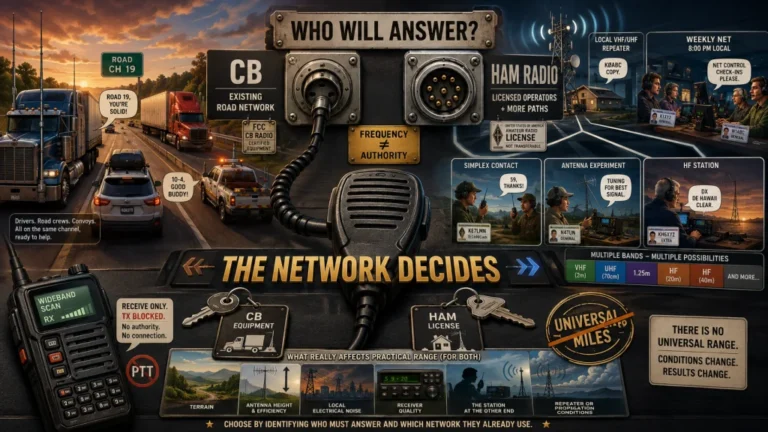
The weak comparison is “satellite works everywhere” versus “ham works when phones fail.” Neither statement is reliable. A phone satellite path can fail because the feature is unavailable, the sky is blocked, the phone is damaged, or the battery is empty. A ham path can fail because the antenna is wrong, the repeater is unreachable, no one is listening, propagation is poor, or the operator has never practiced the channel plan.
| Smartphone satellite limitation | Ham radio limitation |
|---|---|
| Supported hardware, software, region, account, and carrier may all be required | Normal transmitting requires a properly licensed control operator |
| Blocked sky can prevent or delay connection | Terrain, antenna height, band conditions, and infrastructure affect reach |
| The phone is one fragile device for maps, photos, calls, and satellite access | The radio, antenna, power, programming, and operating plan must all be ready |
| Message types, recipients, and service terms may be limited | There is no guaranteed listener or automatic rescue-center connection |
| Feature availability can change by country, plan, or provider | Each transmitting participant needs the appropriate license for routine use |
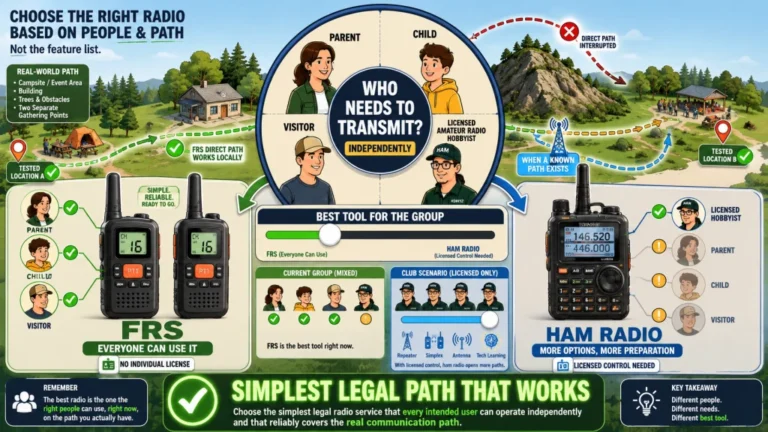
The license point deserves special attention. In normal United States amateur operation, the transmitting station must be under the control of a properly licensed operator. Do not build an emergency plan around the idea that an unlicensed person can buy a radio, leave it in a drawer, and legally use it as a routine substitute for preparation.
The practical response is redundancy with different failure modes. A charged supported phone, an external battery, a written contact plan, and a practiced radio path can complement one another. Two untested devices in the same backpack are not automatically two working communication systems.

The Anker 737 combines a 24,000mAh battery with up to 140W charging. It provides two USB-C ports and one USB-A port for three-device connectivity. Its smart digital display shows real-time input and output power and estimates remaining recharge time.
Check On AmazonIf you click this link and buy, we earn a commission at no additional cost to you.
Match Each Emergency Job to the Right Communication Path
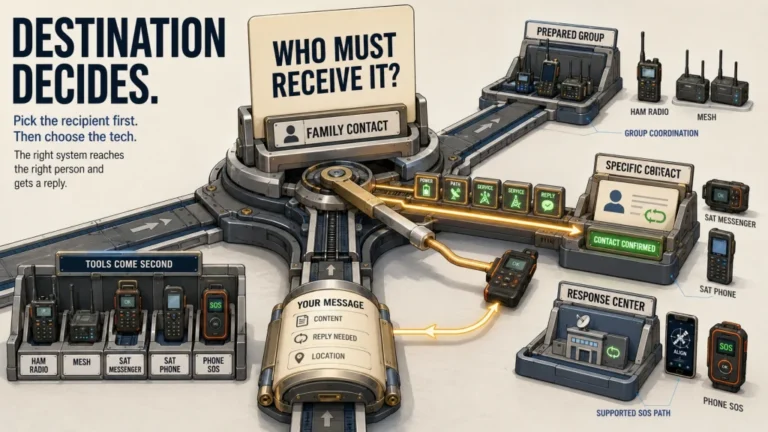
The best emergency plan does not ask which technology wins. It assigns a path to each job. This prevents the common mistake of buying one tool and expecting it to handle rescue dispatch, private family updates, neighborhood coordination, and daily practice equally well.
| Communication job | Best starting path | Why |
|---|---|---|
| Specific external SOS | Supported emergency satellite feature | Designed to route a structured distress report toward emergency response |
| Short family update | Supported satellite messaging | Targets named contacts without requiring them to monitor a radio frequency |
| Local group voice | Practiced radio plan | Allows several licensed participants to hear and respond on the same channel |
| Neighborhood coordination | Local simplex, repeater, or organized net | Supports shared situational information when the local path is known |
| Daily practice and hobby use | Ham radio | Lets the operator build skill before a disruption instead of saving the system for emergencies |
| Live voice to one named remote person | Evaluate a satellite phone path separately | That is a different endpoint and service model from both ham and phone SOS |
For broader planning, my guide to using ham radio for emergency preparedness explains where radio fits alongside power, contact procedures, and local operating practice. The key is to define the recipient and workflow before choosing equipment.
If direct voice to a specific person is the requirement, use the separate comparison of ham radio versus satellite phone use. A smartphone SOS feature should not be stretched into a satellite-phone promise it does not make.
When a Smartphone Satellite Feature May Be Enough
The phone feature may be enough when your job is narrow and verified. A good example is an occasional trip where you need a way to report a life-threatening emergency or send a short status message to a named contact, and the current feature is supported on your exact phone throughout the travel region.
Use this readiness test before depending on it:
- The feature is active on the exact phone you will carry.
- The required software, SIM, carrier, account, and messaging settings are complete.
- The destination country and route are within the current service area.
- You know whether the feature reaches emergency services, roadside assistance, or ordinary contacts.
- You have practiced the demo and know how to reach open sky.
- You carry enough protected battery capacity for navigation and communication.
If all six are true, adding ham radio solely because the phone has satellite capability may not solve another real problem. I do not think every phone owner needs an amateur license. A tool earns its place when it covers a communication job the existing plan does not cover well.
The answer changes for groups. One phone may be enough for a solo traveler’s external SOS, but it does not automatically create local voice coordination among several vehicles, households, or team members. That is a separate job and should be evaluated separately.

This ultra-mini power bank provides 10,000mAh capacity and up to 45W output. It includes a fully detachable nylon-braided USB-C lanyard cable that supports both charging and recharging. Amazon lists support for PD, QC, and Samsung Super Fast Charging.
Check On AmazonIf you click this link and buy, we earn a commission at no additional cost to you.
When to Add a Dedicated Satellite Messenger
Add a dedicated messenger when you need a communication path that is physically separate from the phone or designed around repeated remote use. Tracking, independent battery life, rugged construction, a provider-managed SOS workflow, and current coverage across a broader travel pattern can justify carrying another device.
The strongest reason is not that a dedicated device is automatically better. It is that it may fail differently. If the phone is damaged, drained by navigation, or unavailable to one group member, the separate device can preserve a second path. That advantage matters only when its subscription, contacts, tracking settings, and SOS procedure are also current.
Do not make this article’s smartphone comparison carry the entire dedicated-device decision. Use the detailed guide to ham radio and satellite messenger differences when tracking, ruggedness, provider coverage, and independent power are central requirements.
A messenger provides a managed satellite path, not a local voice net. Ham radio serves the coordination side instead, so both can belong in one plan when each has a defined job and a different failure mode.
When Ham Radio Is Worth Adding
Add ham when you want a practiced local or amateur communication system, not merely another emergency gadget. The clearest reasons are local group voice, repeater access, simplex coordination, scheduled nets, HF operating, digital modes, or a hobby you will use often enough to maintain skill.
The word practiced matters. A handheld stored with factory channels, an untested antenna, and no knowledge of local activity is not a reliable backup. The operator should know which channel to try, whether a repeater is reachable, how to switch to simplex, what power source is available, and who else is expected to answer.
When that is your goal, focus on building a complete emergency ham radio system rather than choosing a radio by wattage or feature count. The useful system includes licensing, programming, antenna placement, power, contacts, and regular on-air practice.
Ham is not mandatory for every hiker, driver, or phone owner. It becomes valuable when open radio communication with other operators is a real activity you want to build and maintain. That is a stronger reason than buying it only because the phone’s satellite screen looks limited.
Quick Decision Checklist
Use this final check to prevent one feature from being assigned every communication job. Answer each question with the exact recipient, route, and equipment you will use rather than a general belief that satellite or radio should work.
- Need an emergency relay? Verify the phone’s emergency SOS feature and regional availability.
- Need to update named contacts? Verify two-way satellite messaging, recipient rules, and carrier support.
- Need independent tracking or rugged backup? Evaluate a dedicated messenger separately.
- Need live voice to one named remote person? Evaluate a satellite phone service separately.
- Need local group voice or neighborhood coordination? Build and practice the appropriate licensed radio path.
- Need more than one failure mode? Use complementary systems rather than duplicate assumptions.
If you cannot name who receives the first message and what happens next, the plan is not finished. The device matters only after the complete path is clear.
Final Thoughts: Add Only the Path the Phone Cannot Cover
Keep a supported smartphone satellite feature in the plan when you have verified and practiced it for the exact route, recipient, and purpose. It may already solve the external SOS or short-message job.
Add another path only for a job the phone does not cover, such as independent tracking or practiced local group voice, and test that path before depending on it.
FAQs
🛰️ Is iPhone satellite SOS better than ham radio in an emergency?
It is usually the clearer path when the exact job is contacting emergency services from a supported region with open sky. Ham radio is better suited to practiced communication with other operators, but it does not guarantee a listener or automatic rescue dispatch.
💬 Can phone satellite messaging replace ham radio?
It can replace ham for short messages to eligible contacts when that is the only job. It does not replace local group voice, repeaters, simplex coordination, organized nets, or the amateur-radio hobby.
🌲 Does smartphone satellite communication work under trees?
Heavy foliage and other obstructions can slow or prevent a connection. Move to the clearest safe view of the sky and horizon available, then follow the phone’s pointing guidance.
🔋 Will satellite messaging drain my phone battery?
Searching for a satellite and retrying messages uses time and power, especially when the view is obstructed. Start the trip with a charged phone and carry protected backup power appropriate for the route.
📻 Can an unlicensed person transmit on ham radio during an emergency?
Do not build a routine emergency plan around unlicensed amateur transmitting. Normal United States amateur operation requires a properly licensed control operator, and the safest plan is to license and practice before the emergency.
🗺️ How do I know whether my phone’s satellite feature works where I am going?
Check the current official device and carrier support pages for the destination country, exact phone, software version, SIM status, plan, and feature type. Recheck shortly before travel because availability and terms change.
🚗 Is roadside assistance via satellite the same as emergency SOS?
No. Roadside assistance connects to a participating vehicle-help provider, while emergency SOS is intended for urgent public-safety contact. Provider charges and regional availability may also differ.