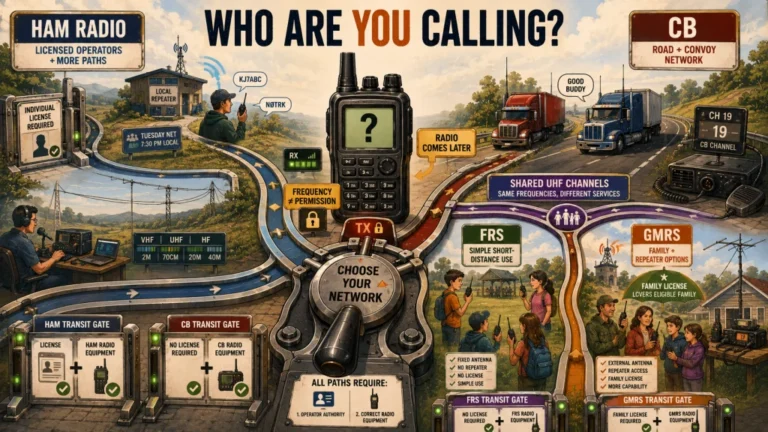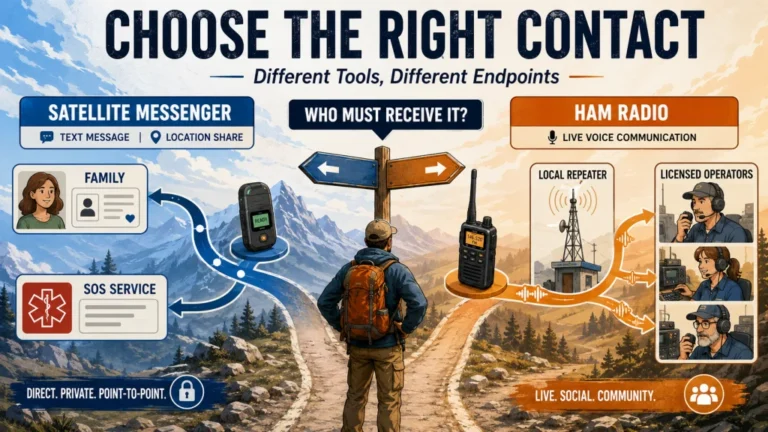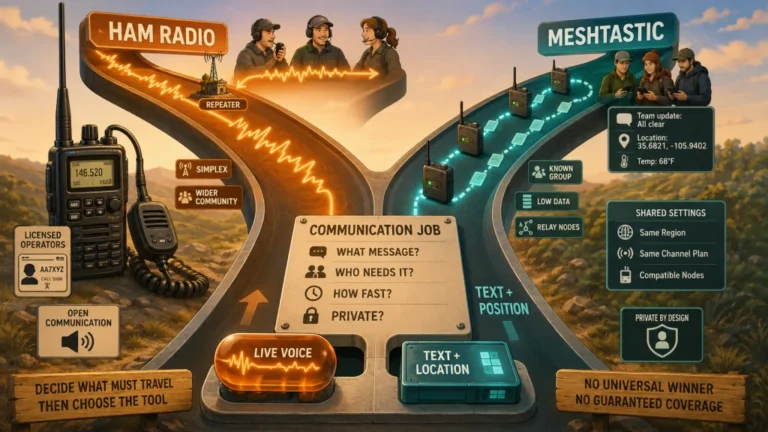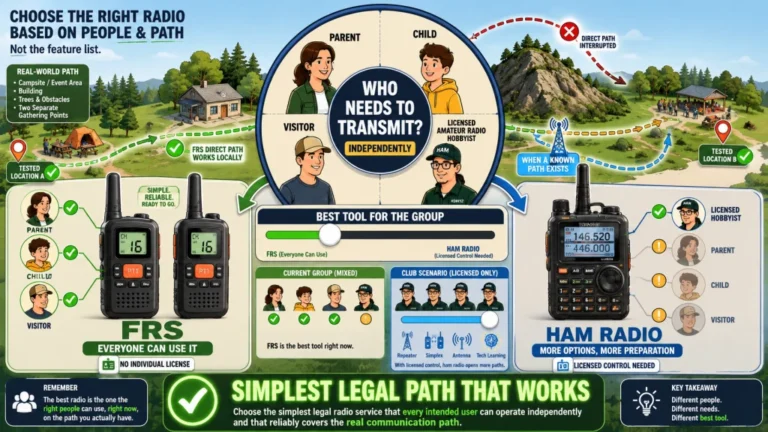
A satellite phone is built to call a specific number through a paid commercial network, while ham radio connects licensed operators over reachable amateur frequencies. Choose satellite voice when a named person, office, dispatcher, or expedition contact must receive a direct call beyond cellular coverage. Choose ham radio when the real need is local group communication, repeater access, scheduled radio networks, simplex coordination, or ongoing amateur operation. Neither system guarantees contact or rescue, so the correct choice depends on the recipient, legal authority, coverage path, power plan, and tested procedure.
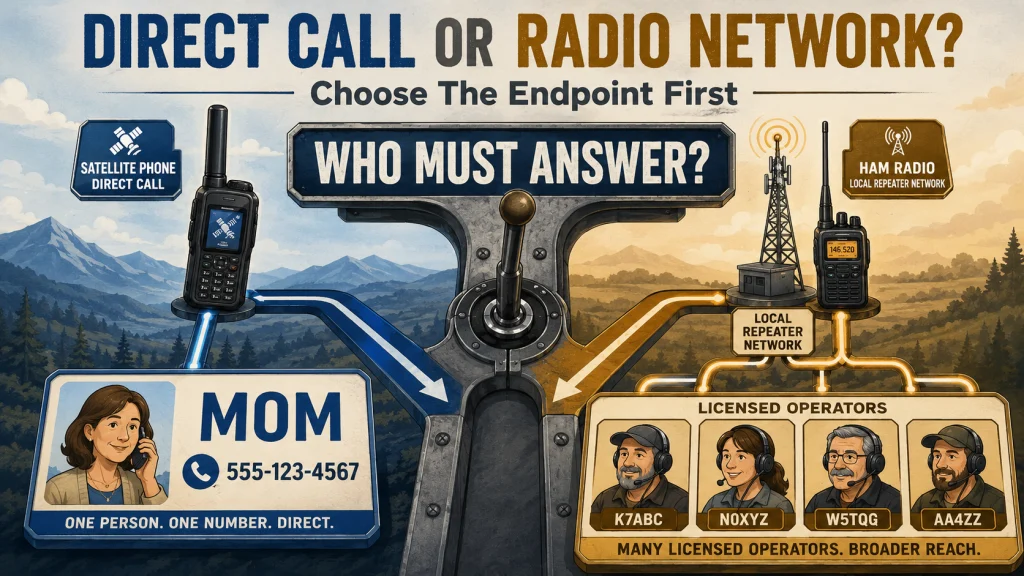
Ham Radio vs Satellite Phone Starts With the Recipient
The central difference in ham radio vs satellite phone is not distance. A satellite phone aims to place a direct voice call to a specific telephone number through an activated commercial service. Ham radio places a call sign on an amateur frequency and depends on another licensed station, repeater user, scheduled net, or HF operator being reachable and listening.
That difference changes the entire plan. A remote worker who must call an operations desk has a named recipient and a direct-voice requirement. A group of licensed volunteers coordinating across a county may need one-to-many radio communication instead. Both may be operating beyond normal cellular coverage, but they are not asking the same system to do the same job.
Key point: Write down who must answer before comparing hardware. “Someone on the radio” is not a direct substitute for a known telephone contact, and a satellite call to one person is not a substitute for a local group channel.
This article covers commercial satellite phones used for direct voice and any SMS or low-rate data functions supported by the exact network and service. It does not cover dedicated messengers, smartphone-only satellite SOS, broadband satellite terminals, or amateur satellites. Use the satellite messenger comparison for two-way text and tracking, and the smartphone satellite SOS comparison for phone-integrated emergency features.

The Yaesu FT-65R is a 144/440 MHz dual-band handheld transceiver rated for up to 5 watts output. It includes a 1950mAh lithium-ion battery pack. The supplied battery is rated for more than nine hours of operation, and a 2.5-hour rapid charger is included.
Check On AmazonIf you click this link and buy, we earn a commission at no additional cost to you.
Direct Dialing and Amateur Calling Use Different Workflows
A satellite phone normally has an assigned number, active service identity, and calling procedure determined by the provider. Outgoing calls may require an international dialing format, while incoming callers may need the full satellite number, a special access method, or awareness of potentially high calling charges. SMS, voicemail, call forwarding, and data are provider and plan specific rather than guaranteed category features.
The practical advantage is direct intent. The user can call a family member, employer, logistics contact, medical coordinator, marina, or other known number without requiring that person to hold an amateur license or monitor a radio channel. The receiving party still needs to answer, recognize the number, and know what action to take.
Ham radio replaces the assigned telephone number with call signs, frequencies, operating schedules, and radio paths. VHF or UHF may connect nearby simplex partners or a repeater community. HF may support longer-distance contacts when the operator has the privileges, antenna, frequency plan, propagation, and skill required for the path.
Field Note: When a new operator describes an emergency radio plan, I ask for the expected station at the other end. A programmed frequency is not a recipient. The plan becomes real only when it identifies a partner, repeater audience, scheduled net, or other trained operator who is expected to respond.
Ordinary amateur operation does not provide normal telephone service by default. Some radio systems may have specialized linking or phone-patch arrangements, but those should never be assumed to exist, remain active, or permit the intended traffic. If direct dialing is the requirement, evaluate it as a satellite telephone requirement.

The BTECH UV-PRO is an IP67 dual-band VHF/UHF radio with built-in GPS and APRS support. It pairs with the BTECH app for channel sharing and field configuration. The radio also includes Bluetooth audio support, NOAA weather alerts, and USB-C battery charging.
Check On AmazonIf you click this link and buy, we earn a commission at no additional cost to you.
The Two Systems Solve Different Communication Jobs
A useful satellite phone vs ham radio comparison separates the contact, infrastructure, operating authority, and failure points. The table below does not declare a universal winner. It shows which conditions must be true before either system becomes useful.
| Decision factor | Satellite phone | Ham radio |
|---|---|---|
| Primary job | Direct voice to a specific number through a commercial network | Voice or permitted data with reachable amateur stations |
| Recipient | Known personal, business, emergency, or operational contact | Simplex partner, repeater user, net control, or HF operator |
| Access requirement | Legal possession and use, activated service, valid account or airtime, and network access | Appropriate amateur authorization, legal privileges, working equipment, frequency plan, and another operator |
| Infrastructure | Satellite constellation, gateway network, service provider, and telephone interconnection | Direct RF path, repeater infrastructure, or propagation-supported HF path |
| Privacy model | Provider-routed commercial call subject to network security and service terms | Generally open radio communication that may be received by others |
| Recurring cost | Service, airtime, account, or prepaid validity may apply | No commercial network subscription for ordinary amateur operation |
| Main uncertainty | Coverage, obstruction, service state, congestion, dialing, and recipient response | Terrain, repeater status, propagation, interference, operator availability, and skill |
The right system is the one whose contact model matches the task. Paying for direct dialing can be justified when one known office must answer. Amateur radio can be more useful when several prepared operators need to hear the same local voice traffic.

The Icom IC-2730A is a dual-band VHF/UHF mobile radio rated for 50 watts. It supports simultaneous VHF/VHF, UHF/UHF, and VHF/UHF receive. Separate main dials, volume controls, and squelch controls are provided for the two bands.
Check On AmazonIf you click this link and buy, we earn a commission at no additional cost to you.
Satellite Coverage Still Depends on the Network and the Sky
A satellite phone should not be described as working everywhere merely because the user can see some sky. Coverage depends on the provider’s current constellation, service map, local authorization, gateway availability, account status, and the antenna’s usable path. Different networks may use moving low-Earth-orbit satellites or geostationary satellites that remain in one direction from the user.
That network design changes field use. A moving constellation may require a broad open view because satellites cross the sky and obstructions can interrupt a call. A geostationary service may require the antenna to face a particular direction and maintain a suitable elevation angle. Mountains, deep canyons, dense foliage, tall buildings, metal roofs, vehicle cabins, and ship structures can block or weaken the path.
Research-based: Provider instructions commonly require outdoor operation or a correctly installed external antenna with a clear, unobstructed view. The exact orientation and acceptable obstruction depend on the network and terminal, so generic “point it upward” advice is not sufficient.
- Check the current coverage map for the exact network and destination.
- Confirm whether the handset needs a broad sky view or a specific satellite direction.
- Identify safe outdoor calling locations before an emergency.
- Test incoming and outgoing calls using the active service configuration.
- Verify whether a vehicle, building, vessel, or external antenna changes the setup.
- Plan for blocked terrain rather than assuming a call can be placed from the lowest point on the route.
Network congestion and call setup delay can also matter during a regional emergency. A registered signal does not guarantee that a call will connect immediately or remain connected. The operating plan needs a retry interval, an alternate location, a backup contact, and a maximum waiting time before the user changes tactics.
Ham Radio Depends on a Reachable Station, Not a Coverage Map
VHF and UHF mobile or handheld communication is usually constrained by terrain, antenna height, building loss, and repeater location. A published repeater may be unreachable from a canyon, inactive, differently configured, restricted, or silent at the time it is needed. A simplex channel requires another prepared operator within a workable path.
HF can support off grid voice communication over longer distances, but it is not direct dialing and it is not a fixed-range service. Band conditions change with frequency, time, season, solar conditions, noise, antenna efficiency, and operator technique. The station that answers may be helpful, but it may not be the family member, office, or dispatcher the caller originally wanted.
For a planned radio path, record the primary frequency, mode, time, call signs, net procedure, antenna, power source, and fallback. Test from the actual operating area when practical. A successful contact from home does not prove the same station can be reached from a remote valley, offshore route, or work site.
Field Note: I do not count a repeater memory as tested because the display shows the right frequency and tone. I count it after the intended radio, antenna, location, and operator have completed the contact. That distinction prevents a directory entry from being mistaken for communication readiness.
The guide to planning long-distance ham radio explains where HF can fit and why propagation, antenna space, and license privileges must be treated as operating conditions rather than sales claims.

The Nagoya UT-72 is a 20-inch magnetic-mount VHF/UHF antenna centered on 144/430 MHz. It uses a PL-259 connector and includes an SMA adapter for compatible BTECH and Baofeng handheld radios. The package includes 13 feet of RG-58A/U coax for a 50-ohm radio installation.
Check On AmazonIf you click this link and buy, we earn a commission at no additional cost to you.
Privacy and Permitted Content Are Not Equivalent
A commercial satellite call travels through provider systems and is governed by the provider’s security, privacy, lawful-access, and service terms. That does not make every satellite conversation immune from interception, monitoring, account compromise, or local government access. Sensitive business or personal communication requires a separate security review rather than an assumption based on the word satellite.
US amateur transmissions are generally open to reception. Part 97 does not permit messages encoded for the purpose of obscuring their meaning, apart from limited rule exceptions that do not turn ordinary amateur voice into a private service. Operators should expect call signs, frequencies, and conversations to be heard by other listeners.
Content rules also differ. Amateur radio cannot be used as a routine substitute for business telephone service, and communications in which the operator has a pecuniary interest are restricted except where the rules specifically permit them. A field worker needing routine commercial calls to clients or headquarters should not assume an amateur license authorizes that traffic.
The practical distinction is simple: a satellite phone is a commercial telecommunications service, while ham radio is a regulated amateur service with a different purpose. Technical ability to place or relay a message does not create legal authority to use the channel for every type of traffic.
Compare the Complete Current Cost of Each Path
Satellite phone pricing changes with the handset, rental period, activation, monthly or prepaid service, airtime, incoming-call method, regional plan, taxes, and accessories. A low handset price can be offset by expensive minutes or a short prepaid expiration period. A rental can be economical for one trip but unsuitable for an organization that needs the same number, contact procedure, and training throughout the year.
Build the satellite total from the exact service being considered:
- handset purchase or rental;
- deposit, insurance, shipping, and return terms for a rental;
- activation, monthly service, prepaid validity, or reactivation;
- outgoing airtime, incoming-call charges, voicemail, SMS, and data where supported;
- regional SIM or service limitations;
- spare battery, charging equipment, protective case, and external antenna;
- test calls and required training airtime.
Ham radio costs begin with licensing and the station. The current FCC application fee for a new amateur license is $35, while ordinary operator-class upgrades are exempt from that FCC fee; exam-team charges are separate and vary. The station total may include a handheld, mobile, or HF radio, antenna, feed line, power supply or vehicle wiring, batteries, mounts, and installation materials.
| Cost pattern | Satellite phone | Ham radio |
|---|---|---|
| Short single trip | Rental or short service term may fit, subject to availability and testing time | License and station preparation may be disproportionate if no continuing radio use is planned |
| Recurring field work | Stable service, assigned number, account management, and airtime become operational costs | Equipment can be reused, but every transmitting operator and path must remain prepared |
| Local group coordination | Individual calls are inefficient for one-to-many voice | A shared simplex or repeater channel may serve the group better |
| Direct external contact | Paid voice path can be the required capability | No subscription saving matters if the intended person cannot be reached |
Refresh every price before publication or purchase. The fair comparison is the complete cost of reaching the required recipient, not the purchase price of two devices placed side by side.
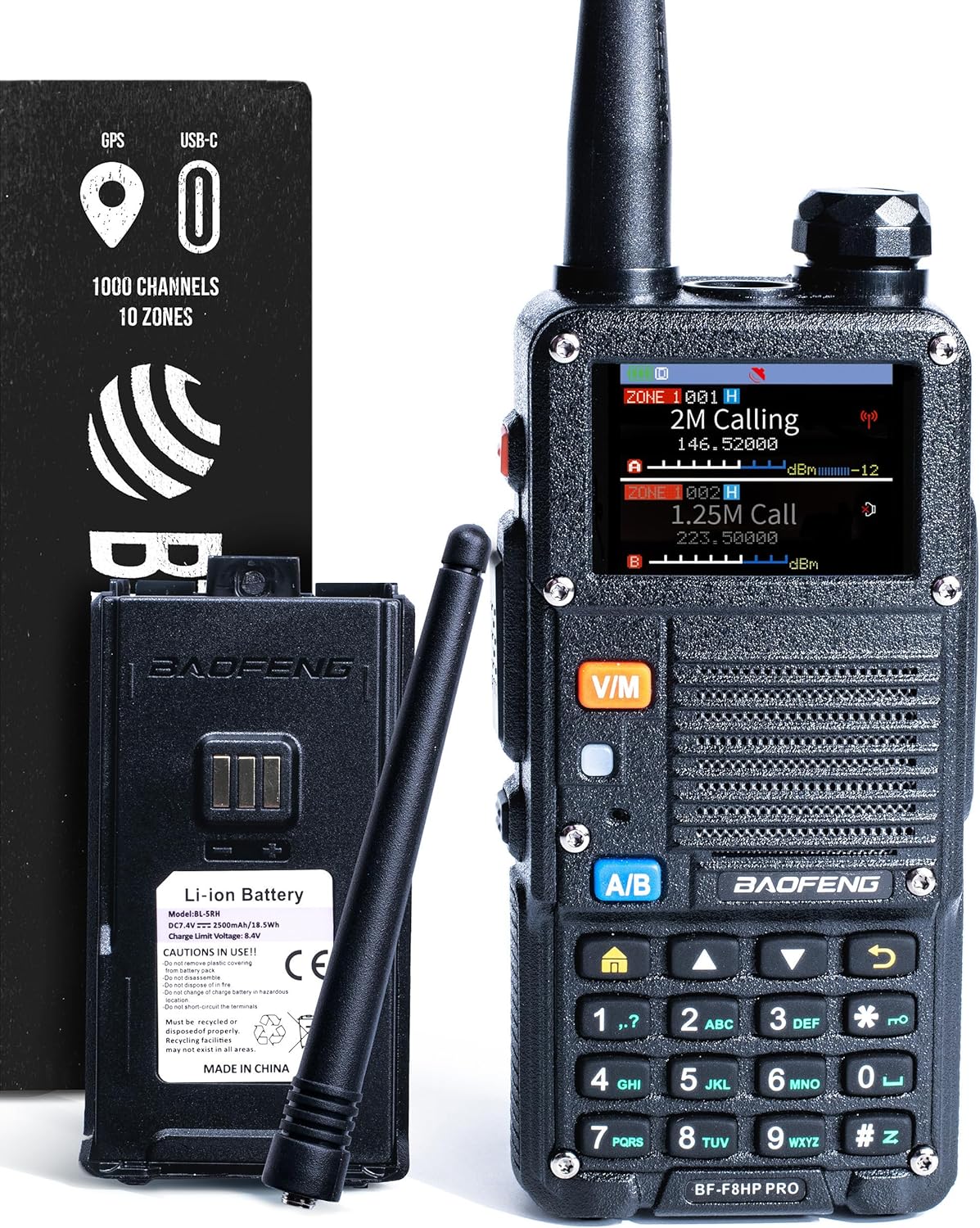
The BF-F8HP PRO is a tri-band amateur handheld covering 144-148, 222-225, and 420-450 MHz for transmit and receive. It supports up to 1,000 organized channels and USB-C charging. The radio also provides aviation AM, NOAA, and FM receive plus GPS support.
Check On AmazonIf you click this link and buy, we earn a commission at no additional cost to you.
International Travel Requires Two Separate Legal Checks
Satellite phone possession, import, registration, and use are country specific. Rules can range from ordinary permission to required authorization, confiscation, fines, or criminal penalties. A network coverage map shows where a technical signal may exist; it does not grant legal permission to bring the device across a border.
Amateur authority also stops at the border unless the destination recognizes the operator’s license through an applicable arrangement or issues the required authorization. The US call sign alone does not provide worldwide transmitting authority. Frequency allocations, power limits, permitted modes, call-sign procedures, equipment import rules, and reciprocal privileges can all change by country.
Warning: Check both technologies separately with the destination’s telecommunications regulator, customs authority, embassy or consulate guidance, and the current provider documentation before travel. Do not pack the device first and ask about legality at customs.
Expedition and maritime plans may add vessel, port, flag-state, employer, or protected-area requirements. Record the written authority, permit number, allowed equipment, frequencies, and dates with the trip documents. If the answer cannot be confirmed, remove the device from the plan rather than relying on forum recollection.
Neither Device Guarantees Emergency Contact or Rescue
A satellite phone still needs legal service, an active account or airtime, a charged battery, a working network, a usable satellite path, the correct dialing procedure, and someone who answers. Emergency-number behavior is not universal across providers, terminals, plans, and countries. A familiar cellular emergency number should not be assumed to route correctly from a satellite handset.
Prepare direct emergency numbers and ordinary contacts in advance. Include the service provider’s emergency procedure where one exists, local rescue or coordination numbers appropriate to the route, the employer’s escalation contact, and a person who holds the trip plan. Test only through the provider’s approved non-emergency procedure; never place a live emergency call merely to see whether it works.
Ham radio needs a reachable listener and an operator who can communicate location, condition, and requested assistance clearly. An amateur station may reach someone quickly, or the channel may remain silent. Emergency provisions in US amateur rules are important, but they do not replace normal licensing, tested paths, contact schedules, and practical operating skill before the incident.
The wider guide to building an emergency radio plan explains why the radio, other station, schedule, power, and response procedure must be prepared together.

The BTECH DMR-6X2 supports both DMR digital and analog operation on VHF and UHF with up to 7 watts output. Its built-in GPS supports location tracking and APRS functions. The included accessory kit has two batteries, with USB-C charging supported by the listed battery configuration.
Check On AmazonIf you click this link and buy, we earn a commission at no additional cost to you.
Choose the System From the Communication Job
Choose a satellite phone when the requirement is direct voice with known contacts beyond cellular service. Common examples include a remote employee calling a duty desk, an expedition leader reporting to logistics, a vessel contacting shore, or a traveler speaking with family. The plan must justify the service cost and confirm legal use, coverage, dialing, and emergency workflow.
Choose ham radio when the real goal is communication with licensed local or regional partners, group simplex, repeater communities, scheduled nets, amateur public-service activity, or HF operating as an ongoing skill. The value grows when the operator practices regularly rather than storing the radio for an event that may never happen.
| User situation | Likely priority | Reason |
|---|---|---|
| Solo remote traveler calling home | Satellite phone | The recipient is a known number and may have no radio training. |
| Remote field team reporting to headquarters | Satellite phone, subject to business and security requirements | Direct commercial voice matches the operational workflow. |
| Licensed group traveling in several vehicles | Ham radio for local coordination | One-to-many voice is more efficient than separate telephone calls. |
| Operator pursuing regular HF communication | Ham radio | The activity itself is amateur operating, not telephone replacement. |
For vehicle groups, the off-road radio selection framework helps match the radio to terrain, partner equipment, power, and antenna needs. It should not be used to justify amateur radio for unlicensed drivers or routine business traffic.

The BTECH UV-5X3 is a tri-band amateur handheld for VHF, 1.25-meter, and UHF operation. It provides 128 memory channels and supports PC programming. The package includes a rechargeable battery, charger, dual-band antenna, and a separate 220 MHz antenna.
Check On AmazonIf you click this link and buy, we earn a commission at no additional cost to you.
Use Both Only When Each Has a Documented Assignment
Carrying both can be reasonable because the systems serve different recipients and fail in different ways. A satellite phone can handle direct external calls while ham radio supports local voice among licensed team members. That is useful redundancy only when the devices are separated appropriately, powered, tested, and assigned to people who understand them.
- Satellite assignment: named numbers, dialing format, check-in schedule, emergency procedure, airtime state, and legal destination use.
- Radio assignment: licensed operators, call signs, frequencies, repeater details, net times, antenna, and fallback path.
- Power assignment: charging equipment, spare batteries, temperature protection, and responsibility for daily checks.
- Separation assignment: decide which device follows which person, vehicle, vessel, or work team.
- Escalation assignment: define what happens after a missed call, failed radio contact, blocked sky, or silent repeater.
Do not keep every device, charger, number list, and frequency plan in one bag. A two-system plan should survive the loss of one person, vehicle, power source, or equipment case. It should also identify which system is tried first for each type of message.
Test the Complete Voice Path Before Departure
A power-on check is not enough. The satellite test must include account access, network registration, an outgoing call, an incoming call, caller recognition, dialing format, audio, voicemail or fallback where used, and a review of remaining service or airtime. Perform the test from a legal outdoor location that resembles the expected operating environment as closely as practical.
The ham test must use the intended radio, antenna, power source, frequency information, and another station. Confirm the primary and backup paths, then print or store the operating details somewhere that does not depend on a single phone.
Temperature can change the power plan for both systems. Cold conditions can reduce available battery capacity and shorten useful transmit time, while prolonged heat can accelerate battery wear and trigger thermal protection or charging limits. Keep spare batteries insulated from extreme temperatures, avoid leaving devices in a hot closed vehicle, and test expected runtime under conditions close to the trip rather than relying only on a room-temperature rating.
- Verify possession and use are legal at every destination and transit point.
- Confirm the satellite account, service period, number, PIN, and airtime state.
- Store numbers in full required dialing format and place a routine test call.
- Have the contact call the satellite number back and confirm the incoming workflow.
- Identify an open-sky calling position and an alternate location.
- Charge all batteries, protect them from temperature extremes, and test every cable, adapter, and external antenna.
- Program and recall the ham channels, then complete a real contact.
- Print numbers, frequencies, call signs, schedules, permits, and fallback instructions.
- Give the home or office contact the trip plan and missed-contact procedure.
The communication plan is ready when the intended person at the far end has answered a routine test and knows what to do next. That standard applies whether the path uses a telephone number or an amateur call sign.

The BTECH PC03 uses a genuine FTDI chipset with a two-pin K1 radio connector. It supports compatible Baofeng and Kenwood handhelds including the UV-5R, UV-82, and BF-F8HP families. The cable works with current FTDI drivers on Windows, macOS, and Linux.
Check On AmazonIf you click this link and buy, we earn a commission at no additional cost to you.
Final Thoughts: Choose the Endpoint Before the Equipment
A satellite phone is the clearer choice when direct voice to a known number is the actual requirement. Ham radio is the stronger fit when trained operators need local or regional group communication, repeater access, or amateur HF activity. Neither becomes reliable merely because the device is expensive, rugged, licensed, or advertised for emergencies.
I would make the decision by writing four answers: who must respond, which legal network can reach that person, what can block the path, and what happens after a failed attempt. Once those answers are specific, the choice between satellite phone and ham radio is usually much less complicated.
FAQs
📞 Can a satellite phone call a normal phone number?
Usually, when the account, network, plan, and dialing format support it. Verify outgoing and incoming procedures because callers may need the full satellite number or a provider-specific access method.
📻 Can ham radio call a specific family member?
Only when that person is properly licensed, has compatible equipment, and is listening on the planned path. Amateur radio does not provide ordinary direct telephone service by default.
🆘 Can I dial 911 from any satellite phone?
Do not assume so. Emergency-number routing depends on the provider, terminal, plan, country, and current service procedure. Carry verified emergency and operational contact numbers for the destination.
🏔️ Will a satellite phone work in a canyon?
Terrain can block the required satellite path. Identify safer open-sky calling positions in advance and follow the exact antenna-orientation instructions for the network and terminal.
🔐 Are satellite phone calls private?
They use commercial provider systems, but privacy and security depend on the service, device, account, lawful-access environment, and threat model. Do not assume that satellite automatically means confidential.
🌍 Can I take a satellite phone to another country?
Only after confirming current import, possession, registration, and use rules for the destination and transit countries. Technical coverage does not provide legal permission.
🪪 Can I use my US ham license overseas?
Not automatically. Confirm reciprocal authority, permit requirements, call-sign procedure, allowed bands, power, modes, and equipment rules for the exact destination before transmitting.
💵 Is ham radio cheaper than a satellite phone?
It may avoid commercial airtime charges, but the license, radio, antenna, power, installation, and training still cost money. It is not a cheaper substitute when the required recipient can only be reached by direct telephone call.