Ham radio and Meshtastic solve different communication problems. Ham radio is an operator-licensed service built for voice, many data modes, repeaters, direct contacts, experimentation, and access to a wider amateur community; Meshtastic is a low-data LoRa system built around text, position, telemetry, and relayed packets among compatible nodes. Meshtastic is usually the better fit when a known group needs silent messaging and location sharing, while ham radio is the stronger fit when live voice and broader operating options matter. Neither system creates guaranteed off-grid coverage, so the decision should start with the message type, the people involved, and the path you can actually test.
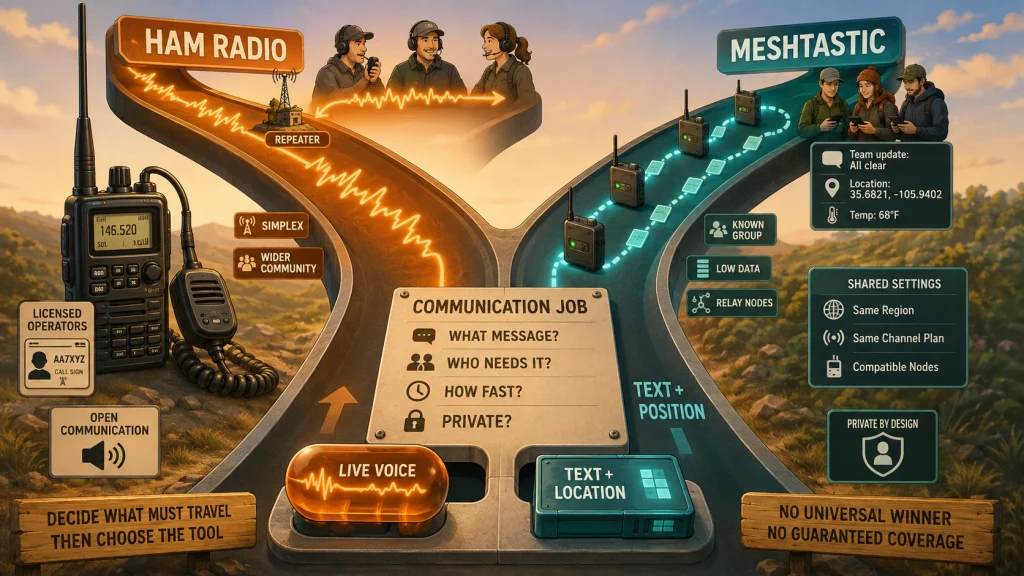
Ham Radio vs Meshtastic Starts with the Job
The easiest way to make the wrong choice is to compare radios before defining the communication job. Ham radio vs Meshtastic is not a contest between an old technology and a new one. One is a licensed radio service with voice and many operating paths; the other is software that turns compatible LoRa devices into a low-data network for short messages, location, and telemetry.
A family spread across a campground may value quiet text updates and shared positions. A volunteer group coordinating changing tasks may need immediate voice. A property owner may want small status packets from fixed points, while someone interested in making contacts beyond a known group may want repeaters, simplex, or HF. Those are different requirements, even when every scenario is described as off-grid communication.
Research-based decision rule: Treat this as a job-matching decision, not a technology ranking. Write down the message, who must send it, how quickly it must arrive, whether it needs privacy, and what infrastructure the group controls. The system that fits those answers is more useful than the one with the most impressive range story.
This comparison stays with U.S. amateur operation and compliant Meshtastic use for local messaging, tracking, events, property, and preparedness. It does not cover satellite communicators, recommend specific boards or radios, or assume that a technically possible setting is lawful.

SenseCAP T1000-E is a card-format tracker designed for Meshtastic. It uses nRF52840, LR1110, and an AG3335 GPS module for LoRa communication and positioning. The sealed IP65 design supports LoRa across the 863 to 928 MHz range along with Bluetooth 5.0, Thread, and Zigbee.
Check On AmazonIf you click this link and buy, we earn a commission at no additional cost to you.
The Communication Models Are Fundamentally Different
Ham radio connects human operators through several paths. Two stations may communicate directly on simplex, use a local repeater, work through an amateur digital network, or use HF when license privileges, propagation, antennas, and operator skill support it. The station operator chooses a frequency and mode, identifies as required, and manages the contact in real time.
Meshtastic sends packets among nodes that share compatible radio settings. A node can receive a packet, recognize that it has not seen it before, and relay it while the packet still has hops available. The person normally interacts through an app or device interface, while the radios handle packet transmission and relaying.
| Decision Factor | Ham Radio | Meshtastic |
|---|---|---|
| Primary interaction | Live operator-to-operator communication | Short packets among configured nodes |
| Common content | Voice, data, images, telemetry, and other authorized amateur modes | Text, position, telemetry, node information, and low-bandwidth application data |
| Who can receive usefully | Compatible stations on the chosen frequency and mode | Nodes sharing compatible radio settings, with readable content depending on channel configuration and keys |
| Relaying | Repeaters and other rule-compliant amateur systems where available | Participating nodes can relay packets until routing and hop limits stop further forwarding |
| Human timing | Immediate conversation and turn-taking | Messages may be delivered, relayed, delayed, retried, or missed depending on the path |
The distinction changes how a group plans. Ham radio asks whether operators can reach one another and manage the contact. Meshtastic asks whether the necessary nodes share settings, have power, and form a usable packet path. Calling both systems “radio communication” does not make their workflows interchangeable.

This RAKwireless WisBlock Mini Starter Kit is the US915 version for Meshtastic projects. It uses the RAK19003 Mini Base as the foundation of the kit. The listing specifically identifies 915 MHz as the radio version for the United States market.
Check On AmazonIf you click this link and buy, we earn a commission at no additional cost to you.
Choose Voice or Low-Data Messaging First
Normal voice communication is the clearest dividing line. Ham radio supports live voice on suitable bands and modes, which makes it practical when the message is changing quickly, when a question needs an immediate answer, or when several details are easier to explain aloud. Tone of voice can also communicate urgency that may be lost in a short text packet.
Meshtastic is designed around low-bandwidth data rather than normal voice calls. It can carry short messages, position information, device telemetry, and other compact data. That makes it useful when silence matters, when a recipient cannot listen continuously, or when a brief written record is more useful than an open microphone.
Bandwidth discipline matters because LoRa’s range and robustness trade against data rate and airtime. A longer or more robust radio preset does not turn the network into a broadband messaging service. More traffic also consumes shared airtime, raises contention, and can reduce the reliability of a busy local deployment.
Ham radio also has digital modes, but “digital” does not mean the same operating model or the same privacy rules. The beginner view of amateur digital modes explains those paths without treating Meshtastic as another amateur voice protocol.

The Retevis RT95 is a dual-band 2m and 70cm mobile ham radio. It includes dual speakers, CHIRP support, VOX, and a 180-degree rotatable LCD screen. The kit is sold as a mobile or base-station transceiver package with a vehicle cable.
Check On AmazonIf you click this link and buy, we earn a commission at no additional cost to you.
Encryption Is a Real Difference, with Important Limits
Meshtastic can encrypt the application payload carried on a channel. Nodes that do not have the key may still relay a packet because routing information remains available, while the message content stays unreadable to them. A private group must replace the default known channel key or create a properly configured private channel rather than assuming the factory-default channel is private.
That capability should not be overstated. Meshtastic’s own security documentation describes limitations in areas such as channel-message integrity, group authentication, key handling, and protection after a device or shared key is compromised. Direct-message protection has improved in current firmware, but a low-power mesh should not be described as equivalent to a modern internet messenger built around a different threat model.
U.S. amateur radio follows a different rule. Amateur stations generally may not transmit messages encoded for the purpose of obscuring their meaning, except where Part 97 specifically provides an exception. A digital amateur mode can use encoding as part of its technical format, but it should not be presented as a private encrypted channel for ordinary personal traffic.
This difference can decide the entire comparison. A group that genuinely requires silent, encrypted low-data messages may find Meshtastic closer to the job. A group that needs open live voice, wider experimentation, or communication with the amateur community may accept ham radio’s non-private operating model.

The ELECROW ThinkNode M1 combines an nRF52840 controller with an SX1262 LoRa radio and a 915 MHz antenna for Meshtastic. Its built-in positioning supports GPS, GLONASS, BeiDou, and QZSS. The device also includes a 1.54-inch EPD screen and a 1200mAh battery.
Check On AmazonIf you click this link and buy, we earn a commission at no additional cost to you.
Meshtastic Software Does Not Make Every Configuration Legal
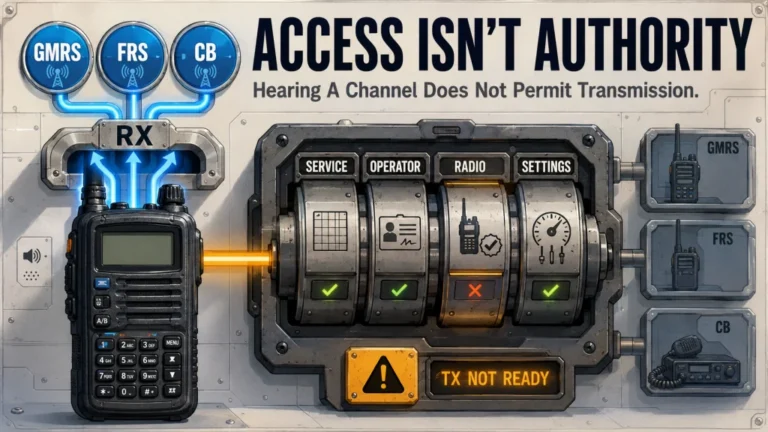
In the United States, many Meshtastic deployments use unlicensed Part 15 operation in the 902 to 928 MHz band, but the absence of an individual operator license is not permission to ignore equipment rules. The device, radio module, antenna arrangement, power, emissions, and operating configuration still need to remain within the authorization and rules that apply to that equipment.
Changing a region setting, enabling a licensed mode, adding an antenna, or increasing power can change the compliance question. Meshtastic offers region-specific settings because frequency and power rules differ across countries. The correct region must match the physical location, and a setting that appears in software is not proof that the connected hardware may lawfully use it.
Part 15 operation also carries a practical limitation: it must not cause harmful interference and must accept interference from authorized services and other compliant devices. If an FCC representative requires a harmful-interference source to stop, operation cannot resume until the problem is corrected. That is not the same operating status as an amateur station using authorized amateur spectrum under a licensed control operator.
Warning: Do not infer legal authority from technical capability. Verify the exact hardware authorization, approved antenna arrangement, current firmware behavior, region, power, and local use before deploying a node.
Ham radio has its own gate. A station needs an appropriately licensed control operator, must stay within the privileges of that license, and must follow Part 97 operating rules. Neither path is “unregulated”; the rules simply attach to different parts of the system.

The ARRL Ham Radio License Manual 5th Edition is a study guide for the Technician Class amateur radio exam. It includes the Technician question pool for exam preparation. The book is designed to help prospective operators prepare for the entry-level amateur radio license test.
Check On AmazonIf you click this link and buy, we earn a commission at no additional cost to you.
Range Depends on the Path, Not the Logo
Fixed miles-per-hop promises are not useful for a Meshtastic plan. Terrain, antenna height, antenna performance, building loss, interference, radio preset, power, and node placement can change the result dramatically. A well-positioned node with a clear path may outperform several poorly placed nodes that are close on a map.
A mesh also needs participating nodes in useful locations. Adding nodes does not automatically improve coverage if they cannot hear one another, repeat the wrong traffic, lose power, or sit behind the same obstruction. Hop limits stop packets from being forwarded forever, and heavy local traffic can consume airtime before a packet reaches its destination.
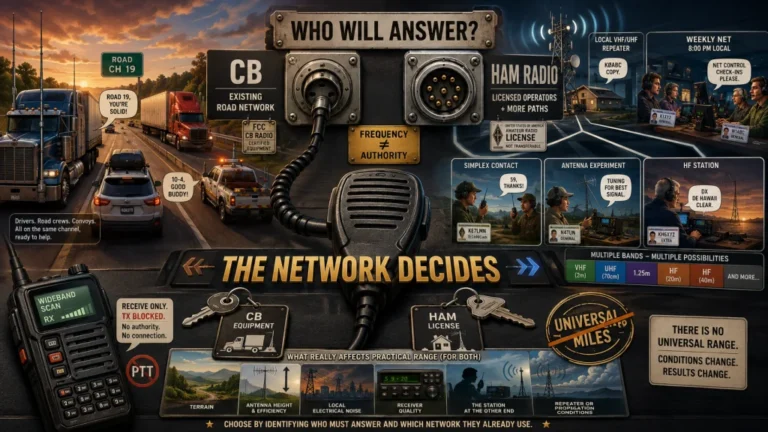
Ham radio range is equally conditional. A repeater may provide excellent regional coverage when it is available and reachable, while a handheld simplex contact may fail across a short distance because of terrain or buildings. HF can reach much farther under the right conditions, but it adds license privileges, antennas, propagation knowledge, power needs, and operating skill.
The useful comparison is a tested path between the actual locations. For ham, that may mean confirming a repeater and a direct fallback. For Meshtastic, it may mean placing trial nodes, checking message delivery from the real sites, and moving relay points before declaring the network ready.

The Nagoya NA-771 is a 15.6-inch whip antenna for VHF and UHF operation. The listing specifies 144 and 430 MHz coverage and an SMA-Female connector. It is listed for compatible BTECH and BaoFeng handheld radios.
Check On AmazonIf you click this link and buy, we earn a commission at no additional cost to you.
Both Can Work Without the Internet, but Neither Works by Magic
Meshtastic can exchange LoRa packets without cell service, Wi-Fi, or internet access. That independence is useful, but the network still depends on functioning nodes, charged batteries or stable power, compatible settings, usable radio paths, and people who know which channel and workflow to use. Optional internet-connected features should not be confused with the core radio mesh.
Ham radio can also operate without commercial internet or cellular service. Simplex contacts do not require a repeater, and HF does not require local repeater infrastructure. Still, repeaters may be absent, damaged, overloaded, or unreachable; direct paths may be blocked; and a station may fail because of power, antenna, configuration, or operator error.
| Failure | Meshtastic Effect | Ham Radio Effect |
|---|---|---|
| Internet unavailable | Core local LoRa messaging can continue; internet-dependent services do not | Local simplex, repeaters with independent operation, and HF may continue; linked services may not |
| Relay or repeater unavailable | The packet may need another participating node or a direct path | The operator may need simplex, another repeater, or another band and station setup |
| Power loss | Dead nodes remove endpoints or useful relays | Dead stations and repeaters remove operating paths |
| Configuration mismatch | Nodes may not share a usable radio mesh or readable channel | Stations may use the wrong frequency, mode, repeater shift, tone, or digital system |
| No trained user | Messages, channel keys, and node plans may be misunderstood | Operators may not know the calling, identification, or fallback procedure |
A preparedness plan should therefore test the entire communication path, not merely power on each device. The emergency communication planning process applies the same discipline to amateur radio: programmed paths, practiced procedures, power, and realistic fallbacks matter more than theoretical capability.

This BAOFENG battery pack provides 3800mAh capacity for compatible UV-5R and BF-F8HP series radios. Each battery supports USB-C charging and the package includes Type-C charging cables. The listing is for a two-pack of extended-capacity batteries.
Check On AmazonIf you click this link and buy, we earn a commission at no additional cost to you.
The People Requirement May Decide Before the Radio Does
A group using Meshtastic needs compatible, configured devices and a channel plan. Members must know which messages belong on the network, how location sharing is handled, who controls keys, how lost devices are removed from trust, and where fixed relay nodes receive power. Giving everyone a node without those decisions creates equipment ownership, not a communication system.
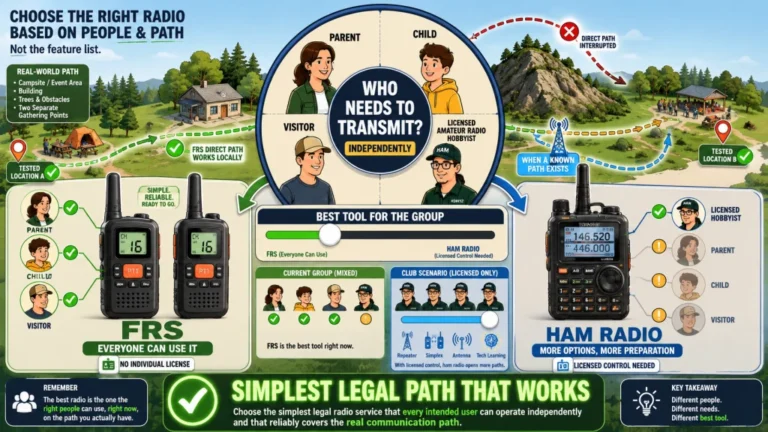
A group that expects each person to independently carry and operate an amateur station needs each operator to hold the appropriate license. An unlicensed person may participate under a licensed control operator in situations allowed by the rules, but that is not the same as independent operation by every group member. Licensing can be a manageable step, yet it remains a real participation gate.
Ham radio has an advantage when communication outside the original group matters. A licensed operator can call other amateurs, use available repeaters, participate in nets, and explore additional bands and modes within license privileges. Meshtastic is strongest when the communicating group is already known and every participant has been given a compatible place in the node plan.
This is why “no license required” is not a complete reason to choose Meshtastic, and “more capable radio service” is not a complete reason to choose ham. The better system is the one the intended people can legally configure, carry, power, understand, and practice.

The Heltec MeshPocket Qi2 combines nRF52840 and SX1262 hardware with Meshtastic firmware. It includes a 10000mAh power bank, wireless charging, and an E-Ink display. The listing identifies this yellow model as a magnetic Meshtastic-compatible device intended for outdoor emergency use.
Check On AmazonIf you click this link and buy, we earn a commission at no additional cost to you.
Choose Meshtastic for a Defined Low-Data Group Plan
Meshtastic is the stronger fit when the core requirement is quiet text, position sharing, or compact telemetry among a known group. It is especially attractive when nodes need a small power budget, messages should wait in an app rather than demand immediate attention, and the group can place and maintain useful nodes along the intended path.
The word “known” matters. You should know who needs a device, which locations must connect, who manages channels and keys, how messages are prioritized, and where a relay can be powered. A public map showing activity nearby may be encouraging, but it is not a substitute for a tested group network.
- Choose it for the message: short text, position, telemetry, or status updates are enough.
- Choose it for the group: participants are known and can use compatible settings and channels.
- Choose it for the environment: silent communication and low power matter more than immediate voice.
- Choose it for the deployment: the group can test locations, maintain nodes, and manage keys.
- Do not choose it for a slogan: “mesh” does not guarantee relays, coverage, delivery, or privacy without correct setup.
Meshtastic is not automatically the easier option. It moves the work from licensing and voice procedure into node placement, firmware, channel planning, key management, app use, and network testing. That trade can be worthwhile when low-data messaging is the actual job.

The Wio Tracker L1 E-Ink ships pre-flashed for Meshtastic and uses nRF52840 with an SX1262 LoRa radio. It includes an L76K GPS and a 2.13-inch E-Ink display. The board supports solar, battery, and USB Type-C power options for off-grid mesh projects.
Check On AmazonIf you click this link and buy, we earn a commission at no additional cost to you.
Choose Ham Radio When Voice and Broader Operation Matter
Ham radio is the stronger fit when live voice is central, when the operator wants access to an existing amateur community, or when the communication plan may expand beyond one closed group. Repeaters, direct simplex, nets, multiple bands, and HF give an operator several paths, although no individual path is guaranteed.
It also fits the person who wants radio itself to become a skill. Learning propagation, antennas, operating procedure, digital modes, and station design creates flexibility that a prearranged text network does not attempt to provide. That flexibility costs time and requires licensing, but it can support many interests beyond the original local messaging problem.
Ham radio is a poor substitute when the actual requirement is private family text or encrypted location sharing. Open amateur communication and operator identification are features of the service, not bugs that can be quietly configured away. Choosing ham means accepting that operating model.
For a wider comparison with present-day communication choices, matching ham radio to modern alternatives keeps the decision tied to voice, data, privacy, infrastructure, and user access rather than treating one technology as the universal answer.
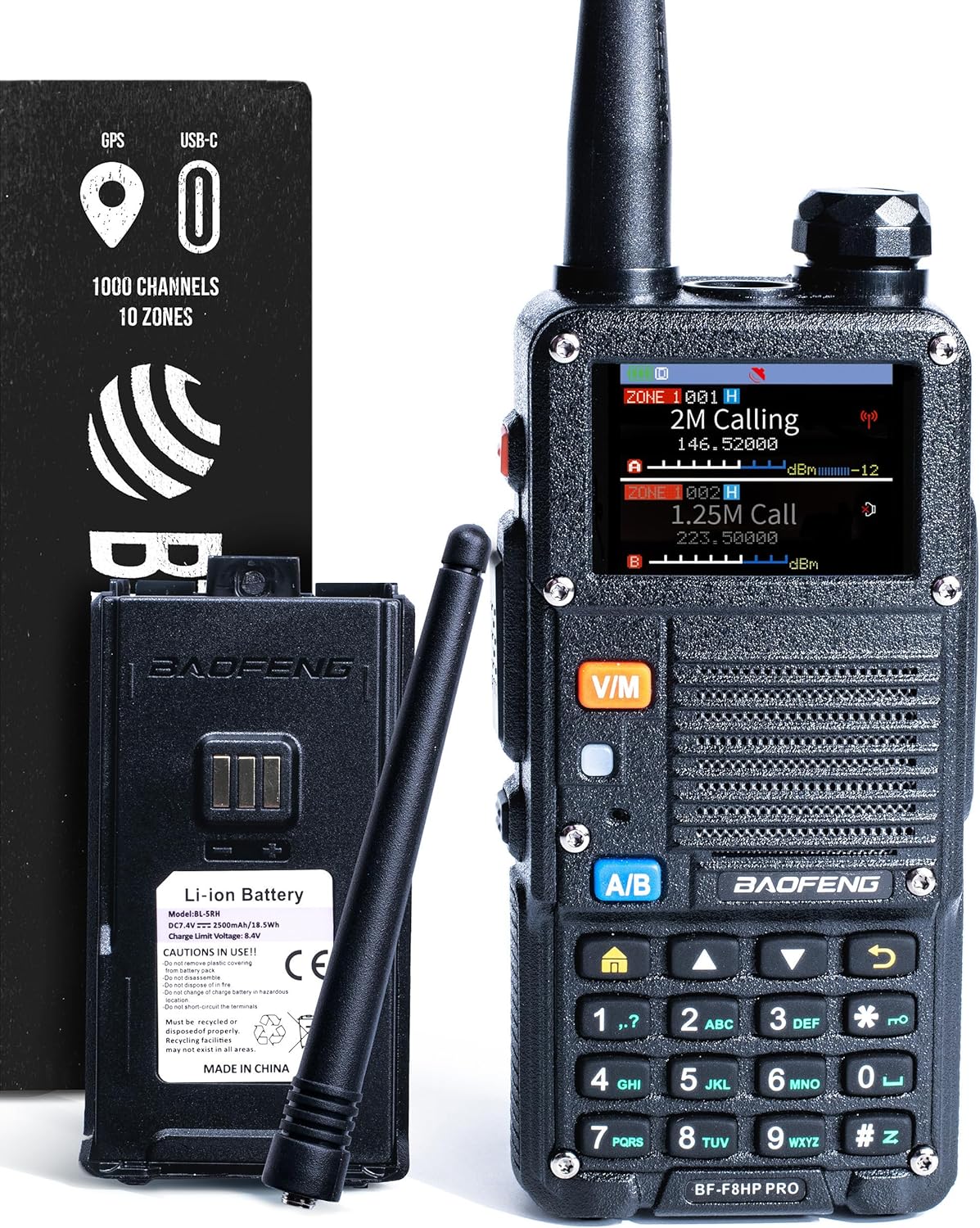
The BAOFENG BF-F8HP PRO is a 10 W tri-band handheld with 1000 channels. It includes GPS, NOAA weather functions, and scanning for aviation, VHF, UHF, and 1.25-meter frequencies. The listing also specifies an IP54-rated body and a USB-C rechargeable battery.
Check On AmazonIf you click this link and buy, we earn a commission at no additional cost to you.
Use Both Only When Each Has a Separate Job
A two-system plan can make sense, but owning both is not a requirement for serious preparedness or outdoor communication. The combination is useful only when the jobs are distinct. Meshtastic might carry quiet positions and short status messages inside a known group, while ham radio handles live voice, contact with other amateurs, or a separate repeater and simplex path.
Write the division down. Identify which system carries routine status, which carries urgent voice, what happens when a packet is not acknowledged, and when the group switches paths. Without those rules, people may watch different devices and assume someone else received the message.
The extra system adds charging, maintenance, training, and configuration work. Add it only after one primary path works. Redundancy is valuable when the second path fails differently and the users know how to activate it.

This Meshnology kit includes two ESP32 LoRa V3 development boards built around the ESP32-S3 platform. Each set includes an 1100mAh battery, protective case, 915 MHz antenna, and SX1262 LoRa hardware. The boards are sold for Meshtastic, Arduino, LoRaWAN, and related IoT projects.
Check On AmazonIf you click this link and buy, we earn a commission at no additional cost to you.
Make the Decision with One Tested Scenario
Do not settle the choice with a feature table alone. Pick one real scenario, such as a group moving around an event site, family members at separate trail points, or communication across a property. Then test the message, locations, people, timing, power, and fallback that the scenario requires.
- Define the message. Decide whether the group needs live voice, short text, position, telemetry, or a combination.
- Define the users. Count the independent ham operators or the Meshtastic nodes and app users required.
- Map the path. Mark terrain, buildings, repeater coverage, candidate node sites, and power locations.
- Set the legal gate. Confirm amateur privileges or compliant Part 15 hardware and settings before transmitting.
- Test delivery. Use the actual locations and record what succeeds, fails, delays, or requires a relay.
- Test failure. Remove a relay, lose internet, shut down a repeater path, or simulate a dead battery.
- Write the workflow. State who sends what, on which system, and what action follows no response.
One successful parking-lot demonstration is not enough. Repeat the test at the time, terrain, and occupancy level that matter. The outcome may show that one system is sufficient, that the planned node site must move, or that the group needs voice and low-data messaging as separate paths.

The SenseCAP Solar Node P1-Pro is a solar-powered LoRa node built for Meshtastic. The listing describes it for outdoor wireless communication and GPS tracking. The product combines a solar-powered enclosure with Meshtastic and GPS tracking functions in one outdoor node.
Check On AmazonIf you click this link and buy, we earn a commission at no additional cost to you.
Final Thoughts: Choose the Communication Model Before the Device
Choose Meshtastic when a known group needs silent low-data messaging, position sharing, modest power use, and a node plan it can maintain. Choose ham radio when live voice, repeaters, contact with other operators, multiple bands, or HF are part of the requirement. Use both only when the group can name the separate job and fallback for each.
The honest answer to ham radio or Meshtastic is not a universal winner. It is the path that carries the required message legally between the actual people and places, with equipment they can power and procedures they have practiced. Test that path before depending on it.
For the broader service-level decision, compare ham radio with GMRS to see how licensing, equipment authorization, group access, and voice communication change under another common U.S. radio option.

The ThinkNode M3 is a 915 MHz Meshtastic card tracker using LR1110 and nRF52840 hardware. It includes GPS, a 770mAh rechargeable battery, and IP66 water resistance. The listing specifies indoor and outdoor positioning tracking as the intended use.
Check On AmazonIf you click this link and buy, we earn a commission at no additional cost to you.
FAQs
📻 Can Meshtastic replace ham radio?
It can replace ham radio only for a narrow job that low-data text, position, or telemetry handles well. It does not replace normal amateur voice, repeaters, nets, broader amateur contacts, multiple bands, or HF operation.
🔐 Is Meshtastic communication private?
Meshtastic can encrypt message payloads, but privacy depends on replacing default keys, managing channels and devices, and understanding the documented security limits. Do not treat it as equivalent to a modern internet messenger with a different security design.
🪪 Do I need a license to use Meshtastic in the United States?
Compliant Part 15 operation generally does not require an individual operator license, but the exact hardware, antenna, power, frequency, and region settings must remain lawful. Software support for a setting does not authorize every physical configuration.
🗣️ Can Meshtastic carry voice messages?
Meshtastic is designed for low-bandwidth packet data, not normal live voice communication. Choose ham radio or another voice service when immediate spoken conversation is a core requirement.
📍 Does Meshtastic work without cell service?
Yes, core LoRa mesh communication can work without cellular service or internet. It still requires powered nodes, compatible settings, a usable radio path, and a node layout that connects the intended locations.
📏 How far will a Meshtastic node reach?
There is no responsible universal distance. Terrain, antenna height and gain, buildings, interference, radio settings, power, and relay placement can change the result, so test the actual path instead of relying on a miles-per-hop claim.
⚖️ Can I use Meshtastic on amateur frequencies?
Only when the station, control operator, frequency, equipment, settings, and messages comply with Part 97. Normal amateur transmissions generally may not conceal message meaning, so enabling an amateur operating mode changes the legal and privacy assumptions.
🔋 Which system is better for emergencies?
Neither is automatically better. Meshtastic may fit silent group status and location sharing; ham may fit live voice and broader operating paths. The better emergency option is the complete path the group has tested with power, users, procedures, and fallbacks.