A ham radio and a scanner can both receive radio signals, but they are built around different jobs. Choose a ham transceiver when licensed two-way amateur operation is the main goal; choose a scanner when following several local receive systems, trunked networks, alerts, or recorded traffic is the main goal. Wide frequency coverage does not prove that either device supports the mode, trunking format, encryption status, or simulcast conditions used in your area. The reliable buying path is to identify the local system first, then match a receiver to that exact system.

Wide Receive Coverage Does Not Make Them Interchangeable
The ham radio vs scanner decision is not really about which device lists more frequencies. A ham radio is designed around authorized amateur transmission, while a scanner is designed around receiving, searching, organizing, and following multiple radio systems. A transceiver may hear some local channels, and a scanner may hear amateur repeaters, but those overlaps do not erase the difference in purpose.
People often ask, “Can ham radio be used as a scanner?” The practical answer is yes for some conventional, unencrypted signals that match the radio’s frequency coverage, modulation, tuning steps, and receiver capabilities. The answer becomes no when the target requires unsupported digital decoding, trunked-system control-channel following, effective simulcast handling, or access to an encrypted talkgroup.
This comparison does not provide local frequency lists, instructions for bypassing encryption, or a complete receiver roundup. Local systems change, and two nearby counties can use completely different technologies. The goal here is to show how to identify the job and avoid buying a radio that can tune to a frequency but cannot follow the communication carried on it.
Research-based note: A common equipment mistake is choosing a handheld before defining the operating job. In a scanner comparison, the same mistake appears when a wide receive range is treated as proof of system compatibility. Frequency coverage is only the first gate; mode, trunking, encryption, and receiver design determine whether useful audio reaches the speaker.
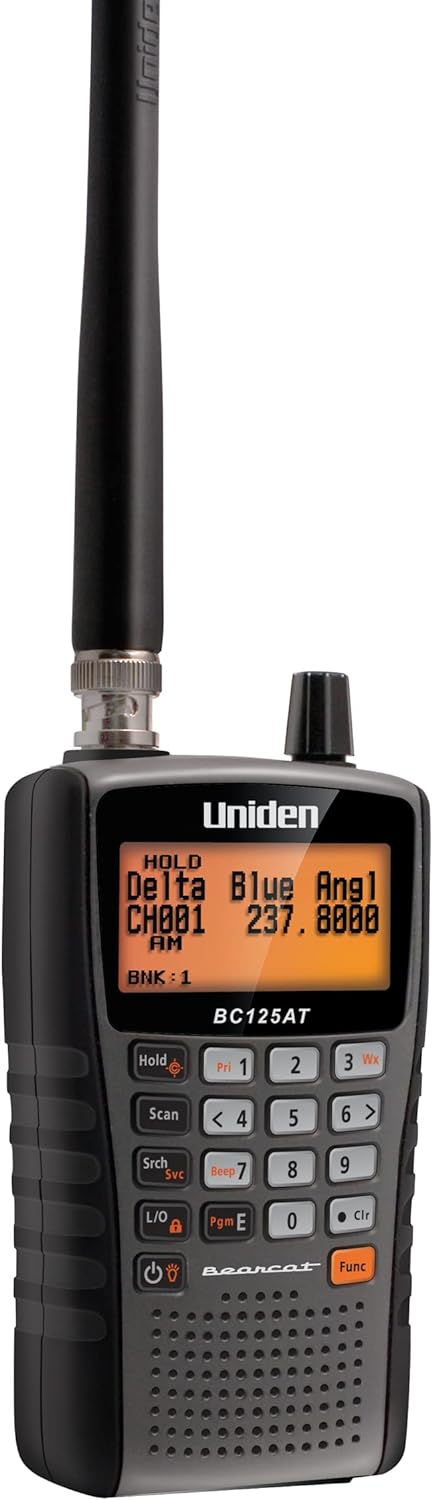
The Uniden BC125AT is a compact analog handheld scanner with 500 alpha-tagged channels and Close Call RF Capture. It covers civil and military air, marine, railroad, weather, and other conventional non-digital services. Uniden explicitly states that this model does not monitor digital systems such as P25, DMR, or NXDN.
Check On AmazonIf you click this link and buy, we earn a commission at no additional cost to you.
What an Amateur Transceiver Does Better
An amateur transceiver earns its place when two-way operation on amateur bands is the primary job. It gives a licensed operator direct frequency entry, repeater memories, transmit controls, tone settings, and operating features organized around amateur use. Handheld and mobile versions are also available in practical formats for local repeaters, simplex communication, vehicles, outdoor use, and home stations.
The strength is not that every ham radio receives everything. The strength is that the controls, memories, microphone, power levels, and antenna system are built to support legal amateur communication. A new operator can program a local repeater, monitor before transmitting, join a scheduled net, and move to simplex when two stations can communicate directly.
Some amateur transceivers add broad receive coverage for weather, aircraft, public-safety, business, or broadcast signals. That extra reception can be useful, but it remains secondary unless the specifications confirm the required mode and system support. A frequency appearing on the display does not mean the receiver can decode the signal, track a changing voice channel, or handle a dense local RF environment cleanly.
When amateur operation is the real goal, start with the broader guide to choosing the right ham radio. If a digital amateur handheld is part of that decision, the digital handheld selection guide helps separate amateur digital features from scanner functions. A digital label alone never proves compatibility with a local public-safety system.
What a Purpose-Built Scanner Does Better
A scanner is receive-only equipment organized around finding and following activity. Depending on the exact device, that may include rapid conventional-channel scanning, service searches, large channel databases, trunked-system following, digital voice decoding, recording, alerts, and location-based programming. Those functions matter when the listener wants to monitor several agencies or services without manually sitting on one frequency.
Trunking is the clearest example. A trunked system assigns conversations to available voice channels under control-channel direction. A scanner that supports the exact trunking format can follow a selected talkgroup as the conversation moves; a conventional amateur receiver may hear fragments on individual frequencies without knowing which talkgroup is active or where the next transmission went.
Database programming can also reduce setup work, but it does not eliminate research. The database must be current, the selected profile must include the right site and talkgroups, and the hardware still must support the system’s voice format. Location-based loading can narrow a large database to nearby systems, yet geography alone cannot make an unsupported mode decodable.
For a broader division among these listening and operating tools, see the comparison of ham radio, scanners, and shortwave. That overview helps when the choice is still between local system monitoring, international listening, and licensed two-way communication.

The Uniden BCD325P2 is a compact digital handheld scanner with 25,000 dynamically allocated channels and TrunkTracker V. It supports APCO P25 Phase I and II plus Motorola, EDACS, LTR, conventional analog, and P25 digital channels. Location-based scanning works with a compatible GPS receiver, and Close Call RF Capture helps identify nearby transmissions.
Check On AmazonIf you click this link and buy, we earn a commission at no additional cost to you.
Run the System Test Before Comparing Features
The police scanner vs ham radio question cannot be answered from a frequency range alone. Start the comparison with a one-line system profile because the target has several layers: frequency, modulation, digital protocol, conventional or trunked operation, trunking variant, encryption status, and local signal behavior. A receiver must pass every relevant layer, not just the first one.
| Target signal or system | What the receiver must support | Common buying mistake |
|---|---|---|
| Conventional analog FM | Frequency coverage, correct FM bandwidth, tuning step, and adequate sensitivity | Assuming poor audio means the frequency is wrong when the bandwidth or front end is the real problem |
| Aircraft voice | Coverage of the civil air band and AM reception | Buying a VHF receiver that supports only FM on the frequencies of interest |
| P25 conventional | The required P25 phase or conventional digital voice capability | Assuming every radio described as digital can decode P25 |
| P25 trunked | The correct P25 phase plus compatible trunked-system following | Checking for P25 but forgetting to confirm trunking and system phase |
| DMR or NXDN | The exact digital format and, when used, the relevant conventional or trunking implementation | Inferring support from broad UHF coverage or from an unrelated amateur digital mode |
| Simulcast public-safety system | Compatible digital and trunking support plus receiver performance suited to overlapping sites | Blaming weak signal when multiple strong sites are creating decode distortion |
| Encrypted talkgroup | No ordinary consumer scanner or amateur transceiver provides supported intelligible monitoring | Buying more expensive hardware in the hope that price defeats encryption |
| Proprietary or uncommon system | Explicit documentation for that exact system | Assuming a familiar frequency band means a familiar protocol |
The order of the test matters. First identify the system, then ask what hardware supports it. Starting with a favorite radio and trying to make the local system fit its feature list reverses the decision and often ends with incomplete audio or silence.

The Uniden BCD996P2 is a digital base/mobile scanner with 25,000 channels, TrunkTracker V, and Close Call RF Capture. It scans APCO P25 Phase I and II, X2-TDMA, Motorola, EDACS, LTR, conventional analog, and P25 digital channels. A compatible GPS receiver enables location-based system selection, which is useful after the target system has been identified.
Check On AmazonIf you click this link and buy, we earn a commission at no additional cost to you.
Encryption Is a Hard Boundary, Not a Premium Feature Gap
Encryption changes the decision immediately. If a public-safety talkgroup is encrypted, an ordinary consumer scanner or amateur transceiver will not turn it into intelligible audio as a supported monitoring function. The correct response is not to search for a hidden setting, a more sensitive antenna, or a higher-priced receiver.
Some systems mix clear and encrypted traffic. One talkgroup may remain monitorable while another on the same trunked network is encrypted full time or only during selected operations. That is why a system-level label such as “P25” does not answer the question by itself; encryption can vary by talkgroup and sometimes by transmission.
This article does not cover defeating encryption or tools marketed for unauthorized decryption. It also does not assume that every technically receivable communication is lawful to monitor or use in every place. Federal limits and state or local restrictions can apply, including rules involving mobile scanner use or use during criminal activity, so the listener must verify the law that applies where the receiver will be used.
Warning: Do not make a buying decision from an outdated database entry that says only “digital.” Confirm whether the specific talkgroups you care about are clear, partially encrypted, or fully encrypted. If they are encrypted, treat them as unavailable rather than as a hardware-upgrade problem.

The Uniden BCD536HP is a digital base/mobile scanner built around the HomePatrol database and TrunkTracker V. Uniden specifies support for unencrypted APCO P25 Phase I and II, Motorola, EDACS, LTR, conventional analog, and P25 digital systems. It also provides location-based scanning, recording and replay, and Wi-Fi connectivity for remote access.
Check On AmazonIf you click this link and buy, we earn a commission at no additional cost to you.
The Antenna and Receiver Front End Can Change the Result
System compatibility is necessary, but it is not the end of the test. A receiver can support the correct mode and still perform poorly because of antenna mismatch, front-end overload, building loss, local transmitter density, or simulcast distortion. These problems can look similar at the speaker even though they require different fixes.
A broadband scanner antenna trades specialization for coverage. It may be convenient across several services, but one antenna cannot be equally efficient on every band. An amateur antenna optimized for a narrow VHF or UHF range may improve ham performance while doing little for aircraft, 700 or 800 MHz public-safety, or another distant band.
More antenna is not always better in a strong-signal area. A high-gain outdoor antenna can feed several powerful nearby transmitters into a wideband receiver and overload its front end, producing desensitization, images, or interference. Attenuation, filtering, a different antenna, or a less exposed location can outperform a larger antenna when excessive signal is the problem.
Simulcast creates another counterintuitive case. Several synchronized sites may arrive at the receiver with similar strength but slightly different timing, causing digital distortion even though the signal meter looks healthy. Moving the receiver, changing antenna direction, or reducing reception from unwanted sites may improve decoding, but the receiver’s simulcast performance remains a major purchasing condition.
The separate guide to monitoring police, fire, aircraft, and weather goes deeper into what an amateur receiver may hear across those services. Use it after identifying the signal type, not as a substitute for checking the exact local system.
A Transmit Button Adds Risk That a Scanner Does Not Have
A scanner is receive-only, so pressing a key cannot place a signal on a public-safety, aviation, business, or other monitored frequency. An amateur transceiver has a transmitter, and the operator is responsible for keeping every transmission within authorized amateur frequencies, privileges, modes, and operating rules.
Many amateur radios restrict transmission to amateur allocations, but hardware, modifications, software, or unusual programming can change what the PTT attempts to do. Technical capability does not create legal authority. A ham license authorizes amateur operation under the applicable privileges; it does not authorize transmitting on public-safety, aviation, business, GMRS, or other services merely because the radio can display those frequencies.
When non-amateur channels are stored for monitoring, use receive-only memories or transmit inhibit as part of safe station control where the equipment supports them. Label the memory clearly, test the behavior without transmitting, and avoid placing a monitored channel beside an active amateur memory in a way that encourages a hurried PTT mistake. This is one reason a dedicated scanner can be the cleaner tool when monitoring is the main job.
If the amateur transceiver remains the right choice, a structured ham radio programming workflow helps separate receive-only channels from usable amateur memories. Programming is not only about convenience; it is part of controlling what the radio is allowed to transmit.
Choose Ham Radio or Scanner by the Primary Job
There is no universal winner because the devices solve different problems. The cleanest rule is to choose the tool that performs the primary job without workarounds, then treat any secondary capability as a bonus. That keeps a useful extra receive feature from being mistaken for full scanner replacement.
| Your main goal | Better starting category | Why |
|---|---|---|
| Transmit on amateur repeaters and simplex | Amateur transceiver | Two-way amateur controls and legal transmit capability are the central job |
| Monitor several conventional local channels | Scanner, unless the ham radio’s confirmed coverage is enough | Scanning organization, search tools, and receive-only operation reduce compromises |
| Follow trunked public-safety talkgroups | Compatible trunking scanner | The receiver must follow control-channel assignments and the exact digital system |
| Record, alert, or load systems by location | Scanner with those confirmed functions | These are monitoring-workflow features rather than amateur transmit features |
| Operate ham radio and monitor a busy local system at the same time | Two separate receivers | One radio cannot reliably stay on an amateur contact while also following unrelated traffic |
| Analyze spectrum on a computer | SDR or specialized receive setup | Software tools and spectrum displays become the primary job |
Choose the ham path when transmitting on amateur bands is the reason for the purchase and extra monitoring is limited to signals the radio explicitly supports. Choose the scanner path when following multiple systems, trunking, public safety, recording, alerts, or database-assisted programming is the reason for the purchase. Buying both is reasonable only when those are two separate, continuing jobs rather than an attempt to collect features.

The Uniden BCD436HP is a digital handheld scanner with the HomePatrol USA/Canada database and location-based scanning. TrunkTracker V supports APCO P25 Phase I and II, X2-TDMA, Motorola, EDACS, LTR, conventional analog, and P25 digital channels. It also includes system discovery, recording, and Close Call RF Capture for an organized monitoring workflow.
Check On AmazonIf you click this link and buy, we earn a commission at no additional cost to you.
Match Form Factor and Ownership Cost to the Monitoring Job
System compatibility decides whether the receiver can follow the target, but form factor decides whether it will be practical where it is used. A handheld suits listening while walking, traveling, or moving between rooms, although its smaller controls, speaker, battery, and antenna limit long stationary sessions. A mobile unit fits a vehicle or compact fixed position, while a base-oriented receiver usually makes more sense for a desk, external antenna, larger speaker, continuous power, and extended monitoring.
Do not let the case style replace the system test. A portable receiver that lacks the required trunking format remains incompatible, and a base receiver does not solve encryption or an unsupported digital mode. Choose the system capability first, then select the handheld, mobile, or base format that fits how often the equipment will move, how it will be powered, and whether an external antenna or recording workflow is part of the real job.
Purchase price is only one part of ownership cost. Check whether database access, firmware updates, programming software, digital-mode activation, location services, recording storage, cables, batteries, mounting hardware, antennas, and power supplies are included, optional, free, paid once, or billed repeatedly for the exact platform under consideration. Do not assume that every database service requires a subscription, and do not assume that every update or advanced function is included without charge.
Cost check: Compare the complete first-year cost and the likely later-year cost, not only the receiver price. A less expensive unit can become the costlier choice when essential accessories or paid functions are added, while a higher initial price can be reasonable when the required capabilities are already included.
Once the location, power method, accessories, and recurring costs are clear, the remaining question is whether a conventional radio interface is enough or whether computer-based analysis is the actual goal.

The Uniden SDS200 is a digital base/mobile scanner with a True I/Q receiver and TrunkTracker X technology. It includes the USA/Canada radio database, location control, Ethernet connectivity for streaming and control, and a 3.5-inch customizable color display. Its base/mobile design and external connectivity support extended desk or vehicle monitoring.
Check On AmazonIf you click this link and buy, we earn a commission at no additional cost to you.
When SDR or Multiple Receivers Make More Sense
An SDR becomes relevant when the real goal is computer-based spectrum analysis, flexible demodulation, wideband recording, or experimenting with software workflows. That flexibility comes with more setup, more dependence on a computer, and a steeper path from raw spectrum to an organized daily monitoring routine. It is not automatically the easiest replacement for a scanner.
Multiple receivers solve a different problem: simultaneous jobs. A single transceiver cannot remain ready for an amateur repeater call while continuously following a trunked system that moves among channels. Separate devices let each receiver stay optimized for its task and allow different antennas, filters, audio levels, and recording rules.
Do not move to SDR or a multi-receiver station merely because one local channel was difficult to hear. First determine whether the problem is unsupported mode, encryption, simulcast, overload, antenna placement, or stale programming. More equipment adds capability only after the original problem has been identified correctly.
Use This Local System Checklist Before Buying
The safest buying sequence is system first, receiver second. Complete the checklist for the agencies and services you genuinely want to hear, not for every signal that might exist within the advertised frequency range. A missing answer is a reason to pause, not a reason to assume compatibility.
- Name the target: identify the agency, service, amateur repeater, aviation channel, weather service, or business system you intend to monitor.
- Confirm the frequency range: verify the active local sites and channels rather than relying on a national allocation alone.
- Identify the mode: determine whether the traffic uses analog FM, AM, P25, DMR, NXDN, or another documented format.
- Check system structure: determine whether operation is conventional or trunked and identify the exact trunking type or phase.
- Check encryption by talkgroup: separate clear, partially encrypted, and fully encrypted traffic.
- Check for simulcast: learn whether several synchronized sites serve your location and whether local users report decode difficulty.
- Verify receiver support: use current documentation for the exact receiver, including whether a mode is included, optional, conventional-only, or trunking-capable.
- Check database freshness: compare update dates and confirm that sites, talkgroups, and labels still match current operation.
- Assess the RF environment: consider building construction, antenna location, strong nearby transmitters, and the bands that matter most.
- Choose the form factor: decide whether handheld portability, a vehicle installation, or a fixed home station matches the main use.
- Calculate ownership cost: include required accessories, software, feature activation, database services, storage, power, and any recurring charges.
- Verify local restrictions: check current federal, state, and local rules for where and how the receiver will be used.
Go or no-go rule: Buy only after the exact receiver passes the frequency, mode, trunking, encryption, and local-law checks. If any one of those remains unknown, the product description is not enough to support the decision.
This process may point to a ham transceiver, a scanner, an SDR, or two devices. That is a better outcome than forcing one radio to cover incompatible jobs. The system you want to hear controls the recommendation, not the category name printed on the box.
Final Thoughts: Identify the System Before Choosing the Radio
Choose an amateur transceiver when licensed two-way amateur communication is the primary job. Choose a scanner when the primary job is following several local receive systems, especially trunked or digital systems that require purpose-built organization and decoding. Broad receive coverage is useful in either device, but it is not a substitute for exact compatibility.
Start with one local target and document its mode, trunking, encryption, simulcast, and legal conditions. Then compare receivers against that completed profile. That single change in buying order prevents the most expensive mistake in this comparison: purchasing a radio that reaches the frequency but cannot follow the system.
FAQs
📻 Can a ham radio replace a police scanner?
Only for supported conventional, unencrypted signals that match the radio’s coverage and mode. It usually cannot replace a purpose-built scanner for trunking, system databases, recording, alerts, or unsupported digital formats.
🚓 Can a ham radio listen to P25 police channels?
Only when the exact receiver explicitly supports the required P25 format, and trunked systems also require compatible trunking support. A wide receive range or a generic digital feature does not prove P25 capability.
🔒 Can a scanner receive encrypted talkgroups?
An ordinary consumer scanner does not provide supported intelligible monitoring of encrypted talkgroups. Treat full encryption as a hard boundary rather than a reason to buy a more expensive antenna or receiver.
✈️ Can an amateur handheld receive aircraft communications?
Some can, but the receiver must cover the civil air band and support AM. Check the exact specifications because VHF coverage alone does not guarantee the correct modulation or useful aircraft-band performance.
📡 Why does a compatible digital scanner sound broken?
Simulcast distortion, front-end overload, antenna placement, weak indoor coverage, or incorrect programming can all interrupt digital audio. A strong signal meter does not rule out simulcast problems.
💻 Is an SDR better than a scanner?
An SDR is better when computer-based analysis and software flexibility are the main goals. A scanner is often easier for organized daily monitoring, alerts, location-based loading, and portable receive-only use.
💳 Do scanner database updates require a subscription?
Not universally. Database access, firmware updates, programming software, advanced functions, and online services may be free, included, sold once, or offered through recurring plans depending on the exact platform. Check the current terms and separate required costs from optional conveniences before buying.
🏠 Should I choose a handheld, mobile, or base receiver?
Choose handheld for portability, mobile for vehicle or compact fixed use, and base-oriented equipment for long sessions with external power, antennas, and speakers. The form factor should follow the location and workflow only after the receiver passes the exact system-compatibility test.