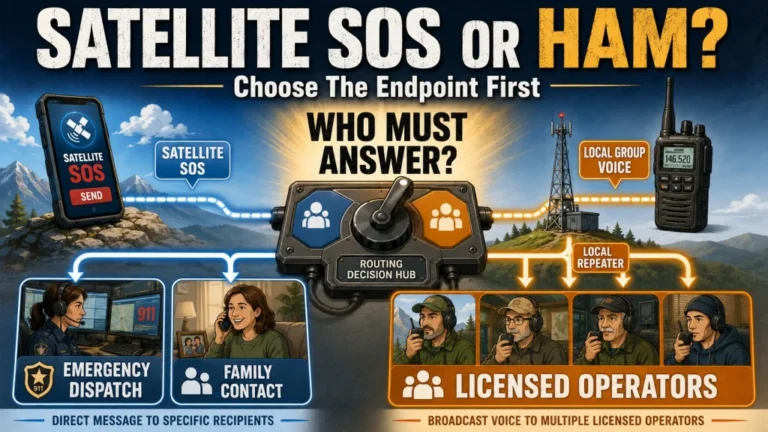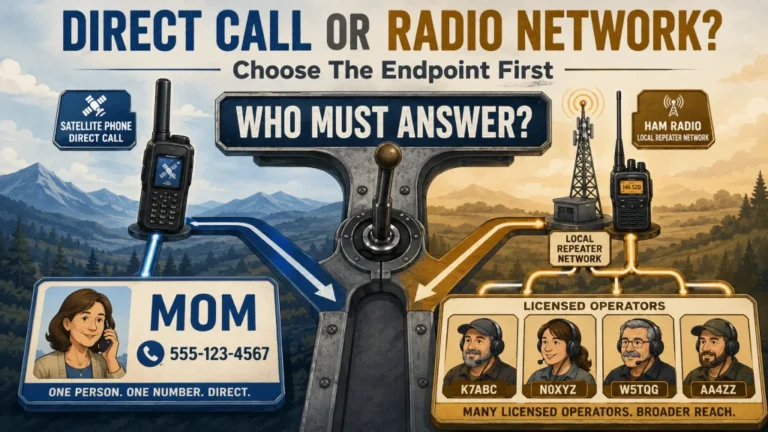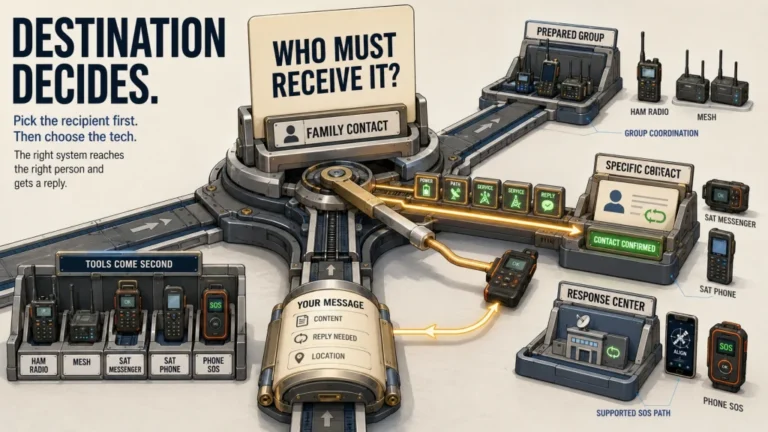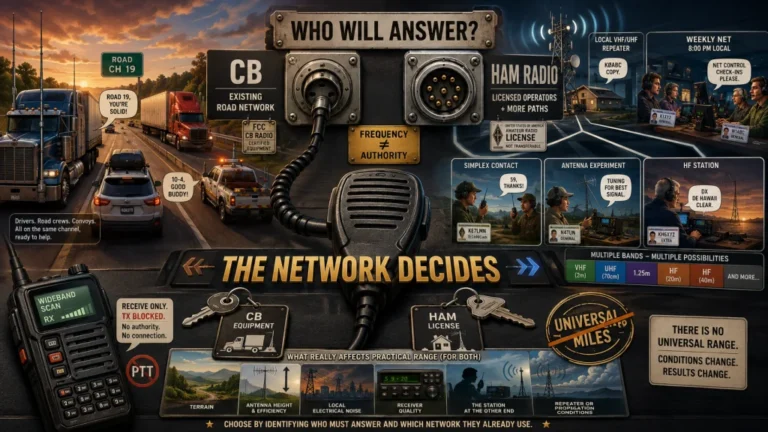
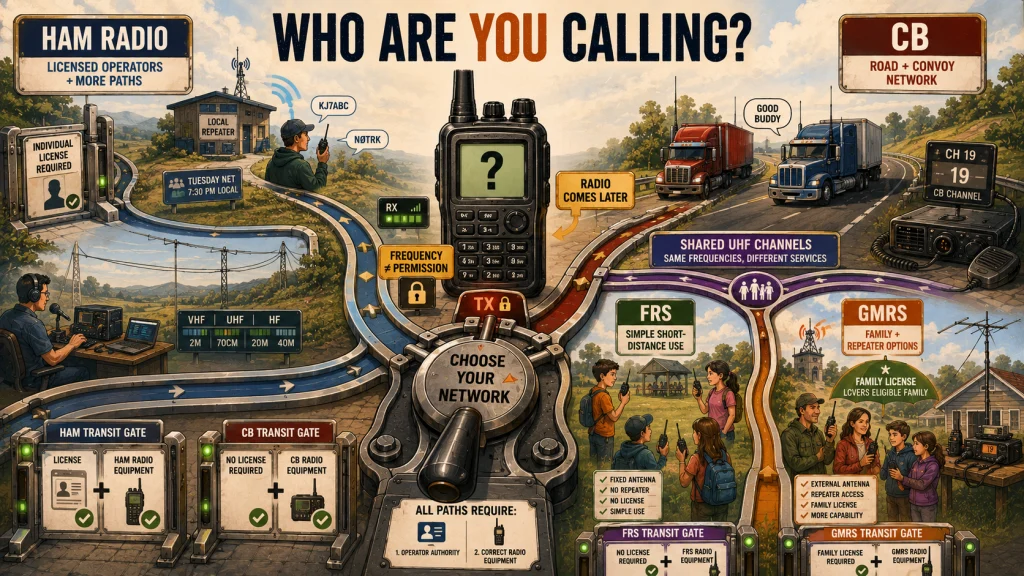
Ham radio, GMRS, FRS, and CB can all put a voice over the air, but they are not interchangeable versions of the same service. The right choice starts with the people you need to reach and the radio network they already use, then moves to licensing, legal equipment, antennas, and operating conditions. CB fits established highway and convoy communication, while FRS fits simple short-distance family or event use. Ham radio offers much more operating flexibility, but only when the other people involved are licensed and prepared to use it.
Similar Radios Can Belong to Completely Different Services
The useful way to compare ham radio vs other radio services is not by the shape of the handheld or the number printed beside its power setting. Two radios can look nearly identical while operating under different licenses, channel plans, antenna rules, and equipment requirements. A frequency shown on a screen tells you where a radio can listen or tune, but it does not by itself tell you where that radio may legally transmit.
This guide covers the U.S. Amateur Radio Service, GMRS, FRS, CB, and the practical limits on communication between them. It does not cover commercial radio services, step-by-step programming, Meshtastic, satellite communication tools, scanners, or shortwave listening. Those are different decisions, and mixing them into one radio service comparison would hide the question that matters most: who are you actually trying to talk to?
I usually start with that question before discussing power or range. A service with impressive technical flexibility is still the wrong choice when the other members of a family, convoy, or event crew are using something else. That is why CB and FRS are not simply weaker versions of amateur radio. They are separate ham radio alternatives built around different users and operating rules.
A Service Map for Ham Radio, GMRS, FRS, and CB
A ham radio vs CB vs FRS comparison becomes clearer when each service is treated as a complete operating system rather than a range claim. Licensing determines who may transmit. The channel or band structure determines where users meet. Equipment and antenna rules determine how much the operator may change the station after buying it.
| Service | Operating authority | Frequencies and repeaters | Equipment and antennas | Common practical fit |
|---|---|---|---|---|
| Amateur radio | Individual operator license earned by examination; privileges depend on license class | Multiple amateur bands rather than one fixed consumer channel set; repeaters are permitted on authorized bands | Broad equipment and antenna flexibility, with the licensee responsible for compliant operation | Learning, local repeater activity, technical experimentation, organized amateur communication, and wider operating options |
| GMRS | Individual FCC license without an examination; qualifying immediate family members may operate under the license | Channelized UHF service that shares many channels with FRS and also supports repeater operation | GMRS-certified transmitting equipment is required; external antenna options and higher-power station types are permitted under service rules | Family or small-group communication when users want more station flexibility than FRS |
| FRS | No individual license application; operation is authorized by rule when a compliant FRS unit is used | Twenty-two shared UHF channels; no FRS repeater operation | Certified FRS unit with a non-removable antenna and tightly controlled transmit capability | Simple short-distance family, recreation, school, and event communication |
| CB | No individual license application; operation is authorized by rule under the CB requirements | Forty shared channels from 26.965 through 27.405 MHz; no CB repeater system | Certified CB transmitter; external antennas are common and antenna installation matters greatly | Highway communication, trucking, road travel, and groups already organized around a CB channel |
The table explains why a single winner does not exist. Amateur radio has the widest operating possibilities, but every transmitting participant needs the proper amateur license. FRS removes that barrier by placing more restrictions on the radio itself. GMRS sits between those approaches, while CB serves a different community and frequency environment. Readers deciding specifically between the first two options should use the full ham radio and GMRS comparison rather than treating this broader map as a substitute.
Choose CB When the Road Network Already Exists
CB makes the most sense when the people you need to hear are already using CB. Highway traffic, trucking, an established off-road group, or a convoy with an agreed channel creates a real network before you buy anything. That existing activity is more valuable than choosing a technically broader service that nobody else in the group monitors.
The service uses 40 channels around 27 MHz and operates without an individual license application in the United States. Certified CB equipment is limited to 4 watts of carrier power on AM or FM and 12 watts peak envelope power on SSB. Those numbers do not turn CB into a guaranteed long-distance service. Vehicle electrical noise, channel activity, antenna length, antenna mounting, and changing propagation can affect the result more than the front-panel power figure.
A practical example is a two-vehicle road trip where both drivers need simple coordination and the wider highway community in that area already uses CB. Installing an effective vehicle antenna and agreeing on a channel may solve that problem directly. Giving both drivers amateur handhelds would add licensing and setup work without connecting them to the road users they wanted to hear.
CB is less convincing when the group wants pocket-size radios for a crowded event or expects a local repeater to bridge hills. Those are not the service’s strengths. The detailed ham radio versus CB radio guide separates the highway use case from hobby operation, home stations, and local amateur repeaters.

The Cobra 29 LTD Classic is an AM/FM CB radio with the full 40-channel CB lineup and 4-watt output. It includes instant access to Channel 9. The radio also provides adjustable receiver controls and built-in SWR calibration for setting up the connected antenna.
Check On AmazonIf you click this link and buy, we earn a commission at no additional cost to you.
Choose FRS When Simplicity Matters More Than Expansion
FRS is usually the cleanest answer when several people need basic short-distance communication and nobody should have to study, apply for an individual license, select an antenna, or learn a repeater. Think of a family at a campground, volunteers inside one event site, or two cars that only need coordination over a limited area. In those situations, simplicity is not a compromise. It is the feature that makes everyone carry and use the radio.
FRS has 22 UHF channels shared with GMRS. Its radios are certified for the service, limited to 0.5 watt on channels 8 through 14 and up to 2 watts on the other FRS channels, and built with non-removable antennas. Those restrictions are deliberate. The user gets an uncomplicated radio, while the equipment design keeps operation inside the service’s limits.
That same simplicity creates the boundary. FRS does not provide repeater operation, external antenna upgrades, or the station-building flexibility associated with amateur radio and GMRS. A pair of FRS walkie-talkies may work well across an open fairground and poorly between opposite sides of a concrete building. Buying another pair with a larger distance printed on the package does not remove the building.
The label “walkie-talkie” does not identify the legal service, so check whether the radio is actually an FRS unit before assuming the rules. For a direct breakdown of licensing, antennas, channels, and practical use, see the ham radio and walkie-talkie differences.

The Midland LXT600VP3 is a two-radio FRS set designed around straightforward handheld communication. The radios provide 22 standard channels and NOAA weather alert functionality. The pair-pack format makes it suitable for two people who need a ready-to-use shared radio setup without building a separate mobile or base station.
Check On AmazonIf you click this link and buy, we earn a commission at no additional cost to you.
Interoperability Requires Four Separate Yes Answers
People often collapse radio compatibility into one question: can this radio reach that frequency? That is only the beginning. Receiving a transmission, tuning a frequency, holding an operator license, and using equipment authorized for the service are separate issues. A radio can pass the first two tests and still fail the last two.
- Can the radio receive the signal? Receiving shows technical coverage, not permission to transmit.
- Can the radio generate the required frequency and mode? Frequency capability alone does not place the radio inside a legal service.
- Does the operator have the required authority? Amateur and GMRS transmitting privileges come from different licenses.
- Is the transmitting equipment permitted for that service? Part 95 services rely on service-compliant certified equipment, while amateur operation follows Part 97 responsibilities.
FRS and GMRS provide the most familiar partial overlap. Their users share the 22 FRS channels, so an FRS unit can communicate with a GMRS station on a shared channel when each station operates within the rules that apply to it. The FRS operator does not gain GMRS power, repeater, or antenna privileges merely because a GMRS radio answers.
Key point: A ham license does not authorize GMRS transmission, and an amateur transceiver does not become legal GMRS equipment because it can be programmed to a GMRS frequency. GMRS transmission requires the appropriate GMRS authority and equipment certified for GMRS under Part 95E.
The same logic applies when someone asks whether one programmable handheld can replace every service radio. A wide receive range can make the unit useful for listening, but the transmit button changes the legal question. The full guide on whether ham radio can talk to GMRS walks through the shared-channel and cross-service cases without treating technical capability as permission.

The Midland GXT1000VP4 is a GMRS two-way radio pair with a 50-channel configuration and 142 privacy codes. The listing includes NOAA weather functions and an SOS siren. Rechargeable battery packs are supplied with the radios, giving the pair a reusable charging setup for regular group communication.
Check On AmazonIf you click this link and buy, we earn a commission at no additional cost to you.
Use the Same Decision Order Every Time
The reliable order is people, network, service, legal equipment, antenna, and operating plan. Reversing that order is how a capable radio ends up unused. A person buys for advertised power, then discovers that the family wants license-free simplicity, the convoy is on CB, or the local activity they hoped to join is on an amateur repeater that requires licensed operators.
Field Note: I have seen new operators buy a handheld before deciding what use case it is supposed to serve. The first useful question is then not how to program it, but whether that radio service matches the people and activity they had in mind.
For a family using radios only inside a theme park, the process may stop at FRS because everyone can use a compliant unit immediately. For a road group already monitoring a CB channel, CB wins before power is compared. For someone who wants to join a weekly local amateur net, earning the license and learning the repeater procedure are part of the communication plan, not paperwork added after buying a radio.
This decision order also exposes mixed requirements early. One household may use FRS for guests and amateur radio for licensed family members who enjoy the hobby. That is not a failure to choose one universal service. It is a recognition that different networks solve different communication jobs.

The Yaesu FT-65R is a compact 5-watt amateur handheld transceiver covering the 144 and 440 MHz amateur bands. The listing identifies 200 channel memories and VHF/UHF operation. Its handheld format fits local amateur communication where an operator wants a portable radio for repeaters and other authorized amateur-band activity.
Check On AmazonIf you click this link and buy, we earn a commission at no additional cost to you.
A Service Name Does Not Produce a Universal Range
Range depends on the entire radio path: frequency, terrain, antenna height and efficiency, transmit power, receiver performance, local noise, buildings, foliage, and whether a useful repeater or active user is available. A service can permit more power and still perform poorly when both antennas are low behind a ridge. A low-power radio can sound excellent when the path is open and the users are close.
Frequency changes the behavior but does not create a simple ranking. FRS and GMRS operate in UHF, which can work well for compact antennas and local line-of-sight communication but is readily blocked by terrain and dense structures. CB operates around 27 MHz and normally needs a much longer efficient antenna, especially in a vehicle or handheld form. Amateur radio spans multiple bands, so its result depends on which band, mode, antenna, license privilege, and network the operator actually uses.
A useful comparison therefore describes a scenario instead of promising a distance. An FRS unit across an open event site, a properly installed mobile CB station on a highway, and a licensed amateur using a well-sited local repeater are three different paths. The service label alone cannot predict which signal will cover the greatest distance at a particular location.
Warning: Do not build an emergency communication plan around a package range figure or an assumption that somebody will always answer. Test the actual route, terrain, buildings, channels, batteries, and participating operators before relying on any service.
Once the range claim is removed, the decision becomes more honest. Choose the service for the people and operating structure, then improve the parts you are legally allowed to change. Sometimes that means antenna placement. Sometimes it means using a repeater. Sometimes it means accepting that short-distance FRS is enough and adding complexity would solve nothing.
U.S. Personal Radio Rules Do Not Travel Automatically
CB, FRS, and GMRS in this article refer to United States rules. Another country may assign different frequencies, use a similar service name with different power or equipment limits, require a license, or prohibit equipment that is normal in the United States. A radio sold for U.S. FRS or GMRS operation should not be treated as an international travel radio without checking the destination’s current regulator and frequency rules.
Amateur radio also requires country-specific authority when operating outside the United States. Reciprocal privileges and temporary operating arrangements exist in some places, but a U.S. call sign is not a universal permission slip. This article stays within the U.S. decision because mixing multiple national systems would make every licensing and equipment statement conditional.
The practical rule is simple: decide where the radio will be transmitted, not only where it will be purchased. A unit that is legal to own or receive with may still be unlawful to transmit with at the destination. Check before travel, especially when a group plans to cross an international border and expects all radios to remain interoperable.
Some Radio Goals Belong in a Different Comparison
Not every alternative to amateur radio is another voice service with a push-to-talk button. Off-grid text networks, satellite communication devices, and other modern systems answer different questions about infrastructure, subscriptions, coverage, and messaging. Readers comparing those systems should move to the guide on modern radio communication alternatives.
Listening goals also need a separate decision. A scanner or shortwave receiver may be useful when the objective is monitoring rather than joining a two-way conversation, but receiving public traffic does not create transmit access to that system. The comparison of scanners and shortwave listening keeps receive-only tools from being confused with CB, FRS, GMRS, or amateur transmitting privileges.
Keeping those boundaries clear prevents an equipment list from replacing a communication plan. First decide whether the goal is group voice, contact with an existing road community, amateur participation, off-grid messaging, or listening. Only then does the right class of device become obvious.
Final Thoughts: Choose the Network Before the Radio
Ham radio offers the broadest room to learn and build an operating setup, but it is not automatically the best service for every family, event, or road trip. CB is often the direct answer when the relevant community is already on CB. FRS is often the direct answer when everyone needs simple, immediate, short-distance communication with compliant radios.
The mistake to avoid is choosing by appearance, power, or an advertised range before identifying the people at the other end. Start with the network, confirm the service rules, use legal equipment, and test the real operating environment. That sequence produces a working communication plan instead of a drawer full of radios that cannot legally or practically talk to one another.
Explore More Traditional Radio Comparisons
The broad service map gives you the decision order. These focused guides handle the three questions that usually need a closer look before selecting equipment or organizing a group.
| Guide | What it helps with |
|---|---|
| Ham Radio Versus CB Radio | Choose between amateur operation and an established highway or convoy channel network. |
| Ham Radio Versus FRS Walkie-Talkies | Compare licensing, fixed antennas, repeaters, simplicity, and short-distance group use. |
| Cross-Service Radio Compatibility | Separate receiving, frequency capability, operator authority, and approved transmitting equipment. |
Use the guide that matches the people and network you identified first, then make the equipment decision inside that service.
FAQs
These answers address the compatibility and service-choice questions that come up most often when similar-looking radios are compared.
📻 Can ham radio talk directly to CB radio?
Not as normal cross-service communication. CB and amateur radio use different service rules and equipment requirements, so each station must transmit only where its operator and equipment are authorized.
👨👩👧 Can an FRS radio talk to a GMRS radio?
Yes, on the shared FRS and GMRS channels when each radio operates under the rules that apply to its service. The FRS unit remains subject to FRS power and antenna limits.
🪪 Do I need a license for CB or FRS?
The United States does not require an individual license application for ordinary CB or FRS operation. You must use compliant equipment and follow the rules for the service.
🚚 Is CB better than FRS for road trips?
CB is usually the stronger choice when you want to hear or join an existing highway, trucking, or convoy channel. FRS can still work for simple communication between nearby vehicles, but it does not connect you to the CB community.
⚙️ Can I program a ham radio to transmit on FRS?
Frequency capability does not make an amateur transceiver an authorized FRS unit. FRS transmission requires a certified FRS radio that meets the service’s fixed antenna, power, and channel restrictions.
📡 Which radio service has the longest range?
No service has one universal range. Terrain, antenna height, frequency, power, receiver quality, noise, repeaters, and the presence of active users determine the practical result.
🌍 Are FRS, GMRS, and CB rules the same outside the United States?
No. Frequencies, licenses, power limits, and permitted equipment may differ by country, so check the destination’s current rules before transmitting.
The safest shortcut is to identify the service printed in the radio documentation, then confirm both the operator authority and the equipment rules before pressing transmit.