Choose a ham transceiver when you want licensed two-way amateur communication, a scanner when you want fast monitoring of compatible local channelized systems, and a shortwave receiver when your priority is international, amateur, broadcast, and other HF listening. Receive coverage printed on a radio does not prove that it can follow trunked systems, decode a particular digital format, or make encrypted audio understandable. Most ordinary unencrypted reception does not require an amateur license, while transmitting and some forms or locations of monitoring raise separate legal questions. The safest buying decision assigns each device one clear job before comparing features.

Ham Radio vs Scanner and Shortwave Starts With Three Different Jobs
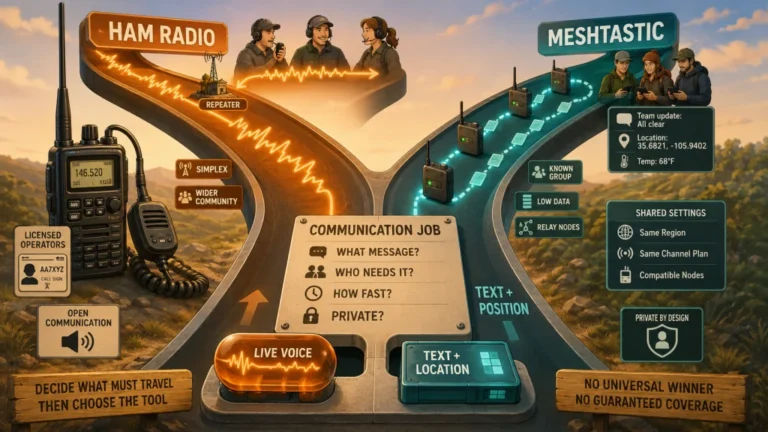
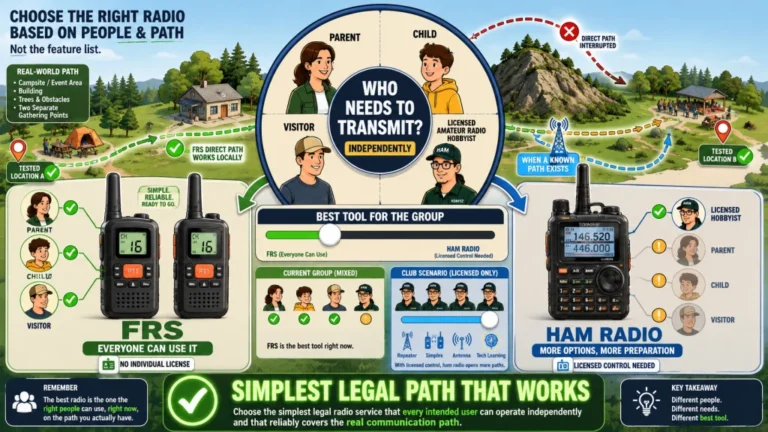
The first question in any ham radio vs scanner and shortwave decision is not which device covers the most frequencies. Decide whether you want to transmit, monitor local systems that use assigned channels, or tune across HF for international and long-distance signals. Those are three different operating jobs, even when their frequency ranges overlap on a specification sheet.
A ham transceiver is built around licensed two-way communication in amateur allocations. A scanner is designed to move efficiently through programmed channels or supported trunked systems. A shortwave receiver is optimized for tuning broad sections of HF, where propagation, time of day, bandwidth, and antenna choice shape what you hear.
Research-based: The radio-buying question often comes before a new licensee has defined the activity. I separate the decision into one sentence: “Who or what do you expect to hear, and do you need to answer?” That answer usually removes at least one entire device category before hardware comparisons begin.
This article is a navigation guide for US adults choosing a listening or transmitting path. It does not explain how to defeat encryption, receive prohibited communications, transmit outside legal authority, or select a specific amateur transceiver model.
Choose a Ham Transceiver for Licensed Two-Way Operation
A ham transceiver is the correct route when the main goal is talking with other amateur operators. In the United States, transmitting from an amateur station normally requires an FCC amateur operator license and operation within the privileges of that license class. The radio, antenna, mode, power, and frequency must all fit the authorized amateur use.
Many ham radios also receive outside the amateur bands, but that capability varies greatly by model. One handheld may receive weather broadcasts and a portion of the aircraft band, while another adds broadcast FM, shortwave coverage, or wider VHF and UHF reception. A wide tuning range alone does not tell you how quickly the radio scans, which modulation modes it demodulates, or whether the receiver remains usable around strong signals.
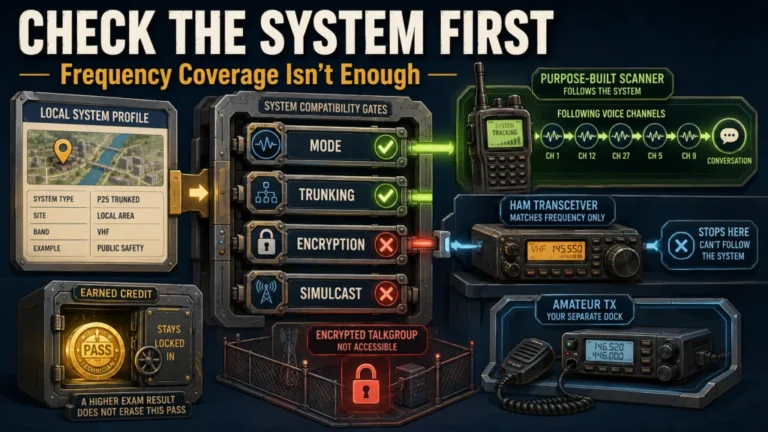
Most amateur transceivers are poor substitutes for a real trunk-tracking scanner. They may stop on one conventional frequency used by a trunked system, but they generally do not follow the system as conversations move among assigned voice channels. The result can be fragments, long gaps, or unrelated traffic rather than a complete conversation.
A digital-capable ham handheld creates another common misunderstanding. Digital amateur voice formats do not automatically equal public-safety digital formats, and support for one protocol does not create support for every system using digital audio. Before treating a handheld as a monitoring device, verify the exact frequency range, analog modes, digital formats, scan behavior, and any trunking limitation.
Readers who have already chosen licensed amateur communication should move to the ham radio selection guide. If portable digital amateur operation is the specific job, compare the role and network first with the digital handheld decision guide.
Choose Shortwave for International and HF Listening
A shortwave receiver is built for listening across the high-frequency spectrum rather than rapidly checking hundreds of local channels. Depending on its coverage and modes, it may receive international broadcasters, amateur operators, time stations, aviation or maritime utility signals, and other HF activity. What is actually available changes with frequency, propagation, season, time of day, location, and antenna conditions.
This route fits the listener who enjoys tuning, identifying signals, comparing bands, and hearing stations that may be hundreds or thousands of miles away. It is less suitable when the goal is following a local fire dispatch system, scanning a list of nearby business channels, or tracking a public-safety talkgroup that changes frequencies under computer control.
Mode support is critical. Basic amplitude modulation covers many broadcast stations, but single sideband reception is needed for much amateur, aviation, maritime, and utility voice activity on HF. Narrow filters, tuning steps, frequency stability, external antenna connections, and interference handling can matter more than a large display or a long list of stored presets.
Antenna expectations also change at shortwave frequencies. A compact built-in whip can receive strong signals, but location, electrical noise, antenna length, grounding, and nearby electronics often decide whether weaker stations are readable. Buying a receiver with broad coverage does not overcome a noisy apartment, an overloaded front end, or an unsuitable antenna arrangement.
The detailed trade-offs between transmitting on amateur HF and listening only are covered in the ham radio and shortwave comparison.
Choose a Scanner for Fast Local Channel Monitoring
A scanner is designed to check many programmed channels quickly and stop when activity is detected. That makes it a better fit for local monitoring of compatible public-safety, aircraft, marine, weather, business, amateur, and other land-mobile systems. The word “compatible” does most of the work in that sentence.
Conventional analog channels are the simplest case: one known frequency carries the traffic, and a scanner with the correct mode can monitor it. Trunked systems are different because a controller assigns conversations to available frequencies. A compatible trunk-tracking scanner follows the control data and the selected talkgroup rather than waiting on one voice channel.
Digital voice adds another requirement. A receiver must support the exact format used by the system, and a digital label by itself is not enough. System phase, modulation, band plan, site configuration, simulcast behavior, and database accuracy can all affect the result.
Location databases can reduce programming work, but they do not guarantee that every listed channel remains active or receivable. Agencies migrate systems, talkgroups change, sites cover limited areas, and local terrain still affects the signal. Database support is a workflow feature, not a replacement for confirming the system you want to hear.
For a direct scanner or ham radio decision, use the scanner and ham radio comparison. It separates two-way amateur operation from local receive-only monitoring without assuming that one device must perform both jobs.
“I Want to Hear Police, Fire, Aircraft, Weather, and More” Is Not One Requirement
Police, fire, aircraft, weather, marine, business, and amateur radio do not share one universal technical standard. They occupy different frequency ranges and may use amplitude modulation, frequency modulation, digital voice, conventional channels, trunked systems, linked networks, or encryption. A receiver must match each target system individually.
Aircraft voice is commonly monitored with AM in the appropriate aviation bands. Weather broadcasts use dedicated channels and a compatible narrowband FM receiver. Marine, business, amateur, and public-safety systems may use analog or digital formats, while large public-safety networks often use trunking. These examples explain why “covers VHF and UHF” is too vague to support a purchase.
| Listening target | Capability to verify | Common mismatch |
|---|---|---|
| Local analog channels | Exact frequency range, modulation, channel step, and scan speed | A radio tunes the frequency but scans too slowly for practical use |
| Trunked public-safety system | Supported trunking type, band plan, sites, talkgroups, and system phase | A conventional receiver hears isolated voice-channel fragments |
| Digital voice system | The exact digital format and system configuration | “Digital capable” refers to a different protocol |
| Aircraft communications | Aviation-band coverage and AM reception | A VHF receiver covers nearby frequencies but lacks the correct mode |
| Weather broadcasts | Weather-channel coverage, alert features when needed, and local signal strength | Assuming weather reception proves broader scanner capability |
| International shortwave | HF coverage, AM and sideband modes, tuning control, and antenna options | A local scanner has little useful HF coverage or tuning flexibility |
Build the requirement list from actual systems in your area, not service names alone. The monitoring guide for police, fire, aircraft, and weather reception explains how to test each target against the receiver’s real capabilities.
Receiving and Transmitting Are Different Legal Questions
An amateur license gives a qualified operator transmitting privileges within authorized amateur allocations. It does not grant authority to transmit on police, fire, aircraft, marine, business, GMRS, or other frequencies simply because an amateur radio can be programmed there. Technical access and legal authority are separate tests.
Receiving most ordinary unencrypted over-the-air broadcasts and radio traffic generally does not require an amateur license. That statement is not a blanket permission to intercept every communication, carry or use a scanner everywhere, disclose what was heard, or use received information for an unlawful purpose. Federal restrictions, state or local scanner laws, vehicle rules, venue policies, and rules protecting particular communications may all matter.
Cellular and encrypted communications require particular caution. Consumer scanning equipment is not a lawful tool for defeating protected communications, and encrypted public-safety audio cannot be turned into understandable speech by selecting a better consumer scanner. Encryption requires authorized keys and system access, not another receive mode.
Scanner restrictions also vary by location and use. Some jurisdictions regulate scanner possession or operation in vehicles, during the commission of a crime, or by people without specified exemptions. Before mobile monitoring or travel, check the current law for the state and locality, plus the rules of the property, event, workplace, or facility where the receiver will be used.
Warning: A frequency appearing in a memory list or database proves neither permission to transmit nor permission to monitor it in every situation. Check the service rule, local law, location, and intended use separately.
Readers comparing amateur radio with another licensed two-way service can use the broader ham radio and GMRS decision guide. That comparison addresses communication authority rather than receive-only monitoring.
Compare Hardware by Capability, Not Frequency Range Alone
Frequency coverage is only the first filter. The receiver must also support the correct modulation, bandwidth, tuning step, trunking type, digital voice format, and antenna connection. A device that reaches the printed frequency may still produce silence, noise, broken fragments, or unusably slow scanning.
Match the workflow to the job. Fast scanning and database support matter when many local channels or talkgroups must be followed, while tuning control and filter selection matter more on HF. Recording may help identify activity later, but it also creates storage, privacy, and lawful-use responsibilities.
The antenna should match the intended band and location. A compact wideband antenna is convenient but rarely performs equally well from HF through UHF. Indoor electrical noise can dominate shortwave reception, while building materials, terrain, and distance can block local VHF and UHF signals.
Portability changes the trade-off again. A small battery receiver is easy to carry, while a desktop scanner or computer-based receiver may offer better controls, recording, display space, or antenna connections. Decide whether the device must work in a vehicle, at home, outdoors, during travel, or in several of those locations.
- List the exact systems or signal types you want to hear.
- Record their frequency ranges, modes, and conventional or trunked structure.
- Check whether any target uses a supported digital format.
- Remove encrypted targets from the expected listening list.
- Choose an antenna and location for the most important band.
- Decide whether scanning speed, tuning control, database support, or portability matters most.
- Verify current local monitoring restrictions before mobile or venue use.
This checklist exposes false bargains early. A cheaper receiver is useful when it covers the actual job, while a more expensive device can still be the wrong purchase if its advanced feature set belongs to a system you do not monitor.

This antenna bundle includes a magnetic base, 2-meter RG58 feed cable, and male SMA connector for compatible SDR receivers. It includes three antenna masts: a telescopic mast, a DVB-T/DVB-T2/GSM mast, and a helical VHF/UHF antenna. The 50-ohm set is designed for SMA-input SDRs including NESDR and HackRF models.
Check On AmazonIf you click this link and buy, we earn a commission at no additional cost to you.
Budget for the Complete Listening Job
Price comparisons are misleading when the devices solve different problems. A simple shortwave receiver may cover broadcast listening with little setup, while a scanner that supports a current trunked or digital system can require more specialized hardware and programming support. An SDR may appear inexpensive until the computer, filtering, antenna, adapters, and software workflow are included.
Count the complete system rather than the receiver alone. That may include an antenna, feed line, mounting hardware, power supply, memory card, computer, recording storage, database access, or a paid service used by the selected workflow. Some of those costs are optional, but leaving them out can make the least suitable option look artificially cheap.
A practical budget rule is to fund the most important job first. One device that completely handles the target system is usually a better starting point than several inexpensive receivers with overlapping frequency coverage and the same missing capability. Add a second device only when it fills a documented signal or workflow gap.

This HF-focused SDR bundle includes an NESDR SMArt receiver, Ham It Up v1.3 upconverter, three antennas, an impedance-matching balun, and interconnect adapters. The upconverter is used for HF reception rather than relying on direct sampling. The bundle connects by USB and is designed for computer-based software-defined radio listening.
Check On AmazonIf you click this link and buy, we earn a commission at no additional cost to you.
No One Receiver Hears Everything
Each receiver type has a practical blind spot. An amateur handheld may cover several local analog signals yet fail at trunking or fast scanning. A scanner may follow a complex local system while offering a poor HF tuning experience, and a shortwave receiver may hear distant stations while being useless for a county trunked network.
Encryption remains a hard boundary. If a talkgroup is fully encrypted, a legal consumer scanner cannot turn it into clear audio. Coverage also remains conditional: local terrain, building materials, site selection, HF propagation, and interference can all remove a signal that appears on a map or frequency list.
Key point: Silence can mean no activity, weak signal, wrong mode, wrong site, wrong talkgroup, unsupported format, encryption, interference, or an outdated listing. Diagnose the path before blaming the receiver.
The correct expectation is a defined set of signals under known conditions. Once that set is written down, the hardware comparison becomes much more honest.

This NESDR SMArt v5 bundle covers 100kHz to 1.75GHz with up to 3.2MHz of instantaneous bandwidth. It includes the SDR, a magnetic antenna base with a 2-meter RG58 feed cable, and three antenna masts for UHF and VHF operation. It supports Windows, Mac OS, Linux, and Android devices.
Check On AmazonIf you click this link and buy, we earn a commission at no additional cost to you.
When a Software-Defined Receiver or Combination Makes Sense
A receive-only software-defined radio can be useful when the listener wants a visual spectrum display, flexible software, recording, experimentation, or broad tuning from a computer. Its capability depends on the hardware, drivers, software, computer performance, filtering, antenna, and supported decoding workflow. It is not automatically simpler than a dedicated scanner or shortwave receiver.
An SDR may suit a home listening station where setup time and software control are acceptable. A dedicated scanner may be better for portable local monitoring and repeatable database-driven operation. A traditional shortwave receiver may be more convenient for direct tuning without booting a computer.
Combining devices is reasonable when each has a separate job. A licensed amateur operator might use a transceiver for two-way contacts, a scanner for a local trunked network, and a shortwave or SDR receiver for HF exploration. The combination becomes wasteful when the devices duplicate broad coverage but none supports the one system the owner actually wanted.
Research-based: I use a role test before adding a second receiver: name the signal or operating task that the existing device cannot handle, then verify that the new device handles it completely. “More frequencies” is not a role. “Follow the local supported trunked system” or “receive sideband voice on HF” is.

The NESDR SMArt v5 is a USB software-defined receiver with a female SMA antenna input and a 0.5PPM TCXO. Its tuning capability spans 100kHz to 1.75GHz with up to 3.2MHz of instantaneous bandwidth. It supports Windows, Mac OS, Linux, and Android for computer, phone, or tablet-based reception.
Check On AmazonIf you click this link and buy, we earn a commission at no additional cost to you.
Decision Matrix: Give Each Device One Job
The matrix below is a starting filter, not a universal winner. Local system technology, legal restrictions, antenna conditions, budget, and the desire to transmit can change the choice. Use it to select the correct route before comparing individual specifications.
| Main goal | Best starting route | Critical verification | Do not assume |
|---|---|---|---|
| Talk with amateur operators | Ham transceiver | License privileges, amateur bands, modes, antenna, and local activity | Wide receive coverage makes it a scanner |
| Follow compatible local channelized systems | Scanner | Conventional or trunked structure, digital format, sites, and encryption status | Every listed police or fire channel is monitorable |
| Explore international and HF signals | Shortwave receiver | HF range, sideband support, filters, antenna, and local noise | A stock whip receives every distant station |
| Experiment with spectrum and software | Receive-only SDR | Hardware range, software support, computer, filtering, and antenna | Software bypasses encryption or legal restrictions |
| Perform several distinct jobs | A planned combination | Each device fills a documented capability gap | Overlap alone creates a better monitoring station |
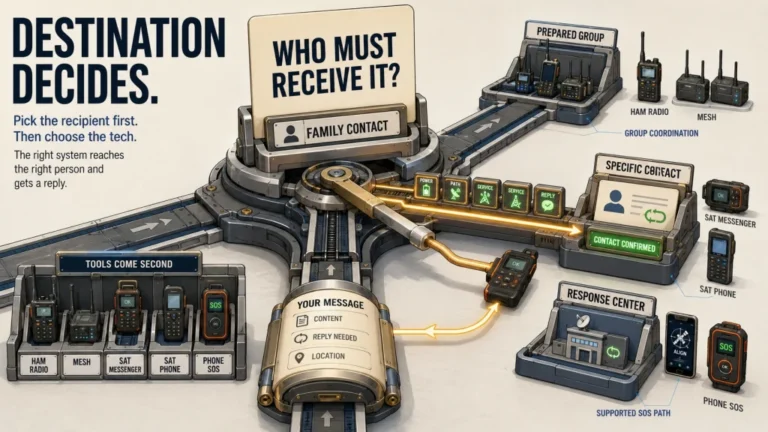
If you cannot choose a row, write down three real signals you expect to hear and whether you need to answer them. That small exercise usually identifies the correct route faster than comparing dozens of features.

The NESDR Mini combines an RTL2832U interface with an R820T tuner in a USB SDR receiver. It includes an antenna and uses an MCX antenna input. The receiver is compatible with laptops, desktops, tablets, and smartphones and is intended for use with SDR software packages.
Check On AmazonIf you click this link and buy, we earn a commission at no additional cost to you.
Final Thoughts: Buy for the Signal and the Job
A ham transceiver, scanner, and shortwave receiver can overlap in frequency coverage without replacing one another. The ham radio route is built around licensed communication, the scanner route around rapid monitoring of compatible local systems, and the shortwave route around tuning and understanding HF signals. An SDR adds flexibility when the listener accepts a software-based workflow.
Research-based: I would choose the target signal first, verify its frequency, mode, system type, encryption status, and legal context, then buy the simplest device that completes that job. That process is less exciting than shopping by the widest frequency range, but it prevents the most expensive mistake in radio listening: owning a receiver that technically tunes the frequency and still cannot deliver the audio you wanted.
Explore More Listening Comparisons
The next guide depends on whether your unresolved question concerns HF listening, local scanning, or the exact services a receiver may cover. Use the comparison that matches the signal you are trying to hear.
| Guide | What it helps with |
|---|---|
| Ham Radio vs Shortwave | Separates amateur transmitting from international, utility, broadcast, and amateur HF listening. |
| Ham Radio vs Scanner | Compares two-way amateur operation with fast monitoring of compatible local conventional and trunked systems. |
| Monitoring Police, Fire, Aircraft, and Weather | Checks individual services against frequency coverage, mode, trunking, digital format, and encryption limits. |
Choose one route, confirm the local technical details, and only then compare hardware within that role.
FAQs
📻 Do I need a ham license to listen to radio signals?
An amateur license is generally required for amateur transmitting, not for ordinary reception of unencrypted over-the-air signals. Monitoring laws and restrictions can still vary by signal type, state, locality, vehicle, venue, and intended use.
🚓 Can a ham radio listen to police and fire channels?
Some ham radios can receive certain conventional analog channels within their coverage. Many cannot follow trunked systems, support the required digital format, or make encrypted communications understandable.
🌍 Is a shortwave radio better than a scanner?
Shortwave is better for tuning international and HF signals, while a scanner is better for rapidly checking compatible local channelized systems. Neither is universally better because the listening jobs are different.
🔐 Can any scanner receive encrypted public-safety radio?
No legal consumer scanner can turn properly encrypted voice traffic into clear audio without authorized system keys and access. A different antenna, database, or digital mode does not remove encryption.
✈️ What receiver do I need for aircraft communications?
Verify coverage of the relevant aviation frequencies and AM reception. Location, antenna, terrain, airport distance, and whether the target is voice or another signal type also affect the choice.
💻 Is an SDR better than a dedicated radio?
An SDR offers flexible software, spectrum displays, and experimentation, but it may require more setup and computer knowledge. A dedicated scanner or shortwave receiver can be easier when the listening job is already defined.
📡 Why can my radio tune a frequency but hear nothing useful?
The signal may be inactive, weak, trunked, encrypted, digitally incompatible, on another site, or using a different mode or bandwidth. Confirm the complete signal path before assuming the receiver is defective.