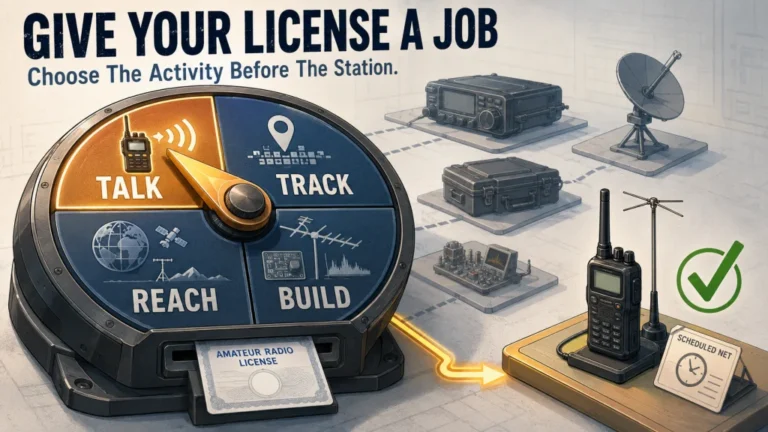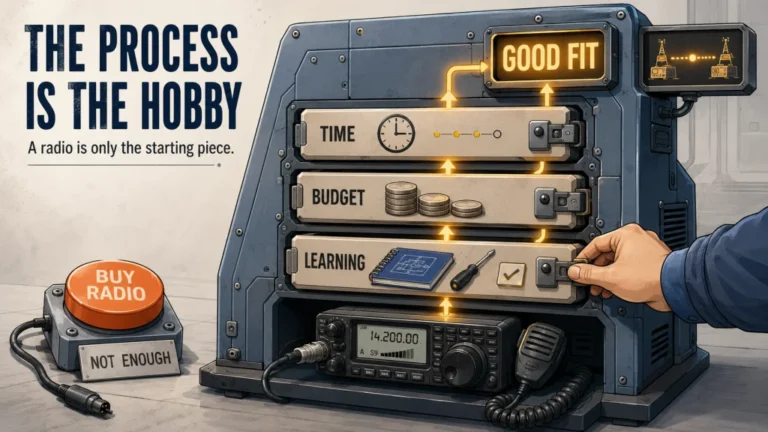
A new Technician needs four connected pieces to make a first local contact: a VHF/UHF handheld, a workable programming method, an antenna, and one verified local repeater. The included antenna is usually enough for the first coverage test, while a programming cable or supported wireless method may be the missing item that turns an unopened radio into a usable one. A base station, separate power supply, home antenna, HF equipment, and SWR meter can wait until the first operating goal is clear. This guide stays focused on minimum local VHF/UHF operation, not product reviews, HF station building, or antenna installation.

The Minimum Setup Is a Complete First-Contact Path
What do you need to start ham radio after passing, or while waiting for, the Technician exam? For a basic local voice contact, the useful answer is not a long shopping list. You need a radio, a way to put the right channel into it, an antenna that can reach the local system, and a repeater you are legally allowed and technically able to use.
The question I hear most often after an exam session is what radio to buy, sometimes before the candidate has checked whether a call sign has been granted. That order creates a predictable problem: the new operator owns a radio but has no confirmed communication path. A useful ham radio beginner gear list should start with the path and then identify the least equipment needed to complete it.
A premade ham radio starter kit may include several accessories and still leave out the one thing the owner needs, such as a compatible programming cable or correct repeater information. The opposite can also happen. A modest handheld with one correctly programmed local repeater may be enough to listen, learn the operating rhythm, and make the first contact without building a full station.
| Part of the path | Minimum useful form | What it solves |
|---|---|---|
| Radio | Analog dual-band VHF/UHF handheld | Provides a practical local Technician starting point |
| Programming | Front panel, compatible cable and software, or supported wireless app | Loads the repeater frequency, offset, tone, and memory name |
| Antenna | The included handheld antenna | Establishes whether the local path already works |
| Repeater | One nearby, active, open analog FM repeater | Gives the first transmission a real destination |
For this specific goal, those four pieces are all a new Technician needs to make a first local contact. They are not a complete answer for every Technician privilege or every location. For the broader sequence from licensing through first use, follow the steps for getting started on air before expanding the shopping list.
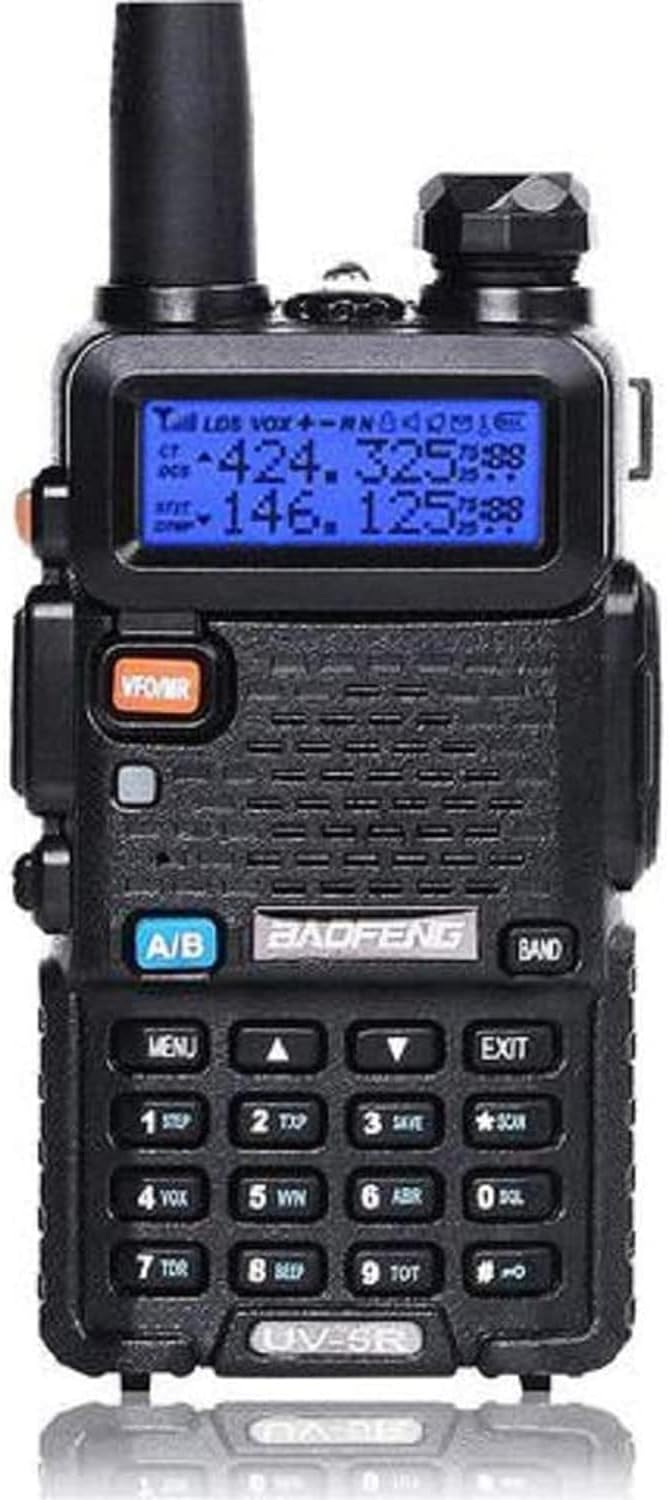
The BaoFeng UV-5R is a dual-band handheld covering 144-148 MHz VHF and 420-450 MHz UHF. This black listing includes an 1800mAh lithium-ion battery and is sold as a portable handheld two-way radio. Its amateur VHF/UHF coverage matches the article's minimum local-contact path when paired with a verified programming method and local repeater.
Check On AmazonIf you click this link and buy, we earn a commission at no additional cost to you.
Item 1: Choose a Radio for the Local Goal
An analog dual-band VHF/UHF handheld is the common minimum because many new Technicians begin with local 2-meter or 70-centimeter FM repeaters. That does not mean a handheld covers everything the license allows. Technician privileges extend beyond those two bands, and a small portable radio is a starting tool rather than a complete station in miniature.
The decision rule is straightforward: confirm that the radio fits the first communication path, not the longest feature list. For a nearby analog repeater, the useful checks are analog FM capability, the correct band coverage, enough memory channels for local use, and a programming method you can realistically operate. A radio with more modes does not help if the local repeater uses analog FM and the owner cannot enter its tone correctly.
Location changes the answer. A person in a town with an active repeater on a nearby tower may make a clean contact with a handheld from outdoors. Someone in a valley, behind dense construction, or far from the nearest system may discover that the same category of radio is not enough for dependable indoor use. That is a coverage result, not proof that the buyer chose the wrong brand or needs every accessory immediately.
Key point: Buy for one known local path. Do not treat a dual-band handheld as a promise that every nearby frequency will be reachable from every room.
If you are still deciding whether local repeater use is the right entry point, the broader beginner guide to ham radio explains how license class, operating goal, and station type fit together.

The BAOFENG BF-F8HP is a dual-band handheld with 136-174 MHz VHF and 400-520 MHz UHF coverage plus selectable 8W, 4W, and 1W power levels. The kit includes a battery, V-85 antenna, charger, earpiece, belt clip, wrist strap, and user manual. It gives a new operator a radio that can be judged against the article's local VHF/UHF goal instead of a general feature list.
Check On AmazonIf you click this link and buy, we earn a commission at no additional cost to you.
Item 2: Decide How You Will Program the Radio
Programming is the item many short gear lists miss. A handheld may be capable of reaching a repeater, but it still needs the output frequency, transmit offset, access tone, and suitable operating mode entered correctly. Until those values are stored and recalled, the radio is only potential.
Front-panel programming costs nothing extra and works well when the radio has clear controls and the owner follows the manual one field at a time. It becomes frustrating when button labels are abbreviated, menu numbers are unfamiliar, or the manual assumes the user already understands repeater setup. The practical test is not whether front-panel entry exists. It is whether you can save one channel, leave that memory, recall it, and confirm that the settings remained intact.
A computer method can reduce repeated menu work. I have seen candidates pass the exam, buy a handheld, and then leave it unused because they never completed the programming step. CHIRP is free, open-source radio programming software for supported radios, but support must be checked for the exact radio before purchase. As checked in July 2026, compatible basic USB programming cables are commonly listed at roughly $10 to $20, although connector fit, driver quality, and radio support matter more than saving the last few dollars.
Some newer handhelds use a supported phone app and wireless connection instead of a traditional cable. That can be easier for a new operator, but only when the app is available for the phone, the radio’s firmware is supported, and the programming workflow includes the fields needed for the local repeater. Wireless programming is a convenience, not a substitute for verifying what was written into memory.
- Confirm the exact radio is supported by the chosen software or app.
- Confirm the cable connector and driver match that radio and computer.
- Read the radio first before changing memories in computer software.
- Program one test memory before importing a large repeater list.
- Recall the saved memory and verify frequency, offset, tone, and power setting.
One verified memory is more useful than one hundred imported entries with unknown status. This is also why the programming method belongs in the purchase decision rather than becoming a surprise after the radio arrives.

The BTECH PC03 uses an FTDI-based USB connection and a Kenwood K1 two-pin radio plug. Amazon lists compatibility with BTECH and BaoFeng models including the UV-5R, BF-F8HP, GMRS-V2, and UV-82HP. It provides a computer-programming path when a compatible radio is easier to manage in software than from its front panel.
Check On AmazonIf you click this link and buy, we earn a commission at no additional cost to you.
Item 3: Start With the Included Antenna
The included handheld antenna is the right baseline because it answers the first coverage question without adding another variable. Charge the radio, program the target repeater, listen from the expected operating location, and then test from a safer or more open position if reception is weak. That sequence tells you more than buying a longer replacement antenna before you know what problem exists.
For example, suppose the repeater is noisy at a desk but clear near an upstairs window or outside. That pattern points toward building loss, antenna position, or terrain rather than a defective radio. A replacement whip might help in some situations, but it cannot remove a hill, and a physically longer antenna is not automatically better on every band or every handheld.
The included antenna is no longer the sensible stopping point when the local path fails consistently after the programming has been verified and the radio has been tested from several practical positions. At that stage, define the failure before choosing the next step. Weak reception indoors, poor vehicle performance, and inability to reach a distant repeater are different problems and do not share one guaranteed accessory fix.
This article stops at that diagnosis. Selecting or installing an external home or vehicle antenna is a separate project because mounting, feed line, grounding, exposure, and property restrictions can change the correct answer.

The Nagoya NA-771 is a 15.6-inch VHF/UHF whip for 144/430 MHz and uses an SMA-Female connector. Amazon lists it for compatible BTECH and BaoFeng handheld radios. It fits this section only as a later antenna option after the included antenna has been tested and a repeatable coverage limitation has been identified.
Check On AmazonIf you click this link and buy, we earn a commission at no additional cost to you.
Item 4: Find One Local Repeater Before the First Transmission
A repeater entry is not just a frequency. For an analog FM memory, the new operator may need the repeater output frequency, the correct offset or input shift, a CTCSS or DCS access tone, and confirmation that the system is open for general amateur use. Entering only the displayed output frequency may let you hear traffic while leaving the radio unable to open the repeater.
RepeaterBook can be searched by location to identify nearby systems, and its entries commonly include the technical fields needed for programming. Treat the directory as a starting point rather than a guarantee that every listing is active at that moment. Check the status and update date, listen for activity or an identification transmission, and use a sponsor or local group page when available to confirm current operating notes.
Choose one analog FM repeater that appears nearby, open, current, and relevant to your operating area. Then program it before the first transmission and listen long enough to understand whether it carries normal conversations, scheduled nets, or little activity. A quiet five-minute window does not prove the repeater is unusable, but a clearly active local net gives a new operator a more predictable place to make the first contact.
Field Note: I have watched new licensees postpone their first contact because they owned a working handheld but had never selected one repeater to try. The barrier was not a missing high-end feature. It was the absence of a specific, programmed destination.
The practical finish line is a memory you can recall and monitor confidently. Once that is true, the microphone button has a purpose instead of becoming an experiment with several unknown settings at once.

The BaoFeng UV-82HP covers 136-174 MHz VHF and 400-520 MHz UHF and provides 128 programmable memory channels. Amazon states that it supports CTCSS, DCS, and DTMF calling methods used in repeater workflows. Those memory and tone functions make it relevant to the section's task of storing one verified local repeater correctly.
Check On AmazonIf you click this link and buy, we earn a commission at no additional cost to you.
What Can Wait Until After the First Contact
A beginner list becomes expensive when every possible future station is treated as a day-one requirement. For the local handheld path described here, a base radio with a separate power supply, a dedicated home antenna, HF equipment, and an SWR meter are optional. Each becomes useful only after the operating goal demands it.
| Optional item | When it becomes relevant | Why it can wait |
|---|---|---|
| Base or mobile radio and power supply | The handheld path works, but more dependable home coverage is needed | It adds power and installation decisions before local coverage is understood |
| Dedicated home antenna | Indoor handheld testing identifies a consistent coverage limitation | Antenna choice depends on location, mounting options, and the problem being solved |
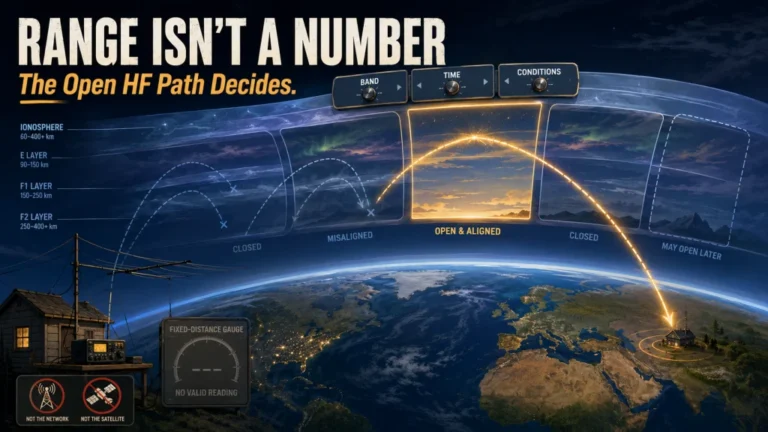
| HF equipment | The operator chooses a later HF goal and understands the relevant license privileges | It does not help with the minimum local VHF/UHF repeater path |
| SWR meter | The operator begins working with an external antenna system that needs testing | It is not needed to evaluate the included handheld antenna as the starting baseline |
| Extra audio and carrying accessories | A real operating habit reveals a comfort, noise, or portability problem | They improve convenience rather than create the first valid radio path |
A full HF station is outside this minimum local setup and belongs to a later operating decision with its own license, radio, antenna, and power requirements. Waiting is not the same as ruling equipment out. It means buying the next item after the first setup reveals a reason for it.

The Mcbazel Surecom SW-33 Plus is a digital VHF/UHF power and SWR meter for 125-525 MHz and up to 100 watts. It connects inline between a handheld or mobile transceiver and the antenna to measure the radio and antenna system. That makes it relevant later, when the operator moves beyond the included handheld antenna and begins testing an external VHF/UHF setup.
Check On AmazonIf you click this link and buy, we earn a commission at no additional cost to you.
Use This Four-Part Check Before You Spend
When someone asks, “What equipment do I need for ham radio?” the answer should name a complete use case, not just a device. For the new Technician in this article, the use case is one local analog FM contact. The buying check below keeps that goal visible while removing accessories that do not yet solve a demonstrated problem.
- Radio fit: Does the handheld cover the band and mode used by the chosen local repeater?
- Programming fit: Can you enter and verify the frequency, offset, and tone by a method you understand?
- Coverage fit: Judge the radio by the locations where you expect to use it, not by antenna length or accessory claims alone.
- Operating fit: Is the repeater current, open, and active enough to provide a realistic first contact opportunity?
If any answer is unknown, research that missing part before adding more gear. This method prevents two common failures: buying a capable radio that cannot be programmed easily, and buying antenna accessories before confirming that the repeater settings were correct.
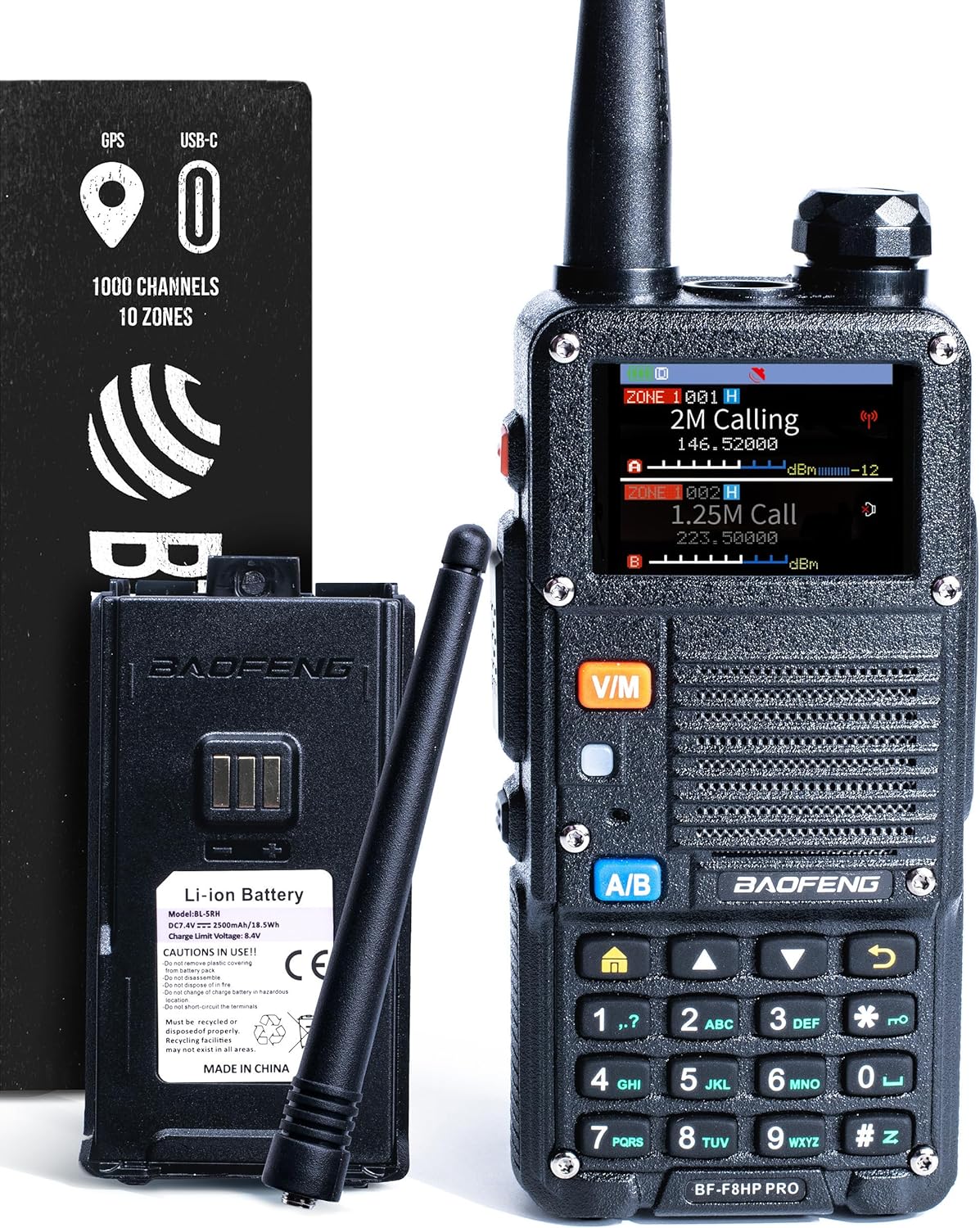
The BAOFENG BF-F8HP PRO is a 10-watt tri-band handheld with 1000 channels, GPS, NOAA weather, and a USB-C rechargeable battery. Amazon states that it supports BTECH CPS and CHIRP-next programming for channels, names, tones, offsets, zones, receive-only channels, and scan lists. That gives a buyer concrete radio and programming characteristics to test against the article's four-part fit check.
Check On AmazonIf you click this link and buy, we earn a commission at no additional cost to you.
Transmit Only After the License and Settings Are Valid
Passing the Technician exam is not the same as having a granted amateur license. For a new license, wait until the FCC grant and call sign appear in the Universal Licensing System before transmitting. You may listen, learn the controls, and prepare memories while the application is pending, but the first amateur transmission must wait for the grant.
Once licensed, operate only within the privileges of the license class and confirm the selected memory is inside an amateur allocation you may use. A wide receive range or an unlocked menu does not expand legal transmitting authority. The radio display tells you what the device can tune, not what the operator is authorized to transmit.
The same distinction applies outside the Amateur Radio Service. A ham license does not turn an amateur transceiver into approved equipment for another radio service. Use equipment authorized for the service involved and follow that service’s licensing and operating rules rather than assuming technical access equals permission.
Warning: Verify the memory before pressing push-to-talk. A wrong channel, incorrect offset, or out-of-service frequency is a legal and practical problem, not a programming detail to fix after transmitting.
Legality is part of the minimum setup because a contact only counts as a successful start when the operator, frequency, equipment, and configuration all match.
Final Thoughts: Build One Working Path Before a Bigger Station
The minimum list is small, but each item has a job. The handheld supplies the local radio platform, the programming method creates a correct memory, the included antenna tests real coverage, and the repeater provides a destination. Remove any one of those pieces and the new operator may still own equipment without having a usable first-contact plan.
I would rather see a new Technician complete one working local path than own a shelf of equipment with no confirmed destination. Let the first weeks of listening and operating reveal what is worth changing. When you know whether the next goal is better home coverage, vehicle use, outdoor portability, or a later HF station, you can compare radios by operating purpose instead of buying features before they have a job.
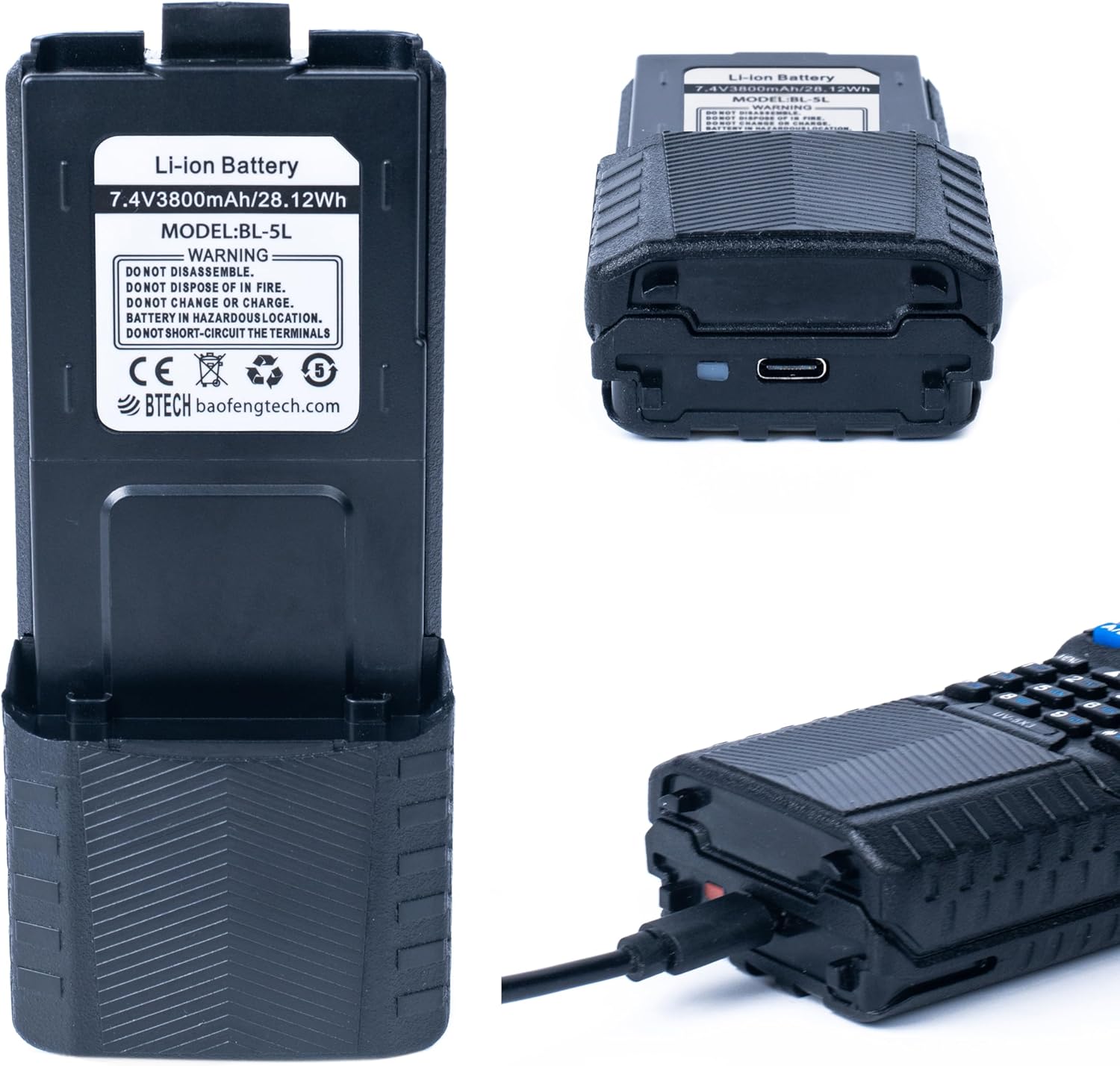
The BTECH BL-5L is a 3800mAh lithium-ion extended battery pack for the UV-5X3, BF-F8HP, and UV-5R radio families. Its listing is specific to those compatible models rather than a universal handheld battery. It fits the article's final point that later purchases should answer a defined operating need, such as more portable power after the first local path is working.
Check On AmazonIf you click this link and buy, we earn a commission at no additional cost to you.
FAQs
📻 Can I start ham radio with only a handheld?
Yes, when your first goal is a reachable local VHF/UHF analog repeater. You still need a way to program the handheld and accurate repeater settings, so the radio by itself is not the complete path.
💻 Do I need a programming cable if the radio has a keypad?
Not always. Front-panel programming is enough if you can enter, save, recall, and verify the repeater settings. A cable becomes useful when the menus are difficult, several channels must be managed, or computer programming is the clearest supported method.
📡 Should I replace the included antenna immediately?
No. Use it as the baseline for one known local repeater, then test from a few practical positions. Replace or add an antenna only after you identify a repeatable coverage problem that the change is meant to solve.
🗼 How do I choose the first repeater to program?
Look for a nearby analog FM repeater that is listed as current and open. Confirm its output frequency, offset, access tone, and activity before using it as your first-contact target.
🪪 Can I transmit as soon as I pass the Technician exam?
Not for a new license. Wait until the FCC grant and call sign appear in the ULS database. While waiting, you can listen, learn the controls, and prepare the radio without transmitting.
🧰 What equipment do I need for ham radio after my first contact?
Buy according to the next operating goal. Better home coverage may point toward a different station and antenna path, while travel or outdoor use may point toward power and carrying needs. Do not add equipment until you can name the limitation or new activity it must support.