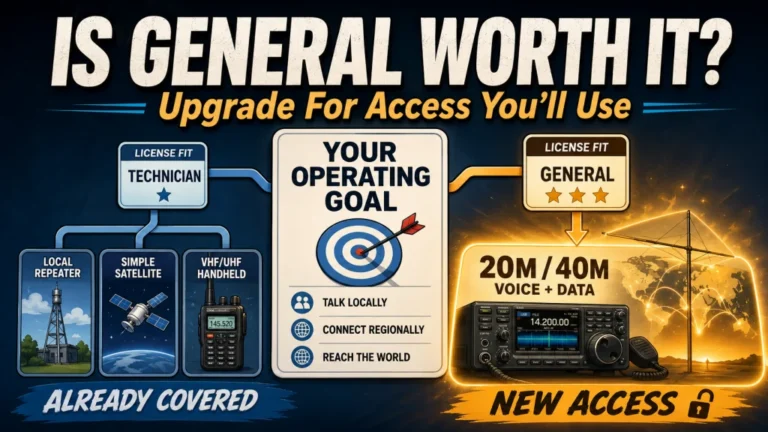
The Amateur Extra license opens every remaining FCC amateur privilege. Its clearest practical value is additional room in several HF bands, plus eligibility for an accredited Volunteer Examiner to administer every current examination element. It does not increase transmitter power, improve propagation, or repair a weak station. For many operators, General already supports every voice, digital, emergency, or casual HF activity they actually use.

Is the Ham Radio Amateur Extra License Worth It?
The ham radio amateur extra license is worth pursuing when you can name a privilege you expect to use, not merely because it is the last license class. Amateur Extra is the highest FCC amateur operator class and gives you access to all frequencies available to US amateur operators. The practical gain over General is narrower than the jump from Technician to General because a General license already provides substantial HF access.
I separate this decision into two questions: what does Extra add legally, and will that addition change what you can do at your station? If a DX station is listening in an Extra-only phone segment, a General licensee cannot answer there. If you mostly use a local repeater, common HF digital frequencies, or voice segments already open to General, the new license may not change a normal week of operating at all.
This article evaluates Extra for General holders and motivated beginners planning ahead. It does not explain the General upgrade process, advanced contest strategy, or specialized station design. Readers who are still deciding how the license sequence fits together should first review how each ham radio license class works, then return to the narrower General-versus-Extra decision.

This 13th edition study manual covers the Amateur Extra exam and includes the full question pool with detailed explanations. Its chapters span operating practices, FCC rules, electronics, signals and measurements, antennas, feed lines, propagation, and safety. The spiral-bound 416-page edition is designed for the current Extra exam cycle through June 30, 2028.
Check On AmazonIf you click this link and buy, we earn a commission at no additional cost to you.
What Extra Adds Over a General License
Extra does not create a new HF band that General operators cannot use. Instead, it removes the remaining class-based frequency restrictions inside several bands, giving you additional CW, data, phone, and image segments. That distinction matters because the benefit is frequency flexibility, not more transmitter power, better propagation, a stronger antenna, or automatic priority over other stations.
The table below shows the Extra-only portions that are most useful when comparing a current General license with Extra in the continental United States. These are legal allocation edges, not suggested operating frequencies, so an operator must still follow emission rules, voluntary band plans, signal-bandwidth limits, and any band-specific restrictions.
| HF band | Additional Extra-only access over General | When it can matter |
|---|---|---|
| 80 and 75 meters | 3.500-3.525 MHz for CW/data and 3.600-3.800 MHz for phone/image | The largest added phone range in this comparison, useful when higher portions are busy or a group operates lower in the band. |
| 40 meters | 7.000-7.025 MHz for CW/data and 7.125-7.175 MHz for phone/image | More room for contacts during busy periods and access to stations operating below the General phone edge. |
| 20 meters | 14.000-14.025 MHz for CW/data and 14.150-14.225 MHz for phone/image | Often relevant when a desired DX contact or event uses the lower phone segment. |
| 15 meters | 21.000-21.025 MHz for CW/data and 21.200-21.275 MHz for phone/image | Provides another place to operate when activity is concentrated below the General phone edge. |
Consider two operators who both hold General. One regularly uses a common 20-meter digital frequency already inside the authorized segment, so Extra does not unlock that activity. The other repeatedly finds a wanted phone contact listening around 14.190 MHz, below the General phone allocation, and the upgrade makes that contact legally reachable. The difference comes from where they operate, not from the title printed on the license.
Extra also makes band-edge management simpler, but it does not eliminate it. Your entire transmitted signal must remain inside the authorized segment, which means a displayed carrier frequency placed directly on an edge can still put part of a sideband outside the legal range. The useful habit is not “I have Extra, so I can tune anywhere”; it is “I have more authorized room, and I still leave enough space for my signal bandwidth.”
What a Ham Radio Extra License Does Not Change
License privileges and station performance are separate. Extra changes where you may transmit, but the same antenna, feed line, power level, receiver noise, and propagation conditions remain in place after the FCC record changes. A signal that was weak because of a poor antenna location will still be weak on an Extra-only frequency.
The distinction is easiest to see during a failed contact. If you can hear a station clearly but cannot answer because it is operating below your authorized phone edge, the license class is the limitation. If you cannot hear the station through local noise, or your transmitted signal does not reach it from an inefficient antenna, additional privileges do not address the cause.
Emergency and casual operation follow the same rule. An operator using an established 40-meter voice frequency already open to General gains no special emergency authority by upgrading. The station still needs a practiced communication plan, correct settings, suitable frequencies, and realistic expectations about terrain and propagation.
I would diagnose the station before assigning the problem to the license. That simple separation prevents someone from studying for Element 4 to solve an antenna, noise, or operating problem that the new privileges cannot change.
Extra Changes Which Exams an Accredited VE May Administer
Amateur Extra also has a specific Volunteer Examiner benefit. Under the FCC rules, a General, Advanced, or Extra licensee may administer a Technician examination; an Advanced or Extra licensee may administer a General examination; and only an Extra licensee may administer an Extra examination. Because new Advanced licenses are no longer issued, upgrading to Extra is the practical route for a current General holder who wants authority to help administer every current exam element.
The license grant alone does not make someone an active VE. The examiner must be at least 18, hold the required license class, satisfy the FCC eligibility conditions, and be accredited by the VEC coordinating the session. Each examination is administered by a team of at least three VEs, and procedures such as registration, document handling, remote-session workflow, and reimbursement can vary by VEC or team.
| VE license class | Technician exam | General exam | Extra exam |
|---|---|---|---|
| General | May administer | May not administer | May not administer |
| Advanced | May administer | May administer | May not administer |
| Amateur Extra | May administer | May administer | May administer |
For someone who wants to volunteer only at Technician sessions, General can already satisfy the license-class requirement once the other VE requirements are met. For someone who wants to grade or administer Element 4, Extra is not optional. That is a clean decision point because the desired responsibility maps directly to a required license class.
As a VE, I would still treat accreditation and session readiness as separate from passing the exam. Knowing the test material helps, but administering an examination also means following the coordinating VEC’s procedures accurately and protecting the integrity of the session. Extra opens the eligibility door; the VEC determines whether and how you participate in its program.
Who Benefits Most From an Amateur Extra Class Ham Radio License
The people who gain the most from Extra usually operate HF often enough to use the added spectrum, need full VE examining authority, or deliberately want the technical challenge. They can point to a band segment, operating event, volunteer role, or learning goal that the upgrade would support. That makes the benefit concrete before study begins.
Extra is most likely to provide meaningful value in these situations:
- You actively pursue HF contacts and regularly find desired stations operating outside your current privileges.
- You participate in crowded HF events and value every additional legal frequency option.
- You want to become an accredited VE who can administer Technician, General, and Extra examination elements.
- You enjoy advanced electronics, measurements, circuits, antennas, propagation, and operating rules as subjects worth learning.
- You want to remove the remaining license-class band-edge restrictions so you can use every amateur frequency privilege available to an operator.
The technical challenge can be a valid reason even when the new spectrum is not essential. The current exam reaches farther into circuit behavior, measurement, receiver performance, signal analysis, antennas, transmission lines, and specialized operating practices than the lower-class exams. A person who wants that structured learning may consider the study itself part of the return.
Still, the license should not become a substitute for using the station. I have seen new operators focus on the next credential while the privileges they already earned remain mostly unused. Someone who has never made an HF contact may learn more from putting a workable antenna on the air, completing several contacts, and observing how the bands are actually used before deciding on the next exam.

The 101st Edition is a 1,280-page softcover reference covering radio electronics, circuit design, digital modulation, and equipment construction. It includes revised material on radio fundamentals, transmission lines, general safety, and assembling a station. Major updates also address batteries, SWR meters, RF safety, and antenna modeling.
Check On AmazonIf you click this link and buy, we earn a commission at no additional cost to you.
Who Can Wait or Skip the Upgrade
A General license already supports a wide range of HF voice, CW, and data operation, along with the VHF and UHF privileges available to lower classes. If your preferred nets, common digital activity, emergency plan, and casual contacts all fit comfortably inside those privileges, Extra may add convenience without changing your actual capability. There is no rule that a serious operator must hold the highest class.
Waiting is especially reasonable when the current bottleneck is not frequency access. An operator fighting severe household noise will not hear better because the license database now says Extra. A portable operator who has not tested the antenna, power source, and setup sequence will gain more immediate value from field practice than from additional slices of spectrum.
Waiting can be a deliberate operating decision rather than a lack of ambition. Use the privileges you already hold long enough to learn which bands, modes, and activities keep your attention. That experience gives a later Extra upgrade a clearer purpose and makes it easier to recognize what the additional access would change.
A motivated beginner may plan for Extra without attempting all three license levels immediately. Each examination element has its own material, and Element 4 is not a replacement study guide for Technician or General. Build the legal and operating foundation first unless you have a realistic reason and enough preparation to take multiple elements in sequence.
What the Current Amateur Extra Exam Requires
The ham radio amateur extra exam, known as Element 4, contains 50 multiple-choice questions. A passing score requires 37 correct answers. Someone who already holds General can qualify for Extra by passing Element 4, while an unlicensed candidate must earn credit for the preceding required elements as well.
The active question pool is the 2024-2028 Extra Class pool, effective from July 1, 2024, through June 30, 2028. Use the version carrying the fourth errata dated February 4, 2026, and confirm that withdrawn questions E4D05, E6D07, E2A13, and E9E10 are not used in your study set. This check matters because an old downloaded file or stale practice database can preserve questions the official pool has removed.
| Official subelement | Main subject | Questions on the exam |
|---|---|---|
| E1 | Commission rules | 6 |
| E2 | Operating procedures | 5 |
| E3 | Radio wave propagation | 3 |
| E4 | Amateur practices and measurements | 5 |
| E5 | Electrical principles | 4 |
| E6 | Circuit components | 6 |
| E7 | Practical circuits | 8 |
| E8 | Signals and emissions | 4 |
| E9 | Antennas and transmission lines | 8 |
| E0 | Safety | 1 |
The distribution shows why Extra often feels significantly harder than General. Sixteen of the 50 questions come from practical circuits plus antennas and transmission lines, while other sections add electrical principles, components, receiver measurements, signals, rules, and specialized operating knowledge. Memorizing isolated answers may produce unstable practice scores because calculation and concept questions can look similar while testing different relationships.
There is no honest universal study-hour number. Preparation depends on your electronics background, how recently you studied General material, whether you learn the formulas or only recognize answers, and how consistently you practice. Use current full-length practice exams to expose weak subelements, then study those weak areas rather than repeating only the questions you already answer correctly.

This sixth-edition Extra study guide uses a question-and-answer format built around the Element 4 question pool. It includes the question pool with an answer key and brief explanations for each question. The 256-page softcover is intended for the 50-question Extra exam and the pool beginning July 1, 2024.
Check On AmazonIf you click this link and buy, we earn a commission at no additional cost to you.
Exam Fees and the License Upgrade Record
An ordinary operator-class upgrade is exempt from the FCC’s $35 amateur application fee. The $35 fee applies to new licenses, renewals, rule waivers, and applications requesting a new vanity call sign, but not to a modification that upgrades an existing operator class or requests a sequential call sign. A VE team or VEC may charge a separate examination-session fee, and that amount depends on the organization conducting the session.
Passing the exam is also not the same moment as seeing the permanent class change in the FCC record. The VE team submits the successful examination through its coordinating VEC, and the application must be processed. Follow the instructions given by that team, keep the examination credit document you receive, and check the official license record before assuming every administrative step is complete.
This is a useful place to avoid unnecessary spending or delay. Do not pay an FCC application fee for a routine General-to-Extra class modification unless the application includes a separate fee-triggering action. At the same time, do not assume every exam session is free, because the FCC exemption and the local examination charge are two different things.
Procedures can differ between in-person and remote sessions and between VEC programs. The controlling rule is the same, but document checks, scheduling, software, and post-exam communication are operational details set by the coordinating organization. Read the session instructions you actually registered under instead of relying on another team’s checklist.
A Practical Decision Framework Before You Study
Do not begin with the prestige of the license name. Begin with the restriction, responsibility, or learning goal you want to address. The following sequence keeps the decision tied to what will change after you pass.
- Check the privileges you use now: Mark the HF bands and modes you operate, then identify whether your current frequency limits have actually blocked you.
- Check operating congestion: Decide whether more legal frequency room would solve a recurring problem or merely add options you are unlikely to use.
- Check your VE goal: Extra is necessary if you want to administer the Extra examination after proper VEC accreditation.
- Check your interest in the material: Treat advanced technical study as a benefit only when you genuinely want to learn it.
- Check the opportunity cost: Compare exam preparation with the antenna, station, safety, and operating work that could improve your results sooner.
Suppose you operate HF several times a week, have missed contacts because they were below your General phone edge, and want to help administer every exam element. Extra solves two specific problems, so the case is strong. Now suppose you use a local VHF net, make occasional digital contacts already inside General privileges, and have not finished your HF antenna. In that case, the license may be worthwhile later, but the antenna and operating practice are the more useful next steps.
The decision can change as your operating changes. A General license that fully fits today may become restrictive after you become more active on HF, join busier events, or begin VE work. When that happens, use planning your next license upgrade to organize the exam step without treating the credential as the goal by itself.
Final Thoughts: Upgrade When Extra Removes a Real Limit
The honest case for Amateur Extra is not that every operator needs the highest class. Extra gives you all remaining amateur privileges, more room on several HF bands, and the license qualification needed to administer Element 4 after VEC accreditation. Those are real advantages, but they matter most when they connect to your normal operating or volunteer goals.
I would upgrade when I could explain what becomes possible afterward in one sentence. If that sentence is about an Extra-only segment, crowded HF operation, full VE eligibility, or a technical challenge you want to complete, the effort has a purpose. If the sentence is only “it is the next license,” use your General privileges first and let actual operating show you whether Extra is worth your time.
FAQs
📻 What does an Extra class ham radio license add over General?
It adds the remaining frequency privileges in several HF bands, including lower CW/data and phone segments unavailable to General operators. It also allows an accredited VE who meets the other FCC requirements to administer Extra examinations.
📝 How many questions are on the Amateur Extra exam?
The Element 4 exam has 50 multiple-choice questions, and you need 37 correct answers to pass. Study from the active 2024-2028 pool with the latest official errata.
💰 Is there a $35 FCC fee to upgrade from General to Extra?
No. A routine operator-class upgrade is exempt from the FCC’s $35 application fee, although the VE team or VEC may charge a separate exam-session fee.
🌐 Do I need Extra to use common HF digital modes?
Not for many common operating frequencies that already fall inside General privileges. Extra becomes relevant when the specific frequency you need is inside an Extra-only segment, so check the band and emission before transmitting.
🧑🏫 Can a General VE administer an Extra exam?
No. An accredited VE who holds General may administer Technician examinations, while only an Amateur Extra licensee may administer the Extra examination, subject to VEC accreditation and the other FCC requirements.
⏳ Should I get Extra before I start using my General privileges?
Usually, use General first unless you are already prepared for Element 4 and have a clear reason to continue. Real operating will show whether band edges, congestion, VE goals, or technical interest justify the additional exam.