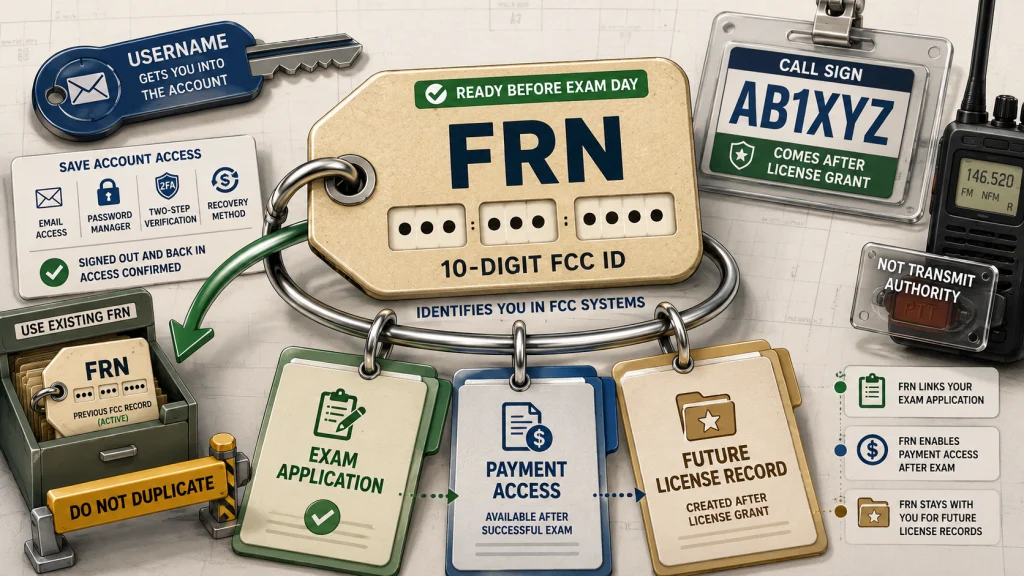
An FCC Registration Number, or FRN, is the 10-digit identifier the FCC uses to connect you with license applications, fees, and future license records. Get it before your amateur radio exam registration deadline, save it somewhere accessible, and bring it with you in the format your exam team requests. The FRN is not your call sign, and creating one does not authorize you to transmit. After you pass, the same FRN helps you pay the FCC application fee and manage the license record tied to your name.
Complete Ham Radio FRN Registration Before Exam Day
Ham radio FRN registration belongs at the beginning of the licensing process, not at the exam table. The FRN is a 10-digit number the Federal Communications Commission assigns to identify you in its systems, and an amateur examination applicant must provide one with the license application information submitted through the Volunteer Examiner process.
The FRN question comes up at almost every exam session I run. People sometimes call it a “ham radio FRN number,” although the N already means number. A candidate may be ready for the radio questions but still be missing the identifier the exam team needs to process the application. That is an avoidable delay, especially because the FRN can be handled before studying, scheduling travel, or arranging a remote video session.
This article covers only the FRN step: what the number does, how to register through FCC CORES, what to save, and how it is used after you pass. The broader Technician license process from start to finish includes studying, finding a session, taking the exam, paying the application fee, and waiting for the call sign to appear.
An FCC Username, FRN, and Call Sign Are Three Different Things
The first practical problem is vocabulary. New applicants often use “FCC account,” “FRN,” and “call sign” as though they are interchangeable. They are connected, but each one has a separate job, and confusing them can send you into the wrong login screen or leave the exam team with the wrong number.
| Item | What it does | When you get it |
|---|---|---|
| FCC username | Provides login access to FCC systems and is tied to an email account you control. | Before requesting or managing an FRN through the current CORES system. |
| FRN | Identifies you in FCC transactions, applications, payments, and license records. | Before the amateur radio exam if you do not already have one. |
| Call sign | Identifies your amateur station and license grant on the air. | After you pass, the application reaches the FCC, any required fee is paid, and the license is granted. |
An FCC registration number for ham radio is not a special amateur-only identifier. The safest mental model is simple: the username gets you into the account, the FRN identifies you inside FCC systems, and the call sign identifies your granted amateur license. A new applicant can have a username and an FRN while still having no legal authority to transmit.
Key point: Do not create a second FRN just because you are applying for a different FCC license or upgrading an amateur license. If you already have an FRN, use that existing number unless the FCC instructs you otherwise.
Why the FRN Must Be Ready Before the Exam
The Volunteer Examiner team needs applicant information that can be submitted into the FCC licensing workflow after a successful exam. The FRN is the identifier that connects the applicant to that filing. It replaces the old practice of putting a Social Security number on amateur examination paperwork, so the examination team should receive the FRN rather than your Social Security number.
Do not treat “get it 24 hours ahead” as a universal rule. Some teams allow walk-ins, some require pre-registration, and remote sessions may close registration well before the appointment. Follow the deadline and instructions for the specific session you selected, then obtain your FRN early enough to fix a misspelled name, inaccessible email account, failed verification, or existing-FRN problem without putting the exam at risk.
A good working rule is to complete this step before you register for the session when possible. That order removes an administrative dependency from exam week and gives you one less account problem to solve while you are trying to focus on the question pool.
Warning: Never send a Social Security number to an exam team as a substitute for an FRN. Enter sensitive information only through the official FCC registration system, and provide the exam team with the resulting 10-digit FRN.
Check for an Existing FRN Before Creating a New One
A first-time amateur applicant is not always a first-time FCC registrant. You may already have an FRN from a GMRS license, a commercial operator credential, a business filing, or another FCC transaction. That existing number normally remains the identifier you use for the amateur application.
Search your records before registering again. Look at prior FCC correspondence, license documents, payment confirmations, and any FCC account you previously created. If you find an FRN but cannot access the username associated with it, use the FCC account recovery or FRN association workflow rather than opening a duplicate registration.
Duplicate FRNs can make account management harder because applications, financial records, and licenses may end up connected to different identifiers. Ten minutes spent checking now is usually easier than sorting out two records after the exam.

The Amazon Basics Expanding Accordion File Organizer has 13 compartments for 8.5 x 11 inch letter-size documents. The listing says it holds up to 260 sheets and uses a flap-and-cord closure. Its poly construction is described as waterproof, tear resistant, acid free, and PVC free.
Check On AmazonIf you click this link and buy, we earn a commission at no additional cost to you.
How to Get an FRN for a Ham Radio Exam Through FCC CORES
The FCC uses the Commission Registration System, commonly called CORES, to issue and manage FRNs. The exact wording and location of buttons can change, so follow the current on-screen registration path rather than relying on an old screenshot that tells you to click a label that may no longer exist.
Use this sequence as the stable part of the process:
- Go directly to the official FCC CORES registration system.
- Create an FCC username if you do not already have one, using an email address you can access reliably.
- Complete email verification and the current security requirements, including two-step authentication when prompted.
- Sign in and choose the option to register a new FRN only after checking that you do not already have one.
- Register as an individual for your personal amateur application, not as a business and not with a restricted-use registration intended for unrelated FCC filings.
- Enter your legal identity and contact information carefully, then review every field before submitting.
- Save the assigned 10-digit FRN and confirm that it is associated with the FCC username you control.
The legal name and contact information deserve a slow review. A nickname, reversed name field, old address, or mistyped email may not stop the FRN from looking complete on your screen, but it can create a mismatch when the exam team prepares the application. The goal is not merely to produce ten digits. The goal is to create a record that can move cleanly from examination paperwork into the FCC licensing system.
Pro Tips: Use a password manager or another secure record for the FCC username, password, two-step authentication recovery method, and FRN. A screenshot of the confirmation can be useful, but do not store or send screenshots that expose a Social Security number, security answers, or other private account data.

The Kingston IronKey Locker+ 50 is a 128GB USB 3.2 Gen 1 encrypted flash drive. The Amazon listing identifies XTS-AES protection and multi-password security options. It also lists automatic cloud backup and a metal casing.
Check On AmazonIf you click this link and buy, we earn a commission at no additional cost to you.
Review the Record Before You Leave CORES
Do not stop at seeing an FRN on the confirmation page. Check that the number contains 10 digits, the registration name matches the identification you will use at the exam, the mailing address is current, and the email account is one you will continue monitoring after the test.
Then confirm that you can sign out and sign back in. That small test matters because the same account access may be needed when an application fee becomes available after the VEC submits your successful exam results. Discovering a login or two-step authentication problem before exam day is inconvenient. Discovering it during a payment deadline is worse.
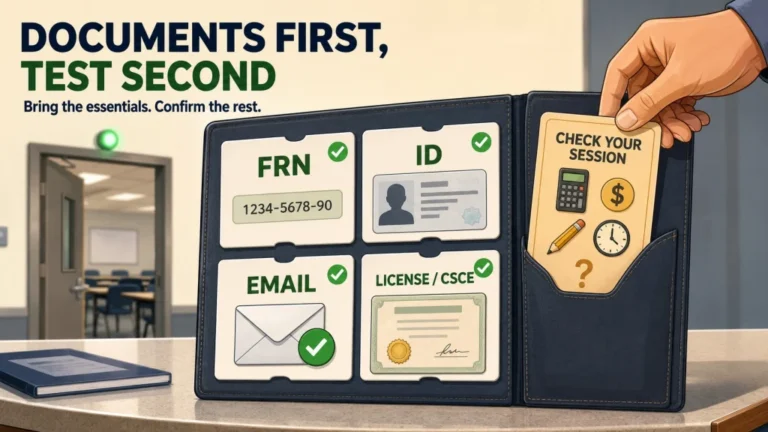
Keep the FRN in at least two secure places. A saved record on your phone plus a printed or handwritten backup works better than trusting a single browser tab. Provide the number during pre-registration if requested and bring it to the session even when you believe the team already has it.
| Final check | Why it matters |
|---|---|
| 10-digit FRN saved | Prevents a last-minute search at check-in. |
| Legal name matches identification | Reduces application and identity mismatches. |
| Email remains accessible | FCC notices and payment instructions depend on working contact access. |
| CORES login tested | Confirms that password and security access work before a fee deadline begins. |
| Session deadline checked | Avoids assuming every VE team accepts the same registration timing. |
This is the point where the FRN task is finished. You do not need to keep changing the record or create anything else before the exam unless the selected team gives you a specific instruction.

This pocket notebook uses weatherproof paper designed for outdoor fieldwork. Each notebook has 100 pages with a top-spiral format and an impact-resistant Wire-O binding. The Polydura cover helps protect field notes from scratches and stains during use.
Check On AmazonIf you click this link and buy, we earn a commission at no additional cost to you.
What the FRN Does After You Pass
Passing the exam does not turn the FRN into a call sign. The VEC must submit the successful application information, the FCC must place the application into its system, and a required application fee must be paid before the new license can be granted. Processing time varies, so use the FCC application and license records rather than a promised number of hours or days.
For a new amateur license, the current FCC application fee is $35 and is paid directly to the FCC after the application reaches its system. The payment window is 10 calendar days from the date the application file number is issued. Exam-session charges collected by a VE team or VEC are separate and vary by organization.
The $35 FCC fee also applies to renewals, rule-waiver requests, and vanity call sign requests. Ordinary operator-class upgrades and sequential call sign requests are exempt. Those distinctions are easy to miss because the exam team charge and the FCC application fee happen at different stages and are paid to different organizations.
The FRN tied to the ham radio license application is used to locate and pay the application in CORES. After payment and FCC processing, wait until the call sign and active license grant appear in the Universal Licensing System before transmitting. A passing certificate, payment receipt, or FRN alone is not operating authority.
CORES Account Records and ULS License Records Need Separate Attention
CORES manages the FRN relationship, account access, and payment functions. The Universal Licensing System displays and manages the wireless application and license record. The systems are related through your FRN, but they are not one interchangeable profile page.
That distinction matters later if you change an email address, mailing address, username profile, or FRN contact detail. Do not assume that editing one screen automatically updates every license record connected to the FRN. Use the current FCC workflow for the specific record you intend to change, then verify the result in ULS.
For a new applicant, the practical move is to enter accurate information once and keep access to the original email account. After the license is granted, treat the ULS license record as something you must verify, not something that is correct merely because the FRN registration looked correct before the exam.
Note: Your FRN normally stays with your FCC transactions over time. Renewing or upgrading an amateur license does not mean starting the identity process again with a fresh number.
Common FRN Mistakes and the Correct Fix
Most FRN problems are account and timing problems, not radio problems. The applicant waits until check-in, creates a duplicate number, uses a nickname that does not match identification, or loses access to the email account used for login. Each mistake is easier to prevent before the exam than to explain while a VE team is trying to complete the session paperwork.
- You already have an FRN: recover or associate the existing record instead of registering again.
- You cannot access the email account: restore account access before relying on that username for the exam application and later payment.
- Your legal name is wrong: correct the FCC record and tell the exam team before the application is submitted.
- You wrote down the call sign of another license: locate the separate 10-digit FRN connected to your own FCC record.
- You registered on exam day: confirm that the FRN is active, saved, and accepted by the team before assuming the paperwork is complete.
- You paid an exam-session charge: do not assume that payment includes the separate FCC application fee for a new license.
I would rather see a candidate spend ten extra minutes checking the FRN and email account at home than spend the first part of an exam session trying to recover a federal login. The FRN itself is not difficult. Treating it as an afterthought is what creates the trouble.

The WEMATE Password Book with Lock is a compact organizer measuring 4.33 x 6.18 inches. It provides space for more than 600 website usernames and passwords and uses alphabetical tabs for organization. The book includes a three-digit combination metal lock.
Check On AmazonIf you click this link and buy, we earn a commission at no additional cost to you.
Final Thoughts: Finish the Identity Step Before the Radio Step
Get the FRN early, use your existing number if one has already been assigned, and save both the number and account access securely. Those actions turn the FRN into a completed administrative step instead of an exam-day surprise.
Remember the dividing line: the FRN identifies you, while the call sign identifies the amateur license the FCC later grants. Once that distinction is clear, the rest of the US ham radio licensing path is easier to follow without confusing registration, examination, payment, and operating authority.
FAQs
🧾 Can I take a ham radio exam without an FRN?
No. Amateur examination applicants must provide an FRN for the license application information handled by the Volunteer Examiners. Obtain it before the registration deadline set by your chosen session.
🔢 Is an FRN the same as a ham radio call sign?
No. The FRN is a 10-digit FCC identifier you obtain before the exam. A call sign is assigned only after you pass and the FCC grants the license.
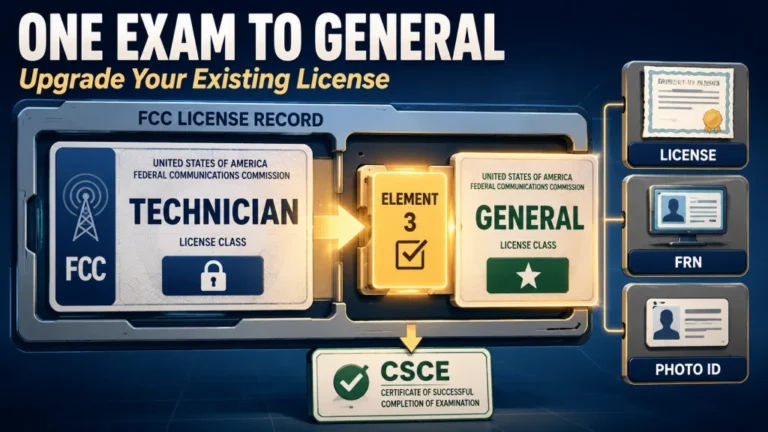
📻 Do I need a new FRN when I upgrade to General or Extra?
No. Use the FRN already connected to your amateur license. An operator-class upgrade changes license privileges, not your FCC identity number.
🪪 What if I already have an FRN from another FCC license?
Use the existing FRN. Recover or associate account access if necessary rather than creating a second number for amateur radio.
⏱️ How long before the exam should I get my FRN?
Follow the registration deadline stated by the specific exam team. Completing the FRN before you register for the session gives you time to solve account, name, or email problems without relying on a universal 24-hour rule.
💵 Does registering for an FRN cost $35?
No. Creating the FRN is not the new-license application fee. After a successful exam application reaches the FCC, a new license applicant pays the current $35 fee directly to the FCC within the required payment window.
✉️ Why does the email address on my FCC account matter?
You need reliable account access for security verification, FCC notices, and the post-exam payment process. Use an email address you expect to keep monitoring and confirm that you can sign in before exam day.
👦 Does a minor taking the amateur exam need an FRN?
Yes. Every applicant needs an FRN for the license application. A parent or guardian may need to help with the registration and account access, but the record must identify the applicant correctly.