The best budget handheld ham radio is not automatically the cheapest listing or the radio claiming the most watts. A useful low-cost HT must support the analog repeater functions you actually need, accept obtainable batteries and programming accessories, and behave well enough in your local RF environment. Because similar listings can hide different variants and bundles, verify the radio you are actually buying before treating a low price as value. Cheap handhelds can be sensible learning, loaner, and backup radios, but low price does not guarantee clean transmit performance, strong-signal receiver behavior, weather protection, or long-term support.
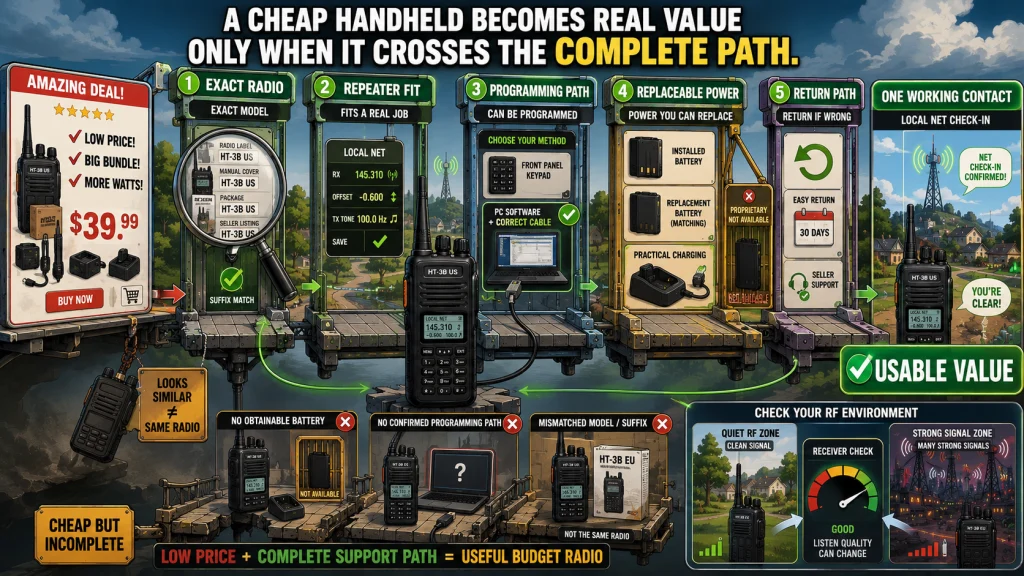
Best Budget Handheld Ham Radio Means the Right Cheap Radio, Not the Loudest Listing
The question I hear most often right after an exam session is what radio to buy, sometimes before the new operator has even asked when the call sign will appear. A cheap ham radio handheld can be a perfectly reasonable first answer when the goal is learning local analog FM, monitoring a nearby net, or finding out whether the hobby fits. The mistake is treating every black handheld with a similar case and a bigger wattage number as the same product.
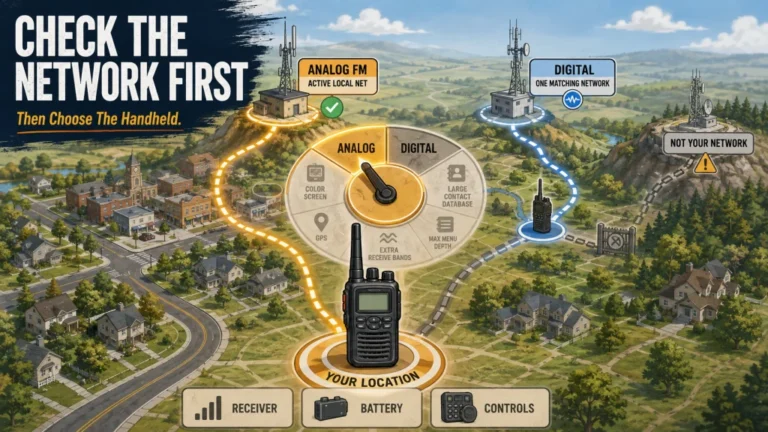
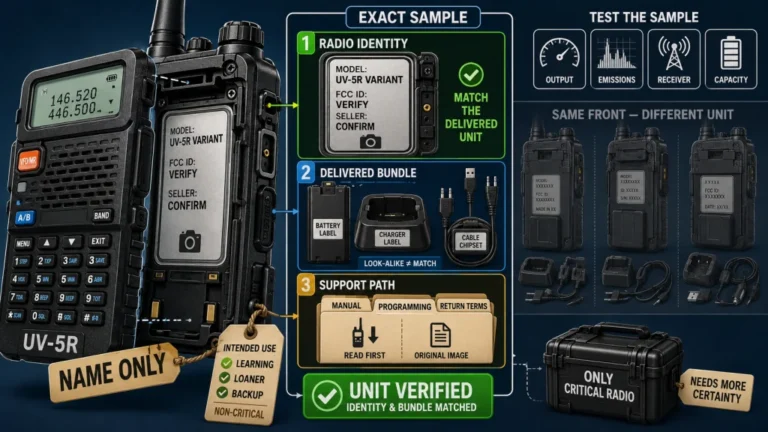
The exact suffix, seller, firmware, included battery, charging arrangement, programming cable, and applicable FCC authorization can separate two listings that look nearly identical. Your location matters too. A radio that works acceptably from a quiet suburban room may become frustrating near a commercial tower, hospital, broadcast site, or other strong RF source because receiver design matters more there than another claimed watt.
Field Note: When a new licensee asks me what to buy, I usually ask whether they have found an active local repeater first. A low-cost handheld is much easier to judge when there is one known channel and one realistic job waiting for it.
Evidence status: Research-based. This article does not present any specific radio as tested or inspected by HamRigs. Output, emissions, receiver behavior, battery runtime, durability, and accessory compatibility should be attributed only to evidence for the exact unit or variant being discussed.
This article stays with low-cost analog handhelds for US amateur use. It does not rank digital radios, choose an emergency-specific system, duplicate a single-model review, or compare handhelds with mobile and HF stations. For that broader decision, start with matching a handheld to your use and then use this guide to judge the budget end of the range.
The Minimum Capability a Budget HT Must Provide
A low price is useful only after the radio clears a basic functional floor. For a beginner planning local VHF or UHF analog operation, that floor is not a long feature list. It is the ability to operate legally on the intended amateur bands, store local repeater information correctly, generate the required access tone, and remain supportable after the included battery wears out.
The local repeater should shape the purchase before the listing does. Confirm its output frequency, input relationship, access tone, and whether it is active. Then check that the radio supports those analog FM requirements without relying on a feature that exists only in a different suffix or regional version.
A single-band handheld can be enough when the repeaters, simplex activity, and nets you plan to use are all on one band. Dual-band capability becomes useful when your local activity is split between 2 meters and 70 centimeters, or when you want room to explore both without replacing the radio. The extra band is flexibility, not proof that the radio will receive better, program more easily, or work through a repeater that is inactive.
| Minimum Check | What It Means in Practice | Reason to Reject the Listing |
|---|---|---|
| Exact US model identity | The suffix, label, manual, and seller description refer to the same radio. | The listing mixes photos, suffixes, or specifications from different variants. |
| Analog repeater functions | The radio stores frequency, shift or offset, transmit tone, and memory channels. | The manual does not confirm the functions your local repeater requires. |
| Usable programming path | Front-panel entry or supported software can load and verify a memory. | The seller promises software support but cannot identify the exact model or cable. |
| Replaceable power system | Replacement batteries and a practical charging method remain obtainable. | The bundle is cheap only because the battery or charger is proprietary and unavailable. |
| Return path | You can return a mislabeled, defective, or incompatible unit without absorbing the loss. | The seller identity, warranty terms, or return window is unclear. |
This minimum screen removes many false bargains before receiver performance or accessory extras enter the discussion. If the radio cannot be identified and programmed with confidence, its advertised savings are not yet real savings.

The Radioddity GA-510 is a dual-band VHF/UHF analog handheld with 128 memory channels. It supports manual front-panel programming as well as CHIRP programming and includes CTCSS, DCS, and DTMF functions. The listed package includes two 2200mAh batteries, a programming cable, desktop charger, antenna, and other basic accessories.
Check On AmazonIf you click this link and buy, we earn a commission at no additional cost to you.
What a Low Price Does Not Guarantee
An affordable ham radio handheld can cover the basic task without matching the refinement of a more established analog platform. The important point is knowing which compromises affect your use and which ones merely look bad on a comparison chart. Cosmetic simplicity may not matter for a spare radio, while poor receiver behavior can make the same radio nearly useless at a busy event site.
Strong-signal receiver performance is one of the easiest trade-offs to miss. A sensitive receiver is not automatically a selective receiver. Near powerful transmitters, a weak repeater may disappear, the noise floor may rise, or unrelated signals may appear where they do not belong. Adding a longer antenna can make that problem worse because the radio receives more of everything, not only the signal you wanted.
Low price also does not prove that every unit or variant has the same transmit output or emissions performance. A measurement from one sample cannot be copied onto a listing with a different FCC ID, suffix, board revision, or seller-supplied firmware. The licensed operator remains responsible for the transmitted signal, so a claim such as “tested clean” is meaningful only when the evidence identifies the exact radio that was measured.
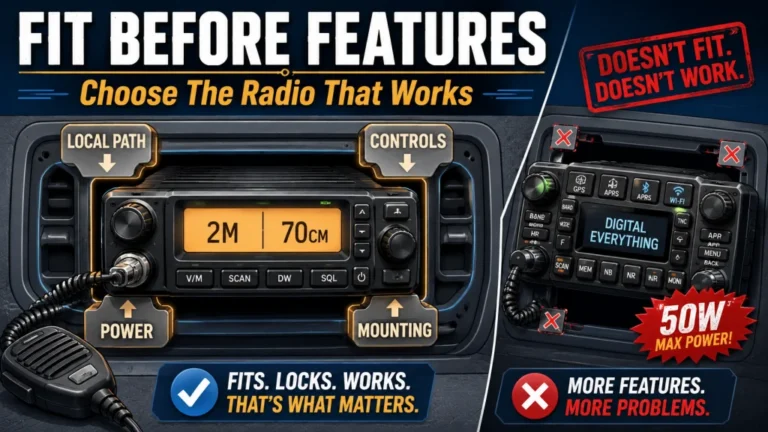
- Wattage: A larger claimed number does not guarantee more usable range, especially when terrain, antenna position, and repeater coverage dominate the path.
- Weather claims: A rugged appearance is not an ingress rating, and an ingress rating must apply to the exact model rather than a similar case.
- Accessories: An included earpiece, antenna, or charger adds no value when it is uncomfortable, fragile, or difficult to replace.
- Controls: A feature-rich menu can be a liability when a channel cannot be corrected away from a computer.
- Support: Community instructions help, but they do not replace a stable manual, current software support, spare batteries, or a seller that handles defects.
A budget radio does not have to win every category. It does need to avoid failing in the category that defines your use. That distinction is why a simple buying method is more dependable than a fixed list of cheap radios.
How to Build a Current Shortlist Without Treating Variants as Interchangeable
The low-cost market changes too quickly for a permanent ranking to stay trustworthy. Listings move between sellers, bundles change, suffixes appear, and a familiar shell may contain a different board or firmware. I would rather rebuild a shortlist from current evidence than preserve a winner whose price, support, or exact identity has changed.
Start by writing down the exact text printed on the radio label and package, not only the product title in the store. Check the manufacturer page and manual for that exact model. Where equipment authorization applies, match the FCC ID or grant information to the unit rather than assuming a brand name settles the question. An FCC ID is also not a magic quality badge; it identifies an authorization record, not how intuitive the menu is or how well the receiver behaves at your location.
Software support must be checked the same way. A listing that says “works with CHIRP” is not enough. The current supported-radio list may distinguish models, variants, and feature limitations, and a similar-looking radio may require a different selection or may not support every function. Before buying around computer programming, confirm the exact model and then follow the safe CHIRP programming workflow instead of treating a cable connection as proof of compatibility.
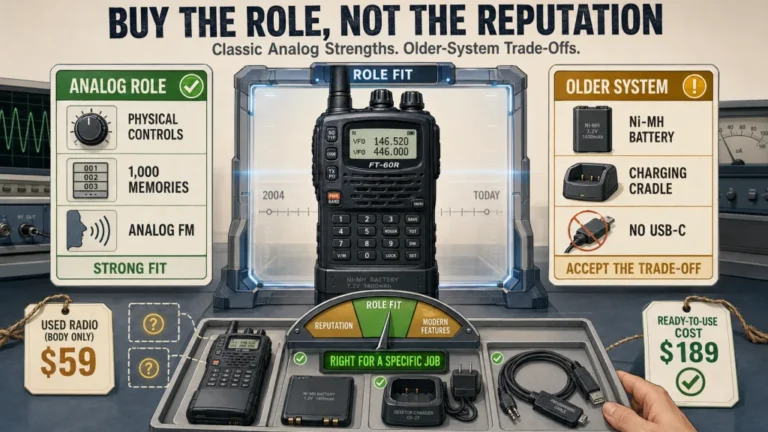
Finally, compare equal bundles. A radio priced below another listing may omit the programming cable, use a different charger, include one battery instead of two, or come from a seller with a weaker return policy. The fair comparison is the total cost of getting one verified repeater memory into a working radio, not the number printed beside the Buy button.
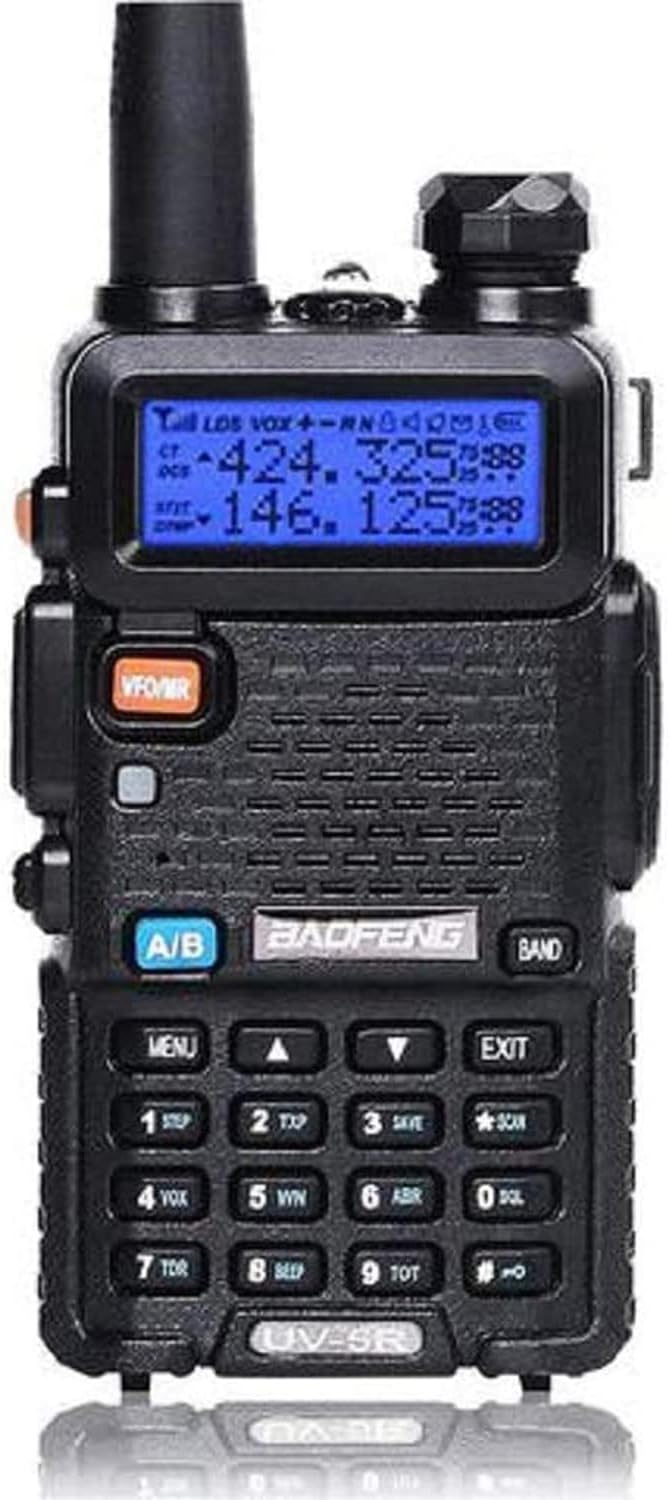
This BaoFeng UV-5R listing is a black dual-band handheld identified for 144 to 148 MHz and 420 to 450 MHz amateur operation. It uses an 1800mAh lithium-ion battery. The exact Amazon listing is identified by ASIN B074XPB313, which helps separate this configuration from other UV-5R bundles and variants.
Check On AmazonIf you click this link and buy, we earn a commission at no additional cost to you.
A Testing Protocol That Keeps Claims Attached to the Exact Unit
A useful test begins with identity. Photograph or record the model label, suffix, FCC ID when present, firmware version when accessible, included battery, charger, antenna, and cable. Without that record, later measurements may describe a different radio than the one a reader can currently buy.
Output power and emissions require suitable test equipment and a controlled method. They should be measured on the exact unit or cited from a source that identifies the same unit clearly. A review should not turn one laboratory result into a promise about every radio sharing a family name. Receiver behavior also needs a defined environment because “worked fine for me” means little without knowing whether the test occurred in a quiet neighborhood or beside strong transmitters.
| Test | Useful Method | What the Result Can Prove |
|---|---|---|
| Front-panel programming | Enter one verified repeater channel using the exact manual. | Whether essential corrections are practical without a computer. |
| Computer programming | Download from the radio, save a clean image, edit one memory, upload, and read it back. | Whether the exact radio, cable, driver, and software path work together. |
| Repeater access | Monitor first, use an appropriate power level, identify correctly, and make a normal test contact. | Whether frequency, offset, tone, audio, and the local RF path work as a system. |
| Battery runtime | Record a stated receive, standby, and transmit pattern at a stated power level. | Runtime for that duty cycle, battery, age, and temperature, not a universal battery-life claim. |
| Receiver environment | Compare behavior in a quiet location and a known strong-signal location. | Whether local RF conditions expose overload or desensitization that a quiet-room test misses. |
Run the practical checks early in the return window, not after the radio has sat unopened for two weeks. Confirm the contents, charge the battery, program a known local channel, listen in the environment where the radio will be used, and test the controls and accessories. A licensed operator can make an identified low-power contact when appropriate; a prospective ham should monitor only or ask a licensed club member to help verify transmit operation. Document any mismatch or defect while a return is still possible.
The result should be labeled honestly as tested, inspected, or research-based. In this article, the method is research-based because no specific unit is being ranked. That boundary matters more than pretending a broad product family has one permanent performance profile.
Who Is Well Served by a Cheap Analog Handheld
A low-cost HT fits best when the job is narrow and known. A learner with one active local repeater, a club assembling clearly labeled loaner radios, an operator who wants an inexpensive spare, or a prospective ham listening before committing more money can all get real value from a modest analog radio. In those cases, the radio is a tool for a defined step rather than a promise to cover every future interest.
The learner case works especially well when someone has local help. A club member can confirm the repeater, build one known-good memory, and show the new operator how to monitor and identify. The cheap radio then teaches practical skills: volume and squelch, repeater timing, tone settings, memory selection, charging habits, and the limits of a handheld antenna indoors.
A loaner or spare has different priorities. It may need fewer features, but the battery must hold a charge, the controls must be explainable, and every channel must be documented. A drawer full of inexpensive radios is not a communication plan when nobody knows which battery fits, which memory contains the net frequency, or whether the radios were ever checked after programming.
For a broader view of whether a handheld is the right first format at all, use choosing the right ham radio. A low-cost HT is a sensible entry point for local analog work, but it is not a substitute for a mobile radio, an HF station, or a service chosen for unlicensed family communication.
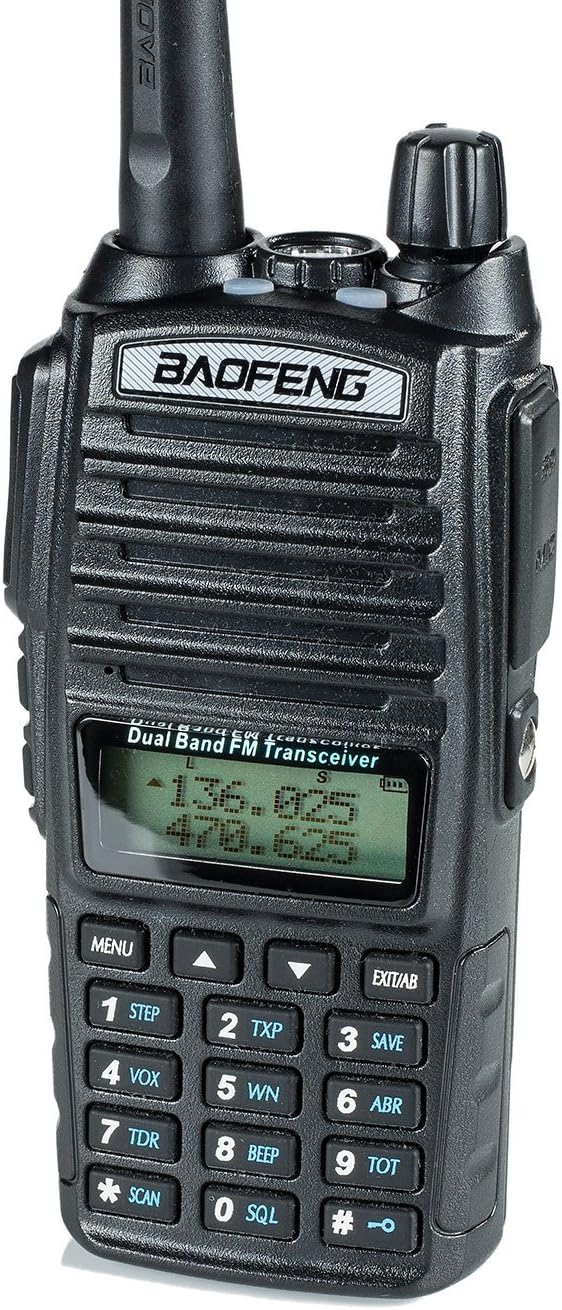
The BaoFeng UV-82HP is a VHF/UHF dual-band handheld built on the UV-82 platform. It provides selectable power levels and a configurable dual or single push-to-talk control. BTECH describes the model as an amateur handheld intended to combine portable operation with the UV-82 control layout.
Check On AmazonIf you click this link and buy, we earn a commission at no additional cost to you.
The Conditions That Justify Spending More
Spending more is justified when it buys a solution to a problem you can name. Paying for a stronger support history may make sense when the radio will be kept for years. Paying for better receiver performance may matter near strong RF sources. Paying for clearer controls may matter when several family members or club operators must use the same radio without a laptop beside them.
Outdoor use changes the calculation too. If the radio will be carried in rain, dust, heat, or repeated field use, verified environmental protection and a dependable accessory ecosystem can matter more than the original purchase price. Emergency preparedness raises additional questions about repeated charging, spare batteries, documentation, and a complete communication plan, which are larger than the cheap-handheld decision covered here.
| Your Conditions | Sensible Direction |
|---|---|
| You have a known analog repeater, a quiet RF environment, a working programming method, realistic expectations, and a returnable exact model. | Stay with the budget path and verify the exact unit. |
| You need stronger receiver performance, easier front-panel control, verified environmental protection, digital network access, longer support, or a stable battery and accessory system. | Move up a tier to solve the named requirement. |
Digital voice is the clearest stop sign. Buying a cheap analog radio first does not create access to DMR, System Fusion, or D-STAR. The protocol and local infrastructure must be chosen before the radio. Likewise, a person who already knows that easy controls and long-term parts support matter should examine a long-support analog case study rather than buying twice to discover the same preference.
Budget Handheld Buying Checklist
The final screen should fit on one page. Do not buy until the listing, official documentation, software path, accessories, and return terms describe the same exact radio. When one item cannot be verified, count it as unknown rather than filling the gap with a review of a similar model.
- Record the exact model name, suffix, regional version, and seller identity.
- Match the label and applicable FCC ID or grant information where authorization applies.
- Confirm the amateur bands, analog FM mode, repeater offset functions, and transmit-tone settings you need.
- Verify current software support for the exact model when computer programming is part of the plan.
- Identify the required cable connector and chipset instead of buying a generic cable by appearance.
- Check whether replacement batteries are currently obtainable from a seller you would use.
- Confirm the charging method and whether it works with your home, vehicle, travel, or backup-power plan.
- Compare the total current cost with the same number of batteries, chargers, cables, and other included accessories.
- Read the return window, warranty terms, and process for a defective or mislabeled unit.
- Decide which condition would make you spend more before a low price persuades you to ignore it.
The phrase best ham radio under 50 dollars is useful as a shopping question, but it is not a complete decision rule because the price line moves and bundles are rarely equal. A slightly higher total may be cheaper in practice when it includes the correct programming path, a replaceable battery, and a seller who accepts a return. To keep the radio within a realistic first-station budget, compare these costs with the full cost of starting ham radio.
If the listing belongs to the most searched low-cost radio family, separate its variant and compliance questions from this broader method by reading the dedicated UV-5R analysis. That keeps a single model discussion from distorting the standards applied to every other budget radio.

BTECH PC03 is a USB-A programming cable for radios using the Kenwood K1 accessory jack. Amazon lists a genuine FTDI chipset, plug-and-play operation, and compatibility with CHIRP. Supported radios listed by Amazon include models such as the BTECH UV-5X3, BAOFENG BF-F8HP, and UV-82HP.
Check On AmazonIf you click this link and buy, we earn a commission at no additional cost to you.
Final Thoughts: Buy the Exact Radio You Can Verify
A budget ham radio can be good value when the job is local analog communication and the radio clears a basic functional screen. The useful bargain is not the listing with the most bands, accessories, or claimed watts. It is the option that fits local conditions and remains practical to program, power, support, and return if something is wrong.
I would make the next step small: find one active repeater, write down its requirements, and use the checklist to eliminate listings that cannot support that job. If a candidate passes the programming, receiver, battery, and return tests, the affordable path may be enough. If it fails on a condition that matters to you, that failure gives you a concrete reason to spend more.
FAQs
💵 What is the best ham radio under 50 dollars?
There is no permanent answer because exact variants, sellers, bundles, and current prices change. Choose only a current US model that supports your local analog repeater, has a verified programming path, uses obtainable batteries, and comes with a workable return policy.
📻 Is a cheap handheld good enough for a new Technician?
It can be good enough for learning local analog simplex and repeater operation when coverage exists and the radio is programmed correctly. It is not automatically the right choice for digital voice, difficult RF environments, or a long-term station.
⚡ Does a higher wattage claim mean more handheld range?
Not by itself. Terrain, antenna position, building loss, repeater location, and receiver conditions often change the result more than a small difference in handheld output power.
🧾 Does every amateur handheld need an FCC ID?
Equipment authorization depends on how the exact device is designed, marketed, and covered by FCC rules, so an FCC ID is not a universal one-step legality test for all amateur equipment. Where an authorization applies, match the record to the exact unit rather than a similar model name.
💻 Should I reject a budget radio that is not supported by CHIRP?
Not automatically. Reject it when you have no practical programming path, but some radios use manufacturer software or workable front-panel entry instead. Verify the method before buying.
🏙️ Why can a cheap HT work at home but fail downtown?
A stronger RF environment can overload or desensitize a receiver that seemed fine in a quiet location. The radio may hear less even though more signals are present around it.
🔋 Is an extra battery more valuable than extra advertised features?
It often is when the radio will be used as a loaner, spare, or field radio. The deciding question is whether replacement batteries remain obtainable and fit your charging plan, not whether one bundle temporarily includes more pieces.