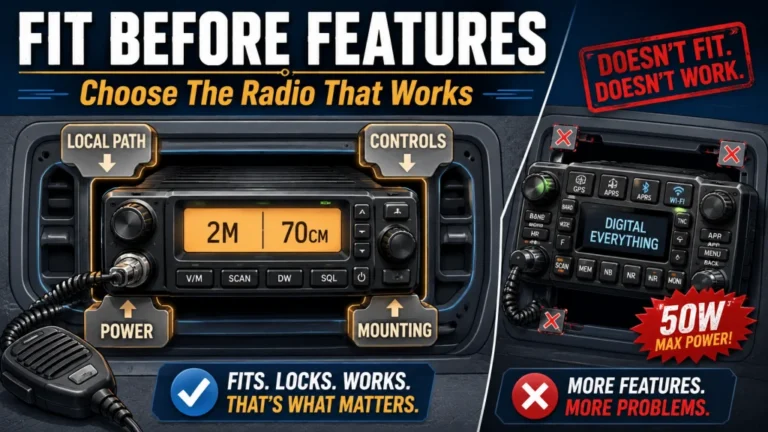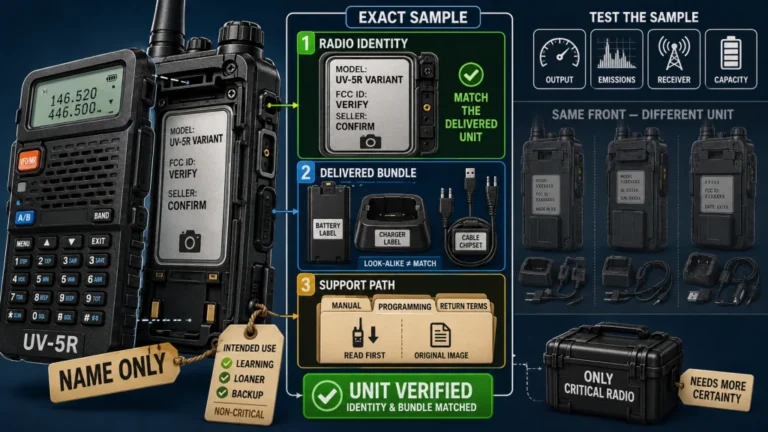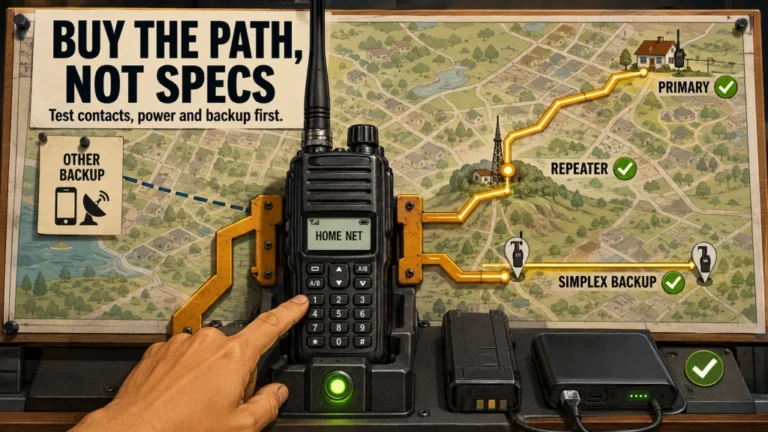
The Icom IC-7300MK2 and Yaesu FT-710 AESS are current 100 W HF and 50 MHz SDR transceivers built for the same station role but different workflows. Choose the IC-7300MK2 when LAN remote operation, dual virtual COM ports, receive-antenna connections, or HDMI matter. Choose the FT-710 AESS when its included speaker, lower package price, longer US warranty, and control layout fit better. Receiver environment, computer workflow, antenna system, and total cost can still change the answer.

The Better Radio Is the One That Completes Your Station
The Icom IC-7300MK2 vs Yaesu FT-710 decision is not settled by choosing the newest name or the largest receiver number. Both radios cover HF and 50 MHz, deliver up to 100 W on their main voice and data modes, use direct-sampling SDR receiver designs, include spectrum displays, and have internal antenna tuners. The meaningful differences appear when you connect the radio to the rest of your station.
I would choose the IC-7300MK2 for an operator who already knows that Ethernet remote control, a receive-only antenna path, HDMI output, or two simultaneous computer-control channels will be used. I would choose the FT-710 AESS for an operator who values its included external speaker, wants a lower radio-package price, prefers its combination of physical controls and touchscreen functions, or places more weight on its longer manufacturer warranty.
That answer assumes a fixed or semi-fixed HF station. This comparison does not cover the original IC-7300 in depth, declare a laboratory receiver winner from unmatched measurements, or treat either radio as a portable or all-band VHF/UHF solution. For a wider view of where these radios sit, start with choosing an HF base transceiver.
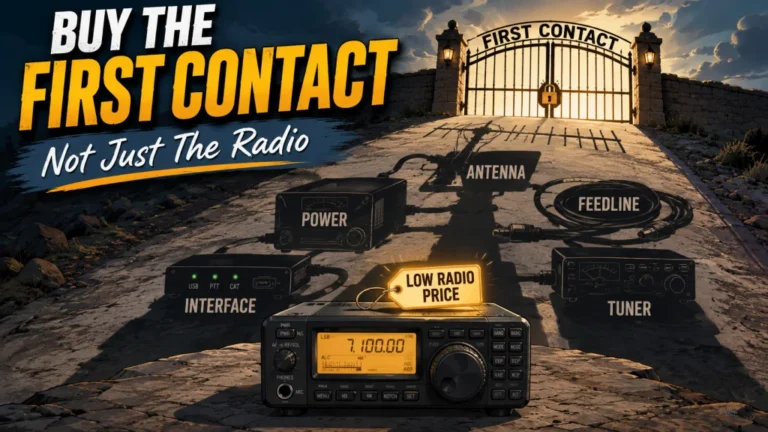
Field note: The first-station mistake I see repeatedly is treating the radio price as the station budget. Reserve money and space for the parts required by the operating plan before choosing between two transceivers.

The Jesverty SPS-30II is a regulated bench supply rated for 30 amps with adjustable 9 to 15 V output and a 13.8 V setting. It uses screw-type output terminals and includes a cooling fan. Its output range and current rating suit the 13.8 V supply requirement of a 100 W HF station.
Check On AmazonIf you click this link and buy, we earn a commission at no additional cost to you.
Exact US Models, Packages, and Evidence Status
This comparison uses the US 100 W IC-7300MK2 and the US 100 W FT-710 AESS package. The IC-7300MK2 is the current Icom generation that began shipping at the end of 2025. It is not the original IC-7300 with a newer label, and older IC-7300 comparisons do not answer the new LAN, HDMI, dual-COM, receive-antenna, and receiver-update questions.
The FT-710 AESS package includes the SP-40 external speaker used by the Acoustic Enhanced Speaker System. The lower-priced FT-710 FIELD uses the same basic transceiver platform but does not include that speaker, so substituting FIELD pricing while discussing AESS audio would distort the comparison. Buyers considering the older Icom generation should use the separate original IC-7300 operating review.
| Comparison item | Icom IC-7300MK2 US | Yaesu FT-710 AESS US |
|---|---|---|
| Evidence status | Research-based, official product information and manuals | Research-based, official product information and manuals |
| Hands-on status | No matched HamRigs test claimed | No matched HamRigs test claimed |
| Supplied audio item | HM-219 hand microphone, internal speaker | SSM-75E hand microphone and SP-40 external speaker |
| Other listed package items | DC cable, fuses, and plugs | DC cable with fuse, spare fuse, and operating manual |
| US manufacturer warranty | 1 year for amateur products | 3 years |
| Firmware checked | Version 1.02, released November 2025 | Main 1.12, Display 1.08, DSP 1.01, SDR 1.04, released February 2024 |
Published dimensions exclude projections, so leave rear space for connectors and cable bends.
| Desk factor | IC-7300MK2 | FT-710 AESS |
|---|---|---|
| Radio body, W × H × D | 240 × 94 × 237.6 mm | 239 × 80 × 247 mm |
| Approximate radio weight | 4.1 kg | 4.5 kg |
| Additional placement | Optional speaker only if added | SP-40 speaker needs separate space |
The FT-710 is slightly deeper and heavier; the IC-7300MK2 is slightly taller. Measure shelf depth and speaker space, not front-panel width alone.
Manuals can establish features, but comfort, audio preference, fan character, and control speed remain partly subjective. I do not present those as HamRigs test findings without matched equipment and operating conditions.

The Komelon 4912IM provides a 12-foot blade with both inch and metric markings. Its nylon-coated blade and triple-riveted end hook are listed for durable measuring use. It is a practical tool for checking radio depth, rear cable clearance, and the extra desk space required by an external speaker.
Check On AmazonIf you click this link and buy, we earn a commission at no additional cost to you.
Receiver Architecture and Strong-Signal Behavior
Both radios digitize incoming RF early and process much of the receiver inside programmable digital hardware. Both also use bandpass filtering ahead of the conversion stage to reduce energy from signals outside the selected amateur band. In practical terms, the front end has to preserve a weak wanted signal while strong nearby signals are trying to consume the receiver’s available range.
RMDR describes how well a receiver protects a weak signal from noise created by a strong signal close in frequency. Blocking describes how much a strong signal can reduce the receiver’s ability to hear another one. Phase noise matters because energy spread around an oscillator or transmitted carrier can mask nearby weak signals even when the displayed frequency is correct.
Icom states that the IC-7300MK2 improves RMDR and transmit phase noise by more than 12 dB compared with the original IC-7300 under a specified close-spacing condition. Yaesu publishes absolute FT-710 claims including RMDR, blocking dynamic range, intermodulation dynamic range, and transmit phase noise under its stated conditions. Those two presentations are not a clean head-to-head test: one is an improvement relative to an older radio, while the other is a set of absolute manufacturer figures.
Decision rule: Do not convert unmatched manufacturer claims into a winner. Use the same independent lab, frequency, spacing, bandwidth, preamp state, attenuation, and test method before treating two receiver numbers as comparable.
Receiver differences matter most near strong transmitters or in crowded bands. At a noisy suburban station, antenna placement and household-noise control may change what you hear more than a small ranking difference.

This receive-only high-pass filter attenuates the AM broadcast band from 500 kHz to 1.7 MHz by more than 50 dB. Its 3 dB roll-off is around 2.5 to 2.6 MHz, and it uses SMA female connectors. It is useful for receive-path testing when strong local AM broadcast signals may be overloading a receiver front end.
Check On AmazonIf you click this link and buy, we earn a commission at no additional cost to you.
Controls and First-Week Usability
The IC-7300MK2 continues Icom’s touchscreen-and-multi-dial approach. The operator touches the operating item or opens a function panel, then uses the multi-dial for adjustment. That arrangement can make band changes, mode selection, filter width, scope tuning, and memory editing feel visually direct, especially for someone who prefers to see the setting before turning a control.
The FT-710 combines a touchscreen with more front-panel controls, a function dial, quick memories, and a visible operating-state indicator. Once learned, frequently used adjustments may stay closer to the operator’s hand.
For first-week use, test five tasks: change bands, switch modes, narrow a filter, set split, and save then recall an operating state. The better fit is the radio that makes those tasks predictable for you.
Neither workflow removes the need to learn the radio. The practical difference is whether you prefer a more screen-led sequence or a layout that exposes more adjustments through dedicated and multifunction controls.
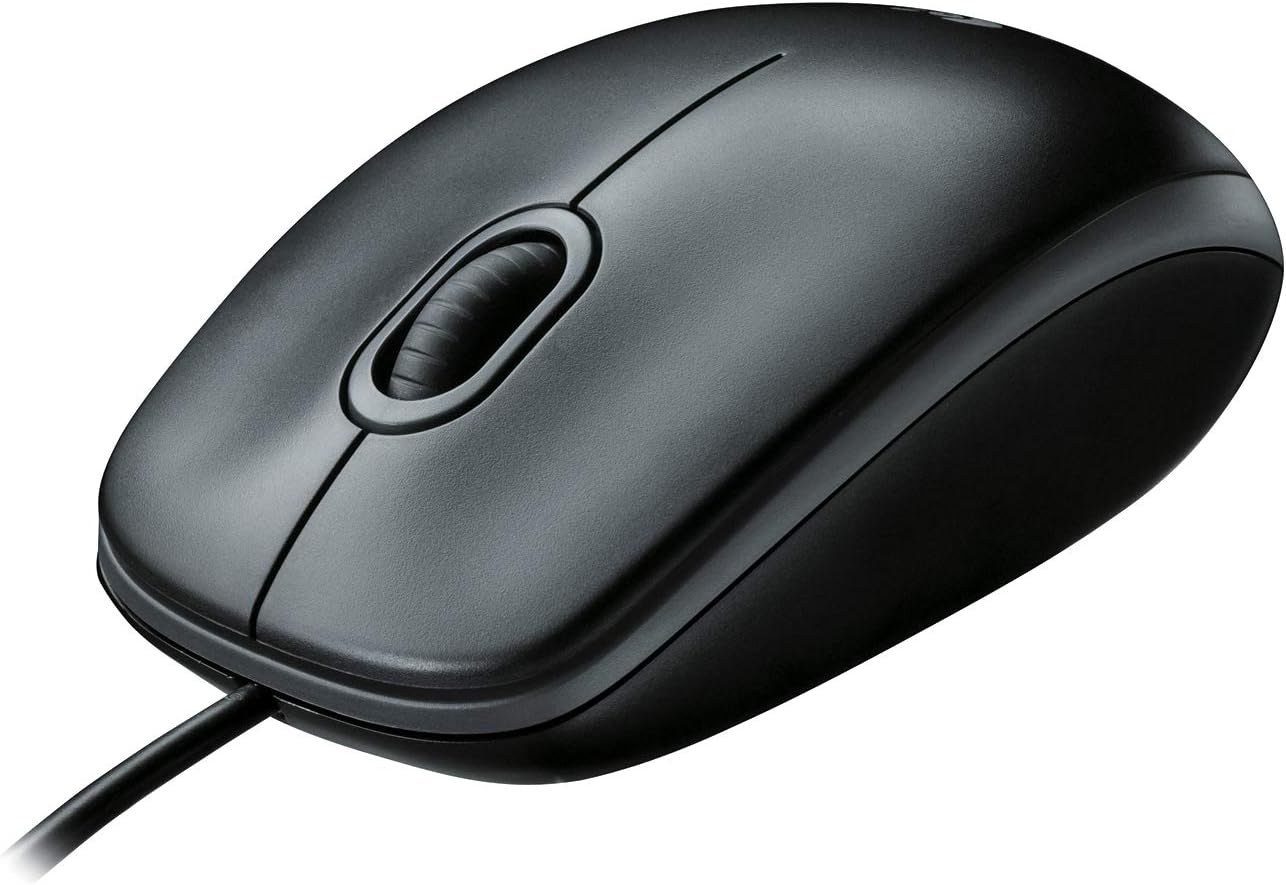
The Logitech B100 is a corded USB optical mouse with an ambidextrous shape. Yaesu documents support for a USB Type-A mouse on the FT-710 for selecting items on the screen. This gives an FT-710 owner a simple way to test the mouse-assisted control workflow described in the section.
Check On AmazonIf you click this link and buy, we earn a commission at no additional cost to you.
Spectrum Display and External Monitor Workflow
Both radios use a 4.3-inch color touchscreen and provide spectrum and waterfall views. Either can help a new HF operator see activity, locate open space, watch band conditions change, and move to a signal without tuning blindly across the band. The display is a navigation tool, not proof that the signal is readable or that the frequency is clear for transmission.
The IC-7300MK2 adds HDMI output and can send operating information and audio to a compatible monitor. That is the cleaner choice for a station already built around HDMI displays. The FT-710 uses DVI-D output and can accept a mouse through its USB Type-A port, which creates a different large-screen workflow.
An HDMI-only monitor may require a compatible FT-710 adapter, so confirm display compatibility before buying. These outputs enlarge control and scope information; they do not add another receiver.
Research-based judgment: Choose HDMI when simple compatibility with a modern monitor is the priority. Choose the FT-710 display path when its DVI-D output and mouse control fit equipment you already own.

This 6-foot Amazon Basics cable links HDMI and DVI-D devices in either direction. Amazon lists 1080p support and gold-plated connectors for this cable. It matches the FT-710 external-display workflow when the radio's DVI-D output needs to connect to an HDMI display.
Check On AmazonIf you click this link and buy, we earn a commission at no additional cost to you.
Digital Modes and Computer Connections
The IC-7300MK2 uses a USB Type-C connection with audio input and output plus two virtual COM ports. That design is useful when one program needs radio control while another application also needs serial access, such as an FT8 application running beside logging or contest software. It reduces the chance that two applications will fight over one serial port, although the software still has to be configured correctly.
The FT-710 provides USB Type-A and Type-B ports, a virtual COM driver, USB audio, several CAT paths, and an FT8 preset workflow. Its Type-A port also supports peripherals such as a mouse, while the computer connection uses the supported Type-B path. The radio can handle digital operation without an external sound-card interface, but the port assignment and application-sharing plan are not identical to Icom’s dual-COM arrangement.
Both radios offer presets for moving between normal operation and FT8 settings. A preset is not a complete installation. You still have to select the correct audio devices, CAT port, data mode, levels, time synchronization, power, and ALC behavior.
| Computer platform | IC-7300MK2 | FT-710 |
|---|---|---|
| Windows 11 or 10 | Official USB driver; RS-BA1 supports these versions | Official virtual COM driver is provided |
| macOS | No official model-specific support path listed | No official model-specific support path listed |
| Linux | Verify radio and application support | Verify radio and application support |
Mac or Linux operation may work with particular applications, but community success is not manufacturer support. Verify CAT, audio, PTT, logging, and update procedures on the exact computer.
- Install the current manufacturer driver before connecting the radio when the instructions require it.
- Record which COM port controls CAT and which function controls PTT.
- Select the radio’s USB audio device instead of a laptop microphone.
- Use a moderate transmit level and confirm the radio is not being overdriven.
- Test logging and digital applications together before assuming simultaneous control will work.
- Save a known-good profile before changing menus for another mode.
For an operator who expects several applications to share the radio, the IC-7300MK2 has the clearer integration advantage on paper. For someone running one digital application and one logger with a proven FT-710 configuration, the difference may be smaller than the feature list suggests.

This Amazon Basics USB 2.0 cable has USB-A and USB-B connectors and a 6-foot length. Amazon rates it for data transfer up to 480 Mbps and uses gold-plated connectors. Yaesu specifically calls for a commercially available USB A-B cable for the FT-710 computer-control connection.
Check On AmazonIf you click this link and buy, we earn a commission at no additional cost to you.
Remote Operation Favors Different System Designs
The IC-7300MK2 has a built-in Ethernet port and supports Icom’s RS-BA1 Version 2 remote software. The radio can connect to the network without a server computer at the station, and the supported path includes remote power control, radio settings, audio, spectrum, and waterfall operation. The software is an added purchase, but the network hardware is already inside the radio.
The FT-710 requires the external SCU-LAN10 network unit for Yaesu’s dedicated network remote system. That unit also needs its own supported power source and current firmware, while the remote computer runs Yaesu’s software. A connected station computer can provide another control path, but it moves more of the system’s reliability, update, and recovery burden onto that computer.
At the July 24, 2026 price check used for this article, RS-BA1 Version 2 was listed at $159.95. The SCU-LAN10 was listed at $299.95 before adding its required power arrangement. That difference matters only when remote operation is a real plan; paying for unused remote hardware does not improve ordinary desk operation.
Network safety: Do not expose radio-control services directly to the public internet. Use current firmware, unique passwords, a secured home network, and a properly configured VPN or another supported protected connection. Confirm that remote shutdown, transmit control, audio levels, and station monitoring work before leaving the equipment unattended.
The IC-7300MK2 is the more integrated remote choice. The FT-710 remains workable, but its dedicated route adds an external unit, power requirement, and more hardware to troubleshoot.

This 10-foot Cable Matters patch cable uses Cat 6 construction and RJ45 connectors. The listing specifies 24 AWG copper conductors, 550 MHz bandwidth, and up to 10 Gbps Ethernet performance. It provides a standard wired network connection for the Ethernet side of a remote-radio station.
Check On AmazonIf you click this link and buy, we earn a commission at no additional cost to you.
Internal Tuners Do Not Replace the Antenna System
The IC-7300MK2 internal tuner is specified for a 16.7 to 150 ohm unbalanced load, corresponding to a mismatch of about 3:1 or less, and stores tuning solutions for faster recall. Icom also provides an enforced-tuning function for emergency use, but warns that it is not for ordinary operation and that transmit power may be reduced. That is a stopgap, not a reason to operate a severely mismatched antenna every day.
The FT-710 tuner also covers 16.7 to 150 ohms on HF and uses a narrower 25 to 100 ohm range on 50 MHz, with 100 tuning memories. Both radios support external tuner arrangements, but the correct external solution depends on the antenna, feed line, operating bands, power, and where the mismatch occurs.
The IC-7300MK2 adds separate receive-antenna IN and OUT connections. That is useful for a dedicated receiving antenna, an external receive filter, or a preamplifier path without repeatedly moving the main transmit feed line. The FT-710 does not offer the same built-in receive-antenna loop, so that feature can be decisive in a station designed around receive-only accessories.
Neither internal tuner makes a random wire efficient, repairs lossy coax, or removes high voltage and current from an unsuitable antenna system. A beginner building the rest of the station should first understand matching an HF wire antenna to the available property and feed-line plan.

The RigExpert Stick 230 covers antenna and cable measurements from 100 kHz to 230 MHz. Its listed measurements include SWR and return loss, which lets the antenna system be checked independently of the radio's internal tuner. That supports diagnosing mismatch and feed-line issues before relying on tuner memory or forced tuning.
Check On AmazonIf you click this link and buy, we earn a commission at no additional cost to you.
Audio, Heat, and Long Operating Sessions
The FT-710 AESS package includes the SP-40 external speaker and combines it with the radio’s internal speaker through the AESS processing system. The operator can adjust the balance and frequency response between the two speakers. That gives the AESS package a clear equipment advantage over a radio sold without an external speaker, but it does not prove that every listener will prefer the resulting sound.
The IC-7300MK2 relies on its internal speaker unless the station adds headphones, an external speaker, or HDMI audio through a compatible display. Icom also states that the newer design reduces receive current, heat, and noticeable fan activity compared with the original IC-7300. Those are manufacturer-supported design claims, not a matched long-session listening test against the FT-710.
For long sessions, comfort depends on filter settings, equalization, headphones, room noise, display position, fan behavior, and control reach. A brief demonstration does not reproduce hours of weak-signal listening.
Decision rule: Count the included SP-40 as real package value, but do not call it the audio winner without listening to both radios at matched levels, bandwidths, equalization settings, speakers, and signal conditions.

The Sony MDR-7506 uses 40 mm drivers in a closed-ear design and folds for storage. Its Stereo Unimatch plug supports both 1/4-inch and 1/8-inch applications. Those connector options make it a practical monitoring headphone for a desk station where long-session listening and room noise matter.
Check On AmazonIf you click this link and buy, we earn a commission at no additional cost to you.
Which Features Matter for Your Operating Style?
For casual SSB operation, both radios provide more receiver and display capability than most beginners can use immediately. The useful distinction is whether you want Icom’s more integrated screen-led workflow or Yaesu’s control layout and included AESS speaker package. Antenna quality, local noise, and operating practice will still decide more contacts than the logo on the front panel.
For CW, the IC-7300MK2 adds a built-in decoder and an audio peak filter, while the FT-710 provides established CW functions including zero-in tools, auto zero-in, reverse operation, keying controls, memories, and audio filtering. A decoder can help with orientation, but it does not replace learning to copy signals, and its accuracy changes with signal quality.
For digital operation, the IC-7300MK2 has the cleaner multi-application story because of USB-C audio and dual virtual COM ports. The FT-710 remains a capable digital radio with USB audio, computer control, and FT8 presets, but the operator should confirm how the intended applications share CAT and PTT before buying.
For contest or crowded-band use, prioritize filter access, split operation, logging integration, and repeatable control sequences. The better fit is the radio you can operate accurately when the band is busy.

The Xiegu VK-6 is an iambic dual-paddle CW key with independently adjustable paddle tension and contact spacing. It uses a standard 3.5 mm TRS key plug, matching the FT-710's documented 3.5 mm three-contact KEY jack for a paddle. It directly supports the CW and contesting workflow discussed in this section.
Check On AmazonIf you click this link and buy, we earn a commission at no additional cost to you.
Compare the Total Station Cost, Not Just the Radio Price
At the July 24, 2026 price check used for this article, the IC-7300MK2 was listed at $1,499.95. The FT-710 AESS was listed at $1,199.95 after a $100 manufacturer promotion, with a regular listed price of $1,299.95. Promotions can expire, so these figures should be refreshed immediately before publication or purchase.
Neither package includes the 13.8 V supply needed for transmit current near 21 A. Add any missing antenna, feed line, computer, and monitor connections to the budget. The FT-710 AESS includes its external speaker; the IC-7300MK2 does not.
Remote operation changes the comparison again. Adding RS-BA1 to the IC-7300MK2 produced a price snapshot of about $1,659.90 before tax, supply, and antenna costs. Adding the SCU-LAN10 to the promotional FT-710 AESS price produced about $1,499.90 before its required power arrangement and the rest of the station.
| Cost item | IC-7300MK2 path | FT-710 AESS path |
|---|---|---|
| Radio package price checked July 24, 2026 | $1,499.95 | $1,199.95 promotional, $1,299.95 regular |
| External speaker | Not included | SP-40 included |
| Dedicated network remote hardware | LAN built into radio | SCU-LAN10 required |
| Remote software or unit price checked | RS-BA1 V2, $159.95 | SCU-LAN10, $299.95 plus power arrangement |
| Manufacturer warranty | 1 year | 3 years |
Resale and long-term support cannot be guaranteed from the model name. Save the receipt, check return terms and firmware support, and price the complete station before treating the lower radio price as the lower ownership cost.

This RFAdapter RG8X feed line is 50 feet long and uses PL-259 male connectors on both ends. The listing identifies it as 50-ohm coaxial cable for ham-radio and antenna-system use. It is a concrete feed-line cost to include when budgeting the complete HF station rather than only the transceiver.
Check On AmazonIf you click this link and buy, we earn a commission at no additional cost to you.
Decision Matrix: IC-7300MK2, FT-710 AESS, or Neither
The best first HF SDR transceiver is the one whose strongest features solve a requirement you can name. Use the matrix below after writing down your antenna, remote plan, computer applications, display connection, operating modes, and full budget. Do not award points to a feature that will stay disconnected.
| Operator requirement | Stronger fit | Reason |
|---|---|---|
| Built-in Ethernet remote path without a station PC | IC-7300MK2 | LAN hardware is built in; RS-BA1 software is still required |
| Two simultaneous serial-control applications over one USB cable | IC-7300MK2 | USB-C provides dual virtual COM ports plus audio |
| Dedicated receive antenna or receive filter loop | IC-7300MK2 | Separate receive IN and OUT connections are included |
| Included external speaker and AESS operation | FT-710 AESS | The SP-40 is part of the compared package |
| Lower current radio-package price | FT-710 AESS | The checked street price was lower even with the speaker included |
| Longer US manufacturer warranty | FT-710 AESS | Three years compared with one year |
| Simple HDMI monitor connection | IC-7300MK2 | Native HDMI output avoids a DVI-D adapter decision |
| Portable battery-first station | Neither | Both are 100 W base-class radios with about 21 A transmit demand |
| HF plus 2 m and 70 cm in one radio | Neither | These models do not provide an all-band VHF/UHF station |
| Lowest possible path onto HF | Neither may be necessary | A lower-cost radio may leave more of the station budget intact |
If portability is the actual mission, compare HF radios designed for portable use instead of forcing a desk radio into a battery-first role. If the total station budget is the limiting condition, the guide to building an entry-level HF station will keep the antenna and power system in the decision.

The Daiwa CN-501H covers 1.8 to 150 MHz and provides 15 W, 150 W, and 1.5 kW forward-power ranges. Its cross-needle display shows forward power, reflected power, and SWR simultaneously. The 150 W range covers the 100 W HF and 50 MHz radio class compared in this decision matrix.
Check On AmazonIf you click this link and buy, we earn a commission at no additional cost to you.
Final Thoughts: Buy the Workflow You Will Use
The IC-7300MK2 is more integrated for LAN remote use, multi-application USB control, receive-antenna switching, and HDMI. The FT-710 AESS offers a lower checked price, an included speaker, a longer US warranty, and more front-panel interaction.
I would not pay extra for the IC-7300MK2 unless its added connections solve a real station requirement. I would not choose the FT-710 only because a receiver ranking or promotion looks impressive. Write down the antenna, computer applications, remote plan, display, operating modes, and missing station parts, then choose the radio that closes the most expensive or inconvenient gaps.

This Rite in the Rain side-spiral notebook measures 4.625 by 7 inches and contains 64 weatherproof pages. Its Journal pattern provides a compact place to record station requirements and missing parts. It fits the section's final step of writing down the antenna, computer, remote, display, mode, and budget needs before choosing a radio.
Check On AmazonIf you click this link and buy, we earn a commission at no additional cost to you.
FAQs
📻 Is the IC-7300MK2 the current version of the IC-7300?
Yes. The IC-7300MK2 began shipping at the end of 2025 and is the current generation in this comparison. It adds LAN, HDMI, dual virtual COM ports, receive-antenna connections, a CW decoder, and updated receiver and transmit characteristics.
🖥️ Can I use these radios with macOS or Linux?
The reviewed manufacturer downloads provide clear Windows 11 and 10 support, not a complete Mac or Linux support path. Verify CAT, USB audio, PTT, and every intended application on the exact operating system before buying.
🔊 Does the FT-710 AESS include the external speaker?
Yes. The compared FT-710 AESS US package includes the SP-40 external speaker. The FT-710 FIELD package does not include it, so confirm the exact package before comparing prices.
💻 Can both radios run FT8 with one USB cable?
Both support USB computer control and audio for digital operation. The IC-7300MK2 adds two virtual COM ports over USB-C, which can make simultaneous logging and digital-control workflows easier to organize.
🌐 Which radio is easier to operate remotely?
The IC-7300MK2 has the simpler dedicated network path because Ethernet hardware is built into the radio, although RS-BA1 software is an added purchase. The FT-710 needs the SCU-LAN10 unit and its supported power arrangement for Yaesu’s network remote system.
📐 Which radio needs more desk space?
The radio bodies have nearly the same width. The FT-710 is slightly deeper and the AESS package adds the separate SP-40 speaker, while the IC-7300MK2 is slightly taller. Leave rear clearance for connectors and cable bends on either radio.
📡 Can the internal tuner match any HF antenna?
No. Both internal tuners are designed for a limited impedance range near a 3:1 mismatch on HF. A severely mismatched or inefficient antenna still needs correction at the antenna system, not repeated forced tuning at the radio.
🧭 Which radio is easier for a new HF operator?
The IC-7300MK2 may suit someone who prefers a screen-led workflow, while the FT-710 may suit someone who wants more front-panel interaction. Try the same five tasks on each interface rather than deciding from knob count alone.