The best dual band mobile ham radio for beginners matches local 2-meter and 70-centimeter activity, the vehicle, the power system, and the operator’s workflow. Analog simplicity, true dual receive, a detachable control head, APRS, and digital voice are valuable only when each feature solves a confirmed need. Full-power operation also requires a suitable fused power path, ventilation, antenna system, and safe control position. This guide provides a research-based selection method without naming individual models.
The Best Dual Band Mobile Ham Radio Fits the Whole Vehicle System
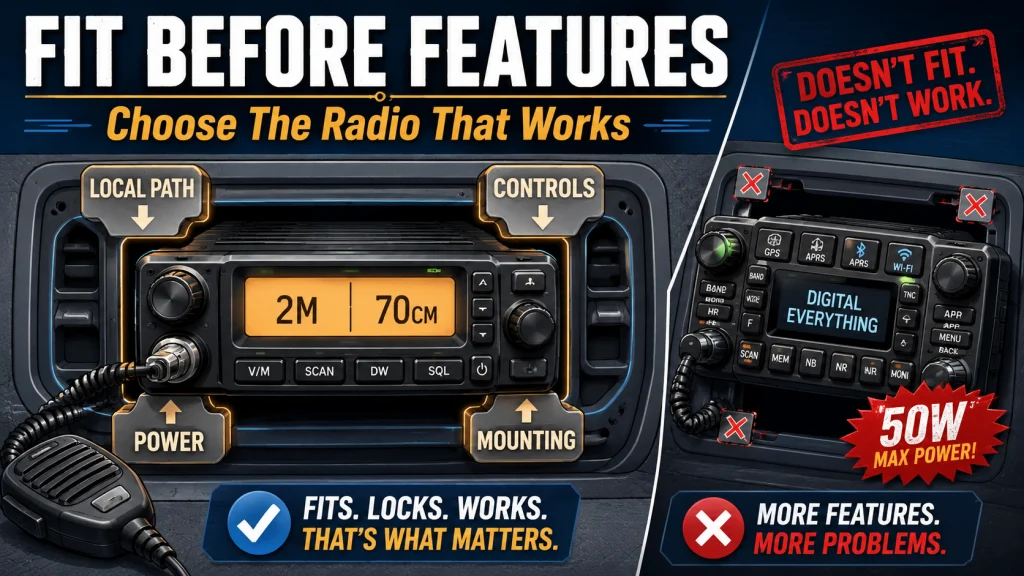
The highest wattage and longest feature list do not identify the best dual band mobile ham radio. A first mobile rig works only when its bands, controls, mounting, power draw, and digital mode fit the intended vehicle and local activity.
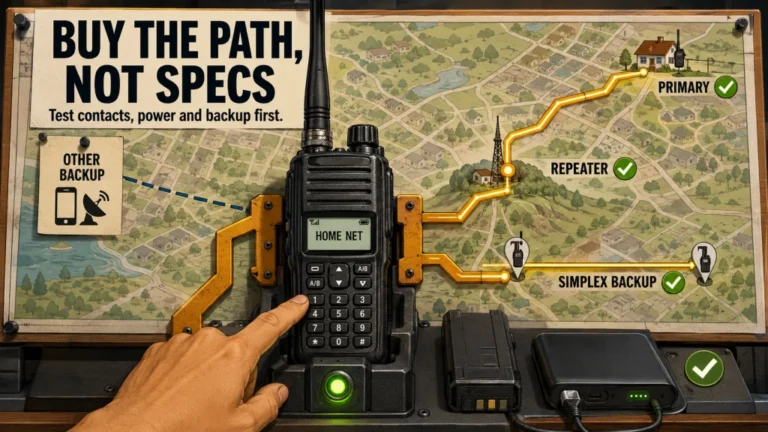
The recurring gap I see with new operators is choosing a radio before deciding what the radio must do. The question about equipment often comes before the new licensee has identified a repeater, checked the vehicle, or planned the antenna. My practical rule is to give the first mobile station one job, such as reaching two local analog repeaters during a commute, then choose only the features required for that job.
Field Note: A new Technician can spend hours comparing output power while the real limitation is still unknown. If the intended repeater cannot be reached because of terrain, antenna placement, or an incorrect channel, another few watts will not repair the missing path.
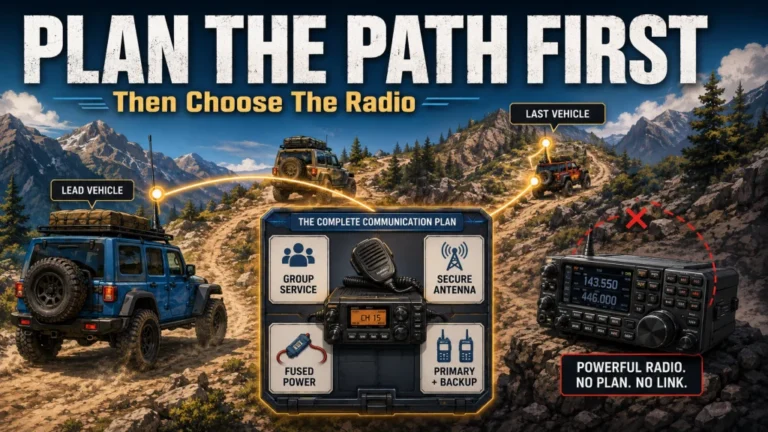
This article covers first dual-band VHF/UHF mobile radios for US Technician and returning operators. It does not cover HF mobile equipment, detailed physical installation, or off-road group planning. Readers who still need to compare mobile categories should begin with choosing the right mobile radio before narrowing the decision to a 2-meter and 70-centimeter rig.

This metal mounting bracket is listed for Icom models including the IC-2730, ID-880H, and ID-4100A. It provides a dedicated way to secure a compatible radio body instead of improvising its vehicle position. That makes it relevant when the radio choice must fit the mounting plan as well as the bands and controls.
Check On AmazonIf you click this link and buy, we earn a commission at no additional cost to you.
Confirm the Bands and Local Infrastructure First
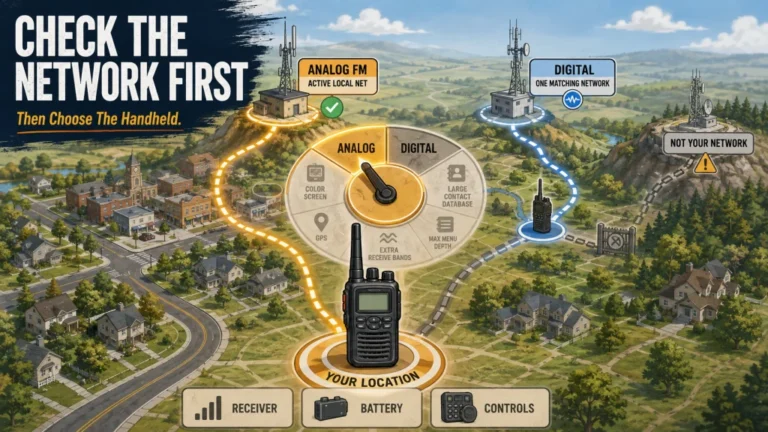
A US Technician license provides access to the 2-meter band at 144 to 148 MHz and the 70-centimeter band at 420 to 450 MHz, subject to the applicable band plan and local restrictions. A dual band mobile ham radio usually focuses on these two bands because they support common local repeater and simplex activity. That does not mean both bands are equally active in every area.
Start by listing the repeaters and simplex activity you realistically expect to use. Record the band, analog or digital mode, access tone or code, location, schedule, and whether the system is actually active. A directory entry proves that information was published at some point; it does not prove that the repeater is open, current, reachable from your route, or busy enough to justify a feature purchase.
- 2-meter activity: confirm whether local voice traffic, nets, and travel routes primarily use VHF.
- 70-centimeter activity: check whether UHF repeaters or urban coverage make the second band useful in your area.
- Analog FM: identify the repeaters that use ordinary FM and the tones or codes required for access.
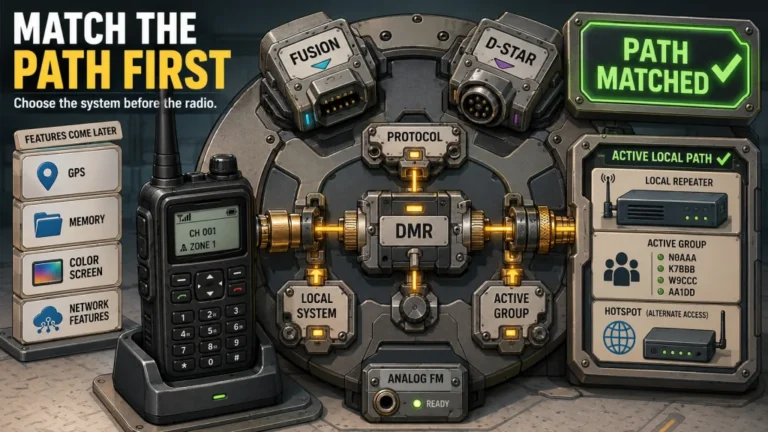
- Digital voice: write down the exact protocol used locally rather than buying a radio labeled only as digital-capable.
- APRS: decide whether you need position reporting, messaging, or packet functions, and confirm that the surrounding network supports the intended use.
A digital protocol is an ecosystem decision, not a general upgrade. DMR, D-STAR, and System Fusion are not interchangeable merely because each carries digital voice. Buying one before confirming local repeaters, active groups, registration requirements, and the normal operating workflow can leave the feature unused.
Use the local repeater verification process to prove at least one working path before building the radio shortlist. The best VHF UHF mobile ham radio is the one that supports activity available where you drive, not activity shown in a nationwide feature chart.
Separate Dual Band, Dual Watch, and True Dual Receive
These terms are often treated as synonyms, but they describe different capabilities. Dual band means the radio operates on two amateur bands. Dual watch may mean the radio checks or monitors a second frequency under specific conditions. True dual receive usually means two receiver paths can monitor two frequencies at the same time, sometimes including VHF/VHF, UHF/UHF, and VHF/UHF combinations.
That distinction matters when the operator wants to monitor a calling channel while using a repeater, follow two public-service nets, or listen to activity on both bands without one side repeatedly interrupting the other. It matters less when the radio will stay on one local repeater during a routine commute. Paying for a second receiver that never has a defined assignment adds complexity without adding operating value.
| Feature term | What to verify | Who benefits |
|---|---|---|
| Dual band | Transmit and receive coverage on both 2 meters and 70 centimeters | Operators who use repeaters or simplex activity on both bands |
| Dual watch | Whether the second frequency is continuously received, sampled, muted, or restricted by mode | Operators who occasionally monitor a second channel |
| True dual receive | Supported band combinations, simultaneous audio behavior, and transmit-side limitations | Operators who regularly monitor two active channels or nets |
| Cross-band repeat | Whether it exists, how identification and control are handled, and whether the planned use is legal | Experienced operators with a specific, compliant remote-use plan |
Do not infer capability from two frequency lines on the display. Read the receiver description and manual for the exact US model suffix. A radio may show two channels while providing only limited priority monitoring, and two digital signals may not be receivable together even when two analog signals are.
Build the Shortlist From Current US Product Records
Static rankings fail when a radio moves to a legacy page, a package suffix changes, or required accessories are no longer included. Build the shortlist from current US manufacturer pages, exact manuals, and current support downloads. Retail inventory alone does not prove current status or package contents.
This guide does not name products, so every recommendation remains Research-based. Compare competing spec sheets by translating each line into an installation or operating consequence rather than awarding points for the larger number.
| Spec-sheet line | Question it must answer |
|---|---|
| Receiver configuration | Does it provide the exact V/V, U/U, V/U, analog, or digital monitoring pattern required? |
| Dimensions and head separation | Can the body, control head, connectors, and cable bends fit the measured vehicle spaces? |
| Maximum current draw | Can the planned fused wiring supply full-power transmit without excessive voltage drop? |
| Included accessories | Which brackets, cables, microphone parts, and programming items must still be purchased? |
| Software and support | Are current firmware, official programming tools, manuals, warranty terms, and US service available? |
Verify the exact US suffix and distinguish current support from legacy availability before comparing prices. A lower price is not meaningful until both candidates are configured to perform the same job.
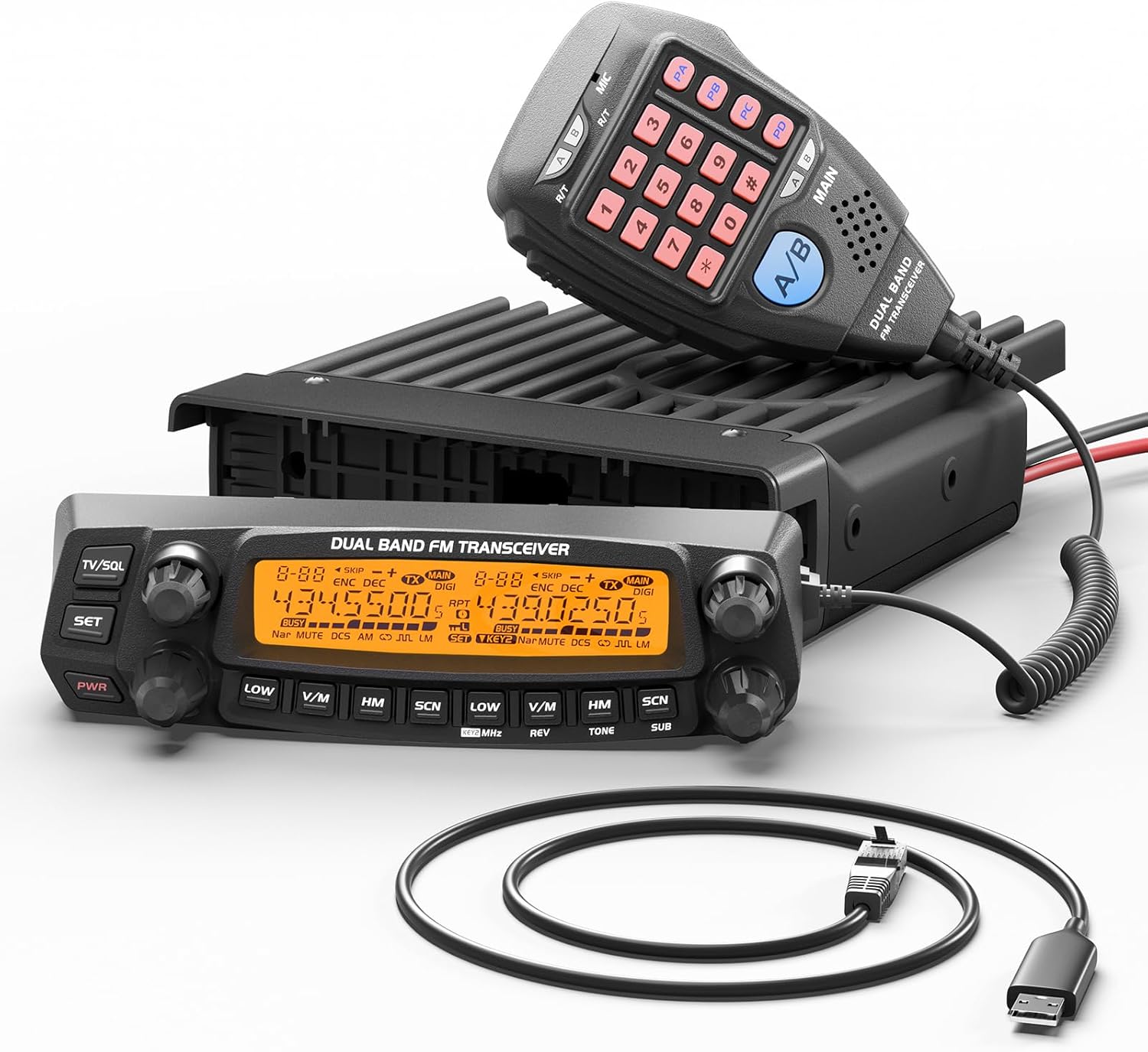
The Radioddity DB50 is a 50-watt VHF/UHF mobile transceiver with a detachable front panel. The Amazon package listing includes a programming cable and identifies the radio as CHIRP programmable. Those package details are useful when comparing body placement, head separation, and included programming hardware rather than comparing wattage alone.
Check On AmazonIf you click this link and buy, we earn a commission at no additional cost to you.
Choose Controls You Can Use Without Menu Hunting
A mobile radio is an in-vehicle control device, so readability and direct access matter more than they do on a desk. The display should remain legible in daylight and at night without producing distracting glare. Volume, squelch, channel selection, band choice, and the most common memory functions should be understandable by touch or a brief glance after the radio is configured.
A large screen is not automatically safer than physical controls, and small shared-function buttons can be equally distracting. The safer approach is to program the radio while parked, place routine channels into useful memory groups, set microphone shortcuts deliberately, and lock controls that should not change during a drive.
| Control question | Practical check |
|---|---|
| Can I read it? | Check text size, contrast, viewing angle, dimming range, and reflections from the intended position. |
| Can I reach it? | Confirm that common controls do not require leaning, looking down, or reaching across the steering wheel. |
| Can I simplify it? | Use named memories, groups, scan lists, lockout, and microphone keys for routine operation. |
| Can I hear it? | Test the speaker location against road, fan, and cabin noise before adding an external speaker. |
Warning: Any task that takes the driver’s eyes, hands, or attention away from driving can become a distraction. Stop safely before programming, editing memories, navigating menus, pairing devices, or troubleshooting a digital connection.
When a display unit is available before purchase, view it from the planned angle, turn brightness from daylight to night settings, rotate the main controls, find a named memory, lock the keypad, and confirm the microphone can be reached without looking down. This parked test reveals more about daily usability than a feature count.

The Icom SP-35 is an external speaker accessory for mobile-radio use. It gives the installation a separate audio source when the radio body or built-in speaker is poorly positioned for the driver. That directly supports the section’s parked check of speaker audibility against road, fan, and cabin noise.
Check On AmazonIf you click this link and buy, we earn a commission at no additional cost to you.
Match Full-Power Operation to the Vehicle Electrical System
Current dual-band mobile radios commonly advertise about 50 watts on VHF and UHF, with some VHF ratings slightly higher. That number describes RF output, not what the radio draws from the vehicle. Current full-power units can require roughly 13 amps during transmit, so the supply path, fuse, wire size, connections, and voltage drop must be evaluated from the exact manual.
A cigarette-lighter or accessory outlet is not automatically suitable. The outlet may be fused below the radio’s documented draw, share a circuit with other equipment, use light wiring, switch with the ignition, or introduce a poor connection. A plug that physically fits says nothing about continuous current capacity or noise performance.
- Read the maximum transmit-current specification for the exact radio.
- Use the manufacturer-specified fused DC cable and fuse values unless a qualified installation plan requires an approved equivalent.
- Confirm the vehicle circuit can supply the load without excessive voltage drop.
- Route and protect the cable so it cannot chafe, pinch, overheat, or interfere with pedals and controls.
- Leave ventilation around the heat sink and fan intake or exhaust.
- Consider the real duty cycle, especially for long net transmissions, packet use, or extended high-power operation.
Cooling deserves the same attention as wiring. A radio body hidden under a seat can be convenient until carpet, stored items, heater ducts, or limited airflow trap heat. Reduced power can be a sensible operating choice when the path is already reliable, but it should not be used to excuse an unsuitable power or ventilation plan.
The separate guide to choosing practical mobile transmit power explains why antenna efficiency, path, and installation quality often matter more than selecting the largest advertised wattage.
Check Installation Fit Before Choosing the Radio Body
A one-piece radio may fit an older dashboard or utility vehicle yet be awkward in a modern cabin with limited flat space. A detachable control head can solve that problem by placing the main body under a seat, behind a panel, or in a cargo area while keeping the controls visible. That flexibility works only when the required head cable, microphone route, bracket, speaker path, and body ventilation all fit the vehicle.
Measure the intended locations instead of estimating from product photographs. Include cable bends and connector clearance behind the radio. Check whether the microphone plugs into the control head or the main body, whether the speaker remains audible when the body is hidden, and whether extension cables and mounting hardware are supplied or optional.
| Vehicle fit item | What can change the choice |
|---|---|
| Control-head position | Viewing angle, sunlight, reach, dashboard shape, and state distraction rules |
| Main radio body | Ventilation, fan clearance, water exposure, seat movement, and cable access |
| Microphone | Connector location, extension availability, hanger position, and safe reach |
| Speaker | Road noise, hidden body location, output level, and external-speaker connection |
| Antenna feed line | Connector type, route length, bend radius, weather entry, and body-panel transitions |
| Safety zones | Airbags, knee bolsters, pedals, seat rails, controls, and emergency exits |
Do not place equipment, brackets, microphones, or cables in an airbag deployment area. A clean installation also needs permission where the vehicle is leased, rented, employer-owned, or shared. PRB-1 addresses state and local land-use regulation for amateur antennas; it does not override private HOA covenants, CC&Rs, rental agreements, property-owner rules, or vehicle lease restrictions.
This section is a fit check, not an installation tutorial. Use the complete mobile antenna installation process for mounting, cable routing, bonding, weather protection, and final verification.

Lido’s height-adjustable cup-holder mount is listed for Yaesu models including the FTM-150R ASP, FTM-200, FTM-300, FTM-400, and FTM-500. A cup-holder base gives the control position a defined location without assuming the dashboard has a suitable flat surface. The model-specific compatibility list makes it appropriate for a detachable-head installation that uses one of those supported radios.
Check On AmazonIf you click this link and buy, we earn a commission at no additional cost to you.
Treat the Antenna as Part of the Radio Decision
A 50-watt radio connected to a poor antenna system can underperform a lower-power station with a suitable mount and clear placement. The antenna must cover both intended bands, tolerate the radio’s power, fit the vehicle, and work with the chosen mount and feed line. Height, ground-plane conditions, vehicle construction, cable loss, and nearby metal all affect the result.
Confirm the antenna connector on the exact US model and avoid unnecessary adapter stacks that can loosen under vibration.
A compact antenna may be the reasonable compromise for a parking garage, while a taller antenna may provide better performance on open roads but create clearance and mounting problems. Neither is universally best. The decision should be made from the route, mounting location, band use, and physical limits of the vehicle.
Use the dual-band mobile antenna selection guide to match the antenna and mount to the planned radio path. Do not spend the entire budget on the transceiver and leave the part that launches the signal as an afterthought.

The Nagoya UT-72 is a 20-inch magnetic-mount VHF/UHF antenna for 144/430 MHz with a PL-259 connector. Its dual-band coverage matches the 2-meter and 70-centimeter focus of this article. It gives a concrete antenna-and-mount option to evaluate against vehicle clearance, ground-plane conditions, feed-line route, and connector fit.
Check On AmazonIf you click this link and buy, we earn a commission at no additional cost to you.
Programming and Support Determine the Long-Term Friction
A first mobile radio may hold hundreds or thousands of memories, but memory capacity is useful only when channels can be entered, organized, backed up, and restored without confusion. Check the official programming method before purchase. Some radios use a direct USB connection, some require a specific cable, some support an SD card, and some depend on optional hardware for wireless functions.
Third-party software support should be verified for the exact model suffix and current firmware rather than assumed from a similar radio. Official software is not automatically easier, but its availability shows how the manufacturer expects memories, repeater lists, settings, and firmware to be maintained. Download the software and manual before buying when possible, then confirm that the current operating system is supported.
- Programming path: official software, required cable, SD card, drivers, and supported computer operating systems.
- Backup path: ability to save a complete configuration before large edits or firmware changes.
- Firmware path: current files, update instructions, required accessories, and recovery procedure.
- Documentation: basic manual, advanced manual, digital-mode guide, APRS guide, and installation drawings.
- Service: written warranty, US repair contact, parts availability, and the process for out-of-warranty support.
Support is part of value because replacing a mobile radio can also mean moving brackets, cables, speakers, and control heads.
Research-Based Recommendation Groups
The best 2 meter 70cm mobile radio depends on which constraint is hardest to solve. These groups identify the right product profile without naming a specific model. Rebuild the actual product list from current manufacturer records and verify each required feature before ordering.
| Buyer group | Recommended profile | Do not pay extra for |
|---|---|---|
| Simplest analog first station | Analog FM, clear display, direct knobs, named memories, detachable head only if the vehicle needs it | A digital protocol with no confirmed local repeater or group |
| Tight mounting space | Compact main body, genuinely detachable head, available extension cables, usable remote speaker path | A large integrated display that has no safe mounting location |
| Regular two-channel monitoring | Verified true dual receive with the required V/V, U/U, or V/U combinations and understandable audio priority | Two display lines that do not provide the needed simultaneous receive behavior |
| Confirmed digital ecosystem | The exact local protocol, current repeater support, appropriate registration, usable controls, and analog FM fallback | Digital features chosen only because they appear more advanced |
| APRS or location-data use | Clearly documented APRS functions, suitable GPS behavior, required data connections, and a working local network | A GPS receiver that does not provide the APRS workflow you need |
| Best value | The least expensive current package that meets the radio, mounting, cable, programming, and support requirements | A lower radio price that requires several costly optional parts to become installable |
Calculate value from the installed system, not the radio price alone:
Installed-system total: radio package + required brackets and extension cables + programming path + power wiring + speaker if needed + antenna, mount, and feed line + any professional work the vehicle requires.
Build that total for every candidate on the same date. A cheaper radio can lose its advantage when the detachable-head cable, bracket, programming connection, or usable speaker path is optional.

The AnyTone AT-D578UVIII Plus combines DMR mobile operation with 50 watts on VHF and 45 watts on UHF. Its Amazon listing also specifies APRS location-data receive and transmit plus Bluetooth audio. That makes it a strong fit for the recommendation group where a confirmed digital ecosystem or APRS workflow justifies the added feature set.
Check On AmazonIf you click this link and buy, we earn a commission at no additional cost to you.
Use a Repeatable Test Before Calling Any Radio the Best
A recommendation should state what was tested and what remains research-based. This article presents no model-specific bench test, so it makes no receiver, emissions, durability, or long-term reliability claim. A complete future evaluation should measure the following when equipment is available.
- Transmit output: measure low, medium, and high power into a suitable dummy load with calibrated equipment.
- Current and voltage: record transmit draw and supply voltage at the radio under the stated power level.
- Heat: state the transmission pattern and duration, then monitor heat, fan behavior, and any power reduction.
- Audio: evaluate microphone reports, speaker clarity, volume, and distortion in both a quiet space and the vehicle cabin.
- Controls: perform common tasks with the vehicle parked, including memory recall, band changes, scan control, lockout, and brightness adjustment.
- Programming: build a clean memory file, write it to the radio, recall channels, back it up, and restore it.
- Receive behavior: verify the claimed dual-watch or dual-receive combinations and document audio priority.
- Vehicle noise: test receive and transmit with the engine, charging system, fans, lighting, and installed electronics operating.
A brief repeater contact proves one path from one place, not full output, repeated-transmit cooling, receiver behavior, or compatibility with every installation.
Buying rule: Treat a recommendation as strong only when its evidence label matches the claim. Official specifications can establish features and ratings. Hands-on inspection can establish control feel and package contents. Instrumented testing is required for measured power, receiver, heat, and emissions claims.

The BECEN PL259 dummy load is a 100-watt, 50-ohm load intended for radio test work. Its PL-259 connection supports a controlled transmitter test setup instead of transmitting into the vehicle antenna. That directly supports the section’s instruction to measure transmitter output into a suitable dummy load.
Check On AmazonIf you click this link and buy, we earn a commission at no additional cost to you.
Final Thoughts: Buy the Radio That Completes the Path
The right first mobile rig is not the product with the most boxes checked. It is the radio that supports verified local activity, fits the available control and body locations, works with a safe fused power plan, connects to a suitable antenna, and can be programmed and supported without creating unnecessary friction.
I would choose analog simplicity over unused digital features, a detachable head over an unsafe dashboard position, and a complete installed system over a higher wattage number every time those conditions match the operator’s real situation. Prove one repeater path, measure the vehicle, calculate the required parts, and then buy the current radio category that solves those specific problems.

The Mcbazel Surecom SW-102 is a digital VHF/UHF antenna power and SWR meter covering 125 to 525 MHz. It provides power and SWR measurements for checking the radio-to-antenna path after the station hardware is assembled. That makes it useful when validating the completed mobile system rather than judging the transceiver by feature count alone.
Check On AmazonIf you click this link and buy, we earn a commission at no additional cost to you.
FAQs
📻 Is a dual-band mobile radio a good first radio for a Technician?
Yes, when local 2-meter or 70-centimeter repeaters and simplex activity match the operator’s goals. Verify at least one usable path and the complete vehicle installation before choosing the radio.
⚡ Does a 50-watt mobile ham radio need direct battery wiring?
Follow the exact manufacturer wiring instructions and maximum-current specification. A full-power mobile can draw around 13 amps, so an accessory outlet is not automatically adequate even when the plug fits.
🔀 Do I need true dual receive?
Only when you have a real reason to monitor two active channels at once. Confirm the supported VHF/VHF, UHF/UHF, VHF/UHF, analog, and digital combinations because two displayed frequencies do not guarantee full simultaneous receive.
💻 Should programming software affect my buying decision?
Yes. Check the official software, required cable or SD card, supported computer system, backup method, and firmware process before buying. Do not assume a third-party program supports the exact suffix.
📡 Should I choose a digital mobile radio?
Choose digital only after confirming the exact protocol used by reachable repeaters or an active group you intend to join. Digital voice systems are not mutually compatible simply because they are digital.
🚗 Is a detachable control head always better?
No. It is valuable when the main body cannot be mounted safely near the driver, but it adds cables, brackets, routing, and speaker questions. A one-piece radio can be simpler when the vehicle has a safe, visible mounting location.
🌡️ How much ventilation does a mobile radio need?
Use the clearances and temperature limits in the exact manual. Keep heat sinks and fan paths away from carpet, stored equipment, heater ducts, and enclosed spaces that trap hot air.
💵 What makes one dual-band mobile radio a better value?
Count the complete installed cost, including brackets, control cables, microphone extensions, programming equipment, speaker, power wiring, and antenna system. The lowest radio price is not the best value when required parts are missing.