The best mobile ham radio antenna is the one whose radiator, mount, vehicle surface, feedline, and clearance limits work as one system. A well-placed, properly matched antenna can improve usable VHF/UHF performance more than moving between two otherwise similar mobile radios. Start with the vehicle and operating route, then choose the mount, antenna length, band coverage, and coax that fit those conditions. This guide helps you make that buying decision without turning the process into a full installation tutorial or a list of specific products.

Why the Antenna System Matters Before More Radio Power
The best mobile ham radio antenna is not automatically the longest whip or the one with the largest gain number on the package. Usable performance begins with where the antenna sits, what is under it, how the feedline reaches the radio, and whether the radiation pattern suits the roads you actually drive. A strong transmitter connected to a compromised mount still has to send every watt through that compromised system.
The question I hear most after an exam session is what radio to buy. For a vehicle station, I usually bring the conversation back to the complete operating path, because a new operator can spend more on the radio and still be disappointed by a low fender mount, weak RF return path, damaged coax, or an antenna that cannot clear the garage. The broader mobile ham radio buying guide explains how the radio fits the job, while this decision starts at the vehicle roof, bracket, or other mounting surface.
Power still matters, but it adds signal margin rather than repairing a poor antenna system. Before paying for a higher-output unit, compare what the antenna and mount are doing with the practical limits explained in the guide to mobile radio power output. That comparison keeps a common beginner mistake from becoming an expensive one: treating watts as a substitute for antenna placement and system quality.

Comet SBB-5 covers the 2-meter and 70-centimeter amateur bands with about 3.0 dBi VHF and 5.5 dBi UHF gain. Its 38-inch whip includes a fold-over hinge for clearance. A gold-plated PL-259 male connector mates with a compatible UHF-female mobile base, which is sold separately.
Check On AmazonIf you click this link and buy, we earn a commission at no additional cost to you.
Buy a Complete Antenna System, Not Just a Whip
A vehicle ham radio antenna is only the visible part of the system. The mount must support it mechanically and electrically, the vehicle may need to provide part of the RF return path, and the coax must carry the signal without being crushed, overheated, or routed through a damaging bend. The connector at the radio also has to match without creating a stack of avoidable adapters.
Use this system check before comparing antenna claims:
- Radiator: the band coverage, electrical design, length, flexibility, power rating, and weather exposure must fit the intended use.
- Mount: the mount standard, panel location, mechanical load, theft exposure, and water sealing must suit the vehicle.
- Vehicle RF behavior: steel, aluminum, composite, glass, brackets, racks, and body seams can change how the antenna uses the vehicle as a ground plane or counterpoise.
- Bonding where appropriate: a mechanically attached bracket is not always an effective RF connection to the larger vehicle body.
- Feedline: the coax must be 50 ohms, long enough for a safe route, flexible enough for the bends, and durable enough for heat and abrasion.
- Connector path: the antenna mount, coax assembly, and radio connector should match directly whenever practical.
- Weather protection: exposed connections, mount seals, cable entry points, and strain relief need a plan before purchase.
Long-term exposure should also influence the shopping decision. Strong sun can age plastic housings and cable jackets, coastal salt can accelerate corrosion at exposed metal and connectors, and winter road salt or freeze-thaw cycles can punish seals and hardware that look adequate in a dry garage. For a vehicle that lives outdoors, favor replaceable seals and whips, corrosion-resistant hardware, UV-resistant exterior materials, and parts that can be inspected without dismantling the entire system.
This is why a bare antenna price is not a useful comparison. One option may include the correct mount and coax, while another may require a separate base, cable assembly, connector, weather cap, or replacement whip. Compare the cost and compatibility of the complete mobile ham radio antenna setup, not the radiator by itself.

HYS combines a 20-inch dual-band NMO antenna with a magnetic base and approximately 16.4 feet of RG-58U coax. The antenna is centered at 144/430 MHz with listed gains of 3.0 dBi on VHF and 5.0 dBi on UHF. The assembly uses a PL-259 connector and is rated for up to 100 watts.
Check On AmazonIf you click this link and buy, we earn a commission at no additional cost to you.
Choose the Mount by Performance, Vehicle Risk, and Daily Use
The mount fixes the antenna’s location, controls how much mechanical stress reaches the panel, and often influences the RF pattern more than buyers expect. A centered roof position on a suitable conductive panel usually gives an omnidirectional antenna a more balanced view of the horizon. A hood, hatch, bed rail, or corner bracket may be easier to install, but the nearby vehicle structure can make the pattern less even.
| Mount approach | Where it fits best | Main advantages | Main compromises to verify |
|---|---|---|---|
| Permanent NMO-style panel mount | Long-term installations on a suitable metal panel | Low-profile base, secure connection, clean cable entry, broad antenna compatibility | Requires a hole, correct sealing, panel access, and vehicle-specific safety checks |
| Lip, fender, hatch, or vehicle-specific bracket | No-drill installations with a solid attachment point | Removable, easier access, useful when the roof is unavailable | Off-center pattern, bonding needs, paint pressure, cable pinch points, limited load capacity |
| Magnetic mount | Temporary use on a suitable ferromagnetic steel surface | Fast setup, no drilled hole, easy to move for testing | Will not hold to aluminum or nonmetal panels, cable entry compromises, theft, paint contamination, movement in wind or brush |
| Glass or adhesive system | Vehicles where panel drilling and magnetic attachment are not practical | Low visual impact and no exterior metal penetration | Must be designed for the intended band and glass type, with lower tolerance for casual substitutions |
| Portable temporary mount | Rental vehicles, occasional trips, or test setups | Minimal commitment and easy removal | More setup steps, greater routing exposure, and less secure highway or trail use |
No-drill does not mean no compromise, and permanent does not mean automatically correct. A badly placed permanent mount can perform unevenly, leak, or interfere with vehicle systems. A well-chosen bracket can be the better ownership decision when roof access is poor, the vehicle is leased, or the operator needs to remove the antenna regularly.
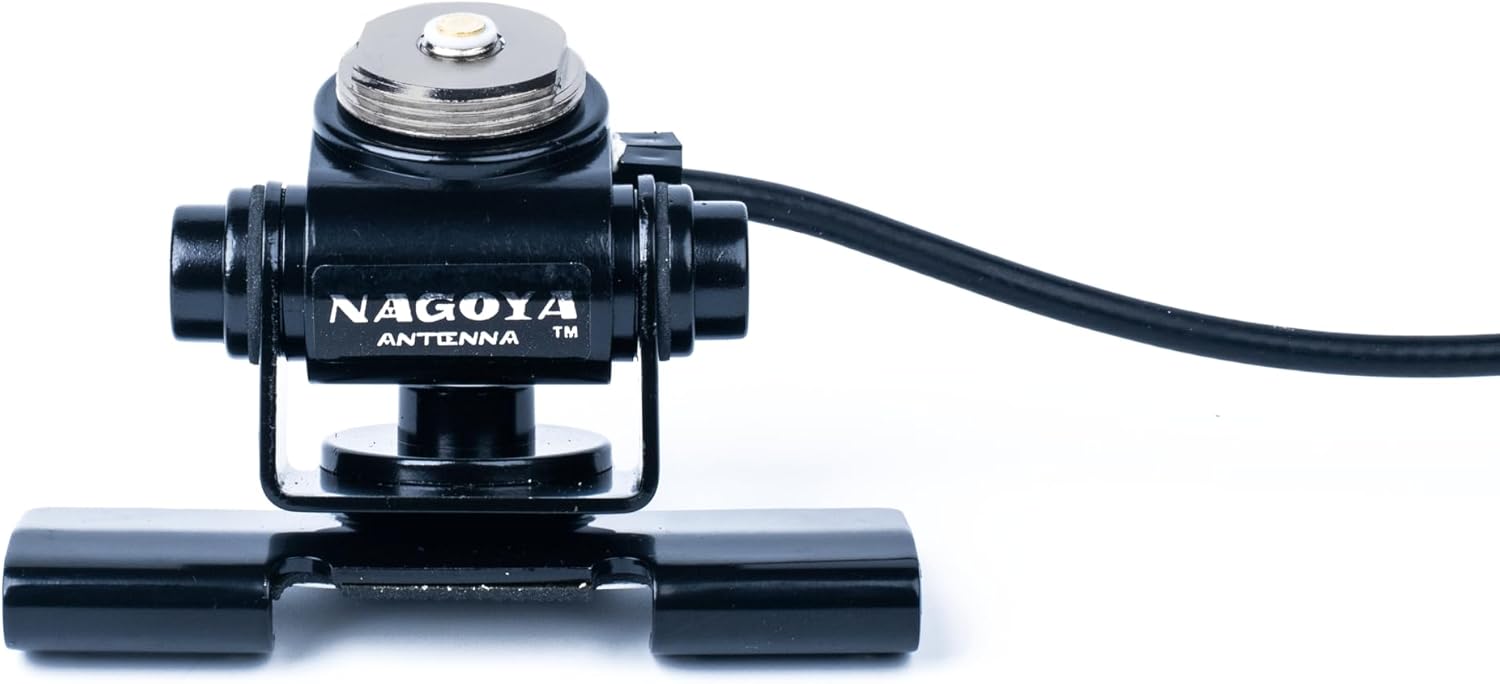
Nagoya RB-700N is a no-drill NMO lip mount with two-axis adjustment for positioning the antenna on a vehicle edge. It includes 20 feet of RG-58A/U coax terminated in a PL-259 connector. Rubber contact pads and an included rain cap support a removable installation without drilling the body panel.
Check On AmazonIf you click this link and buy, we earn a commission at no additional cost to you.
Check the Vehicle Material Before Choosing the Antenna
Do not assume every roof is a steel ground plane. Modern vehicles may use aluminum body panels, fiberglass caps, composite roofs, panoramic glass, insulated roof sections, painted brackets, and mixed-material structures. A magnetic base may be useless on one vehicle, while an ordinary quarter-wave design may behave differently when moved from a broad steel roof to a narrow bracket beside a composite panel.
Start by identifying the actual mounting surface and the structure beneath it. A pickup with a steel cab and fiberglass bed cap presents two different antenna environments. A roof rack may be conductive but electrically isolated from the body, and a bed-rail mount may be mechanically strong without providing the RF relationship the antenna design expects. The label “metal vehicle” is not specific enough to make the buying decision.
Key point: Match the antenna’s ground-plane requirement to the exact mounting location, not to the vehicle as a whole.
When the mounting surface cannot provide the expected counterpoise, look for a design explicitly intended to work with limited or no ground plane, or plan an appropriate RF connection as part of the later installation. Do not treat “ground independent” as permission to ignore placement, coax routing, nearby metal, or clearance. It solves one design constraint, not every constraint around the antenna.

Tram 1185 is a complete dual-band magnetic kit with an antenna, magnet base, and cable. It transmits on 144-148 MHz VHF and 430-450 MHz UHF. The 3-inch magnetic mount includes 12 feet of RG-58 coax and a PL-259 connector.
Check On AmazonIf you click this link and buy, we earn a commission at no additional cost to you.
Antenna Length Changes the Pattern, Not Just the Gain Number
A quarter-wave antenna is short, simple, and often mechanically forgiving, but it normally depends heavily on the conductive surface beneath the mount. A half-wave design can be more tolerant of limited ground-plane conditions, depending on how it is fed and matched. Longer collinear designs can concentrate more energy toward the horizon, which may help on open roads but can be a poor trade when the vehicle moves through steep terrain, dense trees, parking structures, or low branches.
The word “gain” does not mean guaranteed range. Gain describes how an antenna redistributes energy compared with a reference, and published figures are only comparable when the band, reference method, mounting conditions, and test assumptions are comparable. A higher number may represent a flatter vertical pattern, not extra power created by the antenna. That flatter pattern can help toward a distant repeater across open terrain, yet offer less practical advantage when roads rise and fall sharply.
Clearance often decides the real winner. A tall antenna that must be removed every time the vehicle enters a garage will eventually be left off, damaged, or forgotten. For a commuter, a shorter flexible design may produce more consistent real-world use than a longer antenna with a better paper specification. For trail use, flexibility, spring behavior, a secure fold-over mechanism, and replaceable parts can matter more than the last fraction of advertised gain.

Comet CA-2X4SR covers 140-160 MHz and 430-470 MHz for wideband VHF/UHF use. The listing specifies 3.8 dBi gain on 2 meters and 6.2 dBi on 70 centimeters. Its 38-inch black fiberglass whip uses a stainless-steel base and PL-259 connector.
Check On AmazonIf you click this link and buy, we earn a commission at no additional cost to you.
Match the Band and Radiation Pattern to the Operating Route
A dual-band antenna is the practical default for many operators using 2 meters and 70 centimeters, but default is not the same as universal. A 2-meter-only antenna can be simpler when the local activity and radio use are concentrated on that band. A 70-centimeter-focused installation may make sense for a specific local system, while a dual-band design remains the flexible choice when repeaters and simplex activity vary across a regular route.
Then match the pattern to where the vehicle travels. Highway driving across relatively open ground favors a different compromise than urban streets surrounded by buildings. Mountain roads and deep valleys can reduce the value of a highly compressed pattern, while off-road routes add branch strikes, vibration, dust, and repeated flexing to the decision. The guide to choosing a ham radio for off-road use places that antenna choice inside the rest of the trail communication system.
The same logic applies to simplex and repeater use. Repeater access may succeed from a location where direct vehicle-to-vehicle simplex remains weak because the repeater is elevated and well placed. Decide which communication path matters most before using one successful repeater contact as proof that the entire system is ideal.

HYS TC-HC152V covers 136-174 MHz with a 4 MHz listed bandwidth for VHF mobile use. It provides 2.5 dBi gain with vertical polarization and handles up to 150 watts. The antenna uses a standard NMO mount and is intended for 2-meter-focused mobile installations.
Check On AmazonIf you click this link and buy, we earn a commission at no additional cost to you.
Select Coax and Connectors for the Route Through the Vehicle
Mobile VHF/UHF systems use 50-ohm coax, but that does not make every cable equally suitable. Loss increases with frequency and length, while thicker low-loss cable usually becomes harder to bend and route. The right feedline is therefore a balance among attenuation, run length, connector size, flexibility, heat exposure, abrasion resistance, and the minimum bend radius the vehicle can accommodate.
A short mobile run does not automatically need the thickest cable available. Stiff coax can load a small mount, resist dashboard routing, or tempt the installer to force a bend near a connector. Very thin cable is easier to hide, but its loss and durability may become a concern on a longer route or at UHF. Choose from the actual measured path, including service loops and safe routing, rather than guessing from the straight-line distance between antenna and radio.
Connector compatibility deserves the same attention. Confirm the connector on the mount or cable assembly and the connector on the radio before purchase. One suitable adapter may solve a legitimate transition, but a chain of adapters adds bulk, creates leverage, and increases the number of connections that can loosen or admit moisture. The cleaner choice is usually a cable assembly built for both ends of the system.
Choosing the Best Antenna for Mobile Ham Radio: A Final Go/No-Go Check
By this point, the individual specifications should already be understood. The final check is not another parts inventory. It is a decision gate that asks whether the entire choice is ready to survive the vehicle, route, budget, and installation plan.
- Use case locked: the required bands and the main communication path are known, rather than guessed from the widest coverage claim.
- Vehicle fit verified: the exact mounting surface, mount method, RF ground or counterpoise requirement, and mechanical load are compatible.
- Daily clearance accepted: the antenna can remain usable around garages, parking decks, branches, racks, cargo, and normal vehicle access.
- Complete cost known: the total includes the required mount, coax, connector path, sealing parts, and any replaceable hardware, not only the whip.
- Environment matched: the exterior materials, seals, and service parts make sense for sun, rain, coastal salt, winter roads, or trail exposure.
- Installation path confirmed: there is a safe, vehicle-specific route for the cable and a realistic plan for final inspection and SWR verification.
Do not place the order when any gate still depends on an assumption. A ham radio mobile antenna can look ideal on paper and still be the wrong purchase when the mount does not fit, the cable cannot be routed safely, or the height makes daily use impractical. Resolve those unknowns first, then compare listings inside the correct recommendation group.
Choose a Recommendation Group Before Comparing Individual Listings
Specific models change, but the useful buying groups remain stable. Select the group that matches the ownership constraint first, then compare current products only within that group. This prevents a temporary magnetic system from being judged against a permanent roof system as though they solve the same problem.
| Recommendation group | Best fit | Prioritize | Do not overlook |
|---|---|---|---|
| Permanent performance | Long-term daily vehicle station | Central placement, compatible panel, durable mount standard, sealed cable entry | Professional drilling needs, resale plan, vehicle-specific no-drill zones |
| No-drill bracket | Leased vehicles or limited roof access | Rigid attachment, RF bonding path, cable clearance, antenna load rating | Directional pattern changes, paint contact, hood or hatch movement |
| Temporary magnetic | Testing, travel, or occasional operation | Suitable steel surface, broad base, secure cable route, easy removal | Aluminum incompatibility, paint grit, theft, highway and branch loading |
| Low-clearance | Garages, parking decks, high-roof vehicles | Short height, flexibility, acceptable band performance, convenient daily use | Reduced gain claims, ground-plane requirements, fixed obstacles |
| Off-road durability | Trails, brush, vibration, and repeated impacts | Flexible whip, robust spring or fold-over design, replaceable parts, secure mount | Mount fatigue, loose hardware, exposed coax, excessive height |
This grouping also makes current availability easier to verify without chasing a famous model name. Within the selected group, confirm that the antenna, mount, cable, connector, and replacement parts are all available as a compatible system. A well-known radiator is not a recommendation when its required mount is unavailable or unsuitable for the vehicle.

Nagoya UT-72 is a 20-inch magnetic-mount VHF/UHF antenna tuned for 144/430 MHz. The kit includes a magnetic base, heavy-duty cable, PL-259 connection, and an additional SMA adapter for compatible handheld radios. Its weatherproof design and rare-earth magnetic base make it a removable vehicle option for suitable metal surfaces.
Check On AmazonIf you click this link and buy, we earn a commission at no additional cost to you.
Know Where Selection Ends and Installation Begins
This guide helps you choose the antenna system, but it does not replace a vehicle-specific installation plan. Drilling, panel access, firewall passage, airbag deployment zones, cable protection, water sealing, drip loops, bonding, strain relief, and final SWR verification require a separate safety and installation review. Vehicle structure varies enough that a generic hole location or cable route should never be treated as universal.
Before making a permanent change, consult the vehicle manual and any manufacturer upfitter information available for that exact model and year. Use a qualified installer when roof access, airbags, structural panels, panoramic glass, or hidden wiring make the job uncertain. The complete mobile antenna installation guide covers that next stage after the buying decisions here are settled.
Warning: Do not transmit into an unverified antenna system. Confirm the mount, connector work, feedline condition, and antenna match with appropriate test equipment before regular operation.
That handoff matters because a correct product choice can still be defeated by poor installation. Selection determines whether the parts can work together. Installation determines whether they actually do so on the vehicle.
Final Thoughts: Choose the Vehicle System Before the Antenna Claim
A mobile antenna should be chosen from the outside inward. Begin with the bands and route, identify the exact mounting surface, select the mount approach, choose an antenna pattern and height that fit the terrain and clearance, then size the coax and connectors for a safe path to the radio. This order prevents a gain number or familiar antenna name from controlling a decision it cannot solve by itself.
I would rather see a new operator use a modest antenna that stays installed, clears the garage, and works with the vehicle than buy a taller design that spends most of its life folded down or stored in the cargo area. The practical winner is the complete system you can verify, maintain, and use every day.
FAQs
📡 What type of mobile ham radio antenna is best for most beginners?
A dual-band VHF/UHF antenna is a practical starting point when local use includes both 2 meters and 70 centimeters. The mount, vehicle material, clearance, and local repeater activity still matter more than choosing a design only because it is labeled dual-band.
🚗 Is a roof mount always better than a fender or hatch mount?
A suitable centered roof position often provides a more balanced pattern, but it is not always the best ownership choice. Panel material, roof access, airbags, glass, leasing restrictions, garage height, and installation risk can make a well-designed bracket the better option.
🧲 Will a magnetic antenna mount work on every vehicle?
No. It needs a suitable ferromagnetic steel surface and will not attach properly to aluminum, fiberglass, composite, or glass panels. Confirm the exact panel material before buying the mount.
📏 Does a longer mobile antenna always give more range?
No. A longer design may change the vertical pattern and improve performance in some open-terrain conditions, but clearance, mounting location, terrain, and ground-plane behavior can remove that advantage. An antenna that is damaged or routinely removed provides no range at all.
🔌 How much coax should I buy for a vehicle installation?
Measure the safe routing path rather than the straight-line distance. Include enough length for proper bends, service access, and strain relief, but avoid buying a large excess that must be coiled or hidden unnecessarily.
🛠️ Do I need to check SWR on a new mobile antenna?
Yes, verify the completed system before regular transmitting. A factory-rated antenna can still be affected by its mounting location, vehicle surface, connector work, feedline condition, and nearby metal.