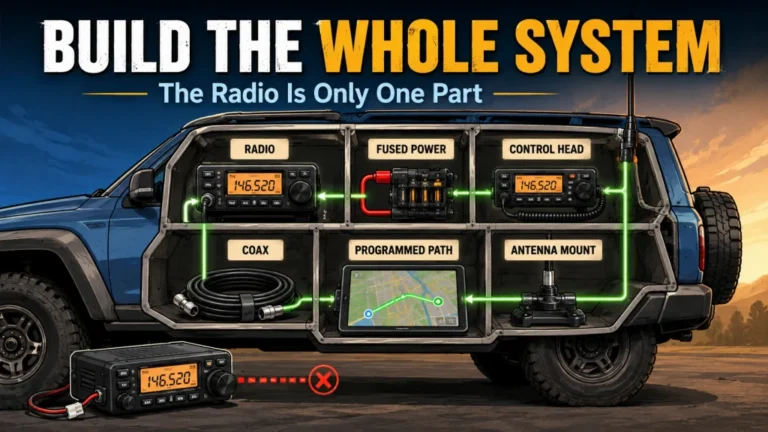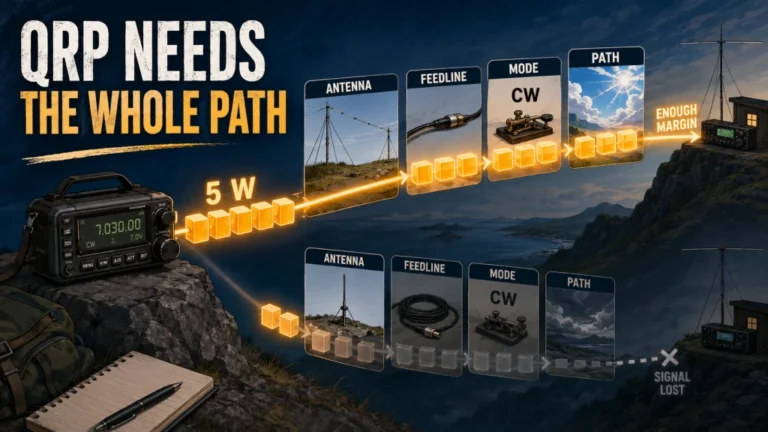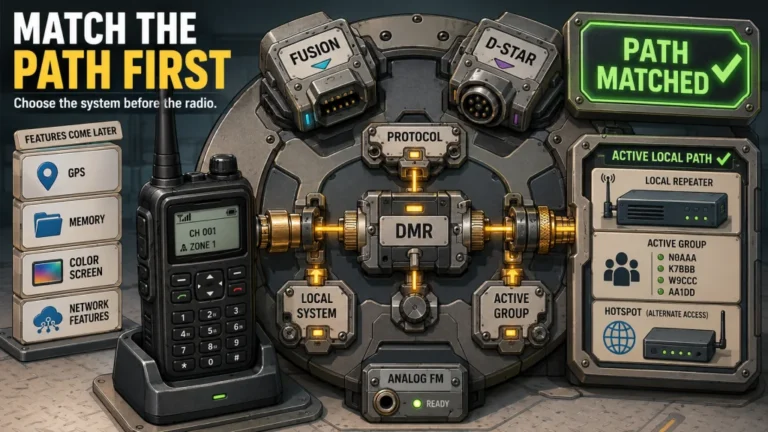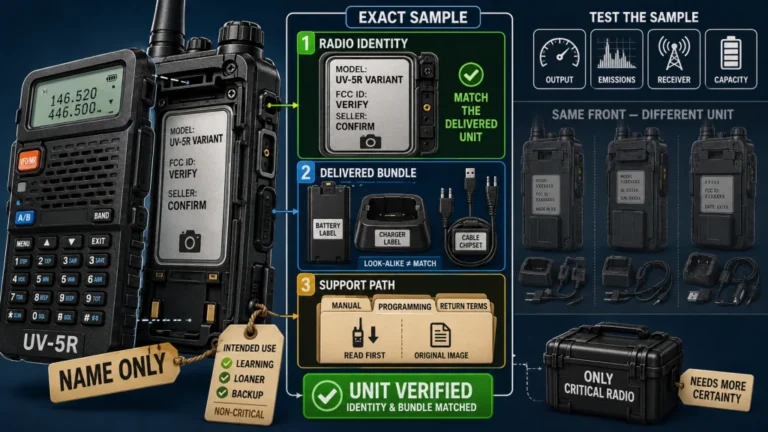
The best entry level HF ham radio completes a usable first station without blocking the mode you want to operate. A low radio-body price can become expensive after adding power, tuning, digital connectivity, feedline, antenna, battery, and missing accessories. Start with the operating job, separate essentials from conveniences, and compare the complete signal path rather than the transceiver alone. This breakdown covers first-station requirements, value categories, used-versus-new trade-offs, and when waiting is the better decision.

The Cheapest HF Radio Can Produce the More Expensive Station
The lowest advertised radio price matters only when the rest of the station supports it. Without suitable DC power, antenna, feedline, mode interface, and a measurement plan, the radio may sit unused. I treat the radio body as one line in the first-station budget, not the budget itself.
An inexpensive radio may still need an external tuner, sound-card interface, adapter cables, and a higher-current power source. A category with the required connectivity built in can cost more at checkout yet require less total spending and troubleshooting.
Field Note: The radio-buying question often comes before a new operator has settled the antenna or operating goal. For HF, reversing that order prevents more mistakes than chasing one extra feature or a temporary discount.
This coverage stays focused on beginner-to-intermediate US amateur operation. It does not rank individual products, teach full antenna installation, cover strict QRP as a separate operating style, or turn a first station into a contest-level setup.

The Tekpower TP30SWI is a 13.8 V DC switching power supply rated at 30 amps. It uses an analog display and includes a noise-offset control for shifting switching noise away from a received signal. The unit provides 13.8 V DC power for compatible radio equipment.
Check On AmazonIf you click this link and buy, we earn a commission at no additional cost to you.
Define the First-Station Job Before Comparing Features
An entry level HF ham radio should be selected for the first operating job, not for the longest feature list. SSB voice, CW, FT8 and other sound-card modes, fixed home operation, occasional portable use, crowded-band listening, remote control, and general experimentation place different demands on the radio and surrounding equipment. A feature is essential only when removing it prevents the station from doing its intended job.
A home voice station may value straightforward controls, effective filtering, reliable cooling, and full-power output. A digital-focused station may place integrated USB audio and CAT control above a built-in tuner or large display. Someone who expects regular field use must also account for current draw, battery size, physical protection, connectors, and setup time, which are explored more deeply in the portable HF station breakdown.
| First operating job | Features that become important | Common buying mistake |
|---|---|---|
| SSB voice from home | Usable filters, stable cooling, suitable output, microphone support, clear controls | Spending on display features while leaving the antenna underfunded |
| FT8 and sound-card digital modes | CAT control, clean audio path, duty-cycle capability, adjustable transmit audio | Assuming a USB port automatically carries both control and audio |
| CW learning | CW mode, key connection, useful filtering, sidetone and break-in controls | Buying around features intended for voice while ignoring the controls used every contact |
| Occasional portable operation | Size, weight, current draw, connector durability, battery plan, readable controls outdoors | Buying a small radio but building a heavy supporting system |
| Crowded-band operation | Receiver behavior, filter adjustment, noise-reduction tools, strong-signal handling | Comparing radios by sensitivity alone |
| Remote access or experimentation | Control interface, documented software support, firmware path, safe remote power control | Assuming remote operation is included because CAT commands exist |
Once one row describes the first year of use, fund its hardest requirement first. A station prepared for sustained digital operation may also support casual voice, while a voice-focused bargain can need several additions before digital use becomes convenient.
Match Band Coverage to License Privileges and Real Plans
A true general-purpose HF transceiver covers amateur allocations across multiple HF bands and supports the modes stated for those bands. A radio marketed around 10 meters alone is not a substitute for an all-band HF station, even when its case, microphone, and output number look similar. Check the actual transmit ranges in the US manual rather than relying on a broad phrase such as wideband coverage.
License class also controls which parts of that hardware you may legally use. Technician licensees have limited HF privileges, including RTTY and data from 28.000 to 28.300 MHz and SSB phone from 28.300 to 28.500 MHz on the 10-meter band. Do not buy an HF radio on the assumption that a Technician license grants general voice or FT8 access across 20, 40, 80, or 15 meters.
A new General who wants regional voice on 40 meters, evening contacts on 80 meters, and digital activity on several bands needs broader capability than a buyer interested only in the Technician portion of 10 meters. The radio may technically receive much more than the operator can transmit on, so receiver coverage and legal transmit privileges must remain separate checks.
Key point: Confirm the US transmit coverage, supported modes, and your license privileges as three separate items. A wide receive range does not prove all-band amateur transmit capability.
Build a Minimum Feature Map, Not a Wish List
The useful way to compare HF radios is to divide features into essential, conditional, and convenient. Essential features make the intended station possible. Conditional features save money or simplify setup only in certain antenna, mode, or operating situations, while conveniences improve the experience without deciding whether the station works.
Receiver architecture matters, but its label alone does not predict results in a specific home. Filter control, strong-signal behavior, noise tools, local interference, software support, and usable controls can matter more than a newer design on paper.
| Feature area | Essential when | What to verify |
|---|---|---|
| Amateur-band coverage and modes | The intended contacts span several HF bands or more than one mode | US transmit ranges, SSB, CW, data capability, and any band-specific limits |
| Output power | The station is intended for conventional full-power home operation | Rated output by mode, required supply current, and thermal limits |
| Receiver and filters | Local signals are crowded or electrical noise is high | Filter adjustment, noise tools, strong-signal handling, and control access |
| Internal tuner | The planned antenna falls within the tuner’s matching range | Actual matching range and whether a wider-range external tuner is still needed |
| USB CAT and audio | Sound-card digital modes or computer control are first-year goals | Whether one cable carries control, audio, or both, plus driver support |
| Display and controls | The operator needs visual band activity or frequent filter adjustment | Readability, menu depth, control size, and access to commonly changed settings |
| Cooling and duty cycle | The station will use sustained digital transmission or long operating periods | Manual guidance, ventilation needs, power reduction, and thermal behavior |
| Firmware and service | The radio depends on software, drivers, or long ownership | Current support, parts path, update method, documentation, and warranty terms |
A built-in tuner is a good example of a conditional feature. It can simplify a station when the antenna mismatch is within its range, but it does not make an arbitrary wire resonant or remove feedline loss caused by a severe mismatch. The antenna design still decides whether the tuner is a convenience or an expensive button that cannot complete the match.
For a wider comparison of these trade-offs across station roles, use the HF radio comparison by operating style. That broader view is useful after the minimum feature map has removed options that cannot support the first job.
Compare Current Value Categories Instead of Chasing One Winner
There is no universal best first HF category because the value moves when the supporting system changes. A simple fixed-station radio can be excellent value for home voice when the antenna is already resonant and computer integration is not a priority. A compact full-power radio may serve both home and vehicle use, but smaller controls and the possible need for external accessories can move cost and complexity back into the station.
Lower-power portable-value radios reduce size, current draw, and battery burden, yet lower output changes the operating margin. They make the most sense when portability, efficient antennas, patience, and mode choice are part of the plan, not when the buyer expects full-power results from a compromised indoor antenna. Used or discounted prior-generation radios can offer more receiver and control capability per dollar, but only when condition, support, modifications, and return rights are verifiable.
| Value category | Best fit | Cost that may move outside the radio |
|---|---|---|
| Simple fixed full-power station | Home voice, straightforward controls, resonant antenna plan | External digital interface, tuner, display tools, or additional filtering |
| Compact full-power station | Limited desk space, mixed home and mobile use, conventional output | Control ergonomics, remote head hardware, tuner, interface, larger DC supply |
| Lower-power portable value | Battery operation, travel, efficient field antennas, digital or patient voice use | Battery, protective case, portable antenna support, weather protection |
| Verified used prior generation | Buyer who can inspect, test, and accept reduced warranty protection | Repairs, missing cables, worn controls, obsolete software, shipping risk |
| Current direct-sampling above entry tier | Easy digital integration, visual tuning, stronger filtering needs, longer ownership plan | Higher initial price, accessories not included, antenna budget pressure |
Research-based framework: These are role categories, not product rankings. Exact model status, included accessories, support, warranty, and current price must be checked at the time of purchase.
A current direct-sampling radio can justify the step above entry level when integrated connectivity and receiver controls replace several external purchases. The separate current midrange HF comparison examines that higher tier without turning this comparison into a model ranking.

The Yaesu FT-891 covers the 160 through 6 meter amateur bands and provides up to 100 watts of RF output. It is an all-mode HF and 50 MHz transceiver built in a compact mobile form factor. The radio also uses 32-bit floating-point DSP for signal processing.
Check On AmazonIf you click this link and buy, we earn a commission at no additional cost to you.
Used Versus New: Price Is Only One Part of the Risk
A used HF radio can bring better controls, filtering, or integration into a first-station budget, but condition and history replace part of the warranty. A low price is not value when generation, accessories, transmit and receive operation, or return rights cannot be verified.
New equipment usually has clearer warranty, documentation, included items, and support, but may still omit power, tuning, interfaces, or mounting hardware. Compare a tested used station path with a complete new station path, not one radio body with another.
- Confirm the exact model suffix, regional version, serial range, and generation.
- Inspect the display for missing segments, burn-in, uneven lighting, or touch problems where applicable.
- Check knobs, encoders, buttons, microphone connector, antenna connector, USB ports, and power socket.
- Look for smoke residue, corrosion, liquid damage, heat discoloration, damaged seals, and nonstandard holes.
- Ask about modifications, repairs, firmware state, internal options, and any removed components.
- Verify receive on more than one band and mode with a known antenna or signal source.
- Verify transmit into a suitable dummy load with appropriate measurement equipment and an operator authorized to perform the test.
- List every missing cable, microphone, bracket, fused lead, manual, and adapter before valuing the deal.
- Prefer a clear inspection period or return right when the history cannot be established.
A prior generation may remain a strong value when its controls, support, and condition fit the intended station. For a concrete example of the questions that belong in that evaluation, the long-form prior-generation HF review shows why generation context matters without making any used radio automatically safe to buy.
Warning: Do not transmit-test unknown equipment into an unmatched antenna or without confirming license privileges, power settings, and a safe RF load. A receive-only demonstration proves very little about the transmitter.

The Surecom SW-102HF covers 1.5 to 70 MHz and provides digital readings of forward power, reflected power, and SWR. Its listed maximum measurable power is 120 watts. The Amazon listing specifies CW, AM, and FM measurement only and says it does not measure SSB or RTTY.
Check On AmazonIf you click this link and buy, we earn a commission at no additional cost to you.
Budget the Complete Signal Path Before Buying the Radio
The complete-station budget begins with the radio but ends at the antenna. For a home station, that can include a regulated supply, fused power lead, antenna, supports, feedline, connectors, weather protection, tuner where required, computer interface, microphone or key, and basic measurement tools. For portable use, replace the AC supply with a battery and charging plan, then add protection and field support.
The visible wire may be inexpensive while feedline, supports, entry hardware, common-mode control, weatherproofing, and measurement add cost. Choose a practical beginner HF wire antenna plan before the radio when the property, trees, rental agreement, or HOA rules limit installation. PRB-1 does not override private HOA covenants, CC&Rs, or rental agreements.
| Budget line | Decision to settle first | Hidden-cost warning |
|---|---|---|
| Radio | Modes, bands, output, controls, integration, support | Low body price may move essential functions outside the case |
| Power | Home AC supply or portable battery, required current, duty cycle | Connectors, fusing, charger, distribution, and cable size may be separate |
| Antenna system | Available space, bands, support points, matching method, restrictions | Feedline, supports, weather sealing, entry hardware, and common-mode control |
| Digital operation | Integrated USB audio and CAT or external interface | Cables, isolation, drivers, ferrites, and computer power noise |
| Operating accessories | Voice microphone, key, headphones, protective case, mounting | Used radios may arrive without the item needed to transmit |
| Measurement and safety | SWR verification, dummy load access, basic electrical checks | Borrowing may be sensible, but the measurement plan cannot be omitted |
First-week setup check: Before transmitting, confirm DC polarity and fusing, connect a suitable antenna or dummy load, begin at low power, verify SWR in the correct meter mode, and provide adequate ventilation. Stop if the feedline is open, digital audio is overdriven, or the tuner is being used to hide a damaged cable or unsuitable antenna.
Do not force a fixed price ceiling onto this decision because current prices, used condition, antenna constraints, and included accessories change. The full ham radio startup cost breakdown is the better place to build a live budget after these requirements are known.
The go or no-go test is simple: if removing one unfunded item stops the planned first contact, the station is not yet funded. Delay the radio purchase, simplify the operating goal, or choose a category that includes the missing function.

The exgoofit RG8X coaxial cable is 75 feet, or 23 meters, long. It uses UHF PL-259 male connectors on both ends. The listing identifies it for ham radio and antenna-analyzer use.
Check On AmazonIf you click this link and buy, we earn a commission at no additional cost to you.
Choose a Recommendation Scenario That Matches the First Year
Recommendation scenarios are more reliable than a single ranked list because they expose the trade-off being accepted. The goal is not to buy the most radio for the money. It is to buy the least complicated complete station that supports the first year’s real operating pattern and leaves room for the next likely step.
Use the scenario that describes the actual station, then compare current radios only inside that category. This prevents a portable bargain from being judged like a fixed 100-watt station and prevents a simple voice radio from being penalized for omitting computer features the buyer will never use.
| Scenario | Prioritize | Acceptable trade-off | Do not compromise |
|---|---|---|---|
| Lowest-cost fixed voice station | All-band coverage, SSB controls, cooling, reliable power, funded antenna | Smaller display or fewer computer features | Transmit coverage, filter usability, service path, complete antenna budget |
| Easiest digital-mode station | Integrated CAT and audio, stable drivers, duty-cycle controls, clean computer connection | Higher radio-body price when it removes interface purchases | Audio control, RF isolation plan, cooling, supported software path |
| Compact full-power station | Physical fit, removable control options where needed, current requirement, usable menus | Smaller front panel and external tuner | Safe mounting, ventilation, power wiring, control access |
| Lower-power portable value | Low current draw, battery fit, efficient antenna, durable connectors, fast deployment | Reduced signal margin and slower voice results | Realistic expectations, battery energy, antenna efficiency, weather protection |
| Used premium-generation value | Verified condition, receiver tools, control quality, return rights, available support | Older interface, larger size, reduced warranty | Transmit test, modification history, included accessories, repair exposure |
For fixed-home FT8, integrated audio can reduce setup friction, but computer noise, antenna limits, and cooling still matter. A voice-focused buyer with a resonant wire may gain more by improving antenna height and feedline than by paying for a larger display.
Pro Tips: Write the first three contacts you want to make, the bands and modes they require, and where the station will operate. Reject any radio category that needs an unfunded accessory before contact number one.

The Yaesu YSK-891 is the separation kit made specifically for the FT-891 HF mobile transceiver. The kit includes a microphone extension cable, control cable, front-panel bracket, and speaker extension cable. It supports a separated-control installation for the compatible FT-891 radio.
Check On AmazonIf you click this link and buy, we earn a commission at no additional cost to you.
Save and Wait When the Cheap Choice Creates an Immediate Replacement
Waiting is the better value when the intended mode depends on connectivity the current budget cannot provide cleanly. Buying a voice-oriented bargain and then adding an interface, isolation hardware, adapters, and replacement cables can cost more than waiting for an integrated path. The same logic applies when local electrical noise makes receiver filtering and noise controls a real requirement rather than a luxury.
Delay the purchase when the antenna system is not funded or the property cannot support the assumed antenna. A better transceiver does not correct a missing outdoor path, severe indoor noise, an unsuitable feedline route, or restrictions that prevent the planned antenna from being installed. Solve the physical station constraint before buying around a theoretical setup.
Also wait when the buyer already expects to replace the radio within a few months. That usually means the minimum feature map has identified a real requirement the cheap option does not meet. Saving once for the correct category is often less expensive than buying, accessorizing, reselling, and rebuilding the station.
Waiting does not mean the most expensive option will be correct later. It means the purchase should happen after mode, antenna, power, integration, and support requirements are stable enough to compare current choices honestly.

Digirig Mobile combines computer audio and serial radio control through a single USB connection. It uses a CP2102 serial interface and CM108 audio codec, with CAT configurable for logic-level, RS-232, CI-V, or TX-500 signaling. Radio-specific cables must be selected separately for the transceiver being connected.
Check On AmazonIf you click this link and buy, we earn a commission at no additional cost to you.
Use This Go or No-Go Checklist Before Paying
This checklist is a decision gate. A radio passes only when the complete station supports the first job without an unverified accessory, privilege, installation, or software assumption. Any unanswered stop question should pause the purchase.
Run the checks against the exact current version and US documentation. Product names, suffixes, included accessories, firmware, warranty, support, and prices can change while an older review remains online.
- Job: Can I name the first mode, band, location, and contact type?
- Privileges: Does my current license authorize the intended transmission?
- Coverage: Is this a true multi-band HF amateur transceiver rather than a 10-meter-only radio?
- Mode path: Does the station include every control, audio, keying, and software connection the mode requires?
- Power: Can the supply or battery deliver the required current with correct fusing and connectors?
- Antenna: Is the antenna physically possible, funded, and suitable for the intended bands?
- Matching: Is a tuner needed, and can the planned tuner match the actual antenna system?
- Noise: Does the location have interference that changes the receiver and filtering requirement?
- Cooling: Can the radio support the intended duty cycle with the planned ventilation?
- Used condition: Have transmit, receive, controls, ports, modifications, and return rights been verified?
- Complete cost: Is every item required for contact number one included in the budget?
- Replacement risk: Am I already planning to replace this radio because one essential feature is missing?
If the only failed check is a convenience, the radio may still be a sound value. If the failed check blocks the intended mode, legal privilege, antenna path, power system, or safe operation, the price is irrelevant because the first station is incomplete.
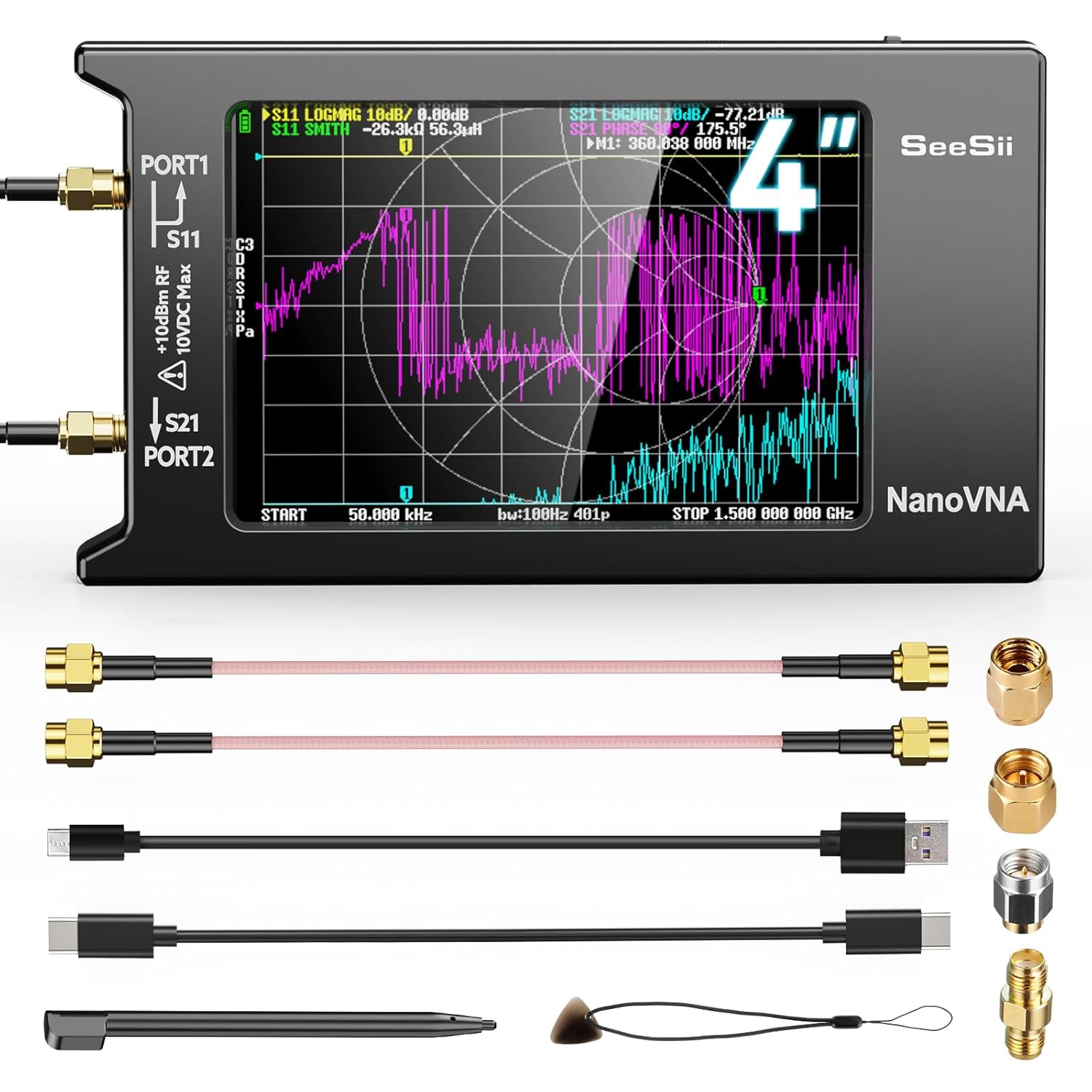
The SeeSii NanoVNA-H4 is a vector network analyzer with a listed measurement range from 9 kHz to 1.5 GHz. Its 4-inch touchscreen can display antenna measurements including SWR and S-parameters. The listing identifies antenna performance measurement as a primary use of its firmware.
Check On AmazonIf you click this link and buy, we earn a commission at no additional cost to you.
Final Thoughts: Buy the First Contact, Not the Radio Body
The best first HF purchase is the category that completes a real operating path with the fewest costly assumptions. Begin with the mode, band, location, antenna, and power plan, then decide which radio features are essential. That order makes affordable HF possible without confusing a low checkout price with complete-station value.
I would rather see a new operator wait and fund one usable station than buy a radio that immediately demands replacement. When the radio, power, antenna, feedline, interface, and measurement plan all support the same first contact, the entry-level decision has done its job.

The GOOZEEZOO JPC-12 is a portable vertical antenna covering 7 to 50 MHz and the 40-meter through 6-meter amateur bands. The assembled antenna is listed at 4.1 meters, or 13.5 feet, tall. Its modular construction is designed for quick outdoor setup for POTA, Field Day, and similar portable operation.
Check On AmazonIf you click this link and buy, we earn a commission at no additional cost to you.
FAQs
📻 What does a beginner need for a complete HF station?
At minimum, plan the radio, suitable power source, antenna, feedline, required connectors, and a way to verify the antenna system. Add a tuner, digital interface, battery, microphone, key, or protective equipment only when the operating mode and location require them.
💻 Do I need USB audio for FT8?
You need a controlled audio path between the radio and computer plus a method of radio control or keying. Integrated USB audio and CAT can simplify the setup, but a USB connector does not automatically provide both functions, so verify the manual.
⚡ Is 100 watts necessary for a first HF radio?
No, but output changes the operating margin and the supporting power system. Lower power can work well with efficient antennas, suitable modes, and realistic expectations, while conventional full-power operation may make early voice contacts less demanding.
🎛️ Is a built-in antenna tuner required?
No. A resonant antenna may not need one, and an internal tuner has a limited matching range. Choose the antenna first, then decide whether an internal tuner, external tuner, or no tuner fits that system.
📡 Can a 10-meter radio serve as a general HF transceiver?
No. A 10-meter-only radio does not provide the multi-band amateur coverage expected from a general HF station. Check the US transmit-frequency specifications rather than relying on the case style or a broad marketing label.
⏳ When should I wait instead of buying an HF radio?
Wait when the antenna is not possible, the intended mode needs unfunded connectivity, local noise requires better receiver tools, or the cheap option is already scheduled for replacement. A stable station plan makes the later comparison more accurate.