The best QRP ham radio is the one that supports your intended bands, modes, antenna, power source, and operating location without turning low power into an unnecessary handicap. QRP usually means transmitting at 5 watts or less, which can work remarkably well when propagation, antenna efficiency, receiver conditions, and operating technique line up. It is also a demanding way to make a first HF contact, especially on voice, because the station has little link margin to waste. This guide will help you decide whether to begin with QRP, use it as a portable specialty, or start with a conventional HF station that can be turned down later.

The Best QRP Ham Radio Starts With the Operating Goal
The best QRP ham radio is not automatically the smallest radio or the least expensive one. Start by deciding whether you want to make casual voice contacts from a park, operate digital modes from a campsite, learn CW, activate summits, or carry a backup HF station that fits in a small bag. Those goals require different controls, filters, band coverage, battery capacity, interfaces, and antenna support. A compact radio can be a good fit for one of those jobs and a frustrating compromise for another.
I have watched new licensees buy equipment before deciding what they want to do with it, and low-power HF punishes that order of decisions more than most parts of amateur radio. A full-power station can sometimes cover a weak antenna, noisy location, or imperfect timing with additional signal margin. A 5-watt station cannot. That does not make QRP ineffective, but it means the operating plan has to be clearer before the radio purchase.
Research-based evaluation: I am not presenting a hands-on bench test of a specific transceiver. This guide compares low-power operating types, power math, station requirements, and documented operator problems so you can choose the right path without mistaking a product list for a decision.
This article stays focused on low-power and portable HF operating for US beginner-to-intermediate operators. It does not cover advanced antenna modeling, contest-level DX strategy, kit construction, or a step-by-step portable antenna installation. For a broader view of conventional and portable HF choices, start with the guide to choosing your first HF transceiver.

The Xiegu X6100 is a 10-watt full-mode SDR transceiver with a 4-inch LCD and wireless connectivity. Its portable format is marketed for POTA, Field Day, travel, and RV use. It fits readers comparing a compact multimode low-power station after first defining bands, modes, controls, and operating goals.
Check On AmazonIf you click this link and buy, we earn a commission at no additional cost to you.
What QRP Means Before You Compare Radios
QRP comes from the Q signal associated with reducing power, but modern operators use it as a label for intentional low-power operation. For this guide, QRP means 5 watts or less of transmitter output. Some organizations and operating events allow up to 10 watts PEP for SSB voice, so check the rules of any award or event before calling a 10-watt contact QRP. A radio that can produce 10 or 20 watts may still be portable, but portable and QRP are not interchangeable terms.
The power difference is large enough to matter. Five watts is 13 dB below 100 watts because the ratio is twenty to one. That does not mean a 100-watt station has twenty times the communication range, since HF paths do not scale that cleanly, but it does mean the 5-watt signal reaches the other station with 13 dB less strength when every other part of the path is equal. In a strong opening, that reduction may still leave a readable signal; near the noise floor, it may erase the contact.
Key point: QRP is a link-margin decision, not a personality test. Using less power is satisfying when the rest of the station supports it, but there is no operating virtue in choosing 5 watts when the real goal is a reliable first conversation.
Power is only one part of the link. The transmitting antenna, feedline loss, propagation, receiving antenna, local noise, mode, and the other operator’s skill all affect whether the signal is copied. This is why one operator can work another country on 5 watts while someone else cannot complete a regional voice contact with the same output. The power label alone cannot predict the result.

The Daiwa CN-901HP is a cross-needle SWR and power meter intended for HF and VHF bench testing. It displays forward and reflected power with SWR, letting an operator verify transmitter output rather than relying on a nominal power setting. Its selectable power ranges make it useful when checking low-power operation alongside higher-power station tests.
Check On AmazonIf you click this link and buy, we earn a commission at no additional cost to you.
Why Five Watts Can Work and Why It Sometimes Does Not
A QRP contact succeeds when the received signal stays above the combination of noise, interference, and the mode’s decoding threshold. The receiving station does not know whether your signal began at 5 watts or 100 watts. It only hears what arrives after antenna efficiency, feedline loss, propagation, and path geometry have taken their share. That is why a clean 5-watt signal from an efficient wire antenna can outperform a higher-power signal sent through a badly compromised system.
Low power becomes difficult when several small losses stack together. A shortened portable antenna may trade efficiency for size, a thin feedline may absorb part of the signal, a low wire may send energy in an unhelpful pattern, and a noisy destination may hide what remains. Each compromise may look acceptable by itself. Together, they can consume most of the 13 dB you already gave up by moving from 100 watts to 5 watts.
| Station factor | Helps a QRP contact | Makes QRP harder |
|---|---|---|
| Antenna | Efficient, resonant, clear of nearby loss | Severely shortened, low, or poorly deployed |
| Feedline | Short run with reasonable HF loss | Long or lossy run that wastes scarce output |
| Mode | CW or a weak-signal digital mode | Casual SSB voice in crowded conditions |
| Timing | Open band and active target area | Closed band or poor path at that hour |
| Operating target | Strong station actively listening | Weak station inside a large pileup |
The table explains why “Can 5 watts reach that far?” is usually the wrong first question. Distance is not the controllable variable; the usable path is. A better question is whether your planned band, mode, antenna, location, and timing leave enough margin for the contact you want to make.

The RigExpert Stick 230 is a pocket-size antenna analyzer covering 100 kHz to 230 MHz. It can measure SWR and other antenna-system parameters without using the transceiver as the test source. That makes it useful when investigating whether antenna and feedline conditions are consuming scarce QRP link margin.
Check On AmazonIf you click this link and buy, we earn a commission at no additional cost to you.
Should QRP Be Your First HF Station?
For most new General licensees who want to make their first SSB voice contacts, I would not make a 5-watt-only radio the default starting point. HF already asks the operator to learn band selection, propagation, tuning, antenna behavior, noise management, and operating procedure. Removing 13 dB of transmit margin at the same time makes it harder to tell whether silence means the band is closed, the antenna is inefficient, the frequency is busy, the other station cannot hear you, or the station is not configured correctly.
A conventional HF transceiver with adjustable output gives a cleaner learning path. You can begin at a moderate or full legal setting appropriate to the contact, establish that the station works, and then reduce power in controlled steps. This separates the challenge of low-power operating from the challenge of building a first functioning HF station. It also lets you discover whether you enjoy QRP before committing to a radio that cannot increase its output.
| Your situation | Better starting path | Reason |
|---|---|---|
| New General seeking first SSB contact | Adjustable conventional HF station | More margin while learning propagation and setup |
| Operator already successful on HF | Dedicated QRP station | Low power becomes a deliberate new challenge |
| Portable operator focused on minimum weight | QRP or low-power portable station | Smaller radio and battery may justify reduced margin |
| CW or weak-signal digital operator | QRP can be reasonable earlier | These modes can work below comfortable voice levels |
| Emergency communication planner | Choose reliability first | Battery efficiency matters, but so does link margin |
There are exceptions. A new operator who already knows CW, has access to a proven antenna, understands the target bands, and expects a learning challenge may do well with QRP from the start. The mistake is not beginning at 5 watts; the mistake is buying a 5-watt radio because it is small or inexpensive without recognizing what the missing power changes.
Choose the Right Low-Power Radio Type
Low-power HF radios fall into several practical types. A narrow-purpose CW or digital transceiver can be extremely compact and efficient, but it may cover only selected bands and modes. A multimode portable radio offers SSB, CW, and digital support with more controls and interfaces, though it usually costs more and draws more current on receive. A 10- or 20-watt portable radio gives extra margin but should not be confused with strict 5-watt QRP.
The fourth path is often overlooked: use a conventional adjustable-power HF radio at 5 watts. It may be heavier and require a larger battery, but it lets you compare power levels using the same receiver, antenna, and controls. That is valuable when the goal is learning what QRP changes rather than owning the smallest possible station. It also provides a fallback when conditions make a low-power contact impractical.
- Bands: Confirm that the radio transmits on the HF bands your license and operating plan support.
- Modes: Match SSB, CW, and digital capability to what you will actually use.
- Output control: Check the real adjustable range and whether power varies by band or supply voltage.
- Receiver tools: Prioritize usable filters, noise controls, and a readable display over decorative features.
- Digital interface: Determine whether audio, control, and keying require extra hardware.
- Antenna matching: Know whether the station needs a resonant antenna, an external tuner, or an internal matching unit.
- Power source: Calculate receive current, transmit current, connector type, voltage range, and realistic field time.
- Controls: Make sure common field adjustments do not require deep menu navigation.
- Support: Check documentation, firmware history, repair options, and availability of replacement cables.
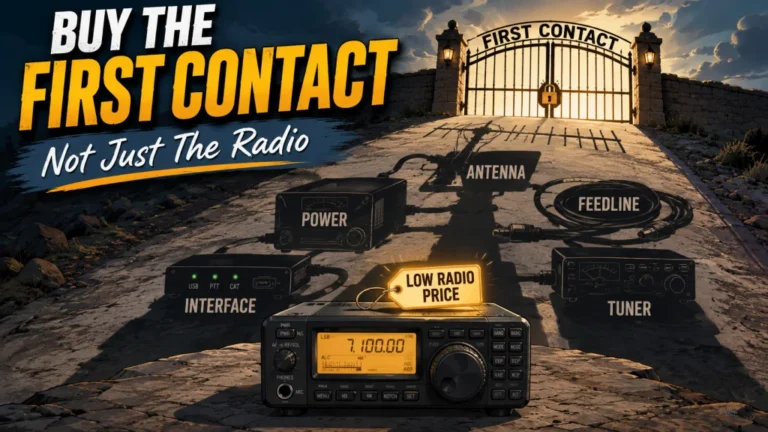
A radio that looks inexpensive can become the costly path after adding a battery, charger, tuner, interface, protective case, cables, key, microphone, and antenna hardware. Compare the complete working station, not the radio body. The best value is the setup that reaches the field ready to operate without hiding essential parts in a second shopping list.

The Xiegu X6200 is a portable HF and 50 MHz transceiver with a 4-inch LCD and a 3200 mAh replaceable battery. The listing supports SSB, CW, AM, NFM, DIGI, and WFM modes. That mix makes it relevant when comparing low-power radio types by bands, modes, interface needs, and field controls instead of size alone.
Check On AmazonIf you click this link and buy, we earn a commission at no additional cost to you.
Portable HF Is a Complete System, Not a Pocket Radio
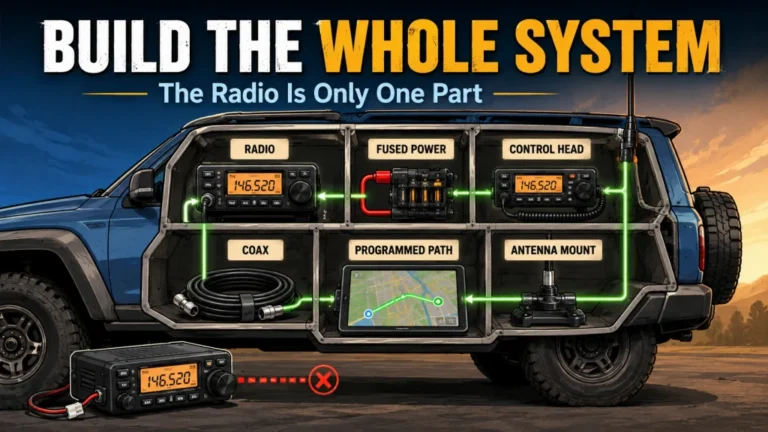
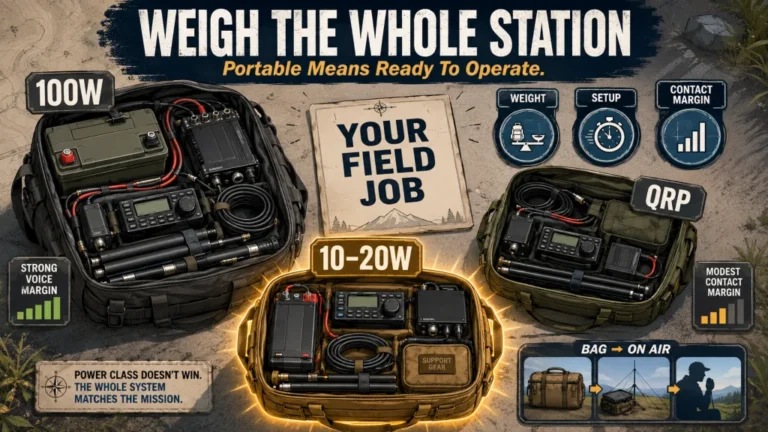
QRP is closely associated with portable operating because lower transmit power allows a smaller power source and a compact radio. The antenna, support line, feedline, battery, logging method, weather protection, and basic tools still have to travel with it. A tiny transceiver attached to a heavy battery and a complicated antenna package is not automatically a lightweight station. Weigh and test the complete load before deciding that low power solved the portability problem.
The antenna deserves the most attention because every lost watt matters more at QRP. A tuner can transform the impedance presented to the radio, but it cannot restore radiation efficiency that the antenna system never had. A short, convenient antenna may still be the right trail choice when weight and setup time matter more than maximum performance. The trade-off should be intentional, and the expected contact difficulty should reflect it.
Parks on the Air and Summits on the Air give operators clear reasons to build portable stations, but portable activation does not automatically require QRP. Some operators choose 5 watts for battery life, pack weight, and challenge; others use more power because their mode, antenna limits, or operating goal needs additional margin. The better decision is to choose the lowest power that reliably supports the planned communication, not to chase a label.
Warning: Do not treat a QRP station as a guaranteed emergency link. Low receive current and compact batteries can be useful, but emergency communication also depends on the intended recipient, frequency plan, antenna, terrain, propagation, operating schedule, and whether anyone is listening.

The Gabil GRA-7350TC is a portable telescopic HF antenna covering 3.5 to 50 MHz with compatible equipment. It uses a 3/8-24 connection and is intended for portable amateur-radio setups. It fits the complete-system discussion because the antenna choice remains part of the portability and efficiency trade-off rather than an accessory afterthought.
Check On AmazonIf you click this link and buy, we earn a commission at no additional cost to you.
Mode and Operating Technique Matter More at QRP
SSB voice can work at 5 watts, but it usually asks more from the path and operator than CW or a weak-signal digital mode. Voice needs enough signal quality for another person to understand speech in real time. CW concentrates information into a narrower bandwidth, while modes designed for weak-signal communication can decode below levels that would support comfortable voice audio. That does not make digital automatic or guaranteed; timing, frequency accuracy, software setup, and clean transmitted audio still matter.
The easiest QRP contact is often not the rarest or weakest station. Begin with a strong station that is actively calling, a scheduled event where operators expect portable signals, or a clear frequency on a band that is obviously open. Listen long enough to understand the calling pattern, send your call once or twice clearly, and avoid repeating it continuously over another station. Good timing can recover more practical success than another feature on the radio.
When a contact fails, protect yourself from random troubleshooting. Check output power, SWR, antenna deployment, band activity, frequency, mode, and computer audio settings in a fixed order. If several variables change at once, even a successful contact will not tell you which improvement mattered.

The Digirig Mobile combines a USB audio codec, CAT control, and PTT switching in one digital-modes interface. A single USB connection links those functions to a computer for supported radio setups. It is relevant for QRP digital operation because computer audio, control, and keying must be configured correctly before weak-signal modes can help.
Check On AmazonIf you click this link and buy, we earn a commission at no additional cost to you.
The Mistakes That Make QRP Feel Broken
The first mistake is buying low power as a shortcut to cheap HF. A small radio may reduce the entry price, but the operator still needs a suitable antenna system, power source, accessories, and enough license privileges for the intended bands and modes. QRP reduces transmitter output, not the number of decisions required to build a station. When the budget forces compromises in both power and antenna efficiency, frustration arrives quickly.
The second mistake is assuming that hearing a station means it should hear you. The other station may be transmitting much more power, using a larger antenna, or operating from a quieter location. Your receiver can deliver excellent audio while your 5-watt signal reaches the far end below its noise floor. Receive strength proves that a path exists in one direction; it does not prove that the path is balanced.
The third mistake is treating a low SWR reading as proof of an effective antenna. SWR mainly describes the match seen by the transmitter. A matching network can produce a safe load while part of the system still loses energy as heat or sends it in an unhelpful pattern. At 100 watts, a few watts of loss may be tolerable; at 5 watts, the same percentage loss is much harder to ignore.
The fourth mistake is choosing a radio before choosing a mode. A voice-focused operator needs different controls and audio performance than someone building a compact CW station or a digital portable setup. Decide what the contact will sound like and how it will be logged before deciding what the radio must contain.
Use a Three-Test Decision Before Buying
The safest way to decide whether QRP fits you is to test the operating style before buying a dedicated low-power radio. Use or borrow an adjustable HF station with a known antenna, make several contacts at a comfortable power level, and then repeat the same type of operation at lower settings. Try 20 watts and then 5 watts without changing the band, antenna, or location unnecessarily. The goal is not to prove that QRP works once; it is to learn whether you enjoy the additional listening, timing, and patience it requires.
Next, perform the portability test. Pack every item needed for a real session, including power, feedline, antenna support, weather protection, logging, headphones, adapters, and basic repair items. Set it up away from the radio room and note which parts consume the most time and weight. The result may show that a slightly larger radio with easier controls creates a better portable station than the smallest available box.
Finally, perform the failure test. Decide what you will do when 5 watts cannot complete the planned contact: change bands, change mode, improve the antenna, wait for better conditions, or increase power. An operator who enjoys that process is likely to enjoy QRP. An operator who mainly wants dependable voice contacts may be happier with a conventional station and the option to turn it down when conditions are favorable.
Once you know which path fits, the broader ham radio buying framework can help connect the radio type to your license class, budget, antenna limits, and real use case. That sequence keeps the equipment decision tied to the communication outcome instead of the reputation of a particular radio.
Final Thoughts: Choose QRP as a Deliberate Constraint
QRP works, and that is exactly why it attracts serious operators. Making an HF contact with 5 watts can teach antenna judgment, timing, mode selection, and listening discipline faster than a station with excess margin. The same constraint can also hide basic setup problems from a new operator who has not yet learned what a normal HF contact feels like. Low power is most rewarding when it is chosen as the challenge, not mistaken for the easy version of HF.
My practical recommendation is to start with the communication you want to complete. Choose QRP early when portability, CW, weak-signal digital work, or the low-power challenge is central to the goal and you accept inconsistent results. Choose an adjustable conventional station when the priority is learning HF with fewer unknowns, then reduce power after the station is proven. The right answer is not the radio with the smallest wattage label; it is the station that matches the way you will actually operate.

The Gabil GRA-ULT01 MK3 is a lightweight folding antenna tripod built for portable radio use. Its connector head includes SO-239, 3/8-24, and 1/4-20 mounting options for compatible antenna systems. It supports deliberate portable deployment by giving the antenna a compact field support rather than treating the radio body alone as the whole QRP station.
Check On AmazonIf you click this link and buy, we earn a commission at no additional cost to you.
FAQs
📻 What license do I need to operate QRP on HF?
QRP does not change your license privileges. For US Technicians, RTTY and data privileges, including FT8, are limited to 28.000 through 28.300 MHz on the 10-meter band; that license does not provide FT8 or other data privileges on 20, 40, 80, or 15 meters. A General license opens much broader HF access, but every operator should check the current US band chart before transmitting.
🌍 Can 5 watts reach another country?
Yes, international contacts are possible at 5 watts when the band, path, antenna, mode, and receiving conditions cooperate. It is not a guaranteed distance capability. Treat a long contact as the result of a complete path, not proof that 5 watts always reaches that far.
🔋 Is 10 watts considered QRP?
Definitions vary by organization and mode. This guide uses 5 watts or less as the clean general definition, while some rules allow up to 10 watts PEP for SSB voice. Check the specific event or award rules before claiming QRP status.
🎙️ Can I use SSB voice with a QRP radio?
Yes, but SSB voice usually needs a stronger path than CW or a weak-signal digital mode. Use an efficient antenna, choose a clearly open band, and call strong stations before judging the radio. Expect fewer completed contacts when conditions are marginal.
🧭 Is QRP a good choice for POTA or SOTA?
It can be a strong fit because a lower-power station may use a smaller radio and battery. Neither portable operating idea automatically makes 5 watts the correct output for every activation. Match the power to the mode, antenna, terrain, pack weight, and reliability you need.
⚡ Can a 100-watt radio be used for QRP?
Yes, when the radio provides stable adjustable output down to 5 watts or less. This is often the easiest way to learn QRP because you can compare power levels without changing the receiver, antenna, or controls. Confirm actual output if an event requires a strict power limit.
📡 Does an antenna tuner make a QRP signal stronger?
A tuner can provide the radio with an acceptable impedance match, but it does not automatically improve antenna efficiency. A matched inefficient antenna can still waste much of the transmitted energy. At QRP, physical antenna design and deployment matter as much as the SWR reading.