The best portable HF station is the complete packed system that fits how you operate, not the smallest radio or highest output number. A compact 100W rig may suit vehicle-adjacent use, an integrated 10W station may be easier on foot, and true QRP works best when low weight matters more than easy contacts. Compare the battery, tuner, interface, antenna system, controls, cooling, packed weight, and setup time before choosing a power class.

Portable HF Is a Complete Field System
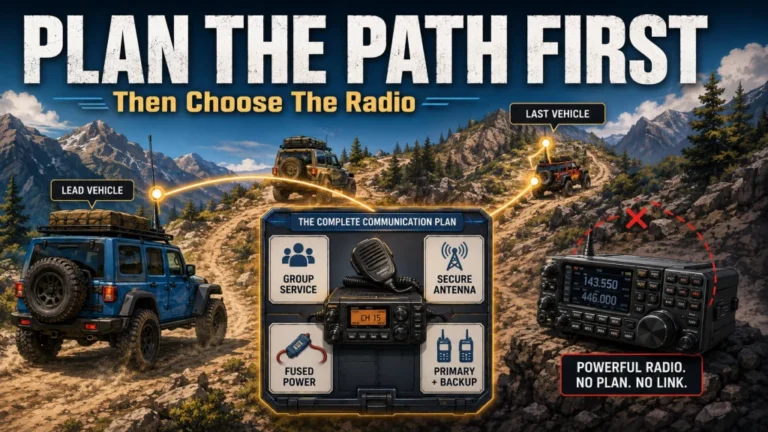
The best portable HF ham radio is not automatically the lightest radio on a specification sheet. I judge portability from the closed bag to the first completed contact, where hidden weight and setup friction appear. A compact 100W radio may need a larger battery, separate tuner, interface, and heavier wiring, while an integrated lower-power radio may create the lighter complete station.
This guide focuses on choosing a portable HF power class for POTA, SOTA, camping, travel, Field Day, temporary deployment, digital operation, or backyard use. It does not teach antenna construction. Start with the operating job, then work backward through power, RF, controls, weather exposure, and packed weight.
Field Note: The same mistake I see when new operators choose a first handheld shows up again in portable HF: the radio is selected before the job is defined. A smaller box does not repair a mismatched operating plan.
License privileges also belong in that first decision. A Technician license does not provide broad voice and digital access across the common HF bands. Technician RTTY and data privileges, including FT8, are limited to 28.000 through 28.300 MHz on 10 meters, so a Technician should not assume a portable digital station can legally use FT8 on 20, 40, 80, or 15 meters. Confirm the privileges you actually hold before spending around an operating plan you cannot yet use.

The Xiegu X6100 is a 10W HF and 50MHz SDR with a 4-Inch color display. It integrates a 3000mAh rechargeable battery, automatic antenna tuner, and USB control, reducing the number of separate field components. That makes it a useful example of the article's central point that real portability depends on the complete station, not radio size alone.
Check On AmazonIf you click this link and buy, we earn a commission at no additional cost to you.
Four Portable HF Classes Solve Different Problems
Portable and QRP are not synonyms. Output power changes battery size, cooling, operating pace, and contact margin. Compare the complete station required by each class, not a large radio against a small one.
| Portable class | What it does well | What it usually adds | Best fit |
|---|---|---|---|
| Compact 100W field rig | Provides full conventional HF output and more margin for voice, noise, or compromised conditions | Larger battery, heavier DC cable, more heat, and often a separate tuner or interface | Vehicle-adjacent POTA, Field Day, emergency deployment, and temporary base operation |
| Integrated 10W-class portable | Combines radio, display, internal battery capability, and digital connections in a compact station | Higher radio cost, lower output, and dependence on compact controls or menus | Walk-in operation, travel, mixed-mode use, and quick deployments |
| Lower-power portable around 20W | Offers more voice margin than strict QRP while keeping power needs below a typical 100W setup | An external battery and careful accessory planning, with integration varying by radio | Value-focused field operation, campground use, and operators who accept moderate output |
| Strict QRP or CW-focused equipment | Minimizes radio and battery weight and rewards efficient operating | More dependence on band conditions, antenna efficiency, mode, timing, and operator patience | SOTA, ultralight hiking, CW-focused operation, and deliberate low-power challenges |
A 100W class is not always the serious choice, and a 5W class is not always the advanced choice. A walk-in operator may gain more from shedding battery and cable weight, while a voice operator beside a vehicle may value power margin more than saving a few pounds.
For a deeper low-power decision, separate this comparison from choosing a true QRP radio. QRP becomes a good fit when the operating challenge is intentional, not when the buyer assumes every small HF radio will be easy to use in the field.

The Xiegu G90 is a 20W HF transceiver supporting SSB, CW, AM, and FM modes. Its detachable display and built-in automatic antenna tuner can reduce the number of separate pieces needed in a field setup. It is a concrete example of the article's lower-power middle ground between strict QRP and a full 100W station.
Check On AmazonIf you click this link and buy, we earn a commission at no additional cost to you.
Match the Power Class to the Operating Style
The best portable HF radio changes with walking distance, operating time, mode, weather, and contact goal. The best HF radio for POTA may be a 100W station beside a car, a 10W integrated station carried to a quiet site, or a QRP station for a short activation. POTA is an activity, not a power class.
- Vehicle-adjacent POTA: Favor output margin, a comfortable microphone, adequate cooling, and a battery that does not have to be carried far.
- Walk-in SOTA: Favor total packed weight, low receive current, simple connectors, fast deployment, and a mode that remains useful at low power.
- Campground or travel: Favor compact storage, quiet power, discreet deployment, headphone use, and an antenna plan that fits the permitted space.
- Field Day: Favor reliable controls, logging integration, cooling under repeated transmissions, and power arrangements that several operators can understand.
- Emergency deployment: Favor predictable power input, protected connectors, readable controls, documented accessories, and a station that can be deployed without experimenting.
- Portable digital modes: Favor clean USB audio and CAT control, stable timekeeping, RF-quiet charging, and cooling for a higher transmit duty cycle.
- Casual backyard operation: Favor quick setup and comfort, but do not pay a large portability penalty if the station rarely leaves home.
Choose the lightest complete system that still provides enough output, runtime, controls, and reliability for the hardest operation you perform regularly. Do not carry extra capability all year for a rare event unless that event truly matters.
Operators whose primary goal is outdoor communication rather than HF alone should also compare the wider equipment and safety tradeoffs in ham radio for hiking and camping. That keeps the radio choice tied to the trip instead of treating the trip as an excuse to buy a smaller transceiver.

The Icom IC-705 is a portable all-mode transceiver rated for 5W on its battery and up to 10W with a 13.8V external supply. Its 4.3-Inch color touchscreen supports field operation without a full-size front panel. HF, 6-meter, VHF, and UHF coverage makes it a flexible radio for mixed portable operating styles.
Check On AmazonIf you click this link and buy, we earn a commission at no additional cost to you.
The Power System Decides Runtime and Travel Practicality
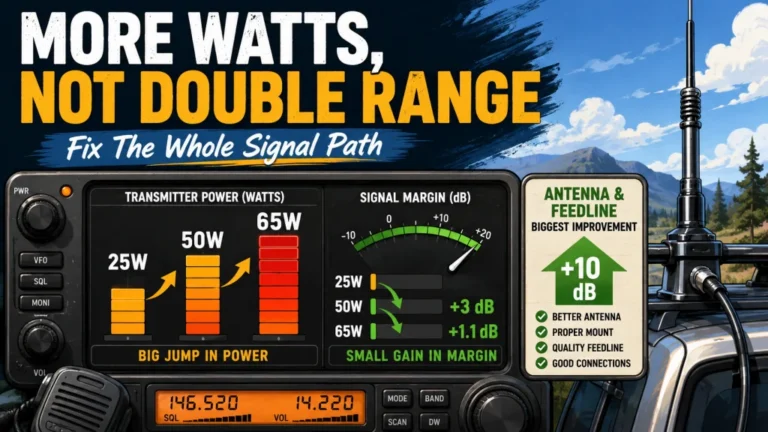
A portable ham radio transceiver is only as usable as its power source. Compare receive current, maximum transmit current, DC input range, output available from each source, and behavior as voltage falls. Internal batteries or lower-voltage supplies may reduce RF output.
Estimate runtime from duty cycle, not battery capacity alone. Multiply receive current by the receive-time share, add transmit current multiplied by the transmit-time share, then divide usable battery capacity by that average current. Leave margin for cold, voltage drop, conversion loss, battery age, and repeated calling.
| Power question | What to verify | Why it changes the field result |
|---|---|---|
| Internal or external battery? | Actual RF output, charging method, replaceability, and whether operation is possible while charging | An internal pack simplifies setup, while an external pack can extend runtime and be replaced independently |
| Battery chemistry? | Nominal voltage, safe charger, temperature limits, protection circuit, and storage requirements | Weight, voltage curve, charging safety, and cold-weather performance differ |
| DC cable and connectors? | Wire size, fuse location, polarity, strain relief, and connector compatibility | Voltage drop can reduce output or cause resets even when the battery still has capacity |
| Solar charging? | Controller compatibility, RF noise, realistic sunlight, and charge rate while operating | A panel may extend a session without replacing the battery capacity needed for transmit peaks |
| Air travel? | Battery watt-hours, terminal protection, carry-on rules, and airline-specific approval | A field battery that works by car may be unacceptable on a passenger flight |
For U.S. passenger flights, lithium-ion batteries up to 100 Wh are generally allowed under applicable baggage rules. Batteries from 101 through 160 Wh require airline approval, only two larger spares are allowed, and batteries above 160 Wh are prohibited. Carry spare lithium batteries in cabin baggage with protected terminals, and check the airline for stricter limits.
Use the correct charger, fuse the DC path close to the source, protect terminals, and confirm polarity. A station that resets on voice peaks or fills the receiver with charger noise is not field-ready.

This ECO-WORTHY battery is a 12V 20Ah LiFePO4 pack listed for uses including ham radio and outdoor equipment. It includes a built-in battery management system for protected lithium operation. Its capacity and chemistry make it relevant when comparing runtime, battery type, and the extra weight of an external field power system.
Check On AmazonIf you click this link and buy, we earn a commission at no additional cost to you.
The RF System Can Erase a Radio’s Portability Advantage
A tuner does not make every antenna efficient, and low SWR does not prove good radiation. Decide whether the antenna will be resonant, require a tuner, need a counterpoise, or place common-mode current on the feedline. Those choices determine tuner range, connector count, weight, and setup time.
An internal tuner can simplify a non-resonant field system, but tuner range varies and cannot recover power lost in poor feedline or an inefficient radiator. A resonant antenna may remove the tuner but require more space or adjustment. The site decides which tradeoff is better.
Count every RF item in the packed system: antenna, transformer or matching unit when required, feedline, adapters, choke or common-mode control, support line, mast, stakes, and weather protection. For the antenna decision itself, use these beginner HF wire antenna options rather than treating the tuner as permission to connect any convenient length of wire.
Setup time is a legitimate specification. A station that takes fifteen careful connections, three adapters, and repeated tuning checks may be acceptable at a campground but poor for a short summit activation. Measure the time from opening the bag to a stable, legal transmit setup, not merely the time required to power on the radio.

The Gabil GRA-ULT01 MK3 is a portable antenna tripod with SO-239, 3/8-24 thread, and 1/4-20 camera mount connection options. Those interfaces make antenna support and connector compatibility explicit parts of the field setup. It fits this section because support hardware and connection choices add real weight, setup steps, and compatibility requirements to the complete RF system.
Check On AmazonIf you click this link and buy, we earn a commission at no additional cost to you.
Digital Modes Add More Than a USB Cable
Portable digital operation needs audio, CAT control, time synchronization, logging, and quiet power. A single cable helps only when it carries the required functions reliably. A separate interface, serial path, or adapter must be counted in weight, cost, and failure points when required by the portable HF transceiver.
Choose the computing device before the radio class. A laptop offers familiar software but adds bulk and charging demand. A tablet or compact computer may save weight but require different software or adapters. Test the complete software and cable path offline.
Time synchronization can fail when the operating site lacks cellular service or internet access. Decide whether the device will use GPS, a hardware time source, or a manual correction method before arriving. Also test power banks, DC converters, solar controllers, and chargers near the receiver, because a quiet-looking power system can raise the HF noise floor.
Digital duty cycle changes thermal planning. A radio comfortable during short SSB transmissions may become hot during repeated digital periods, especially in direct sun or inside a protective case. Verify the manufacturer’s duty-cycle guidance, provide airflow, reduce output when necessary, and test the complete system under the same transmit pattern planned for the field.

Digirig Mobile combines a USB audio codec, CAT control path, and PTT switching in a compact interface. It uses a single USB connection to the computer, while radio-side cables depend on the transceiver and are not included in this listing. It fits this section because portable digital operation depends on a verified audio and control path, not simply the presence of a USB connector.
Check On AmazonIf you click this link and buy, we earn a commission at no additional cost to you.
Field Durability Is Mostly About Exposure and Handling
Do not assume a compact radio is weatherproof. Verify any ingress rating and what it covers, because open ports or a non-rated battery can change the protection. A hard case protects transport, not operation in rain.
Check display readability in sun, controls with cold or gloved hands, outdoor speaker clarity, and headphone connections. Small controls are acceptable only when common changes such as band, mode, filter, power, and tuner state remain practical.
Connector strain deserves the same attention as the radio enclosure. A stiff coax cable, unsupported USB plug, or heavy DC lead can damage a compact socket when the radio is moved or the table is bumped. Use strain relief and arrange cables so the radio is not serving as the anchor point for the whole station.
Heat, dust, and condensation also affect the operating plan. Shade can improve display visibility and thermal performance, while a ground cloth can keep dust away from fans and connectors. In rain, the correct response is often to stop transmitting and protect the system rather than trust a partial cover that traps heat or directs water toward the cables.

The Pelican 1400 is a hard protective case supplied with foam for fitting compact equipment. Pelican's Amazon listing describes a tongue-and-groove design with a polymer O-ring for watertight sealing. It fits this section as transport protection for a portable radio and accessories while keeping safe operation in exposed weather as a separate concern.
Check On AmazonIf you click this link and buy, we earn a commission at no additional cost to you.
Compare Packed Weight and Usable Cost
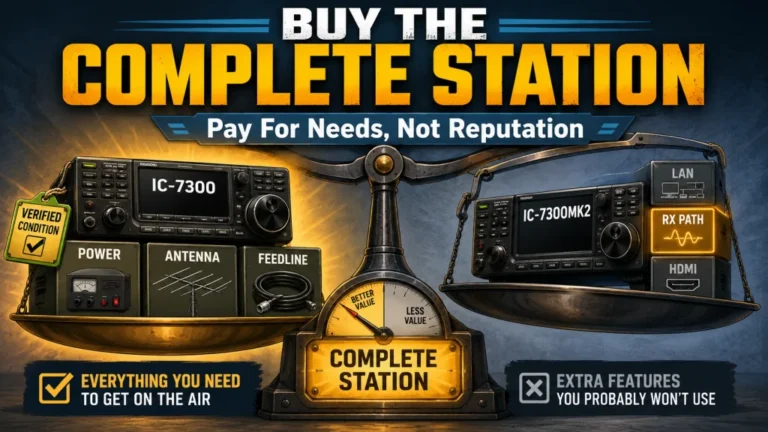
Radio weight and price are incomplete. Include everything required to make the planned contact, power and protect the station, and log the operation. An inexpensive light radio can still become the heavier field ham radio system.
| System item | Include in packed weight? | Include in usable cost? | Common oversight |
|---|---|---|---|
| Radio and microphone or key | Yes | Yes | Forgetting the control method needed for the chosen mode |
| Battery, charger, DC cable, and fuses | Yes | Yes | Comparing radio weight while ignoring the battery needed for full output |
| Tuner or matching equipment | When required | When required | Assuming every internal tuner covers the planned antenna |
| Digital interface and computer | For digital use | For digital use | Counting a USB connector without confirming audio and CAT functions |
| Antenna, feedline, mast, and support gear | Yes | Yes | Choosing a radio before checking what the site can support |
| Case, rain protection, headphones, and adapters | Yes | Yes | Treating small accessories as weightless and failure-proof |
Use two totals: packed weight and ready-to-operate cost. Include the bag in weight and every required purchase in cost, while excluding equipment already owned and truly compatible. This exposes hidden second-round purchases.
Then compare setup complexity. Count separate power connections, RF connections, data connections, adapters, menu changes, and pieces that must be protected from weather. The best value is not always the cheapest station. It is the station that meets the operating goal with the fewest unacceptable compromises.

The Etekcity EL11 is a digital hanging luggage scale rated to 110 pounds. Its hanging hook, rubber grip, easy-to-read display, and included battery make it practical for weighing a closed radio bag before a trip. It directly supports the article's recommendation to compare ready-to-carry system weight rather than the radio body alone.
Check On AmazonIf you click this link and buy, we earn a commission at no additional cost to you.
Choose a Class From the Scenario, Not a Winner List
There is no permanent winner because equipment and field jobs change. I would choose the category first, list the required functions, and then compare current radios that meet them. That prevents extra features from winning a decision they cannot support outdoors.
- Easiest integrated portable station: Start with a battery-capable 10W-class radio when fast setup, built-in display, compact digital connections, and walk-in weight matter more than full output.
- Maximum conventional field capability: Start with a compact 100W class when voice reliability, shared Field Day use, vehicle support, and output margin justify the battery and cooling burden.
- Value lower-power field setup: Start around 20W when strict QRP feels too limiting but a full 100W power system is unnecessary for the usual site.
- Lightweight QRP or CW setup: Start with strict QRP when minimum pack weight and the operating challenge are part of the goal, not an unwanted limitation.
- Portable digital station: Start with the cleanest verified audio, CAT, time, cooling, and computing path, then choose the lowest output class that meets the planned mode and contact goal.
When comparing the broader market, use these HF radio categories by use case to keep portable compromises in context. A field-oriented display, small speaker, or compact control layout may be worthwhile outdoors and needlessly restrictive at a permanent desk.
New operators who are still building a first home station should also compare the priorities in choosing an entry-level HF station. A first HF purchase should make the most common operating location easier, not sacrifice daily usability for a portable trip that may never happen.

The Xiegu G106 is a 5W portable QRP SDR transceiver supporting SSB, CW, and AM transmission, with WFM receive. Amazon's listing describes FT8 support when the radio is used with the optional DE-19 digital adapter and a computer. It is a concrete strict-QRP example for choosing a class from the operating scenario instead of treating higher output as the automatic winner.
Check On AmazonIf you click this link and buy, we earn a commission at no additional cost to you.
Test the Whole Station Before the Return Window Closes
A desk test confirms power-up; a field test confirms fit. Use the same bag, battery, antenna, feedline, computer, controls, and accessories planned for normal operation. Record the site, weather, band, mode, output, and duration so a poor result is not blamed on the wrong component.
- Weigh the closed, ready-to-carry system.
- Time deployment from opening the bag to the first safe transmit.
- Measure receive current and transmit current at the output levels you will use.
- Watch supply voltage at the radio during transmit, not only at the battery.
- Check tuner behavior on every planned band and antenna configuration.
- Complete the full digital interface and logging path when digital modes matter.
- Read the display in sun, shade, and low light.
- Operate long enough to expose heat, fan noise, battery sag, and uncomfortable controls.
- Log attempted and completed contacts without treating contact count as a laboratory receiver test.
- Pack the station again and note which items were unused, missing, or difficult to protect.
Contact count alone is weak evidence because propagation, antenna placement, and activity vary. Judge whether the system behaved predictably and whether failures could be identified. A quiet band is not a product defect, but repeated voltage sag, heat, cable failure, or unreadable controls is a real problem.
Repeat the test after removing unnecessary accessories or correcting a weak connection. The goal is not to prove the purchase was right. It is to discover whether the complete station is reliable, carryable, and understandable before the equipment becomes nonreturnable or is trusted during an important outing.

This 150A power analyzer displays voltage, current, power, amp-hours, and watt-hours on a digital screen. The listing includes two sets of 45-amp Power Pole connectors for inline DC measurement. It directly supports the article's field-test steps of checking supply voltage and current under real receive and transmit conditions.
Check On AmazonIf you click this link and buy, we earn a commission at no additional cost to you.
Who Should Not Buy a Portable HF Radio First
A home-only operator should not automatically buy portable-first. Compact controls, a smaller speaker, reduced cooling, lower output, or an integration premium can make daily operation less comfortable. Portability has value only when it is used often enough to justify those compromises.
A conventional radio can still operate outside occasionally with suitable power and protection. Ask how many of the next ten sessions will require carrying and deploying the station. Rare travel may not justify permanent compromises.
Portable-first may also be the wrong starting point for someone who has not chosen a mode, learned the relevant license privileges, or identified an antenna location. In that case, the most useful next step is to define the home and field operating goals before comparing hardware. Otherwise, the buyer may pay for integration, low weight, or QRP limitations without knowing whether any of them solve the real problem.
The exception is a reader whose living situation makes temporary operation the normal station. Apartment residents, renters, travelers, and operators under antenna restrictions may use portable deployment as their primary access to HF. For them, the portable system is not a secondary convenience. It is the station.

This bundle centers on the Icom IC-7300, a 100W HF and 50MHz base transceiver, and adds a compact manual plus a quick-reference card. It represents the conventional non-portable-first alternative discussed in this section. For an operator who mainly works from home, a full-power base radio is a direct comparison point against paying for portability that may rarely be used.
Check On AmazonIf you click this link and buy, we earn a commission at no additional cost to you.
Final Thoughts: Buy the Field System You Can Repeatedly Deploy
The right portable HF class becomes clearer once the radio body stops being the center of the comparison. Start with the operating site, walking distance, mode, contact goal, weather exposure, and session length. Then build the required battery, RF, interface, control, and protection system around those conditions.
I would rather carry a slightly heavier station that deploys predictably than own a lighter radio that needs forgotten adapters, an undersized battery, or an antenna system the site cannot support. Compare packed weight, ready-to-operate cost, and setup time, then test the complete station under defined field conditions. That process will do more to identify the right power class than any permanent “best” label.

The Gabil GR-ARB01 is a 1680D modular antenna roll bag designed to organize portable radio gear. The package includes removable storage pockets and a pen roll insert, while radios, antennas, coax, and tools shown in the listing are not included. It fits the article's final emphasis on carrying the complete field system in a repeatable, organized way instead of focusing only on the transceiver.
Check On AmazonIf you click this link and buy, we earn a commission at no additional cost to you.
FAQs
📻 Is a portable HF radio the same as a QRP radio?
No. Portable HF includes compact 100W radios, integrated 10W-class stations, lower-power radios around 20W, and strict-QRP equipment. QRP is one power category, while portability describes how the complete station is carried and deployed.
🌲 How much power is best for POTA?
Choose power from the site, mode, battery plan, and contact goal. Vehicle-adjacent voice operation may justify 100W, while walk-in activations may favor 10W, 20W, or QRP to reduce battery and cable weight.
🔋 How do I estimate portable radio battery runtime?
Estimate average current from the percentage of time spent receiving and transmitting, then divide usable battery capacity by that average. Leave margin for cold weather, voltage drop, conversion losses, and repeated calling.
✈️ Can I fly with an HF radio battery?
Many lithium-ion batteries up to 100 Wh can travel under standard passenger rules, while 101 through 160 Wh requires airline approval and larger batteries are prohibited. Spare lithium batteries must be carried on with protected terminals, and the airline may impose stricter limits.
💻 Do I need a separate interface for portable FT8?
That depends on whether the radio provides the required USB audio and CAT control functions. Test the exact radio, cable, software, time source, and computing device together before the trip.
🎒 What weight should I compare when buying?
Compare the closed, ready-to-carry station. Include the radio, battery, power cable, tuner when required, antenna, feedline, supports, interface, computer, microphone or key, adapters, weather protection, and bag.
🏠 Is a portable HF radio a good first home radio?
It can be, but only when temporary deployment or limited storage is part of normal use. A home-only operator may get better controls, speaker performance, cooling, and power convenience from a station that does not prioritize portability.