The best first HF transceiver is the one that fits where you will operate, the modes you plan to use, your license privileges, and the cost of the complete station around it. A fixed 100-watt radio, a compact field radio, a lower-power portable, and a purpose-built QRP transceiver solve different problems. This guide maps those choices without ranking individual models or replacing the detailed buying guides for each path. By the end, you should know which radio class to investigate and what else must be included in the budget.

The Best HF Ham Radio Starts With Your Operating Style
The best HF ham radio is not one model that wins for every new operator. A radio that makes sense on a permanent desk can be awkward to carry into a park, while a light portable transceiver can create unnecessary frustration for someone who mainly wants reliable SSB voice contacts from home. Start by defining the station, then choose the radio body that completes it.
The question I hear most often after a licensing session is what radio to buy. For HF, I answer with three practical questions: Where will you operate, which mode will you try first, and what must fit inside the same budget? Those answers eliminate more bad choices than comparing another page of receiver specifications.
Field Note: New operators often compare transceivers before deciding whether the radio will live on a desk, travel in a vehicle, or run from a battery outdoors. That reverses the decision. The operating location determines the power source, controls, cooling, protection, antenna connection, and accessories the radio needs.
This article covers beginner-to-intermediate US HF transceiver selection. It does not cover VHF/UHF handhelds or mobiles, detailed model testing, advanced contest stations, or antenna installation. Readers still deciding whether HF is the right radio category should begin with choosing the right ham radio type before narrowing the search further.

The Xiegu G90 is a 20-watt HF SDR transceiver supporting SSB, CW, AM, and FM. It includes a built-in automatic antenna tuner. This listing bundles the radio with the CE-19 expansion interface for connections to PCs, data terminals, and compatible accessories.
Check On AmazonIf you click this link and buy, we earn a commission at no additional cost to you.
Match the Radio to the HF Privileges You Can Use
A Technician can own and operate an HF transceiver, but the license does not open every HF band and mode. Technician RTTY and data privileges, including FT8, are limited to 28.000 through 28.300 MHz on 10 meters. Technician SSB phone privileges are available from 28.300 through 28.500 MHz, with CW privileges on specified portions of 80, 40, 15, and 10 meters.
That distinction matters before buying. A Technician interested mainly in 10-meter SSB or data can begin learning an HF radio now, while someone expecting broad voice and data access across 80, 40, 20, 15, and the other HF bands will need General privileges. The radio may cover those frequencies, but the control operator must stay inside the privileges of the license class currently held.
A General license opens much broader operating space, which changes what counts as a sensible first station. More bands create more choices for propagation, nets, digital activity, and voice contacts, but they also make antenna coverage and station planning more important. A radio with wide coverage does not remove the need to understand which frequencies and emission types your license permits.
Key point: Do not buy for the license you imagine while ignoring the operating privileges you have today. When broader HF access is the real goal, review the Technician-to-General upgrade process before spending the entire station budget.
The useful buying question is not whether a Technician is allowed to own an HF radio. The useful question is whether the available privileges support the contacts and modes that justify the station you are about to build.

The No-Nonsense General Class License Study Guide is written by Dan Romanchik KB6NU for General Class exam preparation. The title covers tests given between July 2023 and June 2027. This English-language edition is 216 pages and was published July 5, 2023.
Check On AmazonIf you click this link and buy, we earn a commission at no additional cost to you.
Use an Operating-Style Map Before Comparing Radios
A good first HF radio should reduce the barriers between the operator and the first planned activity. That does not always mean buying the simplest front panel or the smallest case. It means prioritizing the controls, output power, computer connection, current draw, and physical format that support the station’s actual job.
| Operating style | What to prioritize | Common mismatch |
|---|---|---|
| Fixed home station | Comfortable controls, a readable display, 100-watt capability, useful filtering, stable desk connections, and straightforward computer integration | Paying extra for extreme portability while overlooking desk ergonomics and the external power supply |
| Compact home or vehicle use | Small chassis, manageable heat, secure mounting options, clear controls, and a power system that can support full transmit current | Assuming a small case also means low current draw or easy mobile installation |
| Portable field or POTA operation | Weight, battery demand, connector durability, setup speed, weather protection, and controls that remain usable outdoors | Choosing by radio weight alone while the battery, tuner, feed line, and case make the complete pack heavy |
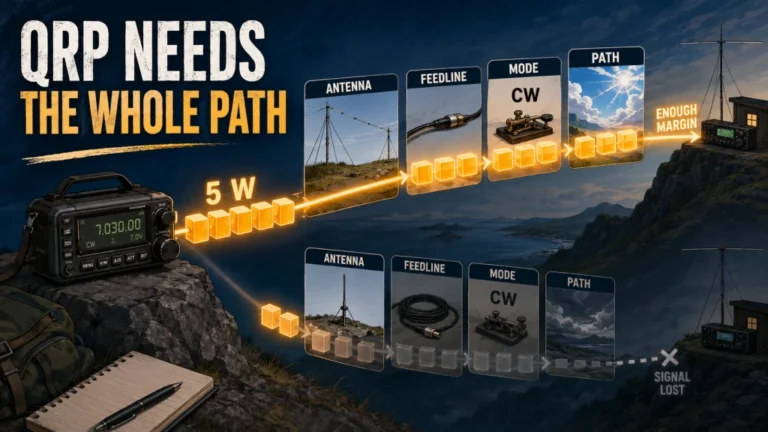
| Strict QRP operating | Low receive current, efficient field setup, mode support, compact controls, and an antenna plan suited to low power | Expecting a 5-watt station to behave like a 100-watt station under the same conditions |
| Digital-heavy operation | Reliable USB audio and control, frequency stability, duty-cycle cooling, computer compatibility, and easy level adjustment | Buying a radio with a waterfall display but no clean plan for audio, control, cables, or sustained transmitting |
| CW, casual contest, or crowded-band use | Filter control, tuning resolution, keying behavior, strong-signal handling, and controls that can be adjusted without menu hunting | Choosing by maximum feature count instead of the receiver and control functions used during actual operation |
| Remote operation | Supported network control, dependable audio and radio control, safe power management, and a station that can be monitored remotely | Assuming a network port alone creates a complete unattended station |
The table is a filter, not a ranking. A compact 100-watt radio may suit both home and field use, but the same unit can still be a poor fit if its controls are difficult for you, the power system is too large for your pack, or the connections do not support your preferred digital workflow.
Write down one primary use and one secondary use. When a choice serves the secondary use brilliantly but makes the primary use harder, it is usually the wrong first radio, no matter how impressive the specification sheet looks.

The Digirig DR-891 is a digital modes interface designed specifically for the Yaesu FT-891. It carries audio, PTT, and CAT control over a single USB connection and includes the transceiver cables. The interface supports Windows, macOS, Linux, Android, and iOS, while the USB-C cable is sold separately.
Check On AmazonIf you click this link and buy, we earn a commission at no additional cost to you.
Compare Complete HF Stations, Not Radio-Body Prices
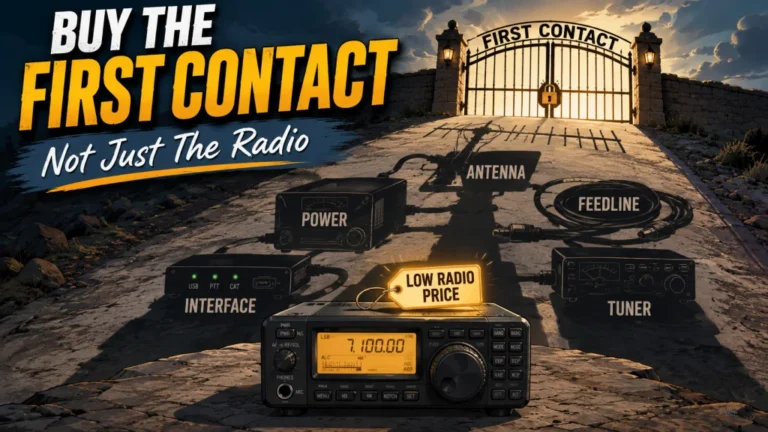
The radio body is only one part of the purchase. Many current 100-watt transceivers are designed around 13.8-volt DC power and can draw roughly 20 amps or more near full output. A home station therefore needs a suitable supply, while a field station needs a battery and wiring that can deliver the required current without excessive voltage drop.
The antenna system can change the budget even more. A resonant wire antenna may need little or no routine tuning on its intended bands, while a compromise multi-band antenna may depend on a tuner and careful feed-line choices. A tuner can present an acceptable load to the radio, but it does not automatically turn an inefficient antenna into an efficient one.
| Station part | Home-station question | Field-station question |
|---|---|---|
| Transceiver | Are the controls, display, filtering, and connections comfortable for long sessions? | Does the output power justify the size, weight, and receive current? |
| Power source | Can the supply provide the radio’s specified current without adding objectionable RF noise? | How many realistic operating hours does the battery provide at the planned duty cycle? |
| Antenna | Which bands fit the available property, supports, and restrictions? | How quickly can the antenna be deployed, supported, and packed? |
| Coax and connectors | Is the run length practical, weatherproofed, and appropriate for the installation? | Is the feed line light enough without becoming fragile or unnecessarily lossy? |
| Tuner | Does the planned antenna actually require one, and is the tuner’s matching range suitable? | Is it built into the radio, carried separately, or avoided through a resonant antenna? |
| Computer interface | Are audio, radio control, logging, and software compatibility already supported? | Will digital operation require another interface, cable, tablet, or computer in the pack? |
| Protection and accessories | Are grounding, cable routing, surge planning, and a practical operating position accounted for? | Are the radio, battery, connectors, and display protected from transport and weather? |
Before comparing transceiver prices, build a written station list. Include the items required to transmit safely and the items required by the first mode you plan to use, not every accessory that might become interesting later.
- Price the correct supply or battery for the radio’s full-current requirement.
- Choose the antenna concept before assuming an internal tuner will solve every match.
- Include feed line, connectors, adapters, and weather protection.
- Add the computer, cables, or audio interface required for digital operation.
- For portable use, calculate the weight and energy demand of the entire pack.
If the antenna decision is still unclear, use the guide to planning a beginner HF wire antenna before locking the radio budget. That sequence prevents a common mistake: buying a capable transceiver and leaving too little money or space for the system that must put its signal on the air.

The Super Antenna Super-MP 1LXMAX is a portable HF and VHF antenna package with a large collapsible tripod. The listing covers amateur bands from 80 through 6 meters plus simultaneous 2-meter VHF operation. Its manual SuperSlider tuning system does not require external power or a separate antenna tuner.
Check On AmazonIf you click this link and buy, we earn a commission at no additional cost to you.
Understand the Current HF Transceiver Tiers
The current US market is easier to understand when radios are grouped by the job they perform rather than by brand. The categories overlap, but each one makes a different trade between output power, portability, controls, integration, and cost. This is the useful market map for a first purchase.
Evidence note: This overview is research-based. It uses current manufacturer product listings and manuals to identify transceiver classes, but it does not claim hands-on testing of every radio. Model-specific testing and ownership claims belong in the detailed reviews.
| Market tier | What it usually offers | Who should investigate it | Main trade-off to check |
|---|---|---|---|
| Entry-value, legacy, or used 100-watt radios | Full-power HF operation with simpler displays, older interfaces, or a lower used-market entry cost | Operators who value basic station capability over the newest screen and connectivity features | Condition, parts and firmware support, included accessories, computer integration, and the cost of missing cables or options |
| Compact 100-watt radios | Full output in a smaller chassis suitable for a tight desk, vehicle, or transportable station | Operators who need one radio to move between locations without accepting QRP output | Small controls, heat, external power demand, and whether the portable system remains genuinely portable |
| Midrange direct-sampling base radios | 100-watt output, spectrum and waterfall displays, modern filtering, USB integration, and increasingly capable remote features | Operators building a fixed first station around voice, digital, and broad everyday use | Paying for features that do not support the planned modes, or assuming receiver measurements from different test conditions are directly comparable |
| Portable multi-band SDR radios | Broad mode and band coverage, low-power operation, visual spectrum tools, and field-friendly packaging | Operators who value a compact all-mode field platform and accept the limits of lower output | Battery life, screen visibility, connector exposure, controls, and the extra equipment required to reach higher power |
| Lower-power value portables | More output than strict QRP with lower power demand and cost than many 100-watt stations | Operators balancing field portability, digital modes, and a moderate first-station budget | Support, software behavior, interface requirements, receiver performance evidence, and whether the lower power suits the first operating mode |
| Specialist QRP radios | About 5 watts, low receive current, compact size, and controls focused on a narrower operating purpose | Operators intentionally choosing the low-power challenge rather than treating QRP as the automatic cheapest path | Mode and band limits, antenna efficiency, operating patience, and the learning curve of making contacts with less signal margin |
A fixed 100-watt station is often the least complicated path for a new General who wants SSB voice, but that is a starting assumption, not a universal rule. A field operator may accept lower power to reduce battery size, while a digital operator may place computer integration and cooling above front-panel size.
For a first HF station, the right entry-level choice is not automatically the cheapest current radio or the most capable used one. It is the radio class that leaves enough budget and attention to finish the antenna, power, and operating workflow.

The Xiegu G90 is a 20-watt HF SDR transceiver with SSB, CW, AM, and FM modes and a built-in automatic antenna tuner. This bundle includes the DE-19 expansion interface. The listing also specifies a 48 kHz spectrum display with waterfall and digital isolation in the DE-19 for computer connections.
Check On AmazonIf you click this link and buy, we earn a commission at no additional cost to you.
Run Every Candidate Through Six Buying Filters
Once the operating style and market tier are clear, compare radios with the same questions. This keeps a bright display, a long feature list, or a temporary discount from changing the job the station is supposed to do.
- License and first mode: Which privileges and modes will you actually use during the first six months?
- Operating location: Will the radio remain on a desk, travel occasionally, or be carried into the field regularly?
- Power class: Do you want the signal margin of 100 watts, a lower-power compromise, or an intentional 5-watt challenge?
- Antenna relationship: Does the radio’s tuner range and connector layout fit the antenna system already planned?
- Workflow: Are USB audio, radio control, remote access, CW controls, or an external display necessary for the first use?
- Complete cost: What does the station cost after power, antenna, feed line, interfaces, protection, and missing accessories are included?
A feature should survive at least one of those filters before it influences the purchase. A built-in tuner matters when it matches the planned antenna. A large spectrum display matters when it improves how you find and manage signals. A network function matters when the rest of the station can be powered, monitored, and controlled safely from a distance.
This method also makes used equipment easier to judge. A lower radio price is not a bargain when the unit lacks required interfaces, needs difficult-to-find accessories, or forces an antenna and power arrangement that does not fit your location.

The mAT-10 is a compact automatic antenna tuner designed for Yaesu FT-817 and FT-818 and usable with other QRP transceivers. It operates from 1.8 to 54 MHz at power levels up to 30 watts. The tuner stores up to 16,000 frequency memories for faster recall near previously tuned frequencies.
Check On AmazonIf you click this link and buy, we earn a commission at no additional cost to you.
Final Thoughts: Buy the Station You Can Put on the Air
The best ham radio for HF is the one that turns your license, location, antenna, power source, and preferred mode into one workable system. Start with a primary operating style, choose the appropriate power class, and reserve enough budget to finish the station. That approach is less exciting than shopping by feature count, but it is much more likely to produce actual contacts.
I would rather see a new operator build one complete, understandable HF path than own a radio that is waiting on five missing pieces. Once that first station is working, experience will show whether the next improvement should be a different antenna, more portable power, stronger digital integration, or a different class of transceiver.

The GABIL GRA-7350T is a portable telescopic HF whip with a PL-259 connector for compatible SO-239 mounts and bases. It collapses to about 240 mm and extends to about 2,170 mm, with the assembled antenna reaching about 2.6 meters. The antenna covers 3.5 to 50 MHz for portable amateur radio operation.
Check On AmazonIf you click this link and buy, we earn a commission at no additional cost to you.
Choose the HF Guide That Matches Your Decision
The market becomes manageable once you stop asking one article to answer five different purchase questions. Use the route below that matches the operating style and trade-off you have already identified.
| Guide | What it helps with |
|---|---|
| Best Entry-Level HF Radios | Compare first-station value, basic capability, and the compromises that matter before moving into more expensive radio classes. |
| Original IC-7300 Review | Evaluate the original generation as a current-new, discounted, or used purchase without confusing it with the newer MK2. |
| Choosing a QRP HF Radio | Decide whether intentional 5-watt operating fits your modes, antenna plan, expectations, and tolerance for reduced signal margin. |
| Portable HF Radio Systems | Compare field power, total pack weight, protection, setup time, connectors, and the real portability of the complete station. |
| IC-7300MK2 vs FT-710 | Compare two separate current midrange choices, including the IC-7300MK2 that entered the market at the end of 2025, without treating the original IC-7300 as the same product. |
Each guide owns a narrower decision so the evidence, trade-offs, and model details can be handled without turning this overview into a duplicated ranking.

The Xiegu G90 is a 20-watt HF SDR transceiver supporting SSB, CW, AM, and FM with a built-in automatic antenna tuner. This bundle adds the CE-19 expansion interface and G90-H1 fan holder. The CE-19 supports connections from compatible Xiegu transceivers to PCs, data terminals, modems, and other supported accessories.
Check On AmazonIf you click this link and buy, we earn a commission at no additional cost to you.
FAQs
📻 Is a 100-watt radio the best HF transceiver for beginners?
It is often the least restrictive starting point for SSB voice from a home station because it provides more signal margin than QRP. It is not automatically best for a battery-limited field station, a strict low-power goal, or a location where the antenna and power system cannot support it.
🪪 Can a Technician use an HF transceiver?
Yes. A Technician can own and transmit with an HF transceiver, but only within Technician frequency and mode privileges. The radio’s coverage does not expand the operator’s license privileges.
📡 Do I need an antenna tuner for my first HF station?
Not always. A resonant antenna used within its designed range may not require routine tuning, while a multi-band or compromise antenna may need a suitable tuner. Check the antenna and the tuner’s matching range together.
🔋 Is a portable HF radio a good home radio?
It can be, especially when desk space is limited or the radio will travel. Check control size, display comfort, cooling, output power, and whether a separate supply and accessories erase the portability advantage at home.
📉 Is QRP a good way to save money on a first HF station?
Sometimes, but low output is not merely a cheaper version of 100-watt operating. QRP places more pressure on antenna efficiency, propagation, mode choice, and operator patience, so choose it because that challenge appeals to you.
💻 What equipment do I need besides an HF transceiver?
At minimum, plan for a suitable power source, an antenna, feed line, and the required connectors. Depending on the antenna and mode, you may also need a tuner, computer interface, computer, protective case, grounding or surge components, and installation hardware.
🧰 Should a beginner buy a used HF radio?
A used radio can preserve budget for the antenna and power system, but condition matters more than age alone. Confirm transmit and receive operation, included accessories, support status, interface needs, modification history, and whether repair would erase the savings.