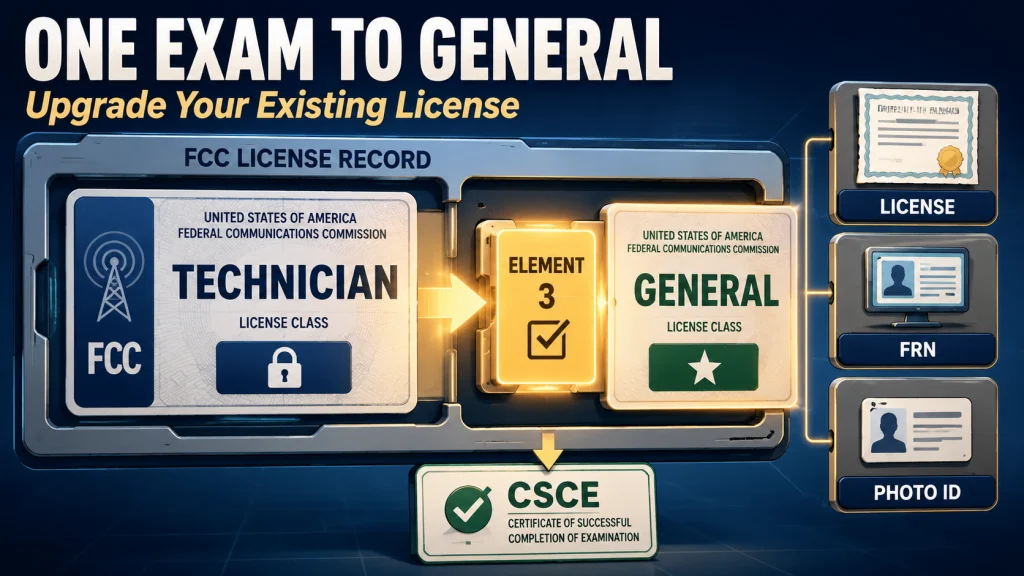
To upgrade from Technician to General, you pass the 35-question Element 3 exam at a Volunteer Examiner session; you do not retake the Technician exam. A current Technician license gives you credit for Element 2, so the practical process is to choose a session, confirm its policies, bring the correct identity and license information, pass with at least 26 correct answers, and keep the issued CSCE. An ordinary operator-class upgrade is exempt from the FCC’s $35 application fee, although the examining organization may charge a session or retest fee. This guide covers the mechanics of the upgrade, not whether General is the right choice for your operating goals or how to build a study plan.
How to Upgrade Your Ham Radio License From Technician to General
The complete process is shorter than many Technicians expect. You register for a VE exam session, show that you already hold Technician privileges, take Element 3, and receive a Certificate of Successful Completion of Examination if you pass. The VE team then sends the application through its coordinating organization for submission to the FCC.
You are not applying for an unrelated second license, and you are not starting the licensing sequence again. Your call sign and FCC Registration Number remain tied to your existing record. The upgrade changes the operator class attached to that record, which is why bringing accurate current-license information matters as much as bringing photo identification.
| Stage | What you do | What to verify |
|---|---|---|
| 1. Choose a session | Register for an in-person or remote VE session | Element 3 availability, deadline, fee, retest policy, and required documents |
| 2. Prove existing credit | Provide your call sign or acceptable Technician license documentation | Your FCC record is current and your name matches the registration |
| 3. Take Element 3 | Answer 35 multiple-choice questions | You need at least 26 correct answers |
| 4. Keep the CSCE | Retain the certificate issued after a passing result | Your name, call sign, exam element, date, and upgrade class are correct |
| 5. Confirm the update | Check the FCC license record after the application is processed | The operator class shows General and the contact information remains accurate |
This article assumes that you have already decided to pursue the upgrade. For the broader path through all three license classes, start with the guide to upgrading an amateur radio license. If you are still deciding whether the added HF privileges fit your situation, first review whether a General license is worth it.

This 10th edition is built for the General Class Element 3 exam used from July 2023 through June 2027. It includes the complete question pool, answer key, and explanations across rules, operating practices, electronics, antennas, propagation, and RF safety. The spiral-bound format also makes it practical to keep open while working through the upgrade material.
Check On AmazonIf you click this link and buy, we earn a commission at no additional cost to you.
Your Technician License Already Covers Element 2
A current Technician does not take the Technician exam again during a General upgrade. Element 2 is the examination requirement for Technician, and your existing license grant provides that credit. The only new written examination required for the ordinary Technician-to-General path is Element 3.
This distinction also changes what you need to prepare. You may encounter General questions that build on concepts introduced at Technician level, but the VE team will not hand you a second Element 2 examination unless your license status creates a special credit issue. You are testing for the next class, not proving the current class from the beginning.
Field Note: At an upgrade session, I treat the license record, FRN, and photo ID as three separate checks. The license record establishes existing examination credit, the FRN connects the application to the correct FCC account, and the photo ID verifies the person taking the exam. One item does not automatically replace the other two.
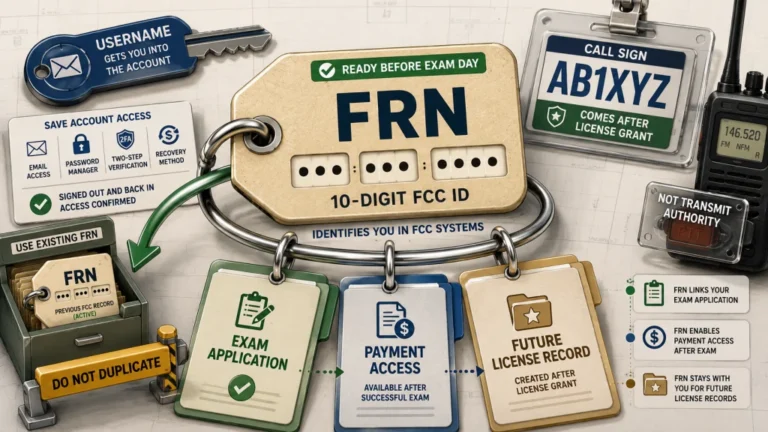
Use the same FRN associated with your Technician license. Creating a second FRN can complicate the record rather than make the application cleaner. Before registering, compare the name and call sign you enter with the information shown in the FCC database, then ask the exam team how it wants current-license proof presented.

This General Class preparation book focuses on FCC Element 3 for the 2023 through 2027 exam cycle. Gordon West uses explanations and exam-focused instruction to cover the material needed for the next license class rather than repeating the Technician test. The paperback contains 256 pages and is aimed specifically at candidates upgrading to General.
Check On AmazonIf you click this link and buy, we earn a commission at no additional cost to you.
Find a Session, Then Confirm Its Actual Rules
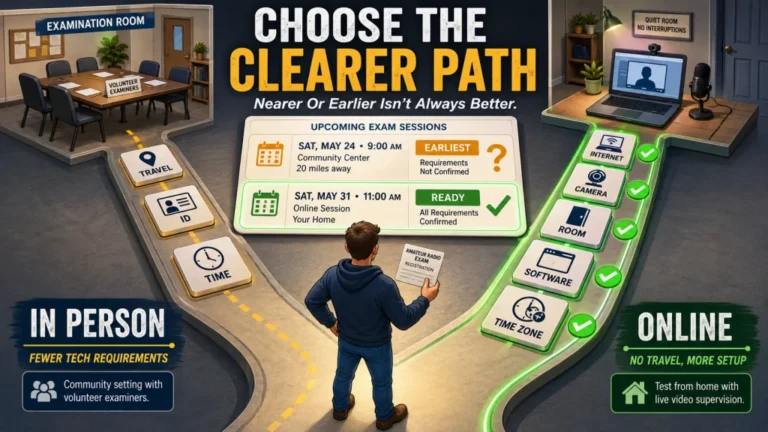
Exam listings are starting points, not complete promises about what will happen at the session. A listing may show a date, time, location, or remote format, but the team still controls registration deadlines, accepted payment methods, retest opportunities, accessibility arrangements, and the amount of time available for additional elements. Contact the named coordinator when any of those details are unclear.
Ask directly whether the session accepts Element 3 candidates. Most ordinary amateur exam sessions can administer the General examination, but you should not assume that a walk-in listing, a club event, or a tightly scheduled remote session can accommodate every request. A two-minute confirmation can prevent a long drive or a missed registration window.
- Is advance registration required, and when does it close?
- Is the session in person or remote, and what identification procedure is used?
- Does the team accept a current Technician seeking Element 3 credit?
- What session fee applies, and which payment methods are accepted?
- Can you retest the same day after a failed attempt, and is there another fee?
- Can the team offer another element if you finish early and qualify to continue?
Keep FCC fees separate from local exam charges. The FCC’s $35 application fee applies to new licenses, renewals, rule waivers, and vanity call sign requests, but an ordinary operator-class upgrade and a sequential call sign request are exempt. A VEC or exam team may still charge for administering the session, and that amount or retest policy is specific to the organization.
What to Bring to a General Upgrade Exam
The safest approach is to follow the specific team’s instructions rather than relying on a generic packing list. An in-person session may ask for printed material and a writing tool, while a remote team may require electronic uploads, a camera check, or a particular room setup. The core information, however, is consistent: identity, existing license credit, FRN, and a valid application record.
For a standard in-person General upgrade, prepare the following items unless the team gives different instructions:
- A government-issued photo ID, or an approved alternative if the team permits one
- Your current call sign and proof that you hold a Technician license
- The same FRN used for your existing amateur license
- A valid email address for FCC correspondence
- The required session-fee payment in an accepted form
- A pen and any pencils the team requests
- Any unexpired CSCE that provides examination credit not yet shown in the FCC record
Do not bring only a screenshot that omits the name, call sign, class, or status the team needs to verify. If you plan to use an electronic record, confirm that the team accepts it and that you can access it without relying on uncertain cellular service at the test location. Expired-license proof is a different case and may need to be submitted for processing rather than merely displayed.

This letter-size expanding organizer has 13 compartments for separating documents and small paper items before an exam session. Its accordion layout gives you dedicated space for license copies, registration paperwork, identification-related documents, and the CSCE you receive after passing. The black organizer is designed for document storage and uses a water-resistant construction for routine carrying.
Check On AmazonIf you click this link and buy, we earn a commission at no additional cost to you.
What the Technician-to-General Exam Contains
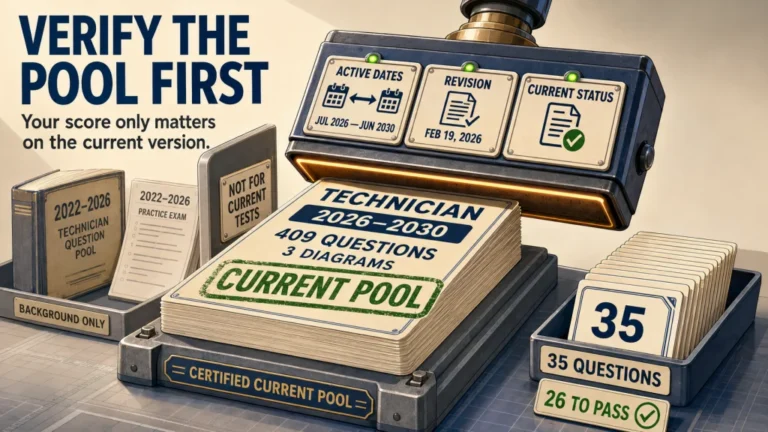
The General examination is Element 3. It contains 35 multiple-choice questions, and a score of 26 correct answers is passing. There is no Morse code examination, so the entire licensing requirement at this stage is the written element plus the application and identity checks handled by the VE team.
The current General question pool is the 2023-2027 Element 3 pool, valid through June 30, 2027. It covers additional FCC rules, HF operating practices, propagation, electrical and radio principles, equipment, signals, antennas, and safety. Because official pools can receive errata or withdrawn questions, use material that reflects the current pool rather than an old practice set saved years ago.
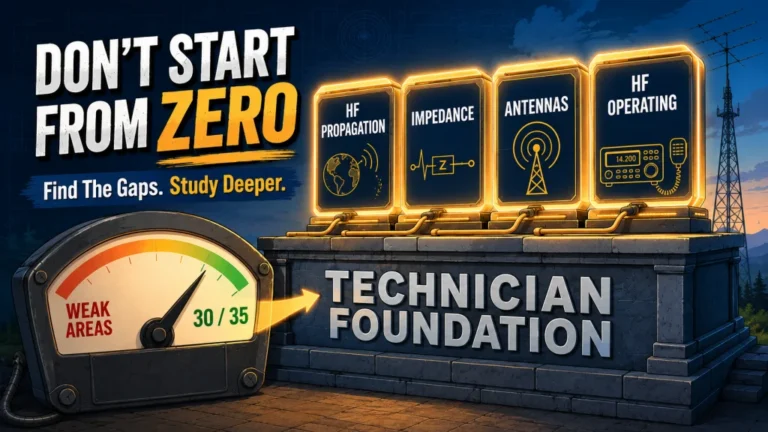
This process article does not prescribe a study schedule or course because the right method depends on your starting knowledge and available time. The practical exam-day point is simpler: verify that your materials are for the active Element 3 pool and that you can consistently clear the 26-correct threshold before booking a date you cannot easily change.

ARRL General Q&A presents the General Class question pool in a question-and-answer format with brief explanations. The 7th edition is intended for the 2023 through 2027 General exam cycle and gives candidates a focused way to review Element 3 topics. Its compact paperback format complements a full study manual when repeated question practice is the priority.
Check On AmazonIf you click this link and buy, we earn a commission at no additional cost to you.
What Happens Immediately After You Pass
After the exam is graded, the VE team completes the session paperwork and issues a CSCE showing the element you passed and the class earned. Check that document before leaving or ending the remote session. Your name, call sign, element credit, date, and result should match what actually happened.
The VEC processes the session package and submits the license modification for FCC action. Processing time can vary with the team, VEC workflow, weekends, holidays, application issues, and FCC systems, so a fixed promise such as “your upgrade will appear tomorrow” is not reliable. Keep the CSCE until the FCC record clearly shows General.
A currently licensed Technician who has properly submitted the upgrade application through the administering VEs and holds the CSCE may exercise General privileges temporarily under FCC rules. Until the FCC database displays the General upgrade, append the required /AG indicator to your call sign when using privileges that exceed Technician authority. This temporary authority ends when the FCC makes a final disposition on the application or 365 days after the examination, whichever comes first. On voice, the indicator is commonly spoken as “slash AG” or “stroke AG.”
Key point: Temporary General authority applies to a currently licensed operator upgrading an existing grant. It does not let a brand-new applicant transmit before the FCC issues the first call sign, and it does not restore operating authority to someone whose license has expired.
Once the FCC record shows General, the temporary indicator is no longer needed. Review the updated grant and verify the operator class, name, address, and email information. If something is wrong, contact the exam team or VEC first because it can identify whether the issue began in the session paperwork or later in the filing process.

This ARRL portable logbook is designed for recording amateur radio contacts away from a full station setup. It gives a newly upgraded operator a simple paper record for contacts made while beginning to use broader General Class privileges. The portable format is suited to field, travel, and temporary operating where a computer logging setup may not be convenient.
Check On AmazonIf you click this link and buy, we earn a commission at no additional cost to you.
Can Technician and General Be Taken on the Same Day?
Yes, sequential testing is possible. A candidate who does not yet hold Technician can pass Element 2 and then attempt Element 3 at the same session, provided the team has the time and its procedures allow another examination. The candidate does not need to wait for the first FCC license grant before taking the next written element.
That is different from the ordinary situation covered by this article, where an existing Technician arrives with Element 2 already credited. It is also different from assuming that every session guarantees unlimited attempts. Remote schedules, closing times, staffing, failed-element retest policies, and added fees can all affect whether another exam is offered.
The decision rule is practical: ask before the session, not after finishing the first test. If a team confirms sequential testing, register for the correct elements and bring every document it requests. Passing both elements in one sitting can shorten the examination path, but it does not change the rule that a first-time applicant must wait for the FCC to issue a call sign before transmitting.
Expired Licenses Follow a Different Element-Credit Path
A current Technician upgrading to General receives Element 2 credit with little complication. An expired license can produce a very different result, especially after the two-year renewal grace period. Do not register as though the current-license process automatically applies if the FCC record shows an expired or canceled grant.
Within the renewal grace period, the old grant may still provide examination credit, but the expired license itself does not authorize operation. Beyond the grace period, the FCC element-credit table depends on the class previously held and, for an old Technician license, when it was granted. The applicant must also provide acceptable proof of the former license at the session.
| Former license status | Typical examination credit | Practical consequence |
|---|---|---|
| Unexpired Technician, or Technician within the renewal grace period | Element 2 | Element 3 is the written examination needed for General, but an expired grant must be renewed or replaced before ordinary operation resumes |
| Technician granted on or after March 21, 1987, expired beyond the grace period | No element credit from the expired grant | Element 2 must be passed again before a new license can be issued |
| Technician granted before March 21, 1987, expired beyond the grace period | Element 3 | Pass Element 2 and document the old license to qualify for the appropriate new grant |
| General or Advanced expired beyond the grace period | Element 3 | Pass Element 2 and provide proof of the former higher-class license |
| Amateur Extra expired beyond the grace period | Elements 3 and 4 | Pass Element 2 and provide proof to return under a newly issued license |
This exception is where assumptions create the most trouble. A canceled call sign displayed in an archive is not the same as an active license, and a claimed former class is not enough without acceptable evidence. Send the team the license status and proof details before exam day so it can confirm what credit applies and what copies must be retained for VEC processing.
Final Thoughts: Treat the Upgrade as a Record Change With One New Exam
The cleanest way to approach an upgrade from Technician to General is to separate the process into three jobs. Prove the license and identity record, pass the single new examination element, then verify that the paper and FCC records match. Most avoidable problems occur when one of those jobs is assumed rather than checked.
I would not arrive at a session with only the confidence that my call sign can be found somewhere online. I would confirm the team’s instructions, use the existing FRN, carry clear Technician proof, know the fee and retest policy, and keep the CSCE after passing. For a wider explanation of how licensing, privileges, exams, and FCC records fit together, use the complete US ham radio license guide.
FAQs
📝 Do I have to retake the Technician exam to upgrade to General?
No. A current Technician license provides Element 2 credit, so the ordinary upgrade requires passing only the 35-question Element 3 exam. Expired licenses can follow different credit rules.
✅ How many questions do I need correct on the General exam?
You need at least 26 correct answers out of 35. Confirm that your practice material uses the active Element 3 pool and current errata.
💰 Does the FCC charge $35 for a Technician-to-General upgrade?
An ordinary operator-class upgrade is exempt from the FCC’s $35 application fee. The VE session may still have its own examination or retest fee.
📻 Can I use General privileges as soon as I pass?
A currently licensed Technician with a properly submitted upgrade application and valid CSCE may use temporary General privileges. Until the FCC database shows General, use the required /AG indicator when operating beyond Technician privileges.
🪪 Do I need a new FRN for the General upgrade?
No. Use the FRN already connected to your Technician license. Confirm that the name and other identifying information used for the exam match the FCC record.
⏱️ How long does the FCC take to post a General upgrade?
There is no reliable fixed time for every session. Submission timing, VEC processing, weekends, application issues, and FCC systems can change the interval, so retain the CSCE and monitor the official license record.