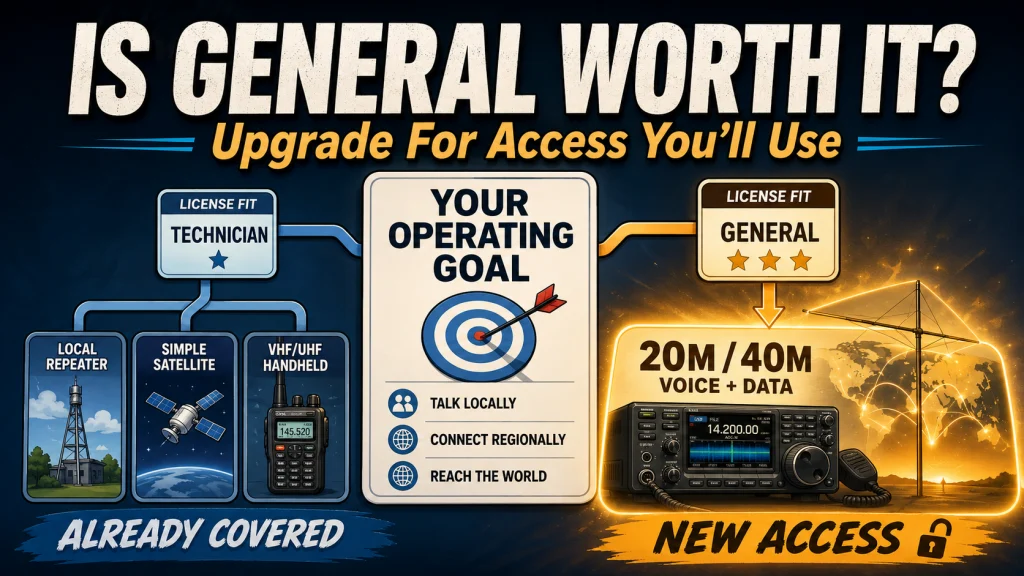
The General license is worth pursuing when you want broad HF voice and data access, especially on working bands such as 20 and 40 meters. It is not a required next step for operators who are satisfied with local VHF/UHF, repeaters, satellites, selected digital activities, or public-service work that stays within Technician privileges. The right decision depends on the contacts you want to make, the station you are prepared to build, and whether HF will become a regular part of your operating. This framework helps you decide based on use, not pressure to collect the next license class.
Is the Ham Radio General License Worth It for You?
Yes, if the operating you want to do requires broad HF voice or data privileges. No, if your real interests are already covered by Technician privileges and you have no practical plan for HF. Moving from Technician to General is worth it when the new frequencies solve a specific limitation, not because General is treated as the default next badge.
I use a simple test: name the contact, band, or activity you cannot legally do with your current license. “I want to use voice on 20 meters,” “I want FT8 access beyond 10 meters,” and “I want dependable choices for regional HF communication” are clear reasons. “I suppose General is what comes next” is not a reason yet.
This article is limited to that decision. It does not cover the upgrade procedure, exam-day paperwork, or study resources. The goal is to separate the real General license benefits from activities a Technician can already pursue without adding another exam.
What a Technician License Already Lets You Do
A Technician license is not a trial version of amateur radio. It provides full operating privileges at 50 MHz and above, which includes the bands most beginners use for local repeaters, simplex contacts, digital voice, packet and other data activity, and many amateur satellite contacts. A Technician can build a useful local station, participate in nets, support many community communication activities, and spend years learning without being blocked by license class.
The practical mistake is assuming that “more privileges” always means “more useful.” A General license does not make a weak local repeater path stronger, fix a poorly programmed handheld, or create activity on an empty channel. If your current goal is checking into a weekly two-meter net, improving your antenna position may change more than adding HF privileges.
Technicians also have limited HF access. They may use RTTY and data, including FT8, from 28.000 to 28.300 MHz on 10 meters, and phone from 28.300 to 28.500 MHz. They also have CW privileges on portions of 80, 40, and 15 meters. The common error is remembering that Technician includes FT8, then transmitting on 20 or 40 meters where Technician data privileges do not apply.
A Technician can reasonably stay at that level while focusing on:
- Local VHF/UHF repeaters and simplex communication.
- Digital voice systems that operate within authorized Technician bands.
- Amateur satellite contacts that fit the operator’s station and privileges.
- Public-service or emergency-support assignments conducted on local VHF/UHF systems.
- Learning programming, antennas, operating procedure, and station discipline before adding HF.
Those are complete operating paths, not placeholders. For a broader view of how the three license levels differ, start with understanding each ham radio license class, then return to the one question that matters here: which new privilege would you actually use?

The AnyTone AT-D878UVII Plus is a dual-band VHF/UHF handheld that supports both DMR digital and analog operation. It provides 4,000 channels and operates across the amateur VHF and UHF ranges used for repeater, simplex, and digital voice activity. APRS transmit and receive capability adds another practical path for operators who want to do more while staying focused on Technician-class VHF/UHF operating.
Check On AmazonIf you click this link and buy, we earn a commission at no additional cost to you.
What General Adds That Changes the Station
The major change is broad access to HF voice and data on the bands used for regional and international communication. General privileges include common operating space on 40 and 20 meters, plus substantial access across the other major HF bands. That gives you more choices when propagation, time of day, distance, and activity make one band better than another.
General is commonly described as opening about 83 percent of the amateur HF spectrum. The percentage is useful, but the practical value is more specific: you are no longer trying to make nearly every HF plan fit inside the Technician portions of 10 meters or CW-only segments on other bands. You can choose a band and mode that better match the contact you want to make.
| Operating goal | Technician position | What General changes |
|---|---|---|
| Local repeater communication | Already fully practical on common VHF/UHF bands | Usually little direct benefit |
| HF digital operation | RTTY and data limited to 28.000-28.300 MHz on 10 meters | Access to common data activity on major HF bands |
| HF voice | Limited phone privileges on 10 meters | Broad phone access on bands such as 20 and 40 meters |
| Regional communication without a repeater | Possible in selected conditions, but choices are limited | More bands for matching distance and time of day |
| International contacts | Possible on 10 meters when conditions cooperate | More frequent opportunities across multiple HF bands |
The table also shows what General does not add. It does not supply an antenna, reduce local noise, improve propagation, or create operating skill. The license opens legal access; the station and operator still have to make that access useful.

The Yaesu FT-891 is an HF and 50 MHz all-mode transceiver covering 1.8 to 54 MHz. It supports AM, FM, USB, LSB, and CW operation with up to 100 watts of output, giving a General-class operator practical access to the broader HF station choices described in this section. Its compact mobile or base format also works for operators building a smaller HF station.
Check On AmazonIf you click this link and buy, we earn a commission at no additional cost to you.
A Five-Question Decision Framework
The cleanest way to decide is to work backward from an operating plan. Do not begin with the exam, a radio purchase, or the idea that every serious operator must hold General. Begin with what you want to hear and transmit, then identify whether Technician privileges block that path.
Ask these five questions in order:
- Which contact do I want to make? Local repeater, regional HF, international voice, digital HF, or something else?
- Which band and mode normally support it? A goal that lives on two meters does not justify an HF upgrade by itself.
- Does my Technician license already authorize it? Check the exact frequency and emission type, not just the band name.
- Am I prepared for the station around the privilege? HF usually adds antenna space, feed line, power, grounding, noise control, and operating practice.
- Will I use it often enough to justify the effort? Curiosity is a valid reason, but it is different from an immediate operating need.
If the first three answers point to HF privileges you do not have, General is a functional upgrade. If the fourth answer is no, the license may still be worth earning now, but you should understand that the station project remains unfinished. If the fifth answer is no, there is no penalty for waiting.
Field Note: I have seen new licensees start planning the General exam while the handheld they already own still has no useful repeater programmed. Studying ahead is not a problem, but in that situation the next barrier to getting on the air is setup, not license class. Solving the actual barrier first usually produces faster progress.

The AURSINC NanoVNA-H4 is a portable vector network analyzer for checking antenna resonance, SWR, and other RF measurements. This version covers 9 kHz to 1.5 GHz and uses a 4-inch touchscreen, so it can support antenna and feed-line work across common amateur bands. The included hard case makes it practical for station setup or field use while you evaluate whether the hardware side of an HF project is ready.
Check On AmazonIf you click this link and buy, we earn a commission at no additional cost to you.
Who Should Upgrade to General
You should upgrade when broad HF access is part of the station you intend to use, not a distant possibility. The strongest candidates are Technicians who already listen to HF activity, have identified the bands and modes they want, or are planning a first complete HF station. In those cases, the license change removes a real operating restriction.
General is especially useful for operators who want regular HF voice, common digital activity on bands such as 20 and 40 meters, regional communication that does not depend on a local repeater, or more consistent opportunities for long-distance contacts. A Technician can make international contacts on 10 meters, but a General has more bands available when 10 meters is quiet or poorly matched to the desired path.
The upgrade also makes sense when an operator’s emergency or public-service role includes HF assignments. That condition matters. Many local teams work primarily on VHF/UHF, where Technician privileges may be enough, while other communication plans use HF for regional traffic. Upgrade for the assignment you are preparing to perform, not for a vague promise that HF is always better in an emergency.
Someone entering the hobby with a clear HF goal may also choose to pass Technician and General at the same exam session. If the intended station is built around 20-meter voice, 40-meter regional communication, or broad HF data access, stopping at Technician creates an unnecessary pause between licensing and the activity that motivated the effort.
Who Can Stay Technician Without Missing the Point
Stay Technician if your operating life is local and working well. A programmed handheld or mobile radio, a reachable repeater, a regular net, and a reliable antenna can provide more real use than an unused HF privilege. The license class should support the activity, not become a substitute for doing it.
Waiting also makes sense when you are still testing whether the hobby fits your time, space, or budget. HF often asks more of the station than VHF/UHF does. Antenna restrictions, indoor noise, limited property, portable setup time, and the cost of building a complete station can matter more than the exam itself.
A Technician focused on satellites, digital voice, local public service, outdoor simplex, or repeater communication is not operating below the hobby’s “real” level. Those activities have their own learning curves and can be technically demanding. General expands options, but it does not invalidate a focused Technician station.
Key point: Do not upgrade to escape a problem that General cannot solve. If the issue is poor antenna placement, no local activity, incorrect programming, or uncertainty about what to say on the air, fix that first.
The Fee and Timing Decision
A later operator-class upgrade is exempt from the FCC application fee. The current $35 FCC fee applies to new licenses, renewals, rule-waiver requests, and vanity call-sign requests, while an ordinary Technician-to-General upgrade does not trigger that fee. A VE team or VEC may still charge an exam-session fee, so the out-of-pocket cost depends on the session you choose.
That fee structure removes one common reason to rush. You do not save a separate $35 FCC upgrade charge by taking General immediately after Technician. Taking both exams in one session can still be efficient when you are prepared and already know you want HF, but delaying the General exam does not create an FCC application-fee penalty.
The timing rule I recommend is simple: upgrade close enough to your HF project that the privileges will be used. That could mean before buying or installing an HF station, before joining an HF operating activity, or after listening long enough to know which modes interest you. The exam is easier to justify when it connects to a real next step.
Once the decision is made, use the separate guide on how to upgrade from Technician to General. Keeping the decision and the procedure separate prevents paperwork details from hiding the more important question of whether the added privileges fit your plans.
Where Amateur Extra Fits Into the Decision
General already provides most of the practical HF access many operators want. Amateur Extra adds the remaining exclusive phone, CW, and data segments, which can be valuable when bands are crowded or when an operator wants every available frequency choice. Extra is a meaningful license, but it is not required to build a capable HF station.
The examination role also changes. After accreditation, a General-class VE may administer Technician examinations, while an Amateur Extra-class VE may administer examinations at every current license level, including Extra. That matters to operators who want to serve in that capacity, but it should not be used as a general reason that everyone needs the highest license.
For the Technician deciding what comes next, General is usually the larger functional jump because it opens broad HF voice and data access. Extra refines that access. Choose General when HF becomes part of your operating plan, then decide later whether the additional segments and examination privileges solve another specific need.
Final Thoughts: Upgrade for Access You Will Use
The honest answer is that a ham radio General upgrade is worth it for an operator who wants broad HF voice and data privileges, and optional for an operator whose goals remain inside Technician privileges. General can open 20-meter voice, common HF data activity, regional communication, and more choices for long-distance contacts. It cannot replace a workable antenna, a complete station, or regular operating practice.
Write down one contact or activity you want, identify the required band and mode, and check whether Technician already covers it. If General removes the legal barrier, move forward. If it does not, keep using the license you have and put the effort into the part of the station that is actually holding you back.
For the wider decision sequence, review deciding when to upgrade your ham license. The best upgrade is not the fastest one. It is the one that turns a defined operating plan into something you can legally and practically put on the air.
FAQs
📻 Do I need a General license to use local repeaters?
No. Technician privileges cover the common VHF/UHF bands used for local repeaters. General is useful only if your communication plan also requires HF privileges.
💻 Can a Technician use FT8 on HF?
Yes, but only within the Technician RTTY and data segment from 28.000 to 28.300 MHz on 10 meters. A Technician does not have FT8 privileges on 20 or 40 meters.
💰 Is there a $35 FCC fee to upgrade to General?
No. An ordinary operator-class upgrade is exempt from the FCC application fee. The exam session may still have a separate charge set by the VE team or VEC.
📝 Should I take Technician and General on the same day?
It can be sensible if you are prepared and already know that broad HF operation is your goal. There is no need to do it only to avoid a future FCC upgrade fee, because the class upgrade is exempt.
🌍 Is General enough for regular HF contacts?
For many operators, yes. General provides substantial voice and data access across the major HF bands, although Amateur Extra retains exclusive segments on several bands.
📡 Will a General license improve my radio range?
Not by itself. It authorizes more frequencies, especially on HF, but actual range still depends on the band, antenna, propagation, terrain, noise, power, and the station at the other end.