A ham radio vanity call sign lets an eligible licensee replace an automatically assigned call sign with a specific available choice. The change affects your on-air identity, not your operator class, frequency privileges, or license term. As of July 2026, a vanity request carries a $35 FCC application fee, and the result depends on eligibility, availability, competing applications, and the order of the choices you submit. The practical question is not only whether a call sign looks better, but whether it will be easier to use and worth the filing cost and record changes.

A Vanity Call Sign Changes Your Identifier, Not Your Privileges
A ham radio vanity call sign is a call sign you ask the FCC to assign in place of the one already shown on your license. You must already hold a current amateur license and call sign before filing. A newly licensed operator cannot make a vanity choice the first call sign issued with the new license.
The new identifier does not upgrade a Technician to General, add HF privileges, extend the license term, or change the station’s legal responsibilities. It replaces the current call sign on the same license record. That distinction matters because a short call can feel like an upgrade while changing nothing about what frequencies or modes the operator may use.
This article stays focused on choosing and requesting a vanity call. For renewal, contact-information changes, and other record tasks, use the guide to managing your FCC license record. For the larger structure behind license classes and privileges, start with how the amateur license system works.

ARRL's 10th Edition General Class License Manual is a 304-page study guide for upgrading a ham radio license. The book includes questions and answers for the General Class exam. It is useful beside this section because an actual class upgrade changes operating privileges, while a vanity call sign only changes the identifier.
Check On AmazonIf you click this link and buy, we earn a commission at no additional cost to you.
Your License Class Limits Which Call Sign Formats You Can Request
The FCC sorts call signs into Groups A, B, C, and D. For an ordinary request-by-list application, the requested call must come from a group assigned to the same or a lower operator class than the applicant holds. This is why a call that is valid and unassigned can still be unavailable to a particular operator.
For the mainland call areas, the practical class limits look like this:
| Current operator class | Eligible groups | Common mainland formats |
|---|---|---|
| Amateur Extra | A, B, C, and D | 1-by-2, 2-by-1, qualifying 2-by-2, 1-by-3, and 2-by-3 |
| Advanced, for existing licensees | B, C, and D | Qualifying 2-by-2, 1-by-3, and 2-by-3 |
| General or Technician | C and D | 1-by-3 and 2-by-3 |
| Novice, for existing licensees | D | 2-by-3 |
The numeral does not normally have to match the applicant’s mainland call area, so an operator who moved or who wants a number with personal meaning may have options outside the number in the current call. Special prefixes assigned to Alaska, Hawaii, Caribbean areas, and Pacific areas are different. Those region-specific calls usually require a mailing address in the corresponding area unless a qualifying close-relative exception applies.
Field Note: Format is a better first filter than memorability. A Technician who begins by searching scarce 1-by-2 calls can spend a long time researching choices the license class cannot receive. Confirm the eligible group first, then judge pronunciation, meaning, or length.

ARRL's 13th Edition Extra Class License Manual is a 416-page study guide for Amateur Extra licensing. The title identifies it as covering exam questions and the privileges granted to Amateur Radio operators. The manual is a useful class-focused reference when checking which vanity call-sign groups match an operator's current license.
Check On AmazonIf you click this link and buy, we earn a commission at no additional cost to you.
Regional Call Signs Require a Matching Mailing Address
Call signs designated for Alaska, Hawaii, Caribbean Insular Areas, and Pacific Insular Areas are not simply uncommon prefixes that any mainland operator may claim when one appears unassigned. For an ordinary vanity request, the FCC assigns one of those region-specific calls only when the primary or club station licensee’s mailing address is in the corresponding state, commonwealth, or island.
The address rule is based on the license record, not on where the operator happens to be traveling or operating temporarily. A vacation, portable activation, or seasonal visit does not create eligibility for a regional call. The close-relative exception for a deceased former holder can remove this geographic limitation, but the applicant must still meet the relationship and operator-class requirements that apply to the request.
Note: Do not change the FCC mailing address to a location that is not genuinely used for your mail just to pursue a regional call sign. Keep the license record accurate and treat regional eligibility as a threshold check before adding the call to a preference list.
An Unassigned Call Sign Is Not Automatically Available
A blank result in a current license search is only the first check. A call may still be inside a waiting period, tied to a pending application, reserved by its letter pattern, or restricted by license class or geographic rules. The FCC expects applicants to research both license records and pending application records before filing.
The ordinary rule is that a call sign shown on an expired, surrendered, or canceled grant remains unavailable to the general vanity system for two years. A former holder may qualify to request the previous call without waiting through that ordinary period. Cases involving a deceased former holder have additional timing rules tied to the death, expiration, and cancellation record, so the apparent release date should not be guessed from a single database field.
The close-relative exception is narrower than it sounds
A qualifying close relative of a deceased former holder may request that person’s call under the in-memoriam eligibility type without waiting for the ordinary two-year period. The recognized relationships include a spouse, child, grandchild, stepchild, parent, grandparent, stepparent, brother, sister, stepbrother, stepsister, aunt, uncle, niece, nephew, and specifically defined in-law relationships.
The everyday phrase “in-law” is broader than the FCC definition. An applicant should use the exact recognized relationship and should not assume that every extended family connection qualifies. The applicant must also hold the operator class required for the call-sign group being requested under this exception.
Key point: “Not currently assigned” answers only one availability question. Before paying for an application, confirm the call’s group, region, prior status, release timing, and pending applications.
The FCC Vanity Call Sign Fee Is $35 Per Application
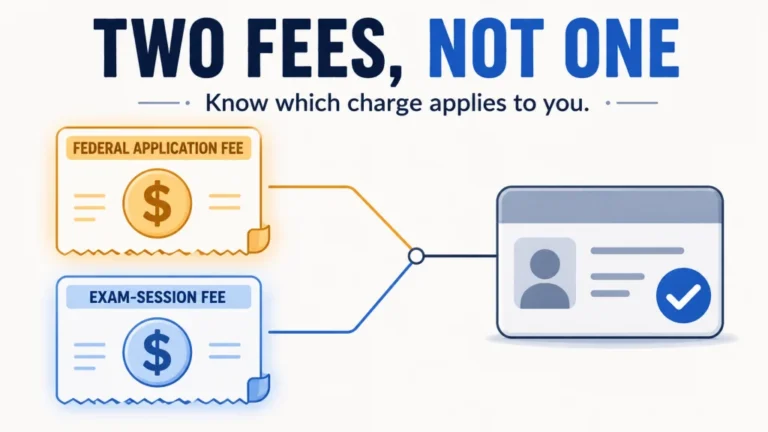
As of July 2026, the FCC application fee for an Amateur Radio Service vanity call sign is $35. The charge is per application, not per call listed. Placing several acceptable choices on one properly prepared request is therefore more efficient than repeatedly filing separate paid applications.
The vanity fee is paid directly to the FCC through its payment system after the application is submitted. It is not an exam-session charge and does not go to a Volunteer Examiner team. Follow the payment instructions and deadline attached to the filing, because an unpaid application can be dismissed rather than held indefinitely.
| Amateur filing | Current FCC application fee |
|---|---|
| New license | $35 |
| License renewal | $35 |
| Rule waiver request | $35 |
| Modification requesting a new vanity call sign | $35 |
| Ordinary operator-class upgrade | No FCC application fee |
| Administrative update or sequential call-sign request | No FCC application fee |
This fee difference creates a useful decision point. If the goal is merely to replace an awkward call with another automatically assigned call, a sequential request may solve the problem without the vanity fee. If the operator wants a particular combination of letters or a specific former call, the vanity application is the relevant path.
How to File a Vanity Call Sign Request Without Creating Avoidable Problems
The filing itself is not the difficult part. Most preventable failures occur before submission, when an applicant chooses an ineligible format, assumes a call is available, or ranks choices without thinking through what the FCC will assign. I recommend treating the application as a short verification project rather than a form to complete impulsively.
- Confirm the current license: The license must be active, and the name and contact information should be accurate before the request is filed.
- Select the correct eligibility type: Use request by list for ordinary choices, former holder for a call previously assigned to you, or the close-relative option for an eligible deceased former holder.
- Research every candidate: Check the FCC license and application records, the call-sign group, geographic restrictions, and any waiting period.
- Rank up to 25 exact calls: Put only calls you would genuinely accept in the order you prefer them. The FCC will not interpret a general request such as “any call with my initials.”
- File through FCC License Manager: Use the vanity-call-sign request associated with the current amateur license and retain the application file number.
- Pay through CORES when directed: Complete the $35 payment within the deadline shown for the application.
- Monitor the pending record: Do not treat submission or payment as a grant. Continue using the current call until the new one appears as granted in FCC data.
The ordering of the list deserves more attention than it usually gets. If the first choice becomes assignable, the FCC stops there and grants it. Do not use a “backup” call in position two unless you would be satisfied to receive it, because the system does not pause and ask whether you still prefer to wait for the first call.
Warning: Filing several vanity applications on the same receipt day does not create extra chances. The FCC processes only the first application from that applicant entered into ULS for that receipt date, and later same-day vanity applications from the same applicant are not accepted.
Competing Applications Are Not Decided by Who Clicks First
Desirable short calls often attract several eligible applications on the first date they can be requested. Vanity applications are processed in receipt-date order. When eligible applicants in the same receipt-date batch compete for the same call, the system uses random selection within that batch rather than awarding it to the person who submitted earliest that morning.
Calling the process a simple lottery still leaves out an important part. Each applicant may list multiple calls in a specific order, and the FCC evaluates the first assignable choice on each list. An applicant selected for a higher-ranked call may no longer compete for a lower-ranked one, while another applicant’s first choice may already have become unavailable. The interaction among preference lists can change the final result.
There are three practical consequences:
- File on the correct first eligible date when pursuing a highly competitive call, but do not assume the earliest timestamp wins.
- Use the preference order strategically, because every listed call can affect which request remains in conflict.
- Do not amend a pending application casually, because a significant amendment may change the filing date used in processing.
A clean application with several acceptable choices is often a better strategy than staking the entire $35 fee on one scarce call. That does not guarantee a grant, but it gives the FCC more eligible choices to work through without assigning something the applicant never wanted.
Is a Vanity Call Sign Worth the Cost?
A vanity call is worth considering when it solves an operating problem or carries meaning you expect to keep. It may be easier to pronounce through noise, shorter to send in CW, quicker during contests, or more memorable to operators who hear it once. A former call or a deceased relative’s call can also carry personal significance that has nothing to do with technical efficiency.
The benefit is smaller when the attraction is only novelty. A new identifier requires updates to logging software, digital-mode profiles, QSL accounts, club records, email signatures, printed materials, and any service tied to the old call. Operators who already have years of contacts under one identity may also spend time correcting people who continue to recognize the old call.
| Reason for changing | When the benefit is real | When keeping the current call may be better |
|---|---|---|
| Easier voice identification | The new call is clearly easier to hear, pronounce, and copy with phonetics | The current call is already familiar and rarely causes repeats |
| Shorter CW or contest exchange | The operator regularly uses modes where fewer characters save time | The operator mainly uses casual local voice and gains little from length |
| Personal or family meaning | The letters or former call have lasting significance | The choice is a temporary joke or preference likely to wear off |
| Consistent public identity | The call will be used across nets, events, logs, and community work | The operator does not want to update existing records and profiles |
I would pay the fee only after saying the candidate call aloud, spelling it phonetically, and writing it as another operator would copy it. A visually clever call can be unpleasant over a weak signal. The best custom call sign is not necessarily the shortest one; it is the one that remains clear and useful in the operating situations that matter to you.
What to Update After the New Call Sign Is Granted
The FCC grant changes the legal call sign on the license, but it does not automatically update every outside account or local record that used the old identifier. Once the new call appears as granted, begin using it on the air and work through a short identity checklist rather than waiting for mismatches to appear during a net, digital contact, award submission, or account login.
- Station and logging software: Change the default station call for new contacts while preserving the call actually used on older log entries.
- Digital-mode and digital-voice profiles: Update any stored call-sign field, identity record, or authentication account connected to on-air operation.
- QSL and award services: Add or link the new call as the service allows, and keep the old call associated with contacts made before the grant.
- Club, net, and volunteer rosters: Tell the record keeper which call is current so check-ins and participation records do not split between two identities.
- Public contact material: Update email signatures, labels, printed cards, personal pages, and any directory profile that operators use to find you.
Third-party databases may take time to reflect a new FCC grant, so a delayed update outside ULS does not by itself mean the vanity application failed. Use the FCC license record as the controlling status, keep the grant date in your records, and avoid rewriting historical contacts as though the new call had been used before it was issued.

This paperback station logbook provides more than 400 QSO entry cards. It includes NATO phonetic alphabet, R-S-T reporting, and Q-code reference material. Its paper format gives an operator a separate place to record new contacts after a call-sign change without altering older log entries.
Check On AmazonIf you click this link and buy, we earn a commission at no additional cost to you.
Run This Final Check Before You Submit
A five-minute review can prevent a paid application from failing for a basic reason. It also prevents the opposite problem, receiving a lower-ranked call that was included casually and then discovering that you do not want to use it.
Before submitting, verify all of the following:
- Your current amateur license is active.
- The requested format is allowed for your operator class and region.
- The call is not assigned, reserved, inside a waiting period, or blocked by a pending application.
- You selected the correct request type.
- Every call on the list is one you are willing to receive.
- The preference order reflects your real priorities.
- You can access the email and CORES account needed to complete payment.
- You will continue using the old call until the new grant appears.
Keep the application file number and check the pending record rather than relying on memory or an informal availability site. Third-party tools can help organize research, but the FCC license and application records control the actual filing outcome.
Final Thoughts: Choose a Call You Will Still Want Years From Now
A vanity call sign can make everyday operating smoother, especially when it is easier to copy or has lasting personal meaning. It is still an administrative change, not a new license level, and the $35 fee buys an application rather than a guaranteed result.
The strongest approach is to start with eligibility, verify real availability, rank only acceptable choices, and wait for the grant before using the new identifier. If the current call already works well and no alternative offers a practical or lasting benefit, keeping it is a perfectly good decision.
FAQs
📻 Can a Technician get a vanity call sign?
Yes. A Technician may request eligible Group C or Group D calls, commonly 1-by-3 or 2-by-3 formats in the mainland call areas. Technician operators cannot receive ordinary Group A or Group B vanity choices.
🔤 Can I request a 1-by-2 or 2-by-1 call sign?
Those short formats are generally Group A choices for Amateur Extra operators. The call must also be valid, assignable, and available when the FCC processes the application.
💰 Is the $35 fee refunded if I do not get my first choice?
The $35 is an application fee, not a purchase price for one specific call. List only choices you would accept and assume the fee covers processing rather than guaranteeing a preferred result.
⏳ How long does a vanity call sign take?
Expect a multi-week process rather than an immediate change. Payment timing, application defects, release dates, competing requests, and FCC processing can affect the result, so monitor the application instead of relying on a guaranteed number of days.
👪 Can I request the call sign of a deceased relative?
A qualifying close relative may use the in-memoriam request type and may be exempt from the ordinary waiting period. The relationship and operator-class requirements must match the FCC rules, and the deceased holder’s license record must be in the proper status.
✅ When can I start using the new call sign?
Use it only after the FCC shows the vanity call as granted. Until then, continue identifying with the call sign currently shown on your active license.
↩️ What happens if none of my choices can be assigned?
Your existing call sign remains on the license when none of the listed choices is assignable. A later attempt requires a new application and, when applicable, another fee.
🌎 Can I request an Alaska or Hawaii call sign if I live on the mainland?
Not through an ordinary request unless the mailing address on the primary or club station license is in the corresponding region. A qualifying close-relative request for a deceased former holder is an exception, but the class and relationship rules still apply.
🗂️ What records should I update after the vanity call is granted?
Update the station identity used for future logs, digital services, QSL accounts, club rosters, and public contact material. Keep the old call attached to contacts made before the grant rather than changing historical records to the new identifier.