The current FCC application fee for a new amateur radio license is $35, but that is not the same charge as an exam-session fee. A Volunteer Examiner team may charge separately for administering the test, while some teams offer exams at no cost. Ordinary General and Amateur Extra upgrades do not trigger another FCC fee, but renewals and vanity call sign requests do. This guide separates every common charge so you can tell what is mandatory, what varies by exam provider, and what you may never need to pay.

A Ham Radio License Can Involve Two Separate Charges
The ham radio license cost starts with one distinction that older articles and exam announcements often blur. The FCC charges for certain license applications, while a Volunteer Examiner Coordinator or local exam team may charge for administering the examination. The FCC does not collect the exam-session charge, and the VE team does not collect the $35 FCC application fee.
For a new adult applicant, add the exam provider’s amount to the FCC charge only after confirming the session policy. That keeps a local administration charge from being mistaken for a universal government exam fee.
This article covers only FCC application fees and examination-administration charges. It does not include study materials, radios, antennas, accessories, travel, or other costs of participating in the hobby. For the larger licensing process, including keeping the authorization current, use the guide to managing an amateur radio license.
Field note: The FRN question comes up at almost every session I run. Candidates sometimes assume passing the exam means the call sign is already active, but the application still has to reach the FCC and the required new-license fee has to be paid before the license can be granted.
The Current FCC Ham Radio License Fee Table
The FCC fee schedule checked on July 24, 2026 lists a $35 charge for the common paid filings in the Amateur Radio Service. The fee is assessed per application, not per exam element and not per requested vanity call sign listed inside one application.
The table below separates ordinary license events from changes that current FCC guidance treats as fee-exempt. This distinction matters because the general wireless fee table uses broad terms such as modification, while amateur-specific guidance identifies several common modifications that do not carry the charge.
| License action | Current FCC fee | What the charge means |
|---|---|---|
| New amateur license | $35 | Paid after the successful exam application reaches the FCC |
| License renewal | $35 | Paid per renewal application; no new exam is required in the normal process |
| New vanity call sign request | $35 | Paid per application, whether one or several preferred calls are listed |
| Rule waiver request | $35 | A rare filing outside the normal path for most individual operators |
| Special temporary authority | $35 | Another uncommon filing, not part of a normal beginner license application |
| Technician to General upgrade | $0 | The exam provider may still charge an exam-session fee |
| General to Amateur Extra upgrade | $0 | The exam provider may still charge an exam-session fee |
| Sequential call sign request | $0 | A sequentially issued call is not treated as a paid vanity request |
| Name, mailing address, or email update | $0 | Administrative updates are fee-exempt |
| License cancellation | $0 | No FCC application charge |
The practical rule is simple: do not assume every change to a license costs $35. Identify the exact filing purpose first, because a vanity request and a sequential call sign request may both change the call sign while producing different fee results.
What a New Technician License Costs
A new Technician applicant pays the FCC $35 only after passing the exam and after the VEC submits the successful application. The payment goes directly through the FCC’s CORES system. It is not normally collected at the exam table and should not be handed to an examiner as part of the test charge.
The payment notice is tied to the application file number, and the applicant has 10 calendar days to complete payment. Log in to CORES to retrieve a payment awaiting completion, then use the file number or FRN to follow the application in ULS. The status may show that the application is pending, dismissed, or granted, which is more useful than relying only on an email message.
If the deadline is missed, do not try to revive the dismissed application with a late payment. Contact the coordinating VEC shown on the CSCE and ask whether it can refile the successful exam application before the CSCE expires. The candidate normally does not retest, and the refiled application starts a new 10-day payment window.
Do not transmit yet: Passing the test and paying the fee are not the same as receiving the license grant. Wait until the new license and call sign appear in the FCC database before transmitting under that authorization.

ARRL's 6th Edition Technician manual is a study guide with the question pool for the Technician Class amateur radio exam. Amazon lists the English-language book at 256 pages. The ARRL-published edition has a June 1, 2026 publication date.
Check On AmazonIf you click this link and buy, we earn a commission at no additional cost to you.
Exam-Session Fees Vary by VEC and Team
Federal rules allow examination organizations to recover certain costs associated with preparing, processing, administering, or coordinating an exam. That does not create one national government exam fee. Each candidate needs to verify the VEC, team policy, amount, payment method, retest policy, and whether the fee covers more than one exam element during the same session.
For 2026, ARRL VEC lists a $15 exam fee for adult candidates. That payment covers one attempt at each of the three exam elements during the session, while another attempt at the same failed element requires another fee. Other VECs and local teams may use different amounts or different retest rules.
Laurel VEC teams provide a useful no-fee option. Their stated policy is that coordinated teams do not charge for examinations or licensing services. Availability is still location and schedule dependent, so do not assume a free session will be offered nearby or on the date you need.
- Confirm which VEC coordinates the session.
- Ask for the exact exam charge before registering.
- Check whether the amount covers multiple license elements that day.
- Check whether a same-element retest requires another payment.
- Verify whether the session is in person or remote and whether any local requirements apply.
- Remember that a free exam does not remove the $35 FCC charge for a new adult license.
This checklist prevents the common mistake of comparing two sessions by price alone when one includes several element attempts and the other has a different retest policy.

ARRL's Tech Q&A 9th Edition is a Technician Class exam-preparation book designed as a quick path to a first amateur radio license. Amazon lists the English-language book at 184 pages. ARRL published this edition on June 1, 2025.
Check On AmazonIf you click this link and buy, we earn a commission at no additional cost to you.
General and Amateur Extra Upgrades Have No FCC Application Fee
An ordinary operator-class upgrade from Technician to General or from General to Amateur Extra is exempt from the $35 FCC fee. The upgrade changes operating privileges under the existing license rather than creating a new individual license. This is why a candidate may pass General, see the upgrade granted, and never receive an FCC payment notice.
The exam organization may still apply its normal session and retest policy. Confirm that amount with the provider, but keep it separate from the FCC portion, which remains zero for an ordinary class upgrade.
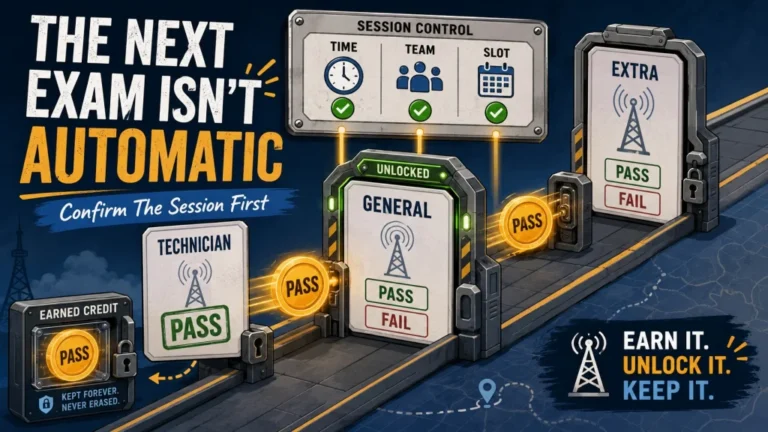
If a new candidate passes Technician and then passes General or Amateur Extra during the same exam session, the FCC still processes a new-license application and charges one $35 new-license fee. It does not charge $35 for each class earned that day. The session provider’s rules determine whether the original examination payment covers the additional elements.
Key point: License class and fee category are separate questions. A higher class does not automatically create a new FCC charge, but taking another exam can create another VEC or team charge.

ARRL's 10th Edition General Class License Manual is a study guide with questions and answers for upgrading an amateur radio license. Amazon lists the English-language book at 304 pages. The ARRL-published edition has a May 15, 2023 publication date.
Check On AmazonIf you click this link and buy, we earn a commission at no additional cost to you.
Current Youth Discounts and Reimbursement Rules
The ARRL Youth Licensing Grant Program currently applies to candidates younger than 18 who test through an ARRL VEC team. The 2026 youth exam fee is $5, regardless of the exam level taken. Proof of age is required at the session.
For a new license, the applicant or payer must still pay the $35 FCC charge through CORES within the payment window. After the license is issued, the reimbursement form is submitted to ARRL VEC, which reimburses the one-time new-license application fee under the program’s terms. This is reimbursement after payment and grant, not an automatic FCC exemption at checkout.
The reimbursement applies to the initial new license, not every future FCC filing. A later vanity request or renewal remains a separate paid application unless another active program covers it. Ordinary class upgrades already have no FCC fee, although the ARRL youth exam charge remains $5 while the candidate is eligible.
Check before registering: Youth programs belong to the sponsoring organization, not to every exam team. Confirm the candidate’s age eligibility, VEC affiliation, current forms, required proof, and reimbursement steps before choosing the session.
License Renewal Costs $35 and Does Not Require Another Exam
An amateur license is normally granted for a 10-year term. Renewing it through the normal process costs $35, and the operator does not retake the Technician, General, or Amateur Extra examination merely because the license is approaching expiration.
The renewal filing is separate from an address or email update. Changing contact information alone is free, but combining that need with a renewal does not make the renewal free. The filing purpose controls the fee.
A license can generally be renewed during the final 90 days before expiration and during the two-year filing grace period afterward. The grace period preserves the opportunity to file, not transmitting authority after expiration. That timing and the account-access steps are covered in more detail in understanding the US ham radio license.
The safest cost plan is to treat $35 every 10 years as the ordinary FCC renewal expense and keep CORES access and the license email address current. Waiting until the account credentials are forgotten turns a small fee into a larger administrative problem.
Vanity and Sequential Call Sign Requests Do Not Cost the Same
A modification requesting a new vanity call sign carries a $35 FCC fee. The charge is per application, so listing several acceptable call signs in ranked order within one properly filed request does not create a separate $35 charge for every choice.
The fee pays for processing the application, not for guaranteeing that the preferred call will be assigned. Eligibility, availability, competing applications, and the FCC selection process can still prevent the requested call from being granted. File only when the possible result is worth the application charge.
A sequential call sign request is different. It asks the FCC to issue the next available call under the sequential system and is currently fee-exempt. A candidate who receives a call sign after an upgrade through that process should not confuse it with a paid vanity request.
Decision rule: Pay the vanity fee only when you are deliberately requesting a chosen call sign. Use the sequential process when any normally issued call sign is acceptable.
Administrative Updates That Do Not Trigger the FCC Fee
Name, mailing address, and email changes are administrative updates and currently carry no FCC application fee. License cancellation is also fee-exempt. These changes still need to be filed correctly, but there is no reason to delay an address or email update because of a nonexistent $35 charge.
An operator-class upgrade and a sequential call sign request are also exempt under current amateur guidance. These actions may produce a modified license record, but they are not treated like a paid vanity request or renewal.
The edge case is a filing that combines several purposes. If the application includes a paid action, such as renewal or a new vanity call sign request, expect the $35 charge even when the same filing also updates an address. Check the application purpose before submitting instead of assuming the free component controls the whole transaction.
That small review is worthwhile because the FCC fee is assessed per application. Submitting the wrong purpose can create delay, dismissal, or another filing rather than saving time.
Ten-Year Cost Examples Without Double Counting
There is no single lifetime price because candidates choose different exam providers and not every operator upgrades, requests a vanity call, or renews on the same timeline. The examples below use current 2026 charges and show each optional event separately.
| Example path | FCC charges | Exam charges assumed | Illustrative total |
|---|---|---|---|
| Adult Technician through a free Laurel VEC session | $35 new license | $0 | $35 |
| Adult Technician through an ARRL VEC session | $35 new license | $15 | $50 |
| Technician, later General at an ARRL VEC session | $35 new license, $0 upgrade | $15 for each of two sessions | $65 before renewal |
| New license plus later vanity request | $35 new license, $35 vanity | Depends on original exam session | $70 plus exam charge |
| New license and one renewal after 10 years | $35 new license, $35 renewal | Depends on original exam session | $70 plus exam charge |
| Under-18 ARRL VEC new license after reimbursement | $35 paid, then reimbursed under current terms | $5 | $5 net after reimbursement |
Do not add the vanity and upgrade lines to every estimate. A licensee who keeps the assigned call sign and never upgrades does not pay those optional costs. The most useful budget separates required events from choices.

Gordon West's 11th Edition book prepares readers for the General Class FCC Element 3 amateur radio exam. The title identifies its coverage for the 2023–2027 examination period. It is focused specifically on General Class license preparation.
Check On AmazonIf you click this link and buy, we earn a commission at no additional cost to you.
Why Some Older Guides Say the License Is Free
The $35 amateur application charge became effective on April 19, 2022. Before that date, the FCC did not collect the current application fee for an ordinary new individual amateur license. Older articles, videos, club pages, and forum answers may therefore describe the federal license itself as free.
Some of those pages are historically accurate but no longer useful for current budgeting. Others mix the old FCC policy with a modern VE exam charge and end up presenting one incomplete number. Check the publication date and identify whether the writer is discussing the FCC, the exam provider, or both.
The same warning applies in the future because application fees and VEC schedules can change. The figures in this article were checked on July 24, 2026, and should be rechecked against current FCC and exam-provider information immediately before publication or registration.
This date check is more reliable than trusting a search snippet that says “free” or shows one unexplained amount without identifying which organization receives it.

ARRL's 13th Edition Extra Class License Manual is a complete study guide for the Amateur Extra exam. The title states that it includes exam questions and covers privileges granted to Amateur Radio operators. This edition is published by ARRL for Extra Class license preparation.
Check On AmazonIf you click this link and buy, we earn a commission at no additional cost to you.
Use This Payment Plan Before Your Exam
The simplest way to avoid fee surprises is to decide the payment path before exam day. You do not need to predict every future vanity or upgrade choice, but you should know the session charge, the $35 new-license requirement, and who will send the next instruction.
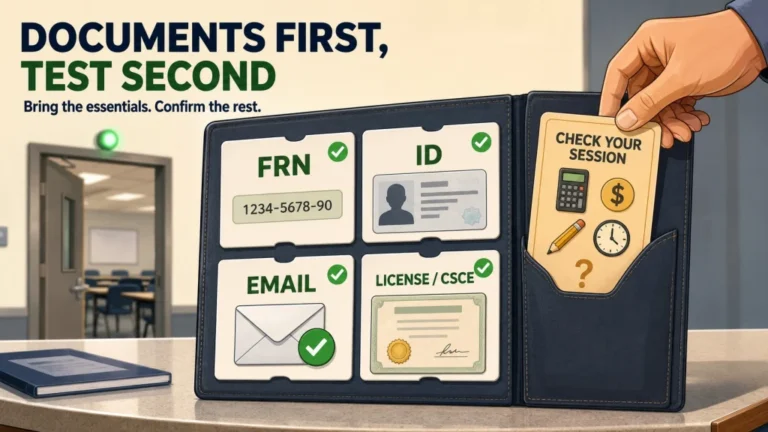
- Create and secure the required FCC Username and FRN before the exam.
- Confirm the exam provider, session fee, retest policy, and accepted payment method.
- Pass the required exam element or elements.
- Watch for the FCC payment notice after the successful application is submitted.
- Retrieve and pay the new-license fee through CORES within 10 calendar days.
- Use the application file number or FRN to check progress in ULS.
- If the filing is dismissed for nonpayment, contact the coordinating VEC about refiling before the CSCE expires.
- Wait for the license grant and call sign before transmitting.
- Save the receipt and keep account access current for future renewals or vanity requests.
That sequence keeps the exam fee, FCC payment, and license grant in the correct order. It also answers the practical version of “how much does a ham radio license cost?” before the candidate reaches the checkout screen.

Gordon West's 9th Edition book is an Amateur Radio license-preparation guide for FCC Element 4. The title identifies coverage for the 2024–2028 Extra Class exam period. It is focused specifically on Extra Class licensing preparation.
Check On AmazonIf you click this link and buy, we earn a commission at no additional cost to you.
Final Thoughts: Pay Only for the Filing You Are Making
For most adult beginners, the required federal cost is $35 for the new license, plus whatever the chosen exam session charges. A later General or Amateur Extra upgrade has no FCC fee, while a renewal or vanity request costs another $35 when that event occurs. Free exam sessions and the current ARRL youth program can reduce the out-of-pocket total, but their eligibility and availability must be checked before registration.
I tell candidates to separate the process into three questions: Who is charging me, what application am I filing, and is this event required or optional? Once those answers are clear, the fee system becomes much less confusing, and you avoid paying attention to numbers that do not apply to your license path.

Ham Radio For Dummies is an amateur-radio reference published by For Dummies. Amazon lists the 4th Edition as an English-language book with 448 pages. The edition was published on April 20, 2021.
Check On AmazonIf you click this link and buy, we earn a commission at no additional cost to you.
FAQs
💰 How much does a ham radio license cost in 2026?
A new license requires a $35 FCC application fee. Add the separate amount charged by the chosen exam provider, which may be free or fee-based.
📝 Do I pay the $35 fee before taking the Technician exam?
No. The new-license payment is made directly to the FCC after you pass and the successful application is submitted. The exam provider may collect its separate session fee before or during the test.
⬆️ Is there an FCC fee to upgrade to General or Amateur Extra?
No. Ordinary operator-class upgrades are exempt from the FCC application fee. The VEC or exam team may still charge for administering the upgrade exam.
🔁 How much does ham radio license renewal cost?
The current FCC renewal fee is $35 per application. A normal renewal does not require another license exam.
🔤 Does a vanity call sign cost money?
Yes. A new vanity call sign request currently costs $35 per application. The fee does not guarantee that a preferred call sign will be assigned.
📬 Does changing my address cost $35?
No. Name, mailing address, and email updates are currently fee-exempt. A separate renewal or vanity action in the filing can still trigger the paid application fee.
🆓 Can I take the ham radio exam for free?
Some sessions are free. Laurel VEC teams state that they do not charge examination fees, but local availability varies and a new adult license still requires the $35 FCC payment.
🧒 Is the FCC fee waived for applicants under 18?
Under the current ARRL VEC youth program, the $35 new-license fee is paid to the FCC first and reimbursed after the license is issued and the required form is submitted. Eligible youth also pay a reduced $5 ARRL VEC exam fee.