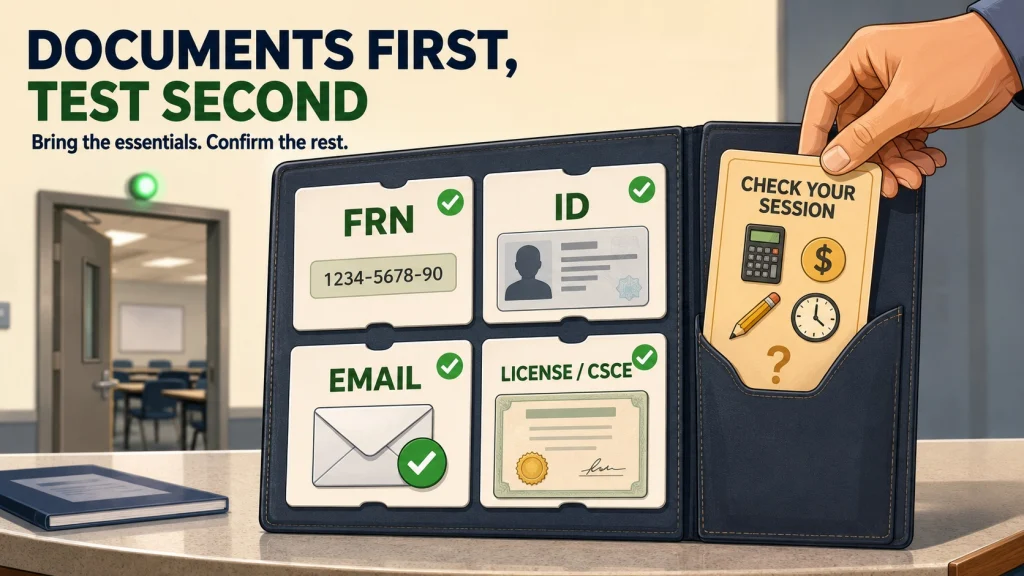
Bring your FCC Registration Number, accepted identification, a valid email address, and any current license or CSCE needed to claim exam credit. Everything else, including pencils, calculators, payment method, printed copies, minor-applicant documents, and whether you may take another element the same day, depends on the instructions from the specific VEC and exam team. The Technician and General exams each contain 35 questions, and you need 26 correct answers to pass. After a first-license pass, watch for the FCC payment notice and wait until your call sign appears in ULS before transmitting.
What to Bring to a Ham Radio Exam
Walking into a ham radio exam session without the right documents can delay your test or force you to reschedule. The basic list is short, but the details matter: bring your FRN, acceptable identification, the email address tied to your application, and proof of any license or examination credit you want the team to recognize. Then follow the exact registration message from the team for everything that varies locally.
I tell candidates to separate exam-day preparation into two columns. One column contains the identity and licensing information the team needs to process an application. The other contains session logistics, such as the fee, calculator policy, writing tools, arrival time, parking instructions, and whether the team uses paper or tablets.
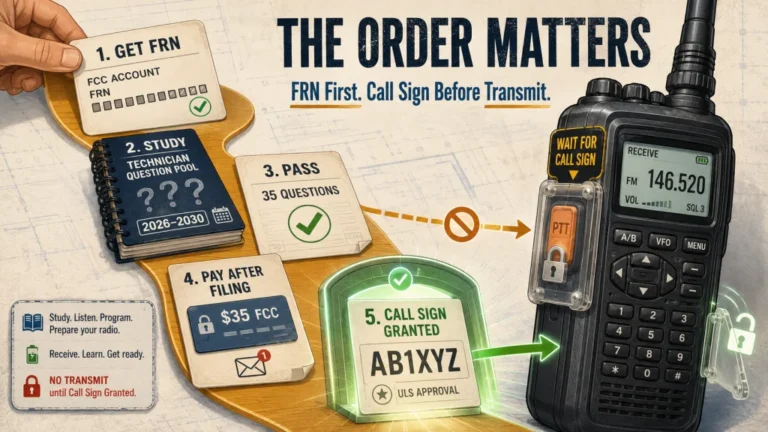
Field Note: The FRN question comes up at exam sessions because candidates sometimes assume the call sign is issued the moment they pass. Passing is the examination result. The VEC still has to submit the application, the FCC may require payment, and a first-time applicant must wait for the license and call sign to appear in the FCC database before transmitting.
This article is limited to the day-of checklist and what happens at the session. It does not cover studying or choosing a test location. For the process before and after exam day, use the complete Technician license process.
Separate Universal Requirements From Session-Specific Instructions
The safest checklist begins with the items that apply broadly, then adds the instructions from the team running your particular session. A candidate testing through one VEC should not assume that another VEC uses the same fee, payment method, registration platform, retest policy, or paper requirements. Even two teams coordinated by the same VEC may use different locations and testing equipment.
Read every confirmation email and registration page again the day before the exam. If the team’s instructions conflict with a generic checklist, contact the team before showing up. The session administrator is the correct source for arrival time, accepted payment, local identification procedure, accessibility arrangements, and any documents the team wants printed.
| Item | Usually required or essential | What can vary by session |
|---|---|---|
| FCC Registration Number | Needed on the license application | Whether the team can help resolve an FRN problem on site |
| Identification | Accepted proof of identity is required | Which combinations of photo and non-photo documents the team accepts |
| Valid email address | Needed for FCC correspondence and application processing | Whether it must match an account used by the team’s registration system |
| Existing license or CSCE | Needed when claiming current status or element credit | Whether a screen display is accepted or a printed copy is requested |
| Exam-session fee | Bring the amount required by the listed VEC or team | Amount, payment method, youth rate, retest charge, or whether the session is free |
| Calculator | Often allowed when cleared of stored formulas and notes | Approved device types and whether a phone calculator is prohibited |
| Pencil and pen | Useful for paper sessions and forms | Whether the team supplies them or uses a fully digital process |
| Minor-applicant documents | May be needed to establish identity or age | Guardian presence, consent procedure, and acceptable supporting documents |
The distinction prevents two common mistakes. The first is arriving with a generic list but ignoring a team-specific requirement. The second is treating a local practice, such as cash-only payment or mandatory pre-registration, as though it applies to every exam session in the United States.
Key point: Your registration confirmation is part of the checklist. Save it where you can open it without relying on a weak signal at the exam site.

These Ticonderoga wood-cased pencils use #2 HB soft graphite. The 30-count pack comes pre-sharpened in a standard-size yellow design. Each pencil also includes an eraser.
Check On AmazonIf you click this link and buy, we earn a commission at no additional cost to you.
Ham Radio Exam Day Checklist
Pack the required documents the night before rather than assembling them in the parking lot. A simple folder or envelope is enough. The goal is not to bring every ham-radio-related paper you own, but to make your identity, FRN, license status, and any claimed credit easy for the team to verify.
Use this list as a final check, then remove anything your session specifically prohibits:
- Your 10-digit FCC Registration Number.
- One accepted legal photo ID, or the required combination of non-photo identification when permitted.
- A valid email address that you can access after the session.
- Proof of your current amateur license if you are upgrading.
- The original and any requested copy of a valid CSCE when claiming recent element credit.
- Any expired-license proof required for the element credit you intend to claim.
- The exam-session fee in an accepted payment form.
- A cleared calculator when the team permits one.
- Pencils, an eraser, and a pen if the session instructions request them.
- The registration confirmation, location details, arrival time, and contact information for the team.
- Any identification or guardian documentation required for a minor applicant.
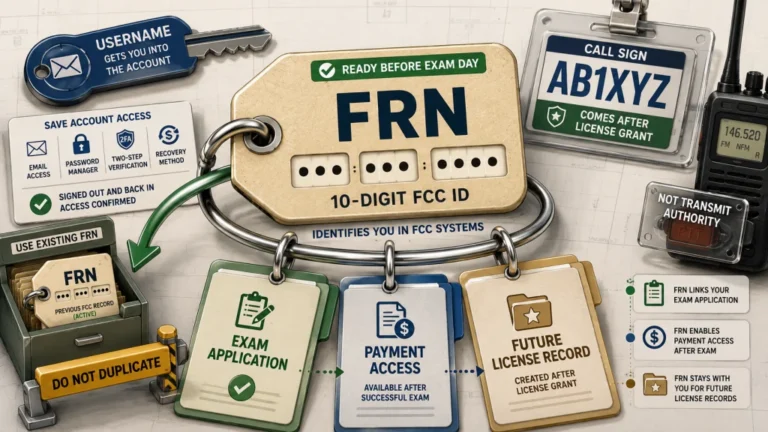
New applicants should obtain the FRN before exam day. Do not bring a Social Security number to substitute for an FRN unless the team has explicitly explained a secure procedure, because current exam processing is built around the FRN. The separate FRN registration walkthrough explains that setup without mixing it into the day-of checklist.
For identification, a government-issued driver’s license, passport, military ID, state photo ID, or qualifying school photo ID may be accepted under common VEC procedures. When no photo ID is available, the team may require two approved non-photo documents, or a different combination for a minor whose guardian presents identification. Confirm the exact rule before the session rather than guessing which document will be enough.
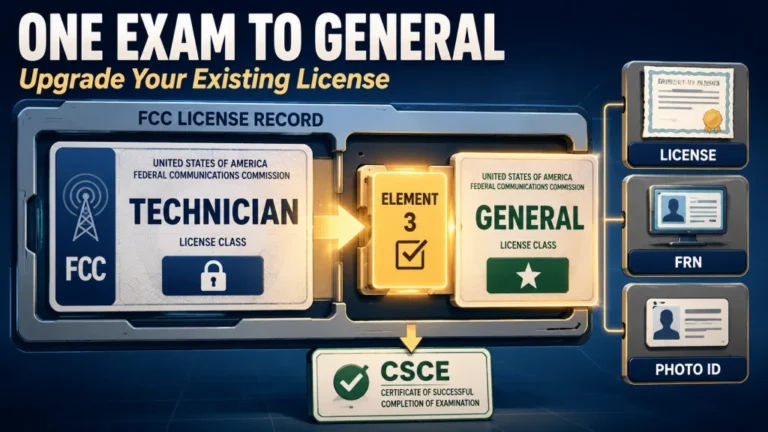
A valid CSCE can matter just as much as identification when you are claiming credit from a prior session. CSCE element credit is generally valid for 365 days. Bring the original and any copy requested by the team, and do not assume the team can reconstruct a missing certificate from memory or from an unrelated registration system.

This Amazon Basics accordion organizer is sized for letter-size documents and has 13 compartments. The listing describes it as waterproof and designed for large-capacity document storage. This ASIN is the black one-pack version.
Check On AmazonIf you click this link and buy, we earn a commission at no additional cost to you.
Calculator, Writing Tools, and Payment
A calculator is allowed at many sessions and is worth bringing for questions involving Ohm’s law, power, wavelength, ratios, or unit conversion. Clear its memory and remove stored formulas before the exam. A basic calculator is usually easier to approve than a device that also stores notes, communicates wirelessly, or gives access to outside information.
Do not assume you can use the calculator app on your phone. ARRL VEC instructions prohibit smartphones and similar devices as exam calculators, and phones are normally silenced or turned off during testing. Another VEC may publish its own procedure, so the team’s instructions control the exact device policy.
Payment is another place where candidates mix two separate charges. The exam-session fee pays the VEC or team for administering and processing the examination. The FCC application fee is paid directly to the FCC after a qualifying application reaches its system, not handed to the examiners as part of the test fee.
For 2026, the ARRL VEC exam fee is $15, and one payment includes one attempt at each examination element needed at that session. A same-session retest of a failed element requires another fee under ARRL VEC policy. Other VECs and teams may charge a different amount, use a different retest rule, or administer exams without a fee, so check before choosing cash, card, check, or another payment method.

The Casio fx-260 Solar II is a solar-powered scientific calculator with a 10-digit display. It includes fraction and trigonometric functions. The Amazon listing positions it for mathematics including algebra and trigonometry.
Check On AmazonIf you click this link and buy, we earn a commission at no additional cost to you.
Tell the Team if You May Take Multiple Exams
If you are prepared to attempt General after passing Technician, indicate that during registration when the form asks. This helps the team plan exam forms, tablet access, staffing, and session time. It does not obligate you to take the next element if you are tired or decide that stopping after Technician is the better choice.
At an ARRL VEC session, one standard exam fee covers one attempt at each of the three elements, so a candidate who passes Technician may take General without paying another fee for that first General attempt. Policies outside that program vary. Some teams automatically offer the next element, some ask before preparing it, and some sessions may not have enough time to continue testing.
Example: A first-time candidate passes Technician, receives the result, and feels ready for General. If the team permits it, the candidate can take the 35-question General exam during the same session. If both are passed, the VEC normally submits one application showing the highest license class earned.
A retest is a different situation. A team may offer another version of a failed element, but availability, waiting periods, and additional charges depend on the coordinating VEC and local team. Ask before assuming you can take unlimited attempts in one visit.
What to Expect During the Ham Radio Exam
After check-in, the team verifies your identification, FRN, contact information, application answers, and any license or CSCE credit. You may complete or confirm an NCVEC Form 605 through paper or electronic tools. Read every field before signing, especially your name, address, email, FRN, current call sign, requested application purpose, and the basic qualification question.
The Technician exam is Element 2 and the General exam is Element 3. Each contains 35 multiple-choice questions selected from the current question pool, and 26 correct answers are required to pass. Depending on the team, you may receive a printed booklet and answer sheet or take the exam on a tablet or computer at the site.
You can normally work through the questions in any order. Answer the ones you know, mark the uncertain ones, then return to them before submitting. Do not let one calculation consume the attention you need for the rest of the exam.
FCC rules do not impose a universal countdown clock for these elements. Many sessions allow candidates to work at a reasonable pace, while a team may set a practical time window because of room access, staffing, or the number of candidates waiting. Ask at check-in if the limit was not stated during registration.
Pro Tips: Before submitting, confirm that every question has one answer and that any changed answer is clearly recorded. On a digital system, use the review screen. On paper, make sure erasures do not leave two readable choices.

Paper Mate Pink Pearl Erasers are sold here as a three-count pack. This listing is for the large-size version. The product is part of Paper Mate's Pink Pearl eraser line.
Check On AmazonIf you click this link and buy, we earn a commission at no additional cost to you.
What Happens Immediately After the Test
The team grades the element after you submit it, often within a few minutes. A digital system may calculate the result immediately, while a paper exam may be checked with a grading template or electronic tool. The team tells you whether you passed and completes the required records.
If you passed, the team issues or electronically records proof of successful completion as its process requires. Review the document before leaving. Your name, call sign if you already have one, the element passed, the new class earned, the date, and the examiners’ information should match the session result.
If you did not pass, ask whether the team can provide a topic breakdown or other feedback allowed by its system. A failed attempt is not a license application, and it does not create an FCC fee. The useful decision is whether to retest under the team’s policy or leave with a clear study target rather than taking another version while mentally exhausted.
If you passed Technician, the team may offer General. If you already hold a license and passed an upgrade element, ask the examiners to explain what your CSCE authorizes, when the application will be submitted, and how to identify temporarily if you operate before the FCC database updates.
After Passing: Payment, Call Sign, and Upgrade Timing
A first-time applicant does not receive transmitting authority merely by passing the exam. The VEC sends the application data to the FCC. When the application reaches the FCC and a fee is required, the FCC sends payment instructions to the email address on the application.
The current FCC application fee is $35 for a new amateur license. It also applies to renewals, rule-waiver requests, and modifications requesting a new vanity call sign. Ordinary operator-class upgrades and requests for a sequentially issued call sign are exempt from the FCC application fee. Exam-session charges are separate and may still apply even when the FCC fee is exempt.
When payment is required, the FCC provides a 10-calendar-day payment window. Pay through the FCC system, then monitor the application and license record. A new operator must wait until the call sign and license grant appear in ULS before transmitting, even if the team has already confirmed a passing result.
Upgrades work differently. A currently licensed operator who has properly submitted the upgrade application through the exam process and holds a CSCE showing completion of the required examination may exercise the higher-class privileges temporarily under FCC rules. Until ULS reflects the new class, the operator must add the applicable AG or AE indicator to the call sign when identifying.
Warning: A CSCE showing only element credit is not automatically the same as a completed upgrade application. Before using higher privileges, confirm that the team issued the CSCE for the new class and that the application conditions for temporary authority have been met.
The larger US ham radio license guide explains how the license classes, FCC record, fees, and operating privileges fit together. Exam day is only one step, but leaving the session with accurate paperwork and a clear next action prevents most avoidable delays.
Final Thoughts: Documents First, Testing Second
The best exam-day checklist begins with the items the team cannot simply lend you: your FRN, accepted identification, valid email address, and proof of any license or exam credit. Add the local instructions for fees, payment, calculator, writing tools, minor documentation, arrival time, and multiple-element testing. That preparation lets the session focus on the exam instead of repairing an application problem.
Once you pass, slow down long enough to understand what happens next. A first license requires FCC processing, payment when applicable, and a call sign in ULS before you transmit. An upgrade has different fee and temporary-authority rules. Take a photo or secure copy of the completed paperwork, verify your email, and leave knowing exactly which system or message you are waiting for.
FAQs
🪪 What ID do I need for a ham radio exam?
Bring an accepted legal photo ID when possible. If you do not have one, ask the exam team which combination of non-photo documents it accepts before the session.
🔢 Do I need an FRN before test day?
Yes, obtain your FCC Registration Number before the session unless the team gives you a different documented procedure. The FRN is required on the license application.
🧮 Can I use a calculator on the ham radio exam?
Calculators are commonly allowed when their memory and stored formulas are cleared. Do not assume a phone calculator is acceptable, because some VEC policies prohibit smartphones and similar devices.
📝 How many questions are on the Technician exam?
The Technician exam contains 35 multiple-choice questions. You need 26 correct answers to pass.
📚 Can I take the General exam right after Technician?
Often, yes, when you pass Technician and the team has time and materials for the next element. Tell the team during registration when possible, because fee and multiple-element policies vary by VEC.
💵 Do I pay the $35 FCC fee at the exam?
No. The exam-session fee is paid according to the team’s instructions, while a required FCC application fee is paid directly to the FCC after the application reaches its system.
📡 Can I transmit immediately after passing Technician?
No. A first-time licensee must wait until the FCC grants the license and the call sign appears in ULS before transmitting.
⬆️ Can I use General privileges immediately after an upgrade exam?
Temporary higher-class operation may be allowed when the upgrade application was properly submitted and you hold the correct CSCE. Use the required AG or AE indicator until the FCC database reflects the upgrade.