Ham radio exams are available both at local in-person sessions and through remotely supervised online sessions. The fastest way to find one is to search a current exam locator, open the individual listing, and follow that team’s registration instructions rather than assuming every session uses the same rules. In-person testing is usually the easier first choice when a convenient local session exists, while online testing removes the travel problem but adds camera, room, and computer requirements. Before registering, confirm the deadline, FRN requirement, identification rules, exam fee, retest policy, and any accommodation procedure shown by that specific team.
How to Find a Ham Radio Exam Near Me
A search for a ham radio exam near me should take only a few minutes because US amateur exams are offered in two practical formats: local sessions run by Volunteer Examiner teams and remote sessions supervised over video. The exam itself is not given at an FCC office. You register with an examination team working through a Volunteer Examiner Coordinator, then follow that team’s instructions for the session you selected.
The part that trips up new candidates is not finding a date. It is treating the first date on a search page as if a seat is already reserved. Some sessions accept walk-ins, others require advance registration, and a listing may close before the scheduled start. Finding a workable date is only the first step; the next step is confirming that you can actually register for it.
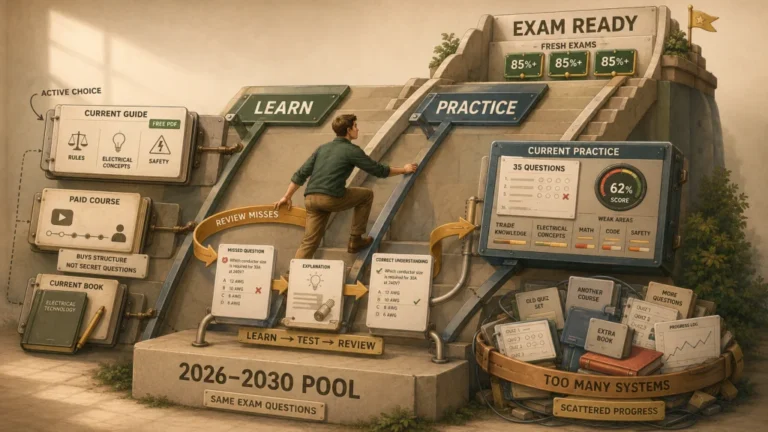
This article stays focused on locating and registering for a session. It does not repeat the study process or walk through the full testing-room procedure. For the broader licensing sequence, start with getting a Technician license step by step, then return here when you are consistently ready to test.
The Two Types of Ham Radio Exam Sessions
An in-person ham radio exam session is usually held at a radio club meeting place, library, community center, public-safety facility, school, convention, or hamfest. You travel to the listed location, show your identification, complete the team’s paperwork, and take the test under direct supervision. The setup is familiar and usually needs less troubleshooting than a remote session.
An online remote session uses live video supervision, commonly through Zoom or a similar meeting platform. You still take an official amateur radio examination administered by qualified Volunteer Examiners. The difference is that the team must verify your identity, observe you throughout the exam, and control the testing environment through cameras, screen sharing, room checks, or other procedures stated in its instructions.
Behind both formats is the same examination structure. Each amateur license examination must be administered by a team of at least three accredited Volunteer Examiners at a session coordinated by a Volunteer Examiner Coordinator. The VEs supervise the examination and certify the result, which is why a club-hosted local session and a video-supervised remote session can both lead to the same FCC license grant.
| Session type | Best fit | Main complication |
|---|---|---|
| In person | A local session is reasonably close and the date works | Travel, limited local dates, or advance registration |
| Online remote | Travel is difficult or no local date is practical | Camera, room, device, software, and proctoring rules |
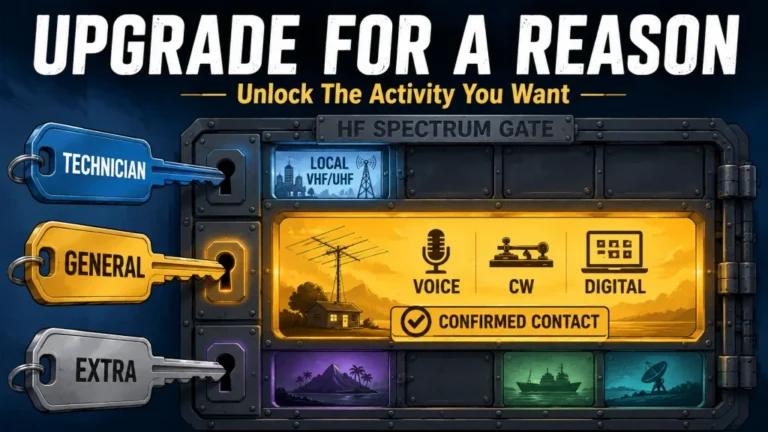
Neither format changes the license class you earn or makes the question pool easier. The real decision is logistical. Choose the format that gives you the fewest ways to miss the session or violate a team-specific instruction.

The Logitech Brio 101 provides Full HD 1080p video for computer-based calls and meetings. It includes a built-in microphone and automatic light balancing. The webcam also has an integrated privacy shutter and connects through USB-A.
Check On AmazonIf you click this link and buy, we earn a commission at no additional cost to you.
Finding an In-Person Ham Radio License Test Near You
The most direct starting point is the ARRL amateur exam session locator. Search by ZIP code and expand the mileage range when the first search is too narrow. The listings may include sessions sponsored through different coordinating organizations, so check the VEC name, location, date, start time, walk-in status, and contact information instead of assuming every result follows ARRL procedures.
You can also use the HamStudy exam session finder, which lets you switch between in-person and remote listings. This is useful when you care more about the next workable date than about a specific organization. In larger metropolitan areas, candidates may see several dates in a month, while rural areas can require a wider search radius or a longer wait.
Before committing to a drive, confirm the date, start time, venue access, and seating with the listed contact or registration page. A locator entry may say “walk-ins allowed,” but the building can still have restricted entrances or a changed meeting room. A five-minute confirmation is better than arriving at the correct address on the wrong side of a locked door.
Key point: Search by distance first, then judge the individual listing. A session twenty miles farther away may be the better choice if it has clear instructions, confirmed seating, and a date that does not force you to rush.
Finding an Online Remote Ham Radio Exam
Remote testing is not limited to candidates who live near the examination team. Many teams accept eligible US license candidates from other states because supervision happens by video rather than through a local proctor sitting in the room. The ARRL online exam team directory and HamStudy’s remote filter are practical places to compare available dates.
Ham Radio Prep’s remote testing overview also lists several organizations and teams that offer online exams. It is a commercial resource rather than the controlling registration page, so use it to discover options, then confirm availability and requirements directly with the selected team.
Teams coordinated through organizations such as GLAARG, New England Amateur Radio, ARRL VEC, and other VECs have offered remote sessions, but availability changes. One team may require a single computer and movable webcam, while another may require a second device, a particular browser, or a phone positioned as an additional camera.
The best remote listing is not automatically the one with the earliest start time. Look for a page that clearly explains the time zone, registration cutoff, cancellation procedure, required devices, software, payment method, identification process, and contact channel. If those details are vague before you pay, choose a better-documented session.
Online testing solves a geographic problem, not every convenience problem. A candidate with unreliable internet, no private room, a locked-down work computer, or no way to reposition a camera may spend more effort satisfying the remote setup than traveling to a nearby library or club session.

The UBeesize camera tripod adjusts from about 20.1 inches to 67.3 inches in height. It includes a phone holder and Bluetooth remote and can also hold compatible cameras or webcams. The adjustable stand provides multiple positioning heights for a phone or camera setup.
Check On AmazonIf you click this link and buy, we earn a commission at no additional cost to you.
What Registration Usually Requires
Registration usually asks for your legal name, email address, FCC Registration Number, license element, and basic contact information. The fee may be collected online, at the session, or not charged at all. Retest policies, refunds, deadlines, and permission to attempt another license element after passing are also set by the VEC or examination team.
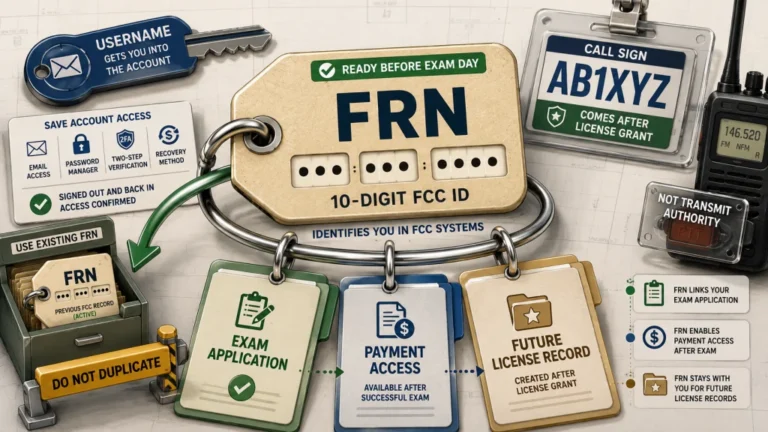
The FRN is where I see avoidable delays begin. Candidates sometimes assume they can provide a Social Security number directly to the exam team or create an FCC account after testing. Current session instructions commonly require candidates to obtain an FRN through FCC CORES registration before exam day, so create it early and make sure the legal name and email information match what you use to register.
- Read the complete session description before submitting payment.
- Confirm the listed time zone, especially for a remote session.
- Use the same legal name and FRN information throughout registration.
- Check the accepted identification documents and age-specific instructions.
- Ask about accommodations before the registration deadline, not after joining the session.
- Save the confirmation email, meeting link, receipt, and team contact information.
There are two separate costs that candidates often combine in their heads. The examination team may charge its own session fee, and the amount depends on the VEC or team. A new amateur license application also carries a $35 FCC application fee, paid directly to the FCC after the successful application reaches its system. The same $35 fee generally applies to renewals, rule-waiver requests, and vanity call sign applications, while ordinary operator-class upgrades and requests for a sequentially issued call sign are exempt.
Registration is also the right time to read what to bring to the exam. That separate checklist covers identification and exam-day materials without turning this session-finding guide into a second exam-day article.

This Amazon Basics expanding organizer has 13 compartments for letter-size documents. It holds up to 260 sheets and uses a flap-and-cord closure. The poly organizer is listed as acid free, PVC free, waterproof, and tear resistant.
Check On AmazonIf you click this link and buy, we earn a commission at no additional cost to you.
Check the Remote Setup Before You Book
A remote exam normally requires a computer with a camera, microphone, stable internet connection, and access to the team’s chosen meeting and testing platforms. Beyond that, requirements vary. The team may ask you to share your screen, show the entire room, remove notes and electronics from reach, cover additional monitors, keep the door visible, or use a second camera angle.
Remote compatibility is the issue to settle before paying. Test the same computer, browser, camera, microphone, and network you plan to use, following the selected team’s technical checklist. A system that handles ordinary video calls can still fail when screen sharing is blocked or the camera cannot show the required room view.
Remote teams are responsible for observing the candidate throughout the examination, so room and camera rules are not decorative. If a procedure feels too intrusive or difficult for your space, the practical answer is not to argue with the listing after booking. Choose a different team or take the exam in person.

The Anker PowerExpand USB-C to Gigabit Ethernet Adapter adds a wired Ethernet port to compatible USB-C laptops and tablets for a more stable network connection during an online exam. It supports Ethernet speeds up to 1 Gbps and uses a compact plug-and-play design that does not require a separate hub. The aluminum body, braided cable, and connection indicators make it a straightforward option when the exam computer needs reliable wired internet instead of Wi-Fi.
Check On AmazonIf you click this link and buy, we earn a commission at no additional cost to you.
Online vs In Person: Which Session Should You Choose?
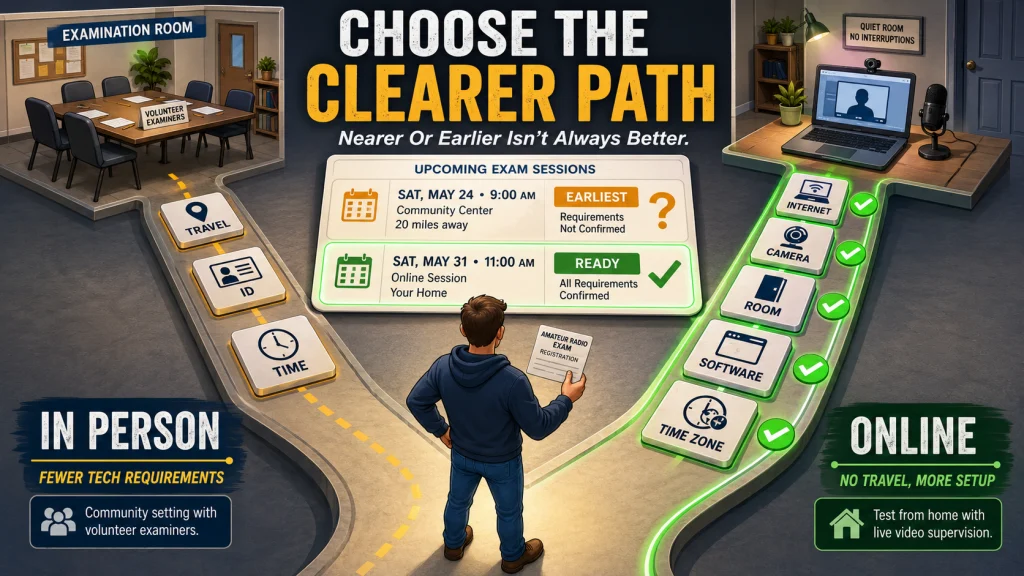
For a first license exam, I would usually choose a nearby in-person session when the travel is reasonable and the date is not far away. There is less equipment to verify, fewer privacy concerns, and a lower chance that a software setting will delay the test. You may also meet local operators who can point you toward repeaters, nets, and clubs after your license is issued.
Online testing is the better option when distance, transportation, mobility, work schedules, or limited local dates are the real obstacle. It can turn a multi-hour trip into a scheduled appointment at home. The trade-off is that the candidate must provide a controlled room and working technology rather than relying on the team’s physical venue.
| Your situation | Usually the better first choice | Why |
|---|---|---|
| A confirmed local session is within a reasonable drive | In person | Less setup and a chance to meet local operators |
| No local session fits your schedule | Online | More dates and no geographic restriction |
| Your internet or computer is unreliable | In person | The venue removes most technical failure points |
| Travel or mobility is the main barrier | Online | Testing can be completed from an approved private space |
| You cannot provide a clear, controlled room | In person | Remote supervision may be impractical |
The simplest decision test is to count failure points. For an in-person session, those are usually travel, timing, and documents. For an online session, they include timing and documents plus internet, software, cameras, room control, and device permissions. Choose the path with fewer unresolved problems in your actual situation.
Age, Citizenship, and Basic Eligibility
The FCC amateur rules do not set a minimum age for earning an operator license. A child can qualify by passing the same examination element required of an adult, although identification, guardian presence, fee programs, and registration procedures may vary by examination team. Families should read the session’s minor-candidate instructions before registering rather than assuming ordinary adult ID procedures will apply.
US citizenship is generally not required to qualify for an FCC amateur operator license. The rule excludes a representative of a foreign government from eligibility for an operator and primary station license grant. That is a narrow eligibility restriction and should not be confused with reciprocal operating authority for a visitor who already holds a foreign amateur license.
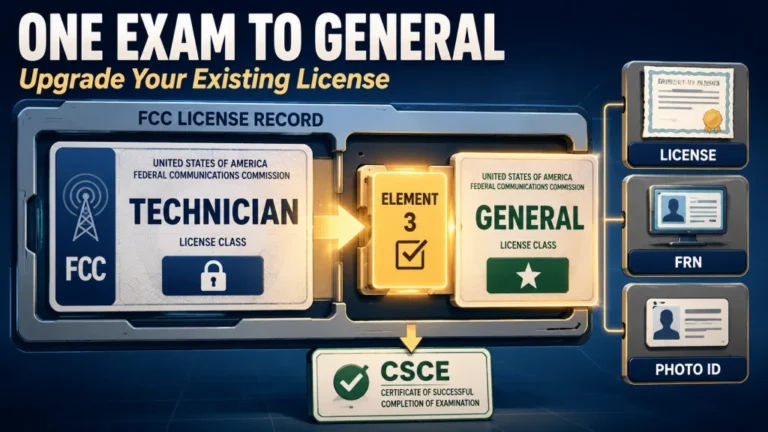
Eligibility is only one part of the licensing process. The exam team verifies the examination result, while the FCC issues the license grant after the application reaches its system and any required application fee is paid. The broader relationship between examination classes, FCC grants, privileges, and renewals is covered in the complete US ham radio license guide.
Note: If a candidate needs disability accommodations, contact the selected team before the session. The procedure may require advance notice, and the workable accommodation depends on the candidate’s needs and the team’s testing format.
Final Thoughts: Choose the Session With the Clearest Path
Finding a session is not difficult, but choosing carelessly can create a preventable registration problem. Search both in-person and remote options, compare the complete instructions, and confirm the details that can stop you from testing: deadline, FRN, identification, fee, time zone, equipment, and accommodations.
When a reliable local session is reasonably close, it is usually the cleanest first choice. When travel or scheduling is the obstacle, remote testing is a legitimate and practical alternative. In either case, the best session is the one whose requirements you can satisfy without guessing.
FAQs
📍 Where can I find a ham radio exam session near me?
Search the ARRL exam locator by ZIP code and compare it with HamStudy’s session finder. Open the individual result and follow that team’s registration page because walk-in rules, fees, deadlines, and required documents vary.
💻 Can I take the ham radio license test completely online?
Yes, remote sessions are available through live video supervision. You must meet the selected team’s camera, room, computer, identification, and screen-sharing requirements.
🪪 Do I need an FRN before registering for the exam?
Most current session procedures require an FCC Registration Number before exam day, and many require it during registration. Create the FRN early and use the same legal name and email information on the session form.
💰 How much does a ham radio exam cost?
The exam-session fee is set by the VEC or examination team and may be free or paid. A new license application also has a separate $35 FCC fee, which is paid directly to the FCC after the application is submitted.
📷 Do online ham radio exams require two cameras?
Some teams require a second device or camera angle, while others use one movable camera. Read the exact session instructions before booking because there is no single equipment rule used by every remote team.
👧 Is there a minimum age for taking the ham radio exam?
The FCC amateur rules do not set a minimum age. Minors still need to satisfy the examination and the team’s identification or guardian procedures.
🌎 Do I have to be a US citizen to get an FCC amateur license?
US citizenship is generally not required. A representative of a foreign government is not eligible for the FCC operator and primary station license grant, which is different from reciprocal operating rules for foreign licensees.
🔁 Can I retake the exam during the same session if I fail?
That depends on the team’s policy, available time, question-set requirements, and any additional fee. Check the listing or ask before the session rather than assuming an immediate retest is included.