U.S. citizenship is generally not required to earn an FCC amateur operator/primary station license by examination. The main eligibility exception is a representative of a foreign government, while the practical requirements are an FRN, accurate contact information, the identification accepted by the selected exam team, a passing examination, and an FCC grant. A foreign license may provide separate reciprocal operating authority for some visitors, but that is not the same as earning a U.S. license. The safest approach is to confirm the FRN, address, identification, and session rules before paying or scheduling anything.

U.S. Citizenship Is Not the Main Eligibility Test
A ham radio license for non-US citizens is generally available through the same examination route used by U.S. citizens. The FCC rule does not make citizenship, permanent residency, or possession of a U.S. passport the general test for an individual amateur license. Instead, the rule asks whether the person qualifies by examination and whether the person falls within the narrow foreign-government exception.
That direct answer matters because several separate issues are often collapsed into one question. My practical rule is to separate legal eligibility from the administrative steps before looking at any exam date. Eligibility under FCC rules, registration for an FRN, identification at an exam session, a usable mailing address, and legal operation outside FCC jurisdiction are different checks. Passing one check does not automatically satisfy the others.
Key point: A non-citizen should not start by asking, “Am I American enough to test?” Start by checking FCC eligibility, CORES registration, contact information, and the selected exam team’s identification rules as four separate items.
This article stays focused on non-citizen eligibility, documents, and the visitor option of reciprocal authority. It does not replace the complete U.S. ham radio licensing process, including study planning, license classes, exam content, and what to do after the grant appears.
What the FCC Eligibility Rule Actually Says
Under 47 CFR §97.5, an operator/primary station license grant is available to any person who qualifies by examination, except a representative of a foreign government. That is the controlling distinction for the citizenship question. The rule does not create a general exclusion for tourists, visa holders, permanent residents, recent immigrants, or people who hold another nationality.
The exception should also be read narrowly rather than expanded through guesswork. Being employed by a private foreign company, attending a U.S. school, or holding a foreign passport does not by itself make someone a representative of a foreign government. A person whose official role may fall within that exception should obtain case-specific guidance before applying rather than relying on a casual interpretation from an exam listing or forum post.
| Question | Practical answer |
|---|---|
| Is U.S. citizenship generally required? | No. Qualification by examination is the central eligibility route. |
| Is a foreign-government representative eligible? | No, that is the specific exception stated in the amateur rule. |
| Does eligibility guarantee that a particular exam team will accept my documents? | No. Session identification and registration procedures must still be confirmed with the selected VEC or team. |
| Does an FCC license automatically authorize operation worldwide? | No. Operation outside places regulated by the FCC depends on the law and authorization of the country involved. |
The third row is where many applicants get stuck. An exam team’s document policy is an administrative requirement for that session, not a new citizenship rule written into Part 97. If one session cannot verify the identification you hold, ask the coordinating VEC what it accepts or choose a team whose published procedures fit your situation.

ARRL Ham Radio License Manual 6th Edition is a complete Technician-class study guide for exams valid July 1, 2026 through June 30, 2030. It covers amateur radio rules, licensing and operating regulations, equipment, antennas, propagation, and radio safety. The book also includes the complete Technician-class question pool with answers and detailed explanations.
Check On AmazonIf you click this link and buy, we earn a commission at no additional cost to you.
Use Contact Information That Will Actually Reach You
The FCC requires the license grant to show the grantee’s correct name, mailing address, and email address. The email must receive FCC correspondence, and the mailing arrangement must allow Commission documents to reach the licensee promptly. For a recent immigrant or visitor, the practical question is therefore not merely whether an address can be typed into a form, but whether it remains dependable after the exam.
Do not turn this into a categorical rule that a post office box is always forbidden. The controlling amateur rule requires correct and reachable contact information, not a blanket PO-box ban. At the same time, some VEC instructions or application workflows may impose a particular address format, so the applicant should show the exact address they plan to use to the chosen VEC before the session.
The address question also has a privacy consequence because license information is maintained in the FCC’s public licensing system. Before filing, decide which lawful and reliable mailing arrangement you are prepared to keep current. A convenient address that becomes unusable a month later is not a good solution.
Create the FRN Through the Correct CORES Workflow
An FCC Registration Number is required for the amateur application workflow. The applicant first creates an FCC Username, then uses CORES to register or manage the FRN associated with that account. The username is tied to an email account, so losing access to that inbox can create a licensing problem long after the exam is over.
A foreign individual who is not eligible for a U.S. Social Security Number should follow the current CORES route for a foreign individual and select the applicable exemption reason when the system asks for taxpayer identification information. Do not enter a made-up number, another person’s number, or a string copied from an old tutorial. The screens and labels can change, so use the current FCC workflow and request FCC support if the foreign-individual option is unclear.
Field Note: The FRN question comes up at almost every exam session I run. The mistake is usually not the exam material. It is treating the FRN as a disposable registration code instead of the account identity that will follow every later license transaction.
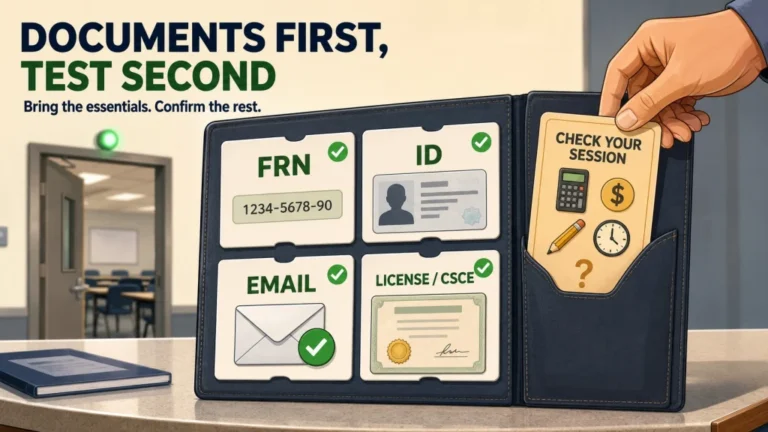
The FRN also does not replace exam identification. CORES registration identifies the applicant in FCC transactions, while the Volunteer Examiner team still has to verify the person appearing for the test under its current procedures. Keep the FRN confirmation, FCC Username access, and identification checklist together, but do not assume they are interchangeable.
Taking the Exam While Visiting or Residing in the United States
A non-citizen who is visiting or residing in the United States may take an amateur examination when eligible and able to satisfy the selected session’s requirements. The exam itself does not become a different test because the candidate is foreign. The practical differences usually appear before the test, in FRN registration, address handling, identity verification, payment, and the team’s ability to process the application.
Contact the selected VEC or exam team before registering and ask it to confirm the exact identification it accepts. In-person and remote sessions may use different verification methods, and one team’s remote-testing policy should not be presented as a universal FCC rule. Do not assume that every foreign passport will be accepted by every team, and do not assume that a team requiring U.S.-issued identification has changed the FCC’s underlying citizenship rule.
- Confirm that the team accepts non-U.S. citizens under its current session procedures.
- Provide the exact type of photo identification you plan to show.
- Confirm whether your mailing address format can be submitted through that VEC.
- Obtain the FRN before the session unless the VEC gives a current, documented alternative.
- Ask how the exam fee is paid and whether another attempt requires another session fee.
- Keep access to the email used for CORES, the exam registration, and FCC correspondence.
I would make this advance check before paying for a session. It is more useful than collecting a generic list of documents from unrelated exam websites. A passport may be accepted in one process while a particular remote team uses a narrower identity policy. The selected team is the right place to verify session practice, while the FCC rule remains the right place to verify legal eligibility.

ARRL's Tech Q&A 9th Edition is built for Technician-class exams valid July 1, 2026 through June 30, 2030. It presents every question and answer in the Element 2 pool with brief explanations after each question. The format is designed for quick exam preparation for the 35-question Technician test.
Check On AmazonIf you click this link and buy, we earn a commission at no additional cost to you.
Passing the Exam Is Not the Same as Receiving the License
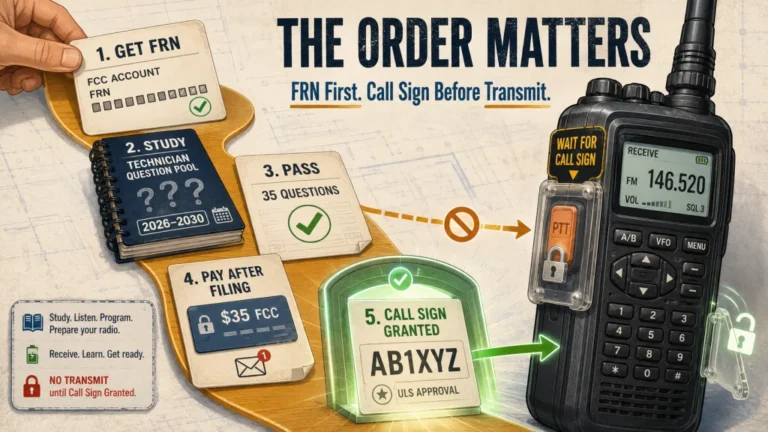
After a successful exam, the VEC submits the application information to the FCC. A new amateur license application currently carries a $35 FCC application fee. Any VE or VEC exam-session charge is separate, can vary by organization, and is not the same payment as the FCC fee.
The authority to transmit under the new U.S. call sign begins when the FCC grants the license and the grant appears in the licensing database, not when the candidate finishes the exam. Watch the email account associated with the application, follow the FCC payment instructions within the stated window, and verify the grant before transmitting. A certificate showing that an exam element was passed is not itself an operator/primary station license grant.
Warning: Do not pay an unexpected third party merely because it sends an official-looking message after the exam. Use the payment path connected to your FCC account and application, and ask the VEC for help if the application cannot be located.
Once the grant is active, keep the mailing address, email address, and account access current. The practical steps for updates, renewals, and maintaining the record are covered in the guide to managing your FCC license record.

The BAOFENG UV-5R is a rechargeable dual-band handheld listed for 144-148 MHz and 420-450 MHz. This black configuration includes an 1800mAh battery. Its handheld format keeps the two-way radio and battery together in a portable package for VHF/UHF operation.
Check On AmazonIf you click this link and buy, we earn a commission at no additional cost to you.
A Practical Checklist for a Non-Citizen Applicant
The cleanest workflow is to remove administrative uncertainty before spending serious time on scheduling. The exam knowledge is the same, but a mismatched address, inaccessible email account, or unsupported identification document can stop the application even when the candidate is fully prepared to pass.
- Confirm eligibility: Make sure the foreign-government representative exception does not apply to you.
- Create FCC account access: Register the FCC Username with an email account you control.
- Obtain the FRN: Use the current foreign-individual route in CORES when no U.S. Social Security Number is available.
- Choose reliable contact information: Prepare the correct name, mailing address, and email that will continue to reach you.
- Verify the session: Ask the chosen VEC or team to approve your identification and address format before you register.
- Take the examination: Follow the team’s in-person or remote rules and retain the successful-exam documentation.
- Complete the FCC step: Monitor the application, pay the current $35 new-license fee through the FCC process, and wait for the ULS grant.
- Verify operating authority: Use the FCC license only where it is legally recognized, and check local law before transmitting from another country.
If one item is uncertain, pause at that item rather than trying to solve everything through the exam team on test day. In particular, an applicant without an SSN should settle the CORES route first, while a visitor holding a foreign license should compare the examination route with reciprocal authority before deciding which one is necessary.
Final Thoughts: Separate Eligibility From Administration
The core answer is simple: a non-citizen applicant is not barred from an FCC amateur license merely because the applicant is not a U.S. citizen. The real work is making sure FCC eligibility, FRN registration, contact information, exam-team identification, payment, and the final grant all line up. Treating those as separate checks prevents a team-specific document rule from being mistaken for a federal citizenship requirement.
For a visitor who already holds a foreign amateur license, reciprocal authority may be the shorter route, but only when a current agreement and all of its conditions apply. For everyone pursuing an FCC grant, verify the administrative path before the exam and do not transmit until the license appears as granted.

The ARRL Operating Manual 12th Edition covers basic station setup and operating procedures for amateur radio. Topics include HF digital communications, VHF/UHF FM and repeaters, digital voice and data, satellites, and portable or mobile operation. It also covers radio-club activities, public-service operating, awards, DXing, QSLing, and contesting.
Check On AmazonIf you click this link and buy, we earn a commission at no additional cost to you.
FAQs
🌎 Can a non-US citizen get a ham radio license?
Yes, a non-US citizen can generally qualify for an FCC amateur operator/primary station license by examination. The specific eligibility exception is a representative of a foreign government.
🪪 Do I need a Social Security Number to obtain an FRN?
A foreign individual who is not eligible for a U.S. Social Security Number should use the current foreign-individual exemption route in CORES. Do not invent a number or use another person’s information.
📬 Can I use a PO box on my amateur license application?
The amateur rule requires a correct mailing address and email address that allow FCC correspondence to reach you. It does not state a categorical ban on PO boxes, but the selected VEC should confirm that your exact address format can be submitted.
🧳 Can a tourist take a U.S. ham radio exam?
A tourist is not excluded merely by being a non-citizen. The candidate still needs an FRN, acceptable contact information, and identification that the selected in-person or remote exam team can verify.
📡 Can I operate in the United States with my foreign call sign?
Only when a current bilateral or multilateral reciprocal arrangement applies and you satisfy its conditions. Check the eligible country, license, citizenship, identification, and operating requirements before transmitting.
✈️ Does an FCC license let me transmit in my home country?
Not automatically. Your authority outside FCC jurisdiction depends on the laws, permits, and reciprocal arrangements recognized by the country where the transmitter is located.
💳 How much does a new FCC ham radio license cost?
The current FCC application fee for a new amateur license is $35. Any exam-session fee charged by a VE team or VEC is separate and varies by organization.