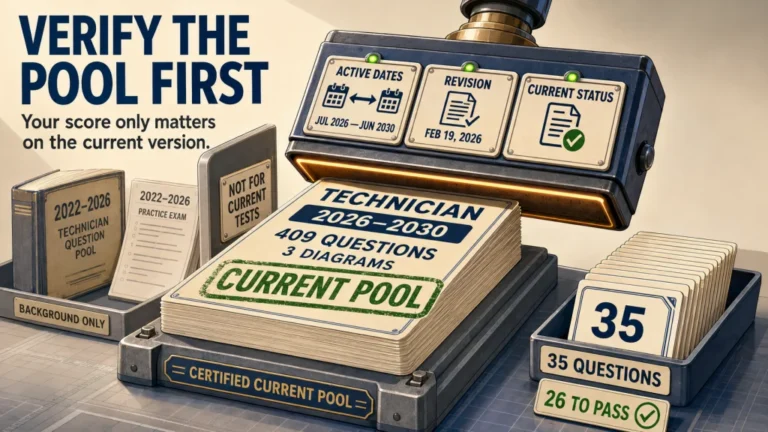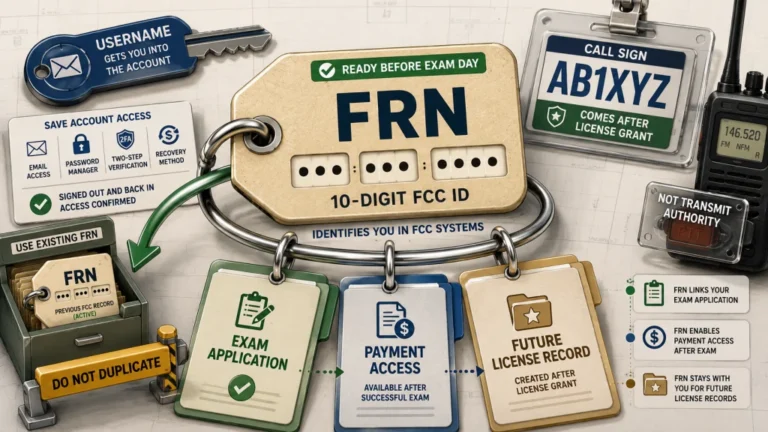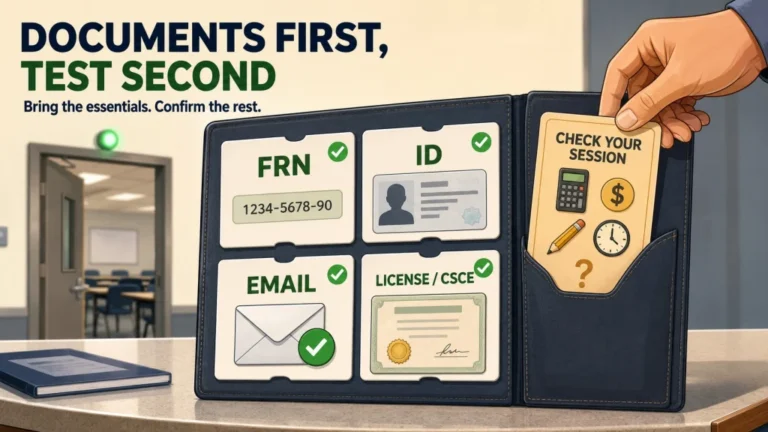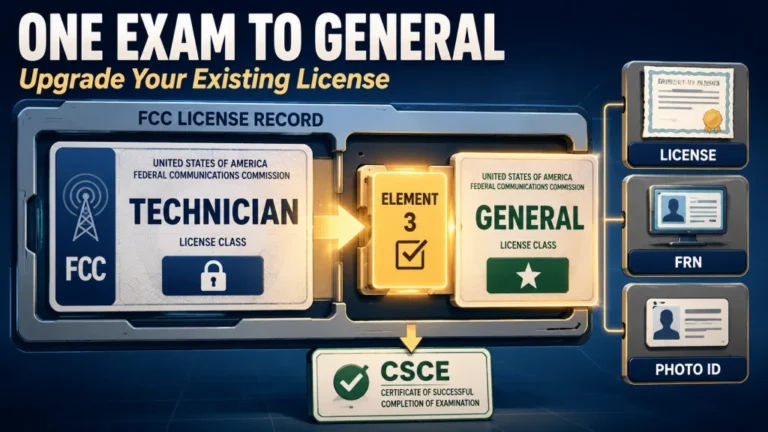
You can prepare for the Technician exam with a free practice system, a free PDF guide, a paid online course, or a current physical book. The best choice is the one you will use consistently, but every option must match the active 2026-2030 question pool and include a way to learn from missed questions. Paying can buy structure, video lessons, progress tracking, and support, but it does not provide access to a private exam pool. For most candidates, one teaching resource plus one current practice system is enough.
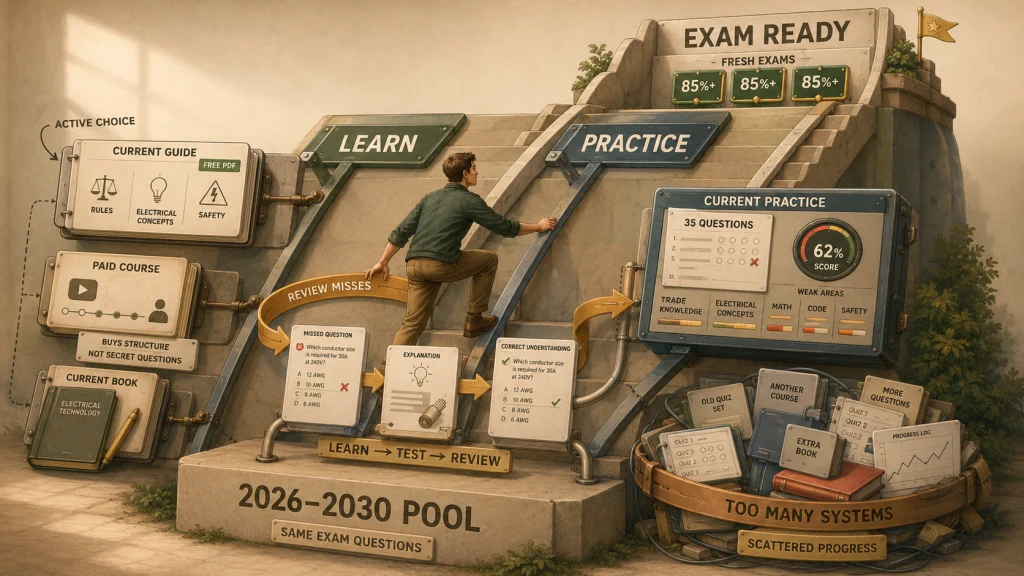
Four Study Methods Work, but They Solve Different Problems
A ham radio license study guide does not need to be expensive to prepare you for the Technician exam. The entire official question pool is public, so free and paid resources begin with the same eligible questions. What changes is how the material is explained, organized, tracked, and delivered.
If you are deciding how to study for a ham radio license, the honest question is not free versus paid in the abstract. It is whether you need explanations, external structure, portability, progress tracking, or direct support. A free practice system may be all a strong independent learner needs, while another candidate may save time by paying for a course that turns the same pool into short lessons and a fixed sequence.
I have proctored Technician candidates who studied over a long period and others who compressed their preparation into a few days. The pattern that matters is not what they paid. Candidates are better prepared when they use a current question set, review why an answer was wrong, and keep studying until their scores remain above the passing line instead of touching it once by chance.
This comparison is limited to the US Technician exam. It does not cover General-class study, and it does not analyze every change inside the current pool. Before choosing any resource, confirm its version against the active Technician question pool requirements.

This sixth-edition ARRL manual is built for the Technician question pool used from July 1, 2026, through June 30, 2030. It combines the current question pool with explanatory study material, photos, and illustrations. ARRL also provides online review and practice support for readers using the manual.
Check On AmazonIf you click this link and buy, we earn a commission at no additional cost to you.
Start With the Study Problem You Need to Solve
Most poor study choices happen because a candidate asks which resource is “best” before identifying what keeps them from studying. Someone who understands written explanations but forgets to practice has a different problem from someone who completes practice tests quickly but cannot understand Ohm’s law or RF safety.
Use the table as a filter. The strongest option is not the one with the longest feature list. It is the least complicated method that removes your specific barrier and still gives you current, exam-shaped practice.
| Study method | Best fit | What it adds | Main limitation |
|---|---|---|---|
| Free practice system | Independent learners who improve by answering questions | Repeated quizzes, score feedback, and weak-area detection | Can encourage answer recognition without enough explanation |
| Free PDF study guide | Readers who want a complete path through the material at no cost | Context, topic order, and an offline reference | Usually has little or no automatic progress tracking |
| Paid online course | Candidates who need structured lessons, video, or support | Guided sequence, multimedia, quizzes, and account-based progress | Costs money and may add features you will not use |
| Physical book | Readers who retain more from paper or want a later reference | Depth, easy annotation, and screen-free study | Cannot update itself when errata or withdrawn questions change |
A candidate can combine methods, but more resources do not automatically produce better preparation. Switching among four incomplete systems often hides weak areas because each one records progress differently. Choose one primary teaching source and one practice source, then stay with them long enough to see a score trend.

This 11th-edition Gordon West guide covers the 2026-2030 Technician Element 2 question pool. Its 248 pages organize all 409 questions by topic and pair them with explanations and operating tips. The edition also points readers to online study resources for additional practice.
Check On AmazonIf you click this link and buy, we earn a commission at no additional cost to you.
Method 1: Free Practice Systems Are Enough for Many Candidates
A current practice system can be the fastest route for someone who learns by answering questions and reading short explanations. HamStudy, for example, has a Technician section labeled for the pool valid from July 1, 2026, with study mode, question browsing, and full practice exams. Other free systems may offer similar functions, but the interface matters less than the database behind it.
Check four things before trusting your score: pool currency, explanation quality, progress tracking, and access conditions. Some systems allow practice without an account but require one to synchronize progress across devices. Others work well in a browser but reserve offline use for a mobile app. Those differences affect convenience, not the questions you can legally receive on the exam.
- The system should clearly identify the 2026-2030 Technician pool.
- Practice exams should contain 35 questions and use the official exam distribution.
- Missed answers should lead to an explanation or a way to review the underlying topic.
- Progress data should show weak sections, not only a single total score.
- Saved tests from the expired pool should not be mixed with current results.
The common mistake is taking full exam after full exam without changing what happens between them. If you score 77 percent, immediately start another test, and recognize several repeated questions, the next score may rise without the weak concept improving. A better loop is to stop, review every miss, answer a small set from that topic, and only then generate a fresh exam.
Key point: A free practice system is a complete exam rehearsal tool, but it is not automatically a complete teaching system. Use its explanations as the deciding test. If they do not help you understand repeated misses, add one reading or lesson source rather than buying several more quiz apps.

This ninth-edition ARRL Tech Q&A is current for Technician exams from July 1, 2026, through June 30, 2030. Its question-and-answer format provides a focused path through the Technician material. That format pairs naturally with a practice system when repeated misses need additional review.
Check On AmazonIf you click this link and buy, we earn a commission at no additional cost to you.
Method 2: Free Study Guides Work Best When They Explain, Not Just Map Answers
A ham radio Technician study guide in PDF form can give the question pool a readable order. The current No-Nonsense Technician-Class License Study Guide is available as a free PDF for exams given from July 2026 through June 2030. It groups related questions and adds enough connecting text to make the pool read like lessons instead of a spreadsheet of prompts and answer letters.
That format is useful for candidates who want to understand why an answer is correct but do not need video or an account dashboard. It also works offline and can be searched, printed, or annotated. The trade-off is that a static file cannot tell you which subelements are costing you points, so it should be paired with a current practice system.
Georgia Tech’s W4AQL boot camp reported a 98 percent pass rate in its fall and spring recap, and the program identifies the No-Nonsense guide as its boot-camp textbook. That is encouraging evidence that a free guide can support a successful program, but it is not proof that downloading one PDF produces a 98 percent result. The boot camp also included instruction, organized study, practice resources, and a scheduled testing environment.
A guide that mainly rewrites correct answers into sentences can still be efficient for exam preparation, but it may not give enough depth for every reader. When a diagram, formula, or rule remains unclear, use a second explanation for that topic. Do not replace your entire study plan because one paragraph failed to click.

This 4-pack contains white binders with 1-inch round rings and two interior pockets. Each binder has a 175-sheet capacity and is sized for 8.5 x 11-inch documents. The transparent exterior overlay lets printed study-guide pages and topic notes stay organized in one paper-based system.
Check On AmazonIf you click this link and buy, we earn a commission at no additional cost to you.
Method 3: A Paid Course Buys Structure, Not Different Exam Questions
Paid courses are useful when the real obstacle is organization. A course can break the pool into lessons, combine text with video, insert quizzes at planned intervals, preserve progress across devices, and provide a support channel when an explanation is not enough. Those features can reduce decision fatigue for a candidate who keeps postponing an unstructured study plan.
As checked on July 21, 2026, the current Ham Radio Prep Technician course was listed at $35 as a one-time purchase with lifetime access. Its format included video lessons, written material, games, quizzes, and unlimited practice exams for the 2026-2030 pool. The provider also advertised a first-attempt guarantee, but the stated conditions required completion of all course chapters and at least 84 percent on one practice exam. Prices, sale terms, and guarantee conditions can change, so verify them on the provider’s page before paying.
No paid provider has a private set of legitimate Technician questions. The public NCVEC pool is the source from which exams are constructed. What a paid course can do is explain that material more clearly, sequence it better, or make it easier for you to return every day.
Field Note: At an exam session, the useful difference is visible in how a candidate handles an unfamiliar wording, not in the logo on the study material. Someone who learned the reason behind the answer can usually slow down and work through the question. Someone who learned only its visual pattern is more vulnerable when the phrasing changes.
Before paying, inspect the lesson format and the fine print rather than the headline pass-rate claim. Confirm the active pool dates, whether a free preview matches the way you learn, how long access lasts, what support actually includes, and what must be completed before any refund or guarantee applies. A provider’s reported pass rate describes its own users under its own measurement rules; it should not be treated as your predicted result.

The Logitech H390 is a wired USB-A headset with stereo audio and a rotating noise-canceling microphone. Inline controls let the user adjust volume or mute without leaving the cable controls. Its adjustable padded headband, leatherette ear cushions, and 6.23-foot cable suit computer-based lesson sessions.
Check On AmazonIf you click this link and buy, we earn a commission at no additional cost to you.
Method 4: Physical Books Trade Speed for Depth and Staying Power
A current physical book is usually the better fit for someone who remembers information by writing in margins, drawing circuits, or studying away from a screen. Full-length manuals often explain operating practices, electrical ideas, safety, antennas, and equipment in more depth than a rapid question-and-answer guide. That extra context can remain useful after the exam when you begin using a radio.
The first check is the edition’s validity range. For a Technician exam taken now, the cover or copyright information should clearly state that it applies to exams from July 1, 2026, through June 30, 2030. A discounted older edition may still explain voltage or feed lines accurately, but its question references and practice material are no longer reliable for final preparation.
Current books also vary in purpose. A compact question-and-answer book is lighter, less expensive, and faster to review, while a larger manual is more likely to include diagrams, background explanations, and material worth keeping. Neither format automatically includes adaptive practice, so plan to use a current online test generator alongside it.
A printed book has one version-control weakness that an online system can avoid: it cannot silently absorb errata or a withdrawn question. Check the publisher’s correction page and the active pool status near your exam date. That small verification step protects the time you invested in a resource that cannot update itself.

This black metal document holder offers seven adjustable viewing positions for reading or typing. It includes a paper clip and a line guide to help hold material and track the current line. The stand accommodates common study materials including A4 or letter-size pages, books, and tablets.
Check On AmazonIf you click this link and buy, we earn a commission at no additional cost to you.
The Best Way to Study Is Usually a Two-Resource Combination
The most reliable setup gives you one place to learn and one place to measure. Your teaching source can be a PDF, course, or book. Your measurement source should generate current 35-question exams and show where mistakes are concentrated.
Choose the combination that matches your learning behavior and budget, then avoid adding another resource until you can name a problem the new one will solve.
| Your situation | Primary teaching source | Practice source | Why it fits |
|---|---|---|---|
| Zero-dollar budget, comfortable reading | Current free PDF guide | Current free practice system | Covers explanation and measurement without paying |
| Short attention span or irregular schedule | Short structured online lessons | Built-in or independent practice exams | Reduces setup time and makes short sessions easier to resume |
| Shift work, military duty, or frequent travel | Downloadable lessons or a portable current guide | A mobile-friendly practice system that saves progress | Lets each session end at a clear checkpoint instead of depending on a fixed weekly routine |
| Limited comfort with apps or account dashboards | Current printed guide or simple PDF | A straightforward browser-based exam generator | Keeps the technology from becoming a second subject to learn |
| Concept-first learner | Full-length current manual | Topic quizzes followed by full exams | Builds understanding before testing recall |
| Strong test taker with radio background | Explanations inside a practice system | The same system’s current exam mode | A separate course may add little unless a topic remains weak |
For example, a candidate who works in electronics may move quickly through electrical principles but repeatedly miss FCC rules. That person does not need a larger electronics textbook. They need targeted rule explanations and enough mixed exams to prove the weakness has closed.
Another candidate may memorize answer patterns quickly but feel lost when a question includes a schematic. Their next move is not more full exams. It is a teaching source that slows down the diagram, followed by a short diagram-focused quiz before returning to mixed practice.

This Post-it Flags To-Go pack contains 100 flags in five standard colors. Each flag measures one-half inch by 1-3/4 inches and comes in a portable dispenser format. The color-coded flags make it easy to mark sections of a primary study source that need review without adding another teaching system.
Check On AmazonIf you click this link and buy, we earn a commission at no additional cost to you.
Build Your Study Schedule From a Baseline Score
Before copying another candidate’s schedule, take one untimed 35-question diagnostic exam from the active pool. Use the subelement breakdown as a map, not the total as a prediction of whether you will pass on a particular date.
A candidate starting below 60 percent usually needs more teaching before repeated full exams help. Someone near 80 percent may need targeted review instead of reading an entire manual. Baseline weaknesses and later score stability are more useful than a fixed number of study weeks.
| Baseline result | Best next emphasis | Practice use |
|---|---|---|
| Below 60 percent | Learn the major topics with explanations | Use topic quizzes and occasional full-exam checkpoints |
| 60 to 74 percent | Review the weakest two or three subelements | Alternate targeted quizzes with fresh exams |
| 75 to 84 percent | Correct recurring misses, diagrams, and rules | Let each exam determine the next review topic |
| 85 percent or higher | Confirm the result across different sessions | Review every miss and check for hidden weak areas |
Convert the diagnosis into small units: one lesson and a topic quiz, or five missed questions during a break. Clear next actions let shift workers, travelers, and busy adults keep moving without restarting after a disrupted week.

These white 3 x 5 index cards are ruled on one side for note taking. The listing describes heavyweight card stock with precision-cut edges for a uniform size. Their compact format is useful for recording one weak subelement or missed-question explanation at a time and revisiting it later.
Check On AmazonIf you click this link and buy, we earn a commission at no additional cost to you.
Use a Repeatable Study Loop Instead of Chasing More Material
For most candidates, the best way to study ham radio exam material is a short feedback loop. Learn a manageable topic, answer questions from it, explain every miss, and then test the topic again after a gap. Full practice exams come later, when you need to measure whether separate topics hold together under a randomized draw.
- Read or watch one defined lesson, not an entire course in one sitting.
- Answer a small set of questions from that subelement.
- Write the reason for each miss in plain English.
- Repeat the missed questions after studying something else.
- Take a fresh 35-question exam only after several topics have been reviewed.
- Use the score report to choose the next lesson.
This ham radio exam study method separates learning from score collection. A practice test is valuable because it reveals what to study next, not because the act of taking it counts as a complete study session. Once the score stops changing your next action, you are probably taking too many exams and doing too little review.

This pack includes four Sharpie tank-style highlighters in assorted fluorescent colors. The narrow chisel tips can highlight, underline, or write notes, and the ink is designed to resist smearing after the underlying ink has dried. They are useful for marking recurring misses and the lesson sections that need another pass.
Check On AmazonIf you click this link and buy, we earn a commission at no additional cost to you.
Aim for 85 Percent or Better Before Exam Day
The Technician exam has 35 questions, and 26 correct answers are required to pass. That is slightly more than 74 percent, which means a 74 percent practice score represents the edge of the passing line, not a comfortable readiness target.
Ham Radio Prep recommends an average practice score of 85 percent before taking the real exam. In practical terms, 30 correct answers out of 35 is about 85.7 percent. That gives you a four-question buffer above the required 26 and reduces the chance that one unfamiliar draw, a rushed reading mistake, or a weak topic turns a borderline practice result into a failed attempt.
I would not use one high score as proof. A better readiness check is at least three fresh practice exams at 85 percent or higher, taken across more than one study session, with every missed answer reviewed. This is a recommended buffer, not an FCC rule and not a guarantee of passing.
Do not hide a weak section inside a strong total: If you repeatedly pass because familiar operating questions carry the score while rules or safety remain poor, return to the weak subelement. The real exam is structured to draw from every required area.
When your scores are stable, stop trying to reach perfection for its own sake. Use the final review to correct recurring misses, confirm that your practice system still uses the active pool, and arrive rested enough to read each question carefully.
The Casio fx-300ES Plus 2nd Edition is a black scientific calculator with 262 functions. Its Natural Textbook Display shows fractions, expressions, and solutions in textbook-style notation. It provides a dedicated tool for working through numerical practice and electrical-math review while keeping those calculations separate from a phone or browser.
Check On AmazonIf you click this link and buy, we earn a commission at no additional cost to you.
Put Study Materials in the Right Part of the Licensing Process
Study resources prepare you for Element 2, but they do not register you for a session, satisfy the exam team’s identification instructions, or complete the FCC application after you pass. Keeping those tasks separate prevents a common last-week problem: strong practice scores paired with incomplete exam-day preparation.
Use the complete Technician licensing sequence to coordinate registration, preparation, testing, and the steps after a passing result. For the wider relationship among Technician, General, and Amateur Extra, review how US ham radio licensing works.
Your next action should now be specific. Select one current teaching source, select one current practice system, schedule regular study sessions, and use the 85 percent readiness buffer to decide when your preparation is stable enough for exam day.

This black accordion organizer has 13 compartments for letter-size 8.5 x 11-inch documents. It holds up to 260 sheets and uses a flap with cord closure, with durable poly construction that is waterproof and tear resistant. The divided format can keep study notes, registration paperwork, and exam-related documents separated as licensing steps move forward.
Check On AmazonIf you click this link and buy, we earn a commission at no additional cost to you.
Final Thoughts: Pay Only for the Friction You Need Removed
Free resources can prepare a candidate completely for the Technician exam. A paid course can still be worth the cost when video, structure, progress tracking, or support is what turns good intentions into consistent study. The mistake is assuming price changes the question pool or guarantees a result.
I would choose one resource that teaches in a format I will use, pair it with current practice exams, and stay with that combination until the score trend is clear. Once you can produce several fresh results at 85 percent or better and explain your recurring misses, the study method has done its job.

This 12-pack contains retractable, refillable PILOT G2 gel pens with black ink and a 0.7 mm fine point. The pens are designed for smooth, consistent writing and everyday note taking. They give a candidate a simple way to record recurring misses and keep one consistent study record instead of scattering notes across multiple systems.
Check On AmazonIf you click this link and buy, we earn a commission at no additional cost to you.
FAQs
These questions address the decisions that usually remain after comparing the four study methods. The answer depends less on the price of a resource than on whether it is current, whether its explanations work for you, and whether your practice scores are stable.
Any time a provider, app, PDF, or book changes, verify the active pool dates and current terms directly. Study tools are replaceable; the version and the quality of your review process are not.
🆓 Can I pass the Technician exam using only free resources?
Yes. A current free guide paired with a current practice system can cover both learning and exam rehearsal. Paying is optional when the free explanations and study structure already work for you.
💳 Is a paid ham radio course worth it?
It can be worth it when you need video lessons, a fixed sequence, synchronized progress, or support. It is poor value when you already study consistently with free resources and would not use the additional features.
🔐 Do paid courses have different Technician exam questions?
No. Legitimate Technician exams are built from the public NCVEC question pool. Paid courses repackage, explain, and track the same eligible material rather than providing a private pool.
📈 What practice-test score should I reach before testing?
Aim for an average of at least 85 percent, preferably across several fresh exams. The official passing requirement is 26 correct answers out of 35, so the higher practice target provides a useful buffer.
🧠 Should I memorize the answers or learn the concepts?
Use question repetition to prepare for the exam, but learn enough of the reason to survive changed wording and use the knowledge afterward. Rules, safety, operating procedure, and basic electrical ideas deserve more than answer-letter memorization.
⏱️ How long should I study for the Technician exam?
There is no reliable universal number of days or hours. Let repeated current-pool practice scores determine readiness rather than copying another candidate’s compressed schedule.
📚 Can I use an older Technician study book?
Use it only for background concepts, not for your final question bank or readiness tests. Current preparation should state that it is valid for exams from July 1, 2026, through June 30, 2030.
🔄 Should I use more than one practice-test website?
One current system is usually enough if it explains misses and reports weak areas. A second system is useful only when you need a different explanation style or want to confirm that your score is not based on memorizing one interface.