The Baofeng UV-5R can be a sensible low-cost radio for learning analog repeater programming, simplex operation, and basic handheld habits. Its real buying risk is not a lack of basic functions, but the inconsistent seller ecosystem behind a name that has covered many versions and bundles. It fits best as a learning tool, loaner, experiment, or non-critical backup, not as the only radio assigned to a critical job. This assessment is research-based, not a claim that HamRigs tested or inspected the retail unit currently in your cart.
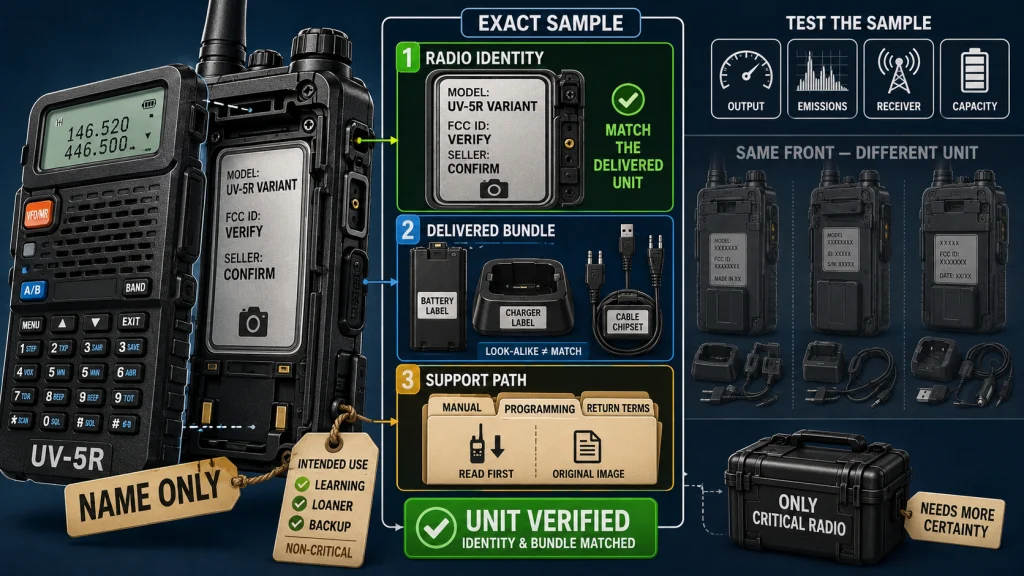
Baofeng UV-5R Review: Start With the Exact Radio, Not the Name
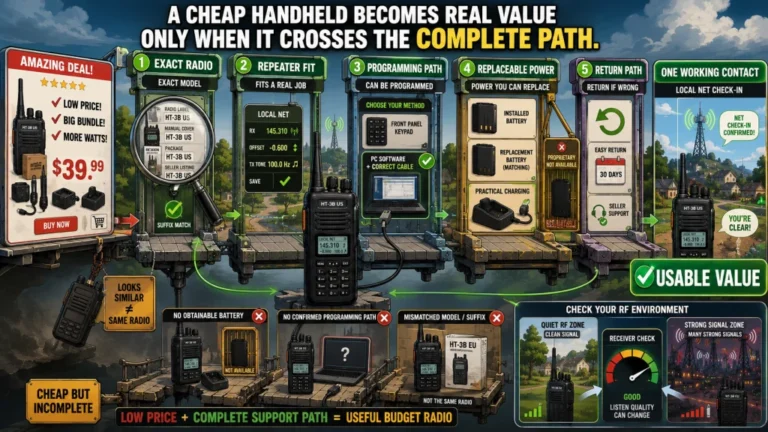
The UV-5R name has survived through years of revisions, alternate cases, seller bundles, relabeled units, and listings that sometimes use “Baofeng UV5R” as though every radio were interchangeable. They are not. Two radios with the same front badge may have different labels, firmware families, batteries, chargers, transmit limits, programming behavior, or support paths.
That is why I would not begin this purchase by asking whether the UV-5R is famous, cheap, or popular. I would begin by asking whether the seller has shown enough information to identify the exact unit. A review of one measured sample can tell you something about that sample; it cannot automatically prove the emissions, receiver performance, output power, or battery capacity of another unit from another seller.
| Reference point checked July 21, 2026 | What was available | What remains unproven |
|---|---|---|
| Product and seller | UV-5R 5W Dual Band Radio, SKU 28-020-105, on a Baofeng-branded storefront | Whether another marketplace listing supplies the same hardware |
| Listing status and price | Listed at $22.99 and shown as sold out at the time checked | The price, stock status, and bundle at a later date |
| FCC identification | The listing states FCC ID 2AJGM-UV5R | Whether the radio delivered by a different seller carries that exact ID |
| Included items | Radio, 1800 mAh battery, antenna, earpiece, belt clip, hand strap, manual, adapter, and desktop charger | Actual battery capacity, charger construction, and accessory quality |
| Firmware information | No useful firmware or hardware revision was stated on the product page | Image compatibility with another UV-5R-branded radio |
| Return terms | No complete return window was presented beside the reference listing details reviewed | Whether a buyer can return an opened radio after label or programming checks |
Evidence status: Research-based. HamRigs did not inspect or laboratory-test the reference unit, so performance judgments below are limited to documented capabilities, verified listings, official records, and measurements tied to identified samples.
A buyer also cannot prove authenticity from the front logo alone. Treat mismatched listing photos, model wording that changes between the sales page and the delivered package, a battery or charger labeled for another radio, missing rear-label images, or substituted accessories as reasons to stop. Preserve the listing before ordering, compare the package as soon as it arrives, and use the return window when the seller sends something materially different from what was represented.
This scope matters because one US distributor now lists its historical UV-5R as discontinued, while another Baofeng-branded storefront still presents a UV-5R for sale. That does not prove either listing is wrong. It shows why generation, support, and specification must be attached to a clearly identified sales channel rather than assumed from the badge.

This two-radio UV-5R bundle includes 3800mAh rechargeable batteries, Type-C charging, a programming cable, tactical antennas, and earpieces. The Amazon listing identifies the package as an 8-watt UV-5R configuration rather than a generic radio bundle. Its clearly listed components give buyers a concrete configuration to compare with the delivered labels, batteries, charger, and accessories.
Check On AmazonIf you click this link and buy, we earn a commission at no additional cost to you.
What the UV-5R Can Do When the Variant Is Properly Identified
At its core, the UV-5R is an analog VHF/UHF handheld designed around common local amateur-radio tasks. A suitable unit can be programmed for analog simplex channels and repeaters, store memory channels, apply transmit and receive tones, scan, and operate from a removable battery. Those capabilities are enough for a new Technician to learn how a local communication path is assembled.
A practical example is one known repeater memory. The radio needs the repeater output as the receive frequency, the correct offset direction and spacing, the required access tone, an appropriate transmit power setting, and a saved memory that can be recalled later. When all of those fields match the local system, the UV-5R can perform the same basic contact task as a more expensive analog handheld.
The large user base also means that programming explanations, menu references, cable troubleshooting notes, and community experience are widely available. That documentation is an advantage only when it applies to the same variant. Instructions for a visually similar three-power version, tri-band version, or later internal revision may not map cleanly to a basic UV-5R.
- Good use of the feature set: Store a small group of verified local repeater and simplex memories, then practice recalling and using them.
- Poor use of the feature set: Import a large frequency list without confirming which channels are legal, reachable, active, or configured correctly.
- Good use of the removable battery: Confirm the exact battery family, charging method, and condition before depending on a spare.
- Poor use of the display range: Assume every frequency shown on the screen is authorized for transmission.
The distinction is simple: the UV-5R offers enough controls to build a working local memory, but it does not verify the data or operating authority for you. Its usefulness rises sharply when the owner starts with one proven channel instead of treating the radio as a universal walkie-talkie.
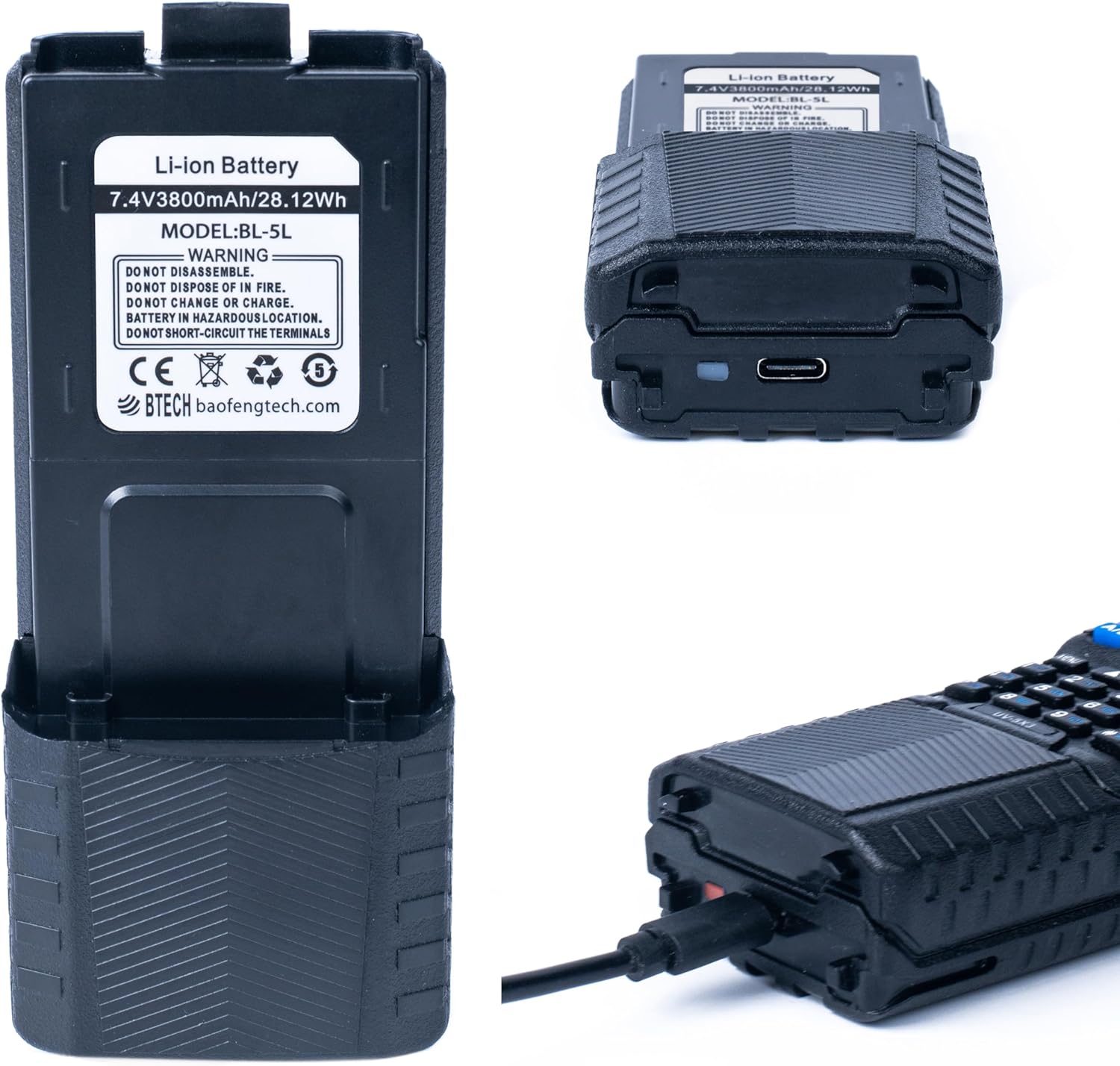
The BL-5L is a 3800mAh Li-ion extended battery listed for UV-5R, UV-5X3, and BF-F8HP radios. It gives a UV-5R owner a named spare-battery option tied to a specific battery family instead of an unspecified replacement pack. The extended format also provides a clearly identified power accessory to match against the radio and charging setup in hand.
Check On AmazonIf you click this link and buy, we earn a commission at no additional cost to you.
What a UV-5R Ham Radio Review Must Verify
The most consequential claims are the ones that cannot be confirmed by turning the radio on. The display may show a frequency, the battery label may show a capacity, and the listing may show an output rating, but none of those observations proves clean emissions, real capacity, receiver selectivity, or consistent performance under strong nearby signals.
Independent measurements of specific UV-5R samples have not all produced the same story, which is exactly why sample identity matters. A clean result from one labeled unit should not be copied onto an unverified bundle, and a failed sample should not be used to declare every UV-5R ever sold defective. The responsible conclusion is narrower: electrical performance needs unit-specific evidence when it matters to the role.
| Claim | Why the listing is not enough | Practical verification |
|---|---|---|
| Authorized transmit frequencies | Tuning range and legal operating authority are different questions | Match the rear label, FCC ID, license privileges, and applicable service rules |
| Output power | Advertised power can differ by band, battery voltage, sample, and test method | Use a suitable power meter and dummy load if the number affects the decision |
| Spurious emissions | A front-panel test cannot reveal unwanted transmitter output | Rely on measurements tied to the exact unit or test the sample with appropriate equipment |
| Receiver overload and selectivity | A quiet rural test may not reveal problems near strong broadcast or commercial transmitters | Run a repeatable listening comparison at the intended locations |
| Battery capacity | The printed number does not establish usable capacity or cell condition | Run a controlled receive and transmit cycle and inspect charging behavior |
| Charger safety | Similar-looking docks and adapters can come from different suppliers | Check labeling, voltage, physical condition, heat, fit, and seller support |
| Water resistance | A rugged appearance is not an ingress-protection rating | Require a documented rating for the exact model if rain exposure matters |
| CHIRP compatibility | Badge similarity does not guarantee compatible memory images or model selection | Download from the exact radio first and preserve its original image |
A common mistake is upgrading the antenna before testing the receiver environment. A more efficient antenna may improve a weak signal in one location, yet expose a wide-front-end receiver to more strong nearby RF in another. When reception becomes worse after the antenna change, the problem may be overload rather than a defective antenna or insufficient gain.
Simple receiver-overload check: Start with the stock antenna and one known, stable local signal in a relatively quiet location. Repeat the same listening test where you intend to operate, then try the more efficient antenna without changing frequency, squelch, or position unnecessarily. A desired signal that becomes weaker or disappears, unrelated audio appearing on several channels, or widespread false squelch openings can indicate overload. If reception returns when you reinstall the stock antenna or move away from the strong-signal area, overload is plausible, although this listening check is not a laboratory measurement.

The SW-102 is a digital VHF/UHF meter covering 125 to 525 MHz for antenna power and SWR checks. Its frequency range covers the VHF and UHF bands used by the UV-5R, making it useful for measured setup checks instead of relying only on advertised output claims. The meter provides a compact way to inspect power and standing-wave ratio in a controlled test setup.
Check On AmazonIf you click this link and buy, we earn a commission at no additional cost to you.
Programming Is Manageable, but the Workflow Matters
The front panel can handle basic frequency and repeater setup, but it is not forgiving when several fields must be entered in the right sequence. A new owner can display the correct repeater output and still fail to make a contact because the offset, tone mode, tone value, power level, or saved memory is wrong. The screen looking correct is not proof that the stored channel is complete.
The recurring gap I see with new licensees is not a lack of intelligence or effort. They often know what a repeater is, but the exam did not teach the button sequence for their exact radio, the behavior of their USB cable, or the difference between editing a frequency on the screen and saving a complete memory. That is why I treat the programming workflow as part of the buying decision, not an afterthought.
A USB programming cable adds another variable. The connector may look like the familiar two-pin K-plug while the internal USB-to-serial chipset requires a different driver. A cable can also appear connected when the plug has not fully seated, which may cause read failures, upload errors, or unexpected keying.
- Confirm the cable and port: Seat the two-pin plug fully, identify the USB-to-serial chipset, and verify which serial port the computer assigned.
- Install a current CHIRP build: Confirm that the exact model selection applies to the radio in hand rather than choosing a similar-looking badge.
- Read from the radio first: Create a radio-specific image before importing any channel data.
- Save the untouched image: Keep one clean backup and edit a separate working copy.
- Build one known-good channel: Enter receive frequency, shift, offset, tone mode, tone value, power, and a short name.
- Upload and verify: Recall the saved memory on the radio, listen, and confirm the complete path before importing a large list.
Do not upload an image taken from another UV-5R merely because both radios share a name. CHIRP documentation and support history repeatedly point back to the same safe method: download from the target radio first, then import channel data into that radio-specific image. Calibration and revision-dependent data should not be treated as a generic template.
If the radio stops behaving correctly after an upload, return to the untouched image from that exact unit before trying random recovery files. For a fuller workflow, use the read-before-write CHIRP process and prove one memory before building the rest of the channel list.

This USB programming cable uses a CH340 chipset and a two-pin connector. The Amazon compatibility table specifically lists the UV-5R along with BF-F8HP, UV-82, 5RM, and other supported radios. Its identified chipset and connector type make the driver, serial-port, and radio-selection checks in a CHIRP workflow easier to troubleshoot.
Check On AmazonIf you click this link and buy, we earn a commission at no additional cost to you.
Legal Operation Depends on the Service, License, and Exact Transmitter
Possessing the radio and receiving a signal are not the same as having authority to transmit. In the United States, an amateur operator may transmit only within the privileges of the control operator’s license and under the amateur rules. A wide displayed tuning range does not grant permission to use public-safety, business, aviation, marine, GMRS, or FRS channels.
The FCC ID is also not a universal permission slip. It identifies an equipment authorization record tied to particular rule parts and configurations; it does not make every frequency the radio can enter legal for every owner. Within amateur operation, the control operator remains responsible for using an authorized frequency, suitable emission, necessary bandwidth, and a transmitter that does not cause harmful interference.
Warning: Do not use an amateur UV-5R for GMRS or FRS transmission. GMRS transmitting requires equipment certified for GMRS under Part 95E, and holding a ham license does not change that requirement. FRS likewise relies on service-specific certified equipment. Technical access to those channels is not transmit authority.
A practical example is a family plan built around GMRS. Even when a licensed amateur can manually enter the same frequency into a UV-5R, that does not turn the amateur handheld into a compliant GMRS transmitter. The correct path is to use equipment certified for the service and operate under that service’s rules.
This section is limited to the buying decision and the most common cross-service mistake. For the broader US licensing framework, read how ham radio operating privileges work before programming transmit memories.

The GXT1000VP4 is a two-radio GMRS package with 50 channels, 142 privacy codes, NOAA weather alerts, and rechargeable battery packs. Midland identifies the GXT1000 line as GMRS equipment and states that GMRS operation requires an FCC license. The bundle includes a desktop charger and boom-mic headsets, making it a service-specific alternative when GMRS communication is the actual goal.
Check On AmazonIf you click this link and buy, we earn a commission at no additional cost to you.
Baofeng UV-5R Pros and Cons by Use Case
The question “is the Baofeng UV-5R good?” needs a role attached to it. A low price can make uncertainty acceptable for a learning radio and unacceptable for a critical communication tool. The same unit may be a sensible experiment for one operator and the wrong choice for another who needs predictable support and documented environmental protection.
| Use case | Fit | Reason |
|---|---|---|
| Learning analog repeater and simplex programming | Reasonable | Low financial exposure and enough controls to learn the complete memory path |
| Loaner for supervised practice | Reasonable with verification | Works when the exact channel set, battery, and operating limits are controlled beforehand |
| Experiment or non-critical backup | Potentially suitable | The owner can accept troubleshooting, test the unit, and maintain another communication option |
| Dense high-RF location | Uncertain to poor | Receiver behavior must be tested where strong nearby transmitters are present |
| Only radio for a critical communication role | Poor | Variant uncertainty and unverified unit behavior are the wrong trade-off for a single point of failure |
| Regular use in rain, dust, or rough field conditions | Poor without documentation | Appearance does not establish weather resistance or ingress protection |
| Buyer wanting simple controls and current support | Often poor | The menu system, cable workflow, seller variation, and aging platform add friction |
The best fit is a buyer who sees the radio as a controlled learning tool. That person will verify the label, build a small channel set, test the receiver locally, keep expectations modest, and maintain another option for any communication task that cannot tolerate failure.
The poor fit is a buyer trying to make the lowest purchase price solve every problem. A longer antenna does not guarantee better reception, a higher claimed wattage does not guarantee a better path, and a large frequency range does not create legal authority or local activity.

This travel case is listed for the Baofeng UV-5R family as well as several related handheld models. Its interior uses thickened sponge protection to hold the radio and accessories during storage or transport. It suits a UV-5R used as a learning radio, loaner, or non-critical backup without implying weather protection for the radio itself.
Check On AmazonIf you click this link and buy, we earn a commission at no additional cost to you.
What Additional Money Should Buy
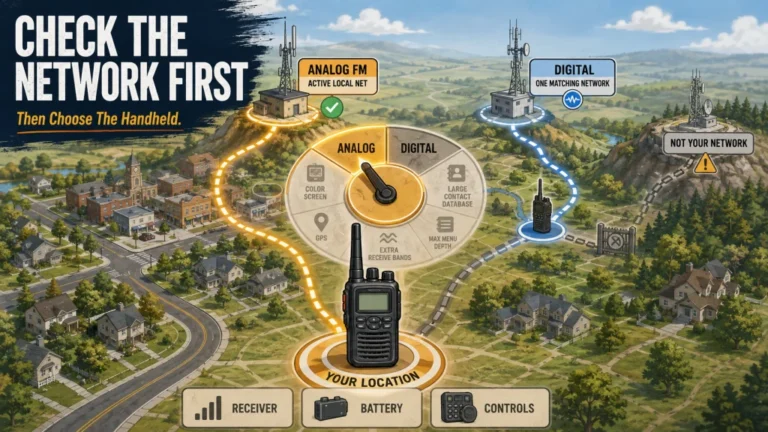
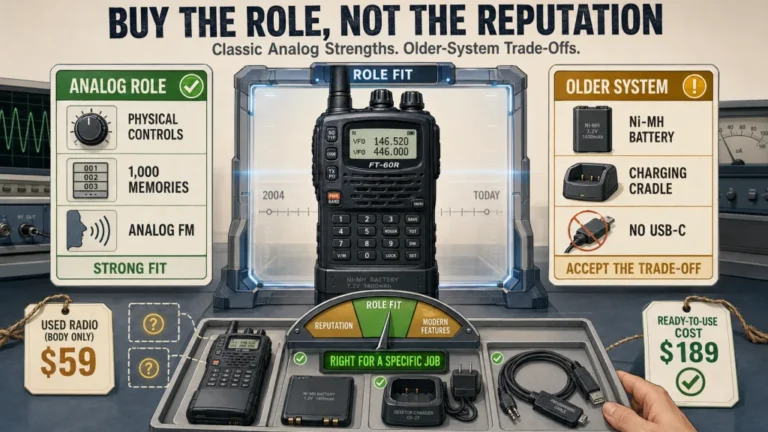
A newer or more expensive handheld is not automatically better. The useful comparison is whether the extra cost removes a limitation that matters in your location and operating routine. Paying more for decorative features while keeping the same weak receiver behavior, unclear support, or awkward programming would not improve the real communication path.
At the low-cost end, additional money should buy a clearly identified current model, stable seller support, an exact manual, consistent accessories, documented CHIRP behavior, and a return policy that allows basic verification. For readers staying within that tier, the practical budget-handheld comparison explains how to compare usable support and compatibility rather than advertised feature count.
A step-up analog handheld should earn its price through a stronger receiver in difficult RF environments, clearer controls, more predictable unit-to-unit behavior, documented environmental protection where applicable, and a support path that still exists. The step-up analog handheld case study shows why longevity, receiver behavior, and interface design can matter more than another row of features.
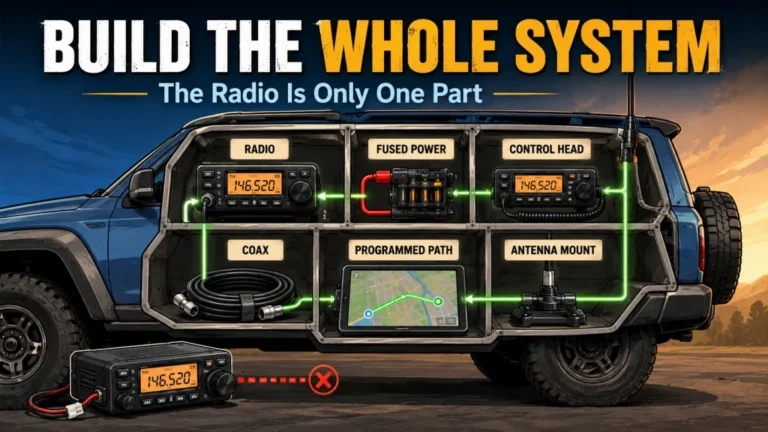
Before comparing price tiers, decide whether a handheld is even the correct radio type. A mobile radio and an external antenna may solve a weak local path more effectively than replacing one handheld with another. Use the handheld selection framework to separate use case, local coverage, antenna limits, controls, and support before focusing on the badge.

The BF-F8HP is a UV-5R-family dual-band handheld with 8, 4, and 1 watt power settings and a 2100mAh battery in the listed kit. The package includes a V-85 antenna, charger, earpiece, belt clip, wrist strap, and user manual. BTECH also lists US-based support, giving this step-up option a more clearly defined support and accessory package than an anonymous UV-5R bundle.
Check On AmazonIf you click this link and buy, we earn a commission at no additional cost to you.
Verdict: Useful at the Right Price, Risky in the Wrong Role
Research-based verdict: Buy the UV-5R when you want an inexpensive classroom for analog handheld basics and are willing to verify, program, and troubleshoot the unit. In that defined role, it gives a new operator enough control to learn memories, tones, offsets, simplex, and repeaters without committing a large budget.
A listing earns consideration when it shows the actual rear label, identifies the battery and charger, states workable return terms, and avoids borrowing performance claims from a different version. A seller that hides those details is asking the low price to compensate for uncertainty it could have removed.
For a new Technician with one reachable local repeater, a modest budget, and patience for CHIRP, the UV-5R can be a rational first purchase. Move to a better-supported handheld when strong-signal performance, weather protection, simpler controls, or predictable unit-to-unit behavior matters more than minimizing the initial cost.

This charging kit includes a desktop charger base, a 100V to 240V US adapter, and a USB charger cable for UV-5R-series radios and the BF-F8HP. It provides a clearly identified replacement charging path for owners checking whether the charger in a bundle is the correct accessory family. The listing ties the kit to named compatible radio series instead of relying on appearance alone.
Check On AmazonIf you click this link and buy, we earn a commission at no additional cost to you.
Final Thoughts: Give the UV-5R One Defined Job
The fairest trial is a narrow one. Program one reachable repeater, save one simplex channel, carry the radio during ordinary non-critical use, and notice whether the controls, receiver behavior, battery routine, and local activity fit the way you actually operate.
Keep it when it performs that job consistently and the troubleshooting remains acceptable for the money saved. Return it or move up a tier when basic setup consumes the entire return period, reception collapses in your normal RF environment, or the role demands support and protection the unit cannot document. That is a buying decision based on use, not on either the cult following or the backlash around the name.

The QHM22 is a heavy-duty IP54 speaker microphone using the Kenwood-style two-pin accessory connection used by the UV-5R and BF-F8HP. It includes a 3.5mm listen-only earpiece jack and an impact-resistant housing for shoulder-mic use. Its documented UV-5R compatibility makes it a practical accessory for ordinary non-critical operation while keeping push-to-talk access on the shoulder.
Check On AmazonIf you click this link and buy, we earn a commission at no additional cost to you.
FAQs
These questions focus on the decisions a new operator should settle before ordering, programming, or transmitting with a UV-5R-branded radio.
📻 Is the Baofeng UV-5R good for a first ham radio?
It can be good for low-cost learning when the exact unit is identified and the buyer accepts programming and quality uncertainty. It is a weaker choice when the first radio must also be the only dependable communication tool.
🏷️ How do I know which UV-5R variant I am buying?
Ask for clear photos of the rear label, model wording, FCC ID, battery, charger, and complete package. Save those details with the order because the front badge alone is not enough to establish the hardware or support path.
💻 Can every Baofeng UV-5R use CHIRP?
Many UV-5R and related variants are supported, but the safe workflow is to select the correct model and download from the exact radio first. Do not upload a memory image taken from another radio simply because the badges match.
🔌 Why will my UV-5R programming cable not connect?
The plug may not be fully seated, the USB-to-serial chipset may need a different driver, or the wrong radio model may be selected. Confirm the port, driver, connector fit, current software version, and exact radio selection before changing channel data.
📡 Can I transmit on GMRS or FRS with an amateur UV-5R?
No. GMRS and FRS transmission require equipment certified for those services, and a ham license does not convert an amateur handheld into compliant GMRS or FRS equipment.
⚡ Does a higher advertised wattage make a UV-5R better?
Not by itself. Actual output can vary, and antenna location, terrain, receiver behavior, repeater coverage, battery condition, and clean emissions can matter more than the number in the listing.
🌧️ Is the Baofeng UV-5R waterproof?
Do not assume it is waterproof from its appearance. Require a documented ingress-protection rating for the exact model if rain, dust, or outdoor exposure is part of the intended use.
🔍 How can I spot a relabeled or questionable UV-5R?
Compare the delivered rear label, model wording, battery, charger, accessories, and packaging with the saved sales page. Mixed product photos, substituted parts, or a package that identifies another model are practical reasons to use the return policy rather than guess about authenticity.
🧪 Do all UV-5R radios have the same transmitter quality?
No universal conclusion is justified from one sample. Measurements should be tied to the exact unit or clearly identified variant, especially when emissions performance matters to the decision.