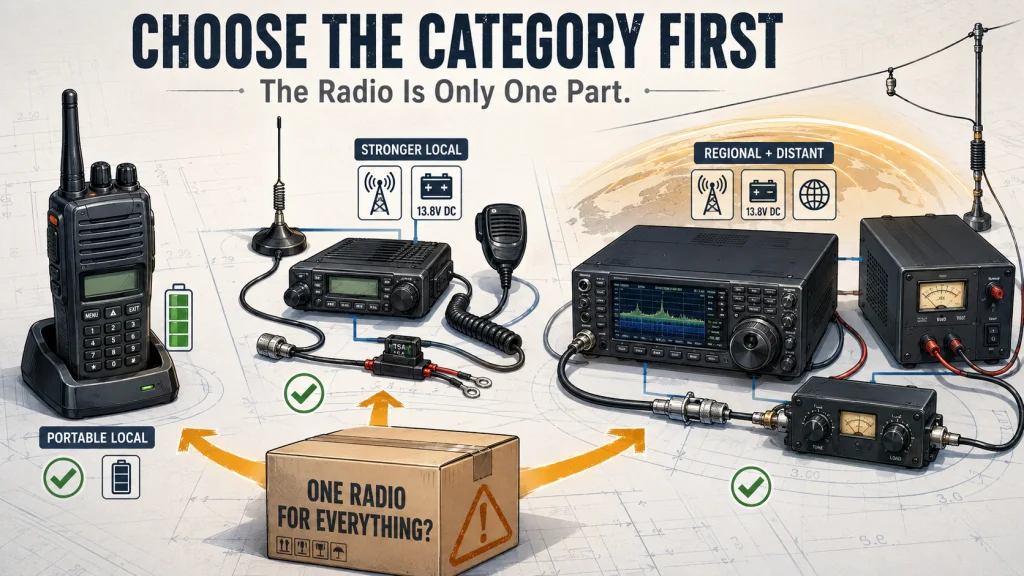
The best ham radio is not one universal model. A beginner should first decide whether the intended activity calls for a handheld, a higher-power VHF/UHF mobile radio, or an HF transceiver, then confirm that the license privileges, antenna, power source, and operating location support that choice. The radio body is only one part of the usable station, especially with mobile and HF equipment. This guide explains the three categories, the trade-offs that separate them, and which detailed buying guide to use next.
The Best Ham Radio Starts With the Right Category
The best ham radio for local repeater use is not automatically the best radio for a vehicle, a home VHF/UHF station, or regular HF contacts. Those are different operating jobs. Comparing all of them in one ranked list is like comparing a pocket flashlight, a truck-mounted light bar, and a house wiring system because all three produce light.
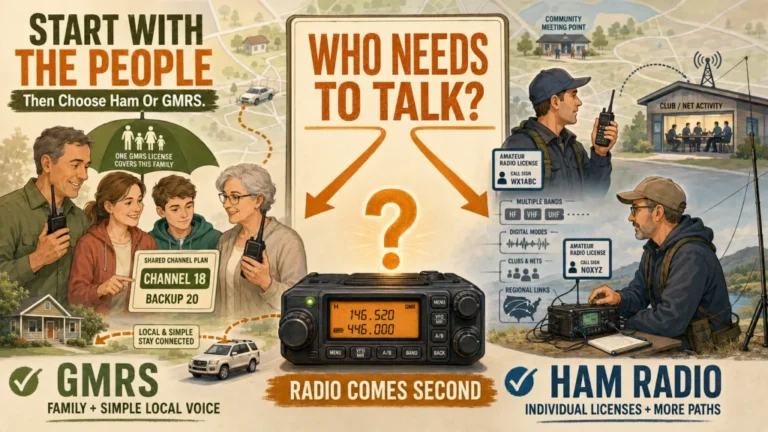
The question I hear most often after an exam session is which radio a new licensee should buy. I usually answer with another question: what do you want the radio to do during the first six months? A person who wants to join a nearby weekly net needs a different starting point from someone who wants to work stations across several states from home.
A top ham radio list becomes misleading when it mixes handhelds, VHF/UHF mobile transceivers, and HF equipment as though they were substitutes. They differ in bands, power sources, antenna requirements, installation effort, operating range, and total station cost. The first useful decision is the category, not the brand badge or the longest feature list.
This page is an orientation, not a model ranking. It does not teach licensing, install an antenna, program a repeater, or compare amateur radio with another service. Its job is to prevent the most expensive early mistake: buying a capable radio that solves a problem you did not have.
Decision One: Name the Operating Goal
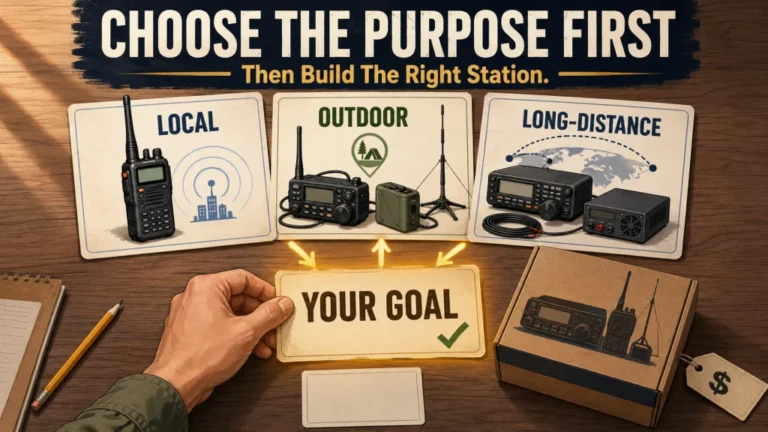
Start with the contact you want to make, not the radio you have seen recommended most often. The useful distinction is not simply portable versus nonportable. It is whether you need local VHF/UHF access from your hand, stronger VHF/UHF performance through an external antenna, or access to the HF bands for regional and long-distance operation.
| Your first operating goal | Category to examine first | The condition that can change the answer |
|---|---|---|
| Join local repeaters, monitor events, or carry a radio while walking | Handheld transceiver | The repeater must be active and reachable from the places where you will operate. |
| Use VHF/UHF from a vehicle or build a stronger home local station | Mobile transceiver | You need a suitable external antenna, power arrangement, and installation location. |
| Make regular contacts beyond the local area on HF | HF transceiver | License privileges, antenna space, power, propagation, and complete station cost matter together. |
The table gives a starting direction, not a promise of range. A handheld may reach a distant repeater from a high open location and fail to reach a closer one from inside a concrete building. A higher-power mobile radio may improve the link, but it cannot transmit through terrain that blocks the path. HF can reach far beyond the local area, but propagation and antenna performance still decide which stations are available at a given time.
When the goal is still vague, stop before comparing specifications. The overview of common ham radio use cases is designed to help separate local conversation, travel, public-service activity, home HF, and other beginner-to-intermediate paths. Once one experience matters more than the others, the category choice becomes much easier.
Decision Two: Match the Radio to Your License Privileges
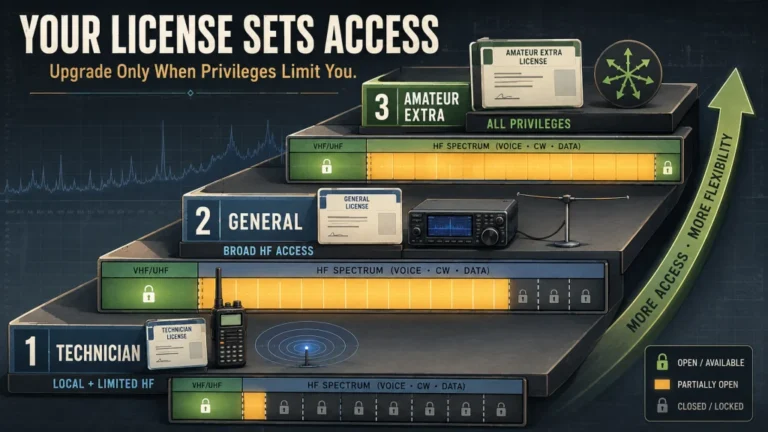
A radio can cover frequencies that the operator is not authorized to use. Buying the hardware does not expand the license. This matters most when a Technician licensee sees an all-band or HF-capable radio and assumes every transmit function becomes available immediately.
Technician licensees have broad amateur privileges at 50 MHz and above, which supports the VHF and UHF activity served by most beginner handheld and mobile radios. Technicians also have limited HF privileges, so it is incorrect to say they cannot use HF at all. Their RTTY and data privileges, including FT8, are limited to 28.000 through 28.300 MHz on the 10-meter band, and broad HF voice and data access across the commonly used bands requires a General or higher license.
That boundary should shape the purchase without turning the radio decision into a licensing lecture. A Technician focused on local repeaters can choose an appropriate VHF/UHF radio and use it fully within the relevant amateur bands. A Technician whose main goal is broad HF operation should treat the General upgrade, the HF radio, and the antenna plan as parts of one path.
The practical comparison is covered in the guide to Technician and General license differences. Read that before paying for capability that your current privileges do not support, but do not assume the highest license class or the widest-coverage radio is automatically necessary for local operation.
Key point: Match three things before buying: the activity, the legal privileges, and the station the radio requires. A mismatch in any one of them can make a good transceiver feel like the wrong product.
Category One: Handheld Transceivers
Evidence level: Research-based category guidance. No individual handheld is presented here as tested or inspected by HamRigs.
A handheld transceiver, often called an HT, combines the radio, rechargeable battery, controls, speaker, microphone, and compact antenna into one portable unit. Most beginner-oriented amateur handhelds focus on VHF, UHF, or both. Many operate in the 5-watt class, although output levels and supported bands vary by model.
The strongest reason to start with a handheld is convenience. It can be carried to a club event, used to listen while learning local repeater activity, or placed in a bag without building a permanent station first. For a new Technician with reachable local repeaters, that low setup burden can turn a license into actual operating experience quickly.
The weakness is that portability creates compromises. A short stock antenna, indoor operation, low elevation, surrounding buildings, and terrain may matter more than the difference between two radios with similar output power. Buying a more expensive handheld does not automatically cure a poor radio path.
Digital voice support is another place where beginners can overbuy. A digital mode is useful when the local repeaters and operators you intend to use support it, or when you have a clear network plan. It is not automatically an upgrade over analog FM for every location. Local infrastructure should decide whether that feature belongs near the top of the list.
A handheld is usually the right category to examine first when you need:
- A battery-powered radio that can be carried easily.
- Access to reachable local VHF or UHF repeaters.
- A low-complexity way to listen and learn operating procedures.
- A radio for club events, walks, or short portable activities.
The usable cost may extend beyond the radio body. Check what the package actually includes, then consider whether your use requires a programming cable, spare battery, charging option, speaker microphone, or a different antenna. None of those accessories should be treated as mandatory until the operating situation gives them a job.
Readers who have already chosen this category should continue to the best handheld ham radio guide. That is where individual features and category-specific trade-offs can be compared without pretending an HT is also a vehicle station or an HF base radio.

The Yaesu FT-65R is a compact 144/440 MHz dual-band handheld transceiver with up to 5 watts of output. The verified listing identifies the exact FT-65R model and lithium-ion battery operation. It also describes the radio as a rugged, compact handheld with selectable transmit power.
Check On AmazonIf you click this link and buy, we earn a commission at no additional cost to you.
Category Two: Mobile VHF/UHF Transceivers
Evidence level: Research-based category guidance. No individual mobile transceiver is presented here as tested or inspected by HamRigs.
A mobile transceiver is designed around external DC power and an external antenna. Many amateur VHF/UHF mobiles operate in roughly the 25-to-50-watt class, with some models offering more, but output power is only part of the improvement over a handheld. The external antenna and its location often make the larger practical difference.
In a vehicle, the radio may be mounted under the dashboard, under a seat, or with a remotely located control head, depending on the design and the available space. At home, the same category can serve as a local base station when paired with a suitable 13.8-volt DC power supply and an outdoor or attic antenna appropriate to the situation.
This category makes sense when a handheld works in some places but not reliably from the vehicle or home location, or when the operator wants stronger audio, more transmit power, and a permanent external antenna connection. It is also useful for a person who knows local and regional VHF/UHF activity is the real destination, not merely a temporary step toward HF.
The mistake is pricing only the radio body. A mobile installation may also need an antenna, mount, feedline, fused power wiring, hardware for the control head, and professional installation when the operator cannot route power safely. A home setup replaces the vehicle wiring problem with a power-supply and antenna-location decision.
More watts do not create a universal coverage radius. If the antenna is poorly located, the feedline is unsuitable, or a ridge blocks the path, the station may still disappoint. A lower-power radio connected to a well-positioned antenna can outperform a more powerful radio trapped behind a bad installation.
Use the best mobile ham radio guide after confirming that external power and an antenna installation are acceptable. That category page can compare display layouts, remote-head options, bands, analog and digital support, and installation needs without mixing them with handheld priorities.

The Icom IC-2730A is a dual-band VHF/UHF mobile transceiver with up to 50 watts of output on both bands. It supports simultaneous VHF/VHF, UHF/UHF, or VHF/UHF receive and uses a separate controller layout for operating the two sides of the radio. The U.S. version transmits on the 144 to 148 MHz and 430 to 450 MHz amateur bands.
Check On AmazonIf you click this link and buy, we earn a commission at no additional cost to you.
Category Three: HF Transceivers
Evidence level: Research-based category guidance. No individual HF transceiver is presented here as tested or inspected by HamRigs.
HF transceivers serve the part of amateur radio most closely associated with regional, national, and international contacts. The category includes full-size desktop radios, compact radios that can be used at home or in a vehicle, portable all-mode units, and low-power QRP equipment. Those subtypes can look similar in a product photo while creating very different stations.
A common full-power HF transceiver operates in the 100-watt class and often requires a substantial 13.8-volt DC power supply unless it has an internal AC supply. Portable and QRP radios may operate at 5 or 10 watts and can reduce the power burden, but lower output changes the operating challenge. QRP is not automatically the easiest or cheapest first HF experience simply because the radio is smaller.
The antenna is central to the decision. A radio covering several HF bands does not mean one small antenna will perform equally well on all of them. Available yard space, rental or HOA restrictions, portable setup time, feedline routing, and the bands you actually intend to use may matter more than a secondary radio feature.
Any article covering a home antenna also needs one legal boundary stated clearly: PRB-1 concerns state and local land-use regulation and does not override private HOA covenants, CC&Rs, or rental agreements. A buyer should understand the property limitation before treating an HF radio purchase as the beginning of an automatic home-station build.
The complete HF station may include a DC power supply, antenna, feedline, connectors, mounting hardware, and an antenna tuner when the chosen radio-and-antenna combination requires one. Digital operation may also require USB audio and control functions or a separate interface when the transceiver does not provide them internally.
This is why the best amateur radio cannot be chosen from receiver features alone. A less expensive radio that leaves enough budget for a suitable antenna and power system may create a more usable station than a premium radio connected to an improvised antenna that does not fit the location.
Once HF is the confirmed direction, continue to the best HF ham radio guide. That page can separate full-power base radios, compact units, portable equipment, and QRP without turning this overview into a long list of model names.

The Yaesu FT-891 is an HF/50 MHz all-mode transceiver with 100-watt output capability. The verified listing identifies coverage from the 160-meter through 6-meter amateur bands and the exact FT-891 model. It is described as an ultra-compact mobile and base transceiver.
Check On AmazonIf you click this link and buy, we earn a commission at no additional cost to you.
Compare the Complete System Cost, Not the Radio Price
The price shown beside a transceiver answers only one part of the buying question. A usable station needs a power source, an antenna system, and the connections required for the chosen activity. The difference is small for some handheld packages and substantial for many mobile or HF installations.
| Category | Usually needed to transmit | Costs that beginners often discover later |
|---|---|---|
| Handheld | Radio, battery, charger, and antenna, often supplied as a package | Programming cable, spare battery, alternate charging, speaker microphone, or an antenna chosen for a specific use |
| Mobile VHF/UHF | Radio, external antenna, antenna mount, feedline, and 13.8-volt power | Vehicle power wiring, remote-head hardware, home power supply, installation labor, or an external speaker |
| HF | Radio, suitable antenna, feedline, power source, and required connectors | Antenna tuner when needed, interface functions, mounting hardware, portable power, and changes required by the property or operating location |
The word “needed” depends on the exact station. Some radios include functions that another radio requires as an external accessory. Some antennas need a tuner over part of their operating range, while a resonant antenna may not. Some handhelds include a complete charging package, while others are sold in configurations that change by market or suffix.
That is why two radios with different body prices cannot be compared honestly until the complete station is listed. The cheaper transceiver may need more external hardware. The more expensive one may include an interface, tuner, or control feature that removes another purchase, but only if that feature matters to the intended activity.
Before paying, write down the whole first-day station:
- The radio and exact US model suffix.
- The antenna and where it will be installed or deployed.
- The power source under normal operating conditions.
- The feedline, mount, adapters, and connectors actually required.
- The programming or digital connection needed for the intended mode.
- Any item assumed to be included in the box.
The broader starter-equipment overview, what you need to start, helps separate essential station parts from accessories that can wait. That check is more useful than padding the cart with items described as beginner necessities but tied to no specific operating problem.

The Powerwerx SS-30DV is a desktop switching power supply rated for 25 amps continuous and 30 amps surge at 14.1 VDC. It provides Powerpole outputs on the front and binding posts on the rear. The manufacturer describes it as a compact regulated DC supply suitable for radio and other equipment.
Check On AmazonIf you click this link and buy, we earn a commission at no additional cost to you.
How HamRigs Labels Recommendation Evidence
A buying recommendation should tell you what kind of evidence supports it. Manufacturer specifications can confirm bands, power requirements, dimensions, connectors, included accessories, and supported modes. They cannot prove long-term durability, receiver behavior in a crowded local environment, or how comfortable a menu will feel after months of use.
HamRigs uses three evidence labels:
- Tested by HamRigs: The product has been operated by HamRigs under conditions stated in the article. Claims are limited to what was actually tested.
- Hands-on inspection: The product has been physically examined for controls, connections, construction, menus, or included parts, but the article does not imply a complete operating test.
- Research-based: The recommendation relies on current manufacturer pages and manuals, FCC equipment records where relevant, attributable independent measurements, and clearly identified owner evidence. No firsthand use is implied.
All category guidance on this page is Research-based. The page recommends a decision path, not an individual model. Product-level pages must state their evidence level and recheck the exact model suffix, current US availability, warranty, firmware or support status, included accessories, and current price before publication.
Warning: A model name without its suffix may refer to different regional versions or generations. Frequency coverage, included accessories, warranty support, and legal market status should never be assumed from a similar-looking version sold elsewhere.
This standard also prevents a common review problem: turning manufacturer language into a performance conclusion. A specified output power is a fact. “Excellent range” is not a fact unless the conditions, antenna, terrain, and comparison method are known.
Use This Decision Path Before Comparing Models
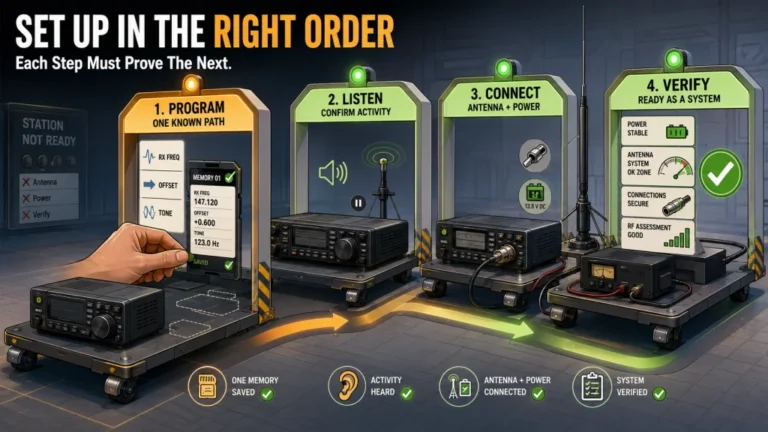
If you already know the operating goal, choose the category that directly serves it. Local portable VHF/UHF points first to handhelds. A vehicle or stronger home VHF/UHF station points to mobile equipment. Broad HF operation points to an HF transceiver and a complete antenna-and-power plan.
If the answer is still “I want a radio that does everything,” pause. Wide frequency coverage can be useful, but it does not remove the need for different antennas, modes, power arrangements, and license privileges. One radio may cover several categories while still being a poor first station for the location or activity.
My practical rule is to choose the smallest station that can give the intended activity a fair test. That may be a handheld for a confirmed local repeater, a mobile radio and external antenna for dependable local VHF/UHF, or an HF station whose antenna is planned before the radio consumes the budget. Starting smaller is useful only when the smaller station still reaches the destination.
The right next guide should now be obvious. Do not compare individual handhelds if you need HF, and do not let a full-featured HF radio distract you when the real goal is a local weekly net. Category discipline makes later product comparisons shorter, clearer, and less expensive.
Final Thoughts: Let the Use Case Choose the Radio Category
The best radio is the one that connects the license, operating goal, antenna, power source, and budget into a usable station. A handheld, mobile transceiver, and HF radio can all be excellent choices, but not for the same job.
I would choose the intended contact first, confirm the legal privileges second, and price the complete station third. Only then would I compare models. That order keeps an attractive feature list from deciding what the hobby becomes.
Explore Ham Radio Buying Guides
Each guide below stays within one equipment category so the comparisons remain meaningful. Use the category that matches the operating goal, power arrangement, and antenna system you are prepared to support.
| Guide | What it helps with |
|---|---|
| Best Handheld Ham Radios | Compare portable VHF/UHF radios for repeaters, local activity, events, and low-complexity first stations. |
| Best Mobile Ham Radios | Choose higher-power VHF/UHF equipment for vehicles or home stations using external antennas and DC power. |
| Best HF Ham Radios | Separate base, compact, portable, and QRP equipment while accounting for the antenna and full station cost. |
Once the category is correct, model-level differences become useful instead of distracting.
FAQs
📻 What type of ham radio should a beginner buy?
Choose by activity. A reachable local repeater may point to a handheld, stronger vehicle or home VHF/UHF use may point to a mobile radio, and broad HF operation points to an HF transceiver and antenna plan.
🪪 Can a Technician license use an HF radio?
Yes, within Technician HF privileges. Those privileges are limited, so a buyer seeking broad HF voice and data access across several bands should include a General upgrade in the plan.
🚗 Can a mobile ham radio be used at home?
Yes. It normally needs a suitable 13.8-volt DC power supply, an external antenna, feedline, and a safe installation. The radio body alone is not a complete home station.
🔋 Is a handheld radio enough for local repeaters?
It can be when the repeater is active and reachable from the operating location. Terrain, buildings, antenna position, and repeater height can matter more than a small difference in handheld power.
🌐 Do I need a 100-watt radio to start using HF?
No. Full-power and low-power HF stations are both valid, but they create different operating conditions. Choose power together with the antenna, operating style, and willingness to work with weaker-signal limitations.
💰 Why does the complete station cost matter?
A transceiver may still require an antenna, feedline, power supply, mount, tuner, or interface. Comparing only radio prices can make the apparently cheaper choice cost more before it becomes usable.
🧪 What does Research-based mean in a HamRigs recommendation?
It means the guidance relies on verified documents, specifications, and attributable evidence rather than claimed firsthand use. The article should not describe the product as personally tested.