The best mobile ham radio is a matched system of transceiver, fused power, antenna, mount, coax, controls, and programming. Start with local repeater activity and intended use, then choose analog or digital features, power, control layout, and antenna fit. Define the system before comparing radios or drilling a mounting hole.
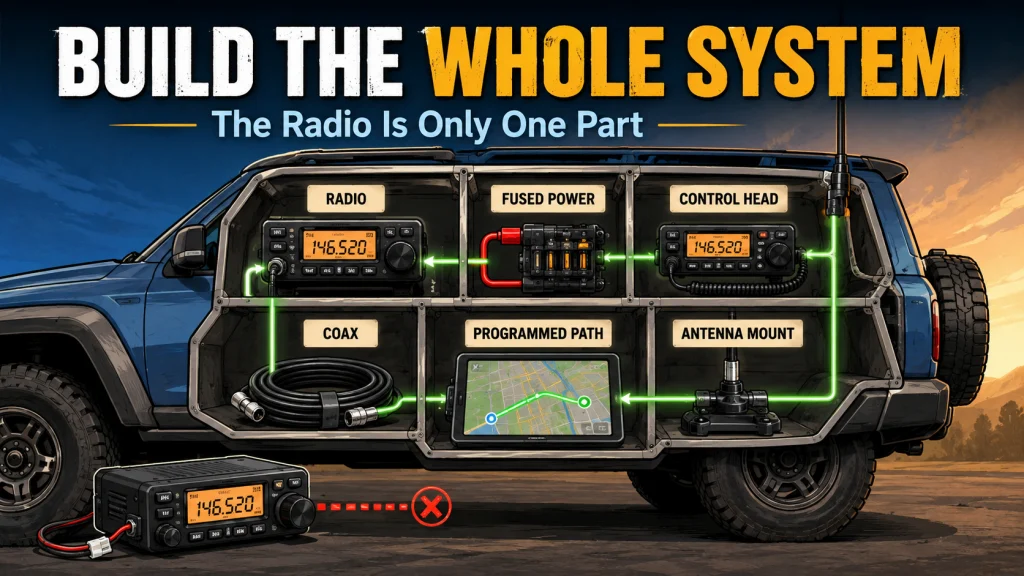
The Best Mobile Ham Radio Is a Complete Vehicle System
I often hear the radio-buying question before a new licensee has decided where or how the radio will be used. That order creates trouble because the transceiver is only one part of the station. A powerful radio with a poor antenna mount, undersized wiring, lossy coax, or awkward controls can be less useful than a simpler, coherent system.
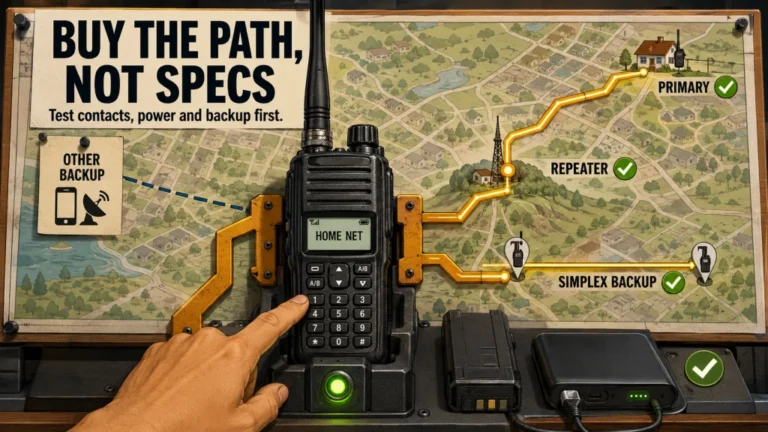
Start by defining who you expect to contact, which repeaters or simplex channels support that goal, where the vehicle travels, and whether the radio must also work from a 13.8V supply at home. This keeps the purchase tied to a real operating job.
- Radio: the bands, operating modes, controls, memory capacity, and receive features you will actually use.
- Power: properly sized wiring, appropriate fusing, a suitable connection point, and enough current capacity at full transmit power.
- Antenna system: the antenna, mount, vehicle surface, coax route, connector quality, clearance, and weather protection.
- Physical installation: a crash-safe radio body, visible control head, reachable microphone, ventilation, and no interference with airbags or driving controls.
- Operating plan: programmed channels, verified tones, scan behavior, local net information, and a way to operate without becoming distracted.
More transmitter power does not guarantee more usable range. It can improve a marginal path, but it cannot remove a hill, repair lossy coax, correct a poor antenna mount, or make a silent repeater active. The broader car and truck radio overview explains where mobile operation fits before equipment selection begins.
This article covers beginner-to-intermediate VHF and UHF mobiles used in a vehicle or as a 13.8V home station. It does not cover handhelds, HF transceivers, advanced antenna engineering, or step-by-step installation, which require different equipment and safety decisions.
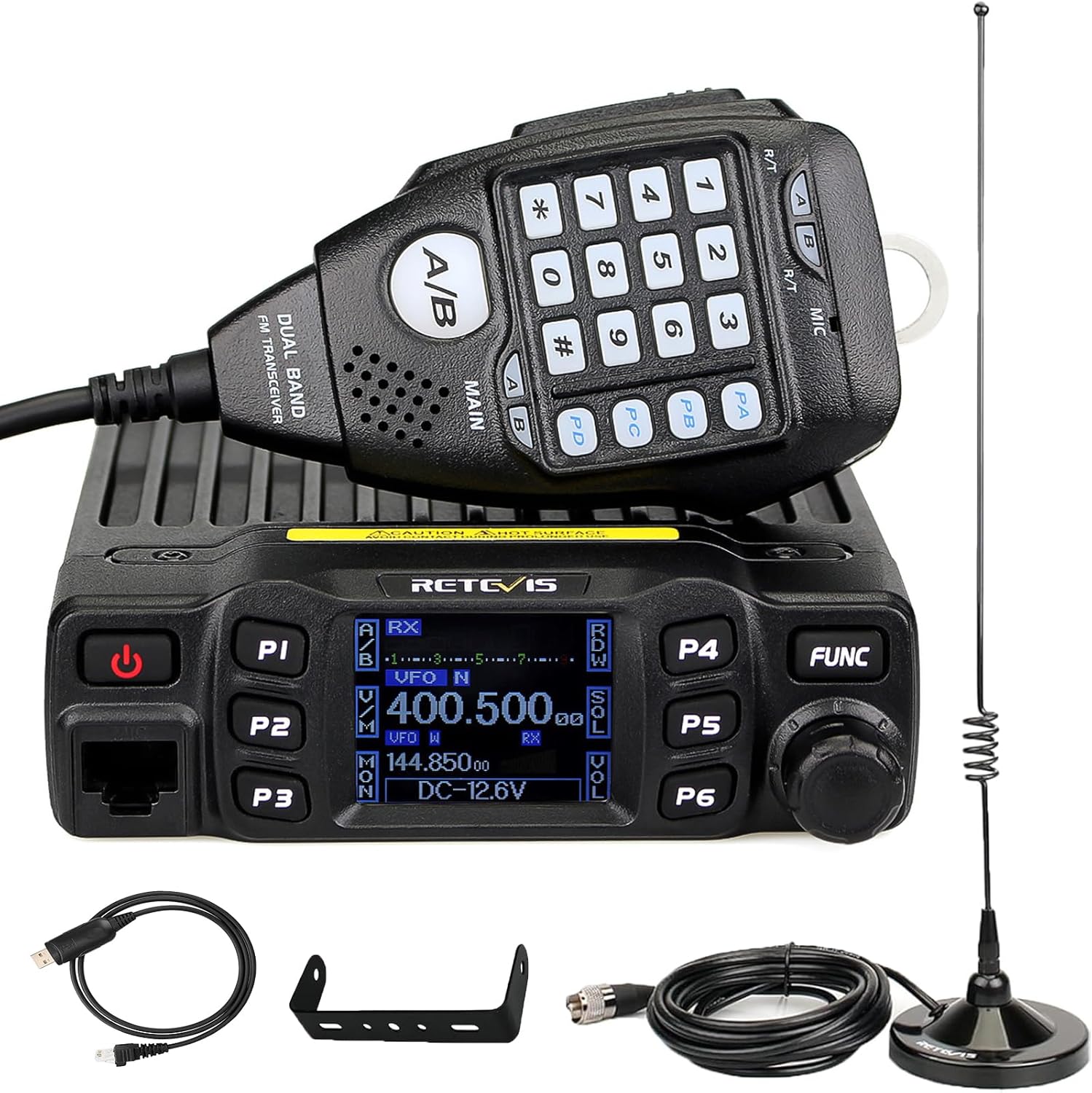
The RT95 is a compact dual-band 2m and 70cm mobile transceiver with a 180-degree rotatable screen. It supports CHIRP and stores 200 channels for programming a local operating plan. The starter-kit listing includes a mobile antenna, while the radio can also be used from a suitable 13.8V source at home.
Check On AmazonIf you click this link and buy, we earn a commission at no additional cost to you.
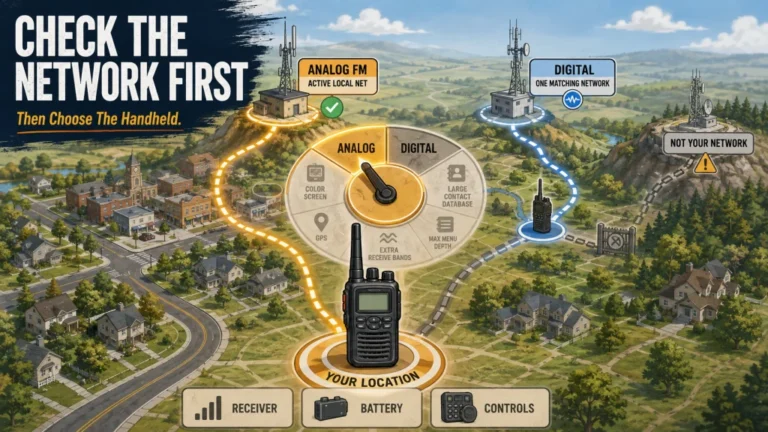
Choose Analog or Digital From the Local Communication Path
An analog dual-band mobile is usually the cleaner starting point when the nearby repeaters and nets are primarily FM. It is easier to program, easier to explain to another operator, and less dependent on registration, network settings, or a specific digital ecosystem. That simplicity matters when the main goal is checking into a local net, monitoring public-service activity, or making routine repeater contacts while traveling.
A digital mobile can add C4FM, D-STAR, GPS, APRS, location data, or network functions. The mistake is treating “digital” as one shared mode. Digital voice systems are not automatically compatible, so the useful feature is a local path that matches the same protocol.
| Decision | Analog FM mobile | Digital-capable mobile |
|---|---|---|
| Best fit | Local analog repeaters, simplex, routine nets, and straightforward travel use | An active local digital system or a specific data and network workflow you plan to learn |
| Setup burden | Frequency, offset, tone, power level, and memory name | Analog fields plus protocol settings, identifiers, repeater data, groups, or network access |
| Hidden cost | Usually the antenna, mount, wiring, and programming cable rather than the mode itself | Higher radio cost, more setup time, possible accessories, and a greater need to maintain data |
| Wrong reason to choose it | Assuming simple means weak or obsolete | Buying every digital feature before confirming anyone nearby uses the same system |
Verify the path before paying for the protocol. Confirm the repeater entry is current, listen during a known active period, and ask which mode is regularly used. A digital radio may also work on analog FM, but an unused digital system does not improve an analog contact.
APRS and GPS deserve the same discipline. Position reporting can be useful for events, travel, or group coordination, but only when the operator understands the local network, beacon settings, privacy implications, and expected workflow. A feature that never gets configured is not extra capability in practice; it is only extra menu depth.
Digital ownership also creates upkeep, even without a recurring subscription. Depending on the system, the operator may need to maintain an identifier, update repeater or contact data, review firmware changes, and reprogram memories as local systems change. Count that time, plus any optional Internet-linked hardware or accessories required by the intended workflow.

The AT-D578UVIII Plus combines analog amateur-radio use with DMR digital operation in a mobile chassis. It is rated at 50W VHF and 45W UHF and includes APRS location-data receive and transmit plus Bluetooth audio. Its built-in speaker and included training course support the more involved setup workflow that comes with a digital mobile radio.
Check On AmazonIf you click this link and buy, we earn a commission at no additional cost to you.
How the Current Mobile VHF-UHF Market Is Divided
The current market is easier to understand by operating class than by brand: analog or digital, one-piece or remote-head, dual-receive, or higher-output single-band. When a search result promises a “top mobile ham radio,” treat it as a shortlist, because these classes solve different problems and one ranking hides the trade-offs.
Research basis: The market categories and feature patterns in this section are based on current manufacturer product pages and manuals. They are not presented as hands-on durability, receiver, emissions, or long-term ownership tests.
| Current radio class | What usually defines it | Where it makes sense | What to verify before buying |
|---|---|---|---|
| Analog dual-band mobile | FM on 2 meters and 70 centimeters, multiple power levels, memories, scanning, and sometimes simultaneous receive | A first mobile station built around local analog repeaters and simplex | Control layout, detachable head, receive behavior, programming support, current draw, and included mounting hardware |
| Digital dual-band mobile | Analog FM plus one digital voice ecosystem, often with GPS, data, repeater lists, or network functions | An operator with a verified local digital path and a reason to use its connected features | Exact protocol, local adoption, required registration, firmware support, data updates, and accessory requirements |
| Compact one-piece mobile | Radio body and controls in one chassis with fewer installation pieces | A vehicle with a safe, visible mounting location and enough ventilation | Display readability, microphone access, heat clearance, and whether the entire unit becomes a crash hazard |
| Remote-head mobile | Main radio body mounted away from a smaller control panel | Modern cabins with limited dashboard space or a need to hide the heavier chassis | Which separation cables and brackets are included, cable length, speaker location, and control-head mounting options |
| Higher-output single-band mobile | More transmit power on one VHF or UHF band with fewer cross-band features | A defined one-band use case where local systems and antenna design support it | Electrical load, duty cycle, cooling, antenna rating, RF exposure evaluation, and the loss of dual-band flexibility |
Use the market map as a filter, not a shopping list. Decide on bands, receive behavior, control format, and operating mode, then remove every radio that fails those requirements. This is more reliable than comparing memory counts or screen size before the operating plan exists.
Before buying, confirm the exact US suffix is current, manuals and programming tools remain available, and warranty and service information are clear. An old product page is not proof of current retail status.

The KT-8900D is a second-generation compact mobile radio with dual-band operation and quad standby. Its listing specifies up to 25W on VHF and 20W on UHF, plus a cooling fan and external-speaker jack. The small one-piece chassis gives this market section a concrete example of the compact mobile-radio class.
Check On AmazonIf you click this link and buy, we earn a commission at no additional cost to you.
The Best Mobile Ham Radio for Beginners Starts With Nine Filters
A first-time buyer does not need to predict every future interest. The job is to avoid a radio that conflicts with the first real use case. I would rather see a new operator choose a straightforward mobile for two active repeaters than leave a complex radio unprogrammed.
Use the following filters in order. The earlier filters eliminate incompatible radios; the later filters separate radios that could all do the basic job.
- Bands: Confirm whether the operating plan needs 2 meters, 70 centimeters, or both. Dual-band flexibility is useful, but a second band has little value if it is not active where you operate.
- Local repeater modes: List the analog and digital systems you can verify, not every listing within driving distance.
- Control-head format: Decide whether the full radio can be mounted safely and seen clearly, or whether a detachable head is necessary.
- Display and physical controls: Prioritize information you can read quickly and controls you can identify without studying the screen while driving.
- Receive behavior: Decide whether one active receiver is enough or whether simultaneous receive is genuinely useful for monitoring two channels or bands.
- Programming workflow: Check front-panel usability, available software, cable requirements, memory import options, and backup capability.
- Digital protocol: Choose only after confirming local use and understanding the setup path.
- Electrical and thermal load: Read the manual for transmit current, fuse requirements, supply voltage, ventilation clearances, and duty-cycle limitations.
- Support: Confirm current US availability, warranty terms, firmware or software support, manuals, service options, and included accessories.
The detailed first dual-band mobile decision guide takes those filters into the narrower buying stage. The key is to arrive there with your local paths, mounting limits, and desired operating mode already written down.
For 13.8V home use, replace the vehicle questions with a regulated supply, safe desktop location, ventilation, and a suitable antenna system. The radio may be the same, but the vehicle battery, body, mount, and cable route are no longer part of the station.

The AT-778UV is a compact dual-band mobile transceiver for VHF and UHF amateur operation. It offers 25W, 15W, and 5W power settings along with a rotatable TFT display. CTCSS and DCS scanning, adjustable display brightness, and PC programming support the practical filters a first-time mobile buyer needs to compare.
Check On AmazonIf you click this link and buy, we earn a commission at no additional cost to you.
A Car, a Work Truck, and an Off-Road Vehicle Need Different Systems
The phrase “best mobile ham radio for a car” sounds specific, but the vehicle type alone does not settle the decision. A commuter may need a compact control head, clear audio, a low-profile antenna, and a small set of local repeater memories. A ham radio for a truck may need a longer cable route, a more durable antenna mount, better microphone retention, and controls that remain usable with a noisy cabin or work gloves.
Off-road and overland use adds another layer because the communication group matters more than the buyer’s preferred radio. Confirm whether the people traveling together actually use amateur radio, GMRS, CB, or another service. If the group uses GMRS, transmitting requires Part 95E-certified GMRS equipment; holding a ham license or owning an amateur transceiver does not authorize GMRS transmission with that radio.
Terrain changes what good performance means. Valleys, ridgelines, forest cover, vehicle spacing, and repeater location can make antenna position and a disciplined channel plan more useful than another power step. A convoy should know its primary channel, backup channel, check-in interval, and lost-contact procedure.
The off-road ham radio planning guide treats service choice, terrain, antenna durability, power, and group procedure as one decision. It also explains why a satellite messenger or other independent backup can be sensible when the route leaves verified repeater coverage. That backup is not a substitute for radio practice; it covers a different failure mode.
Do not let an outdoor-use label replace installation judgment. A rugged-looking radio body does not protect a weak coax entry, an antenna that strikes branches, an unsecured microphone, or wiring that rubs against metal. The system must survive the vehicle and route, not just look appropriate in a product photo.
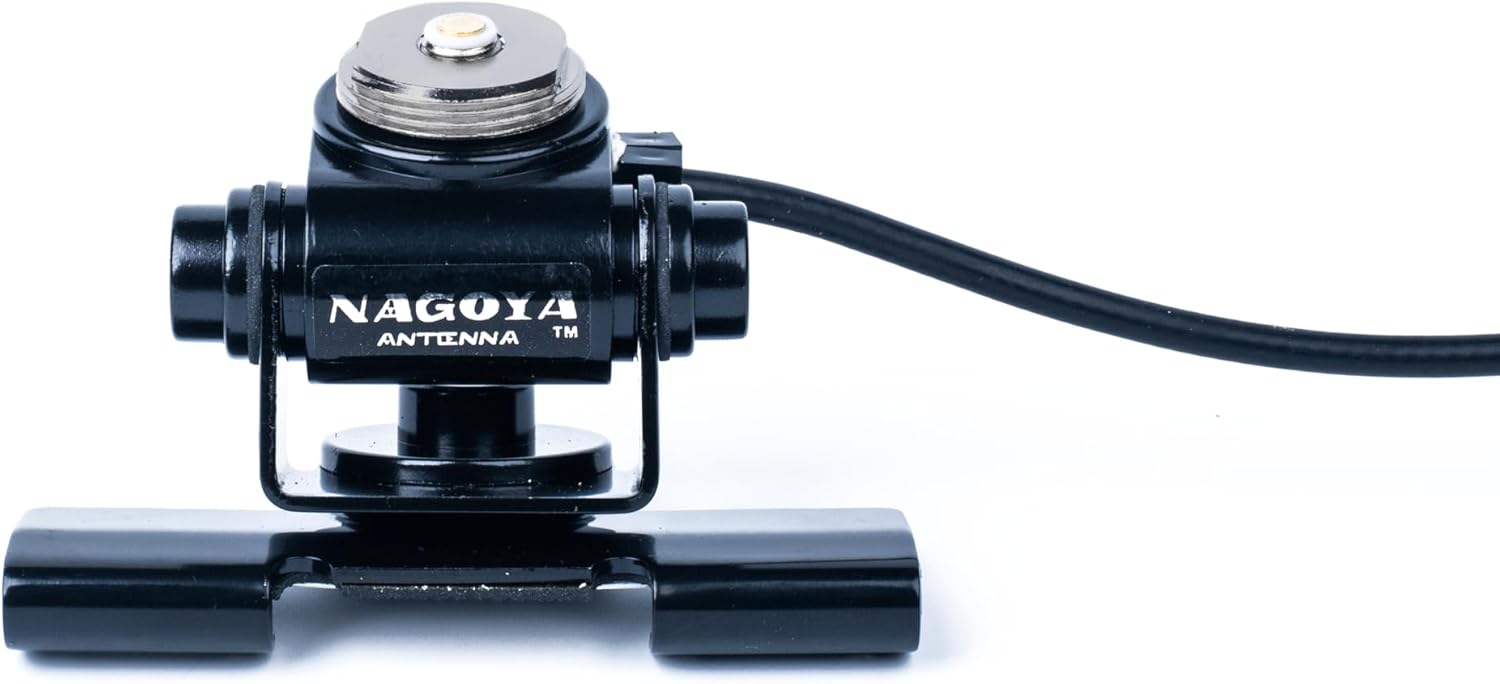
The RB-700N is a no-drill NMO lip mount with multi-axis adjustment for trucks, SUVs, and cars. It includes 20-foot RG-58A/U coax with a PL-259 connector plus a protective rain cap. Rubber contact pads are designed to reduce abrasion where the mount meets the vehicle surface.
Check On AmazonIf you click this link and buy, we earn a commission at no additional cost to you.
What 25W, 50W, and Higher Power Change
Transmitter power changes link margin, not geography. Moving from 25W to 50W doubles the transmitter power, but that is only a 3 dB increase. It may clean up a marginal signal when the rest of the path is already workable, yet it does not mean twice the range and may make little noticeable difference through a major terrain obstruction.
That 3 dB figure puts power in context. Better antenna position, sound coax, a correct mount, or a repeater with a clearer path may help more than changing between similar radios. Treat high power as one setting, not the entire range strategy.
| Power range | Practical role | Trade-off to check |
|---|---|---|
| Low power | Nearby repeaters, strong simplex paths, testing, and reducing unnecessary RF output | May not provide enough margin when terrain, distance, or antenna losses are significant |
| Around 25W | A useful middle setting when low power is marginal but full output is unnecessary | Still depends on the antenna path and can be lost in a poor installation |
| Around 50W | Common full-power level for dual-band mobiles and useful additional link margin | Higher current draw, more heat, and greater need for correct wiring and ventilation |
| Higher output | A specialized one-band or difficult-path use case supported by the complete system | Electrical load, cooling, antenna rating, RF exposure, duty cycle, and reduced equipment flexibility |
Read the exact manual before planning power wiring. A mobile radio designed for nominal 13.8V operation can draw substantial current at full output, and the correct fuse size, conductor size, polarity, and connection method are equipment-specific. Do not assume a dashboard accessory outlet is suitable because the plug physically fits an adapter.
Cooling belongs in the same decision because long nets and repeated high-power transmissions create more heat than brief contacts. The mobile radio power output guide explains link margin, current demand, heat, and why wattage cannot be converted into a range promise.

The RPS-30PRO is a 30A regulated AC-to-DC bench supply with a 13.8V nominal output and an adjustable 9-to-15V DC range. It includes multiple DC connection options and a noise-offset adjustment. That capacity makes it a relevant supply example when evaluating the current demand of a mobile-format radio used as a home station.
Check On AmazonIf you click this link and buy, we earn a commission at no additional cost to you.
The Antenna System Often Changes More Than the Radio
Two similar mobile radios can perform very differently when one is connected to a well-positioned antenna and the other is connected through a compromised mount and cable route. The antenna’s location changes its pattern and obstruction by the vehicle. The mount changes the mechanical bond and, depending on the design, the RF relationship with the vehicle body. Coax length, routing, connector quality, and water entry add losses or failures that the radio cannot correct.
Vehicle material matters. A steel roof, aluminum body panel, composite roof, luggage rack, bed rail, hatch, and fender lip do not provide the same mounting environment. Some antennas require an effective ground plane, while others are designed to work differently. Buying the antenna first and asking where it can fit afterward reverses the decision.
- Mounting surface: Identify the material, thickness, electrical bonding, and whether drilling is permitted.
- Pattern and position: Favor a clear, high position when the vehicle and safety limits allow it.
- Clearance: Account for garages, branches, parking structures, cargo, roof equipment, and folding requirements.
- Coax route: Avoid pinching, sharp edges, heat, moving parts, and water paths; protect every pass-through.
- Weatherproofing: Seal external connections correctly without trapping water or creating an unserviceable joint.
- Serviceability: Make it possible to inspect the mount, cable, and connector after months of vibration and weather.
A short antenna mounted well can be better than a taller antenna that cannot clear the vehicle’s normal routes. A taller option may offer more gain, but gain, pattern, ground plane, and placement must be considered together. Length alone does not predict performance.
Use the mobile antenna selection framework to match the mount, vehicle material, pattern, clearance, coax, and weather exposure before choosing an antenna style. That decision should be made early because it can change the required connector, cable route, radio location, and total installation cost.

The UT-72 is a 20-inch magnetic-mount antenna for 144 and 430 MHz VHF-UHF operation. Its kit includes the antenna, magnetic base, heavy-duty cable, PL-259 connection, and an SMA adapter. It gives this antenna-system section a complete vehicle example where antenna, mount, cable, and connector choice are considered together.
Check On AmazonIf you click this link and buy, we earn a commission at no additional cost to you.
Pass the Installation Gate Before You Buy
A radio is not a good vehicle choice if it cannot be installed safely in that vehicle. Before ordering, identify a secure location for the main chassis, a visible but non-distracting control position, a microphone location that will not swing into the controls, and a coax route that does not crush the cable. Confirm that heat can escape and that the radio, bracket, microphone, and cables stay outside airbag deployment paths.
Power planning needs both the radio manual and vehicle guidance. Modern vehicles may have battery monitoring, manufacturer radio-installation instructions, sensitive electronics, or approved cable routes that change the correct connection method. The safe rule is not “always copy the last installation you saw”; it is “follow the current radio and vehicle instructions, fuse the circuit correctly, and protect the wiring mechanically.”
Operating safety is part of installation. Controls that demand long menu navigation, a display that cannot be read quickly, or a microphone with no secure home can encourage distracted operation. Program the common channels before driving, use voice prompts or external controls only when they genuinely reduce distraction, and follow the laws that apply where the vehicle is operated.
This article intentionally stops before step-by-step installation. The mobile radio installation process belongs in the setup section because wiring, routing, mounting, testing, and antenna checks require a procedural treatment. The buying decision is complete when you know the proposed radio can pass that installation process safely.

The SW-33 Plus provides direct digital VSWR, forward-power, and reflected-power readings from 125 to 525 MHz. Its listing specifies a maximum measurable power of 100W and notes that it is not intended for DMR digital radios. Used with compatible analog VHF-UHF equipment, it supports the antenna-checking step of a mobile installation.
Check On AmazonIf you click this link and buy, we earn a commission at no additional cost to you.
Budget for the Station, Not Just the Radio
The advertised radio price is rarely the complete station cost. The installation may also require brackets, separation and programming cables, an antenna, mount, coax, power wiring, fuses, connectors, weatherproofing, or professional help. Similar radio prices can therefore produce different finished totals.
Build the budget in three columns: required for first contact, required for safe installation, and optional convenience. The antenna, mount, coax, correct power system, and safe brackets belong in the first two columns. Bluetooth, a larger display, GPS accessories, advanced network features, or an external speaker may be useful, but they should not consume the money needed to make the basic station work correctly.
Key point: A cheaper radio with the correct antenna and safe installation can be the better system. A premium radio with no remaining budget for the antenna, wiring, or mounting is an incomplete purchase.
Check what is included. A detachable head may still need a cable or bracket, while programming may require another cable, memory card, or software workflow. Compare the finished station cost, not only the radio body.
For readers still deciding between handheld, mobile, and HF equipment, the radio type selection guide provides the broader framework. A mobile VHF-UHF radio is the right category only when its power, antenna, installation, and local communication path match the job.

The SEC-1235M is a 30A desktop switching power supply built around compact switch-mode conversion. Its listing states that the design minimizes output-voltage ripple and RFI and supports selectable 120V or 240V input. As part of a complete station budget, a suitable regulated supply covers the power source when a mobile-format radio is used away from a vehicle.
Check On AmazonIf you click this link and buy, we earn a commission at no additional cost to you.
Final Thoughts: Prove the Path Before Mounting the Radio
Begin with a verified contact path and a realistic installation plan. Confirm the local bands and modes, choose analog or the digital system that serves them, select a control format that fits the cabin, and calculate the complete station cost. Only then does comparing radios become useful.
I would not choose a first mobile by maximum wattage or the longest feature list. I would choose the radio whose controls, programming, power demand, cooling, and modes fit the verified path and cabin. That turns a capable radio into a station you will use.
Explore More Mobile Ham Radio Guides
The next guides narrow the choice by first-radio features, off-road conditions, power requirements, and antenna fit. Use the one that matches the unresolved part of your plan.
| Guide | What it helps with |
|---|---|
| Choosing a First Dual-Band Mobile | Filters radio features by local repeaters, control layout, programming, receive behavior, support, and first-station practicality. |
| Planning Radio for Off-Road Travel | Connects service choice, terrain, group procedure, antenna durability, vehicle power, and independent backup communication. |
| Understanding Mobile Radio Power | Explains what different output levels change, what they cannot fix, and how current draw and heat affect the system. |
| Selecting a Mobile Antenna System | Matches antenna design and mounting method to vehicle material, position, pattern, clearance, coax, and weather exposure. |
Use these guides to complete the system rather than restart the buying decision.
FAQs
📻 What makes a mobile ham radio better than a handheld in a vehicle?
A mobile radio usually offers higher sustained output, better cooling, louder audio, and a permanent external antenna. It is better only when the vehicle can support the required power, mounting, and antenna system.
🔢 Is 50W enough for a mobile ham radio?
For many VHF and UHF contacts, 50W provides useful link margin. It does not guarantee range, and antenna position, terrain, coax loss, and repeater location may matter more.
🛰️ Should a beginner buy an analog or digital mobile radio?
Choose analog when your local repeaters and nets are mainly FM. Choose digital after confirming an active local system using the same protocol and a workflow you plan to use.
🚙 Can I power a mobile radio from a cigarette-lighter socket?
Do not assume the accessory socket can support full transmit current. Follow the radio manual and vehicle guidance, then use wiring, fusing, and a connection method rated for the actual load.
🏠 Can I use a mobile ham radio as a home base station?
Yes, a mobile-format VHF-UHF radio can work from a suitable regulated 13.8V supply at home. You still need enough continuous current capacity, ventilation, a practical control position, and an antenna system designed for the property.
📡 Does a better mobile antenna increase range more than extra power?
It can, especially when the existing antenna is poorly positioned, mismatched to the mount, obstructed, or connected through damaged coax. The result depends on the vehicle, terrain, frequency, antenna pattern, and the path to the other station.
🧭 What should I decide before buying radio equipment for off-road travel?
Confirm the service used by the group, the legal equipment for that service, the primary and backup channels, expected terrain, antenna-clearance limits, and the plan after contact is lost. Add an independent backup when the route leaves verified radio coverage.