Getting a ham radio Technician license takes five steps in a fixed order: obtain an FCC Registration Number, study the current question pool, register for an exam session, pass the exam, and complete the FCC payment process. The part most beginners miss is that the FRN comes before the test, while the $35 FCC application fee comes after a successful exam application reaches the FCC. Passing the test alone does not authorize transmission; a new operator must wait until the call sign appears in the FCC Universal Licensing System. By following the sequence below, you can avoid the paperwork delays and exam-day surprises that cause an otherwise prepared candidate to stall.
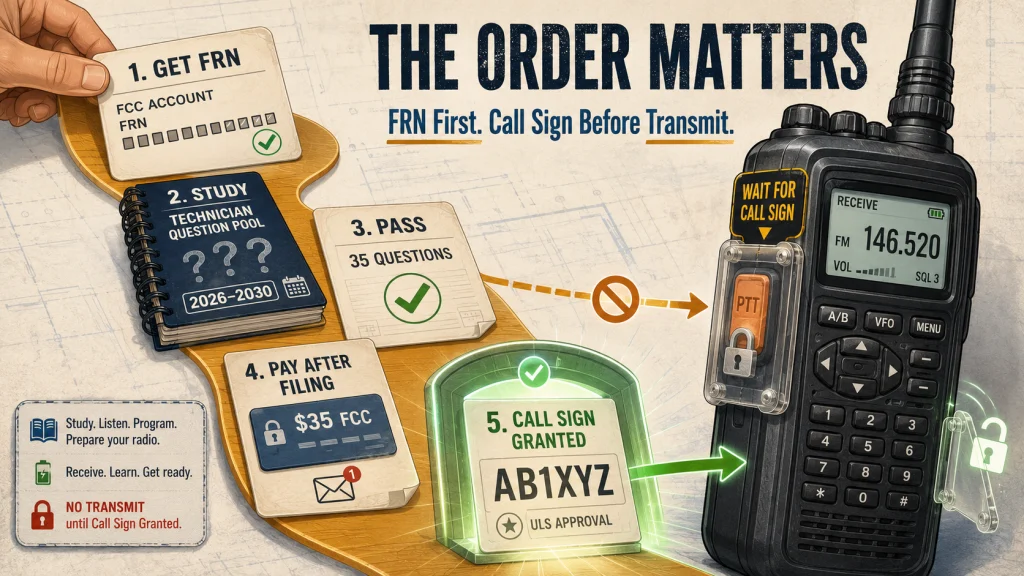
The Five Ham Radio Technician License Steps in Order
Learning how to get a ham radio Technician license is easier when you separate the process into five decisions instead of treating it as one test. Most explanations begin with studying, but that is not the first operational step. Before a Volunteer Examiner team can process a new-license application, the candidate needs an FCC Registration Number, a valid email address, and accurate application information.
I have seen candidates arrive ready for the technical questions but uncertain about the paperwork that makes the license possible. That is why I treat the ham radio license process as a chain: each step creates what the next step needs. You can study and register in parallel, but you should not book an exam until you know the session requirements and can access the FCC account tied to your FRN.
| Step | What you do | What commonly goes wrong |
|---|---|---|
| 1 | Create or recover your FRN | The candidate creates a second FRN or cannot access the original account. |
| 2 | Study the current Technician pool | The candidate uses material that expired on June 30, 2026. |
| 3 | Choose and register for a session | The candidate assumes every in-person or remote team uses the same rules. |
| 4 | Take the 35-question exam | The candidate brings incomplete identification or overlooks team instructions. |
| 5 | Pay the FCC fee and wait for the grant | The candidate assumes a passing result is already permission to transmit. |
The sequence is simple, but the timing matters. For a broader view of license classes, privileges, fees, and future upgrades, use the complete guide to ham radio licensing as your reference point. This page stays focused on the operational steps for a first Technician license in the United States.

The ARRL Ham Radio License Manual 6th Edition is built for the Technician-class exam and the 2026 to 2030 question pool. The listing says it covers the 35-question multiple-choice exam and is designed for self-study or classroom use. It can also be used alongside ARRL online practice resources.
Check On AmazonIf you click this link and buy, we earn a commission at no additional cost to you.
Step 1: Get Your FRN Before You Register for an Exam
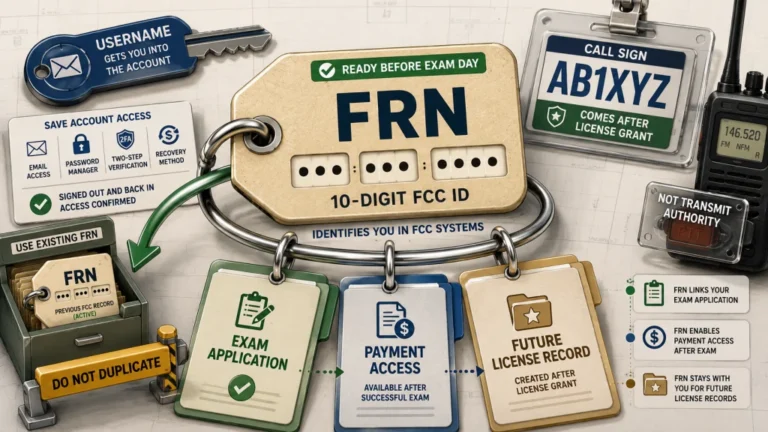
An FRN is the 10-digit FCC Registration Number used to identify you in licensing transactions. A first-time amateur exam applicant must provide it to the Volunteer Examiners before taking the exam, so this is not paperwork to leave until after you pass. You obtain it through the FCC CORES system, and the same FRN remains connected to later license upgrades, renewals, address changes, and call sign requests.
The FRN question comes up at almost every exam session I run. The confusion is usually not about what the number is, but about when it becomes necessary. A candidate may assume the exam team will create it at check-in, or may register again after forgetting that an FRN was already issued for another FCC service. Both situations can delay the application and create account-recovery work that should have been handled before exam day.
Field Note: Treat access to the FCC account as part of exam preparation. Write down the FRN, confirm the email address, and verify that you can sign in before you schedule the test. The number alone is not enough if you cannot later reach the account used to pay the application fee or manage the license.
Use your legal name and current mailing address consistently. The FCC license record is public, so review what you enter rather than rushing through registration. You will also need a working email address because the FCC uses email for payment instructions and the electronic license notice.
Step 2: Study the 2026-2030 Technician Question Pool
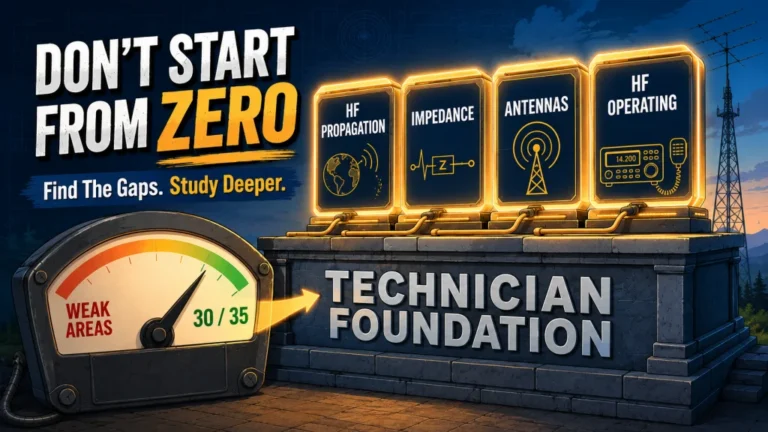
The current Technician question pool contains 409 questions. It was publicly released in December 2025, corrected through an errata issued on February 19, 2026, and is valid for exams administered from July 1, 2026 through June 30, 2030. The exam itself contains 35 multiple-choice questions drawn from that pool, and you need at least 26 correct answers to pass.
This date check matters more than the cover design or popularity of a study resource. Material built around the previous pool can still explain radio fundamentals, but it may teach outdated wording, omit new questions, or drill answers that are no longer tested. Before using any book, class, website, app, or printed handout, confirm that it explicitly covers exams beginning July 1, 2026.
A practical study plan should do more than produce one lucky passing score. Work through the material by topic, review every missed question, and take mixed practice exams until your results are consistently above the passing line. Leave enough margin for exam-day nerves and unfamiliar wording instead of scheduling the real exam the first time you score 26.
The difference shows up after the license is granted. A candidate who recognizes a repeater-offset answer only as a test phrase may still freeze when programming a first radio, while someone who understands what the offset and access tone do has a usable starting point. Passing is the immediate goal, but the best preparation also reduces the gap between receiving a call sign and making a first contact.
Step 3: Find and Register for the Right Exam Session
Technician exams are offered through in-person Volunteer Examiner sessions and remote sessions conducted by video. The ARRL exam locator and HamStudy.org session listings can help you find both types, but the listing is only the starting point. Each session is run by a specific team under a Volunteer Examiner Coordinator, and registration deadlines, fees, accepted payment methods, identification procedures, and retest policies can differ.
Choose the format based on the environment in which you can perform reliably. An in-person session is often easier for someone who wants direct help with check-in or does not have a suitable computer setup. A remote session can be more convenient, but it commonly requires a webcam, a private room, a stable connection, and enough time for the team to inspect the testing area and verify identification.
- Confirm whether preregistration is required or walk-ins are accepted.
- Check the session time zone, especially for a remote exam.
- Read the team-specific identification and room requirements.
- Verify the exam-session fee and how it must be paid.
- Ask whether the team offers retesting or higher-level exams during the same session.
Do not choose a session only because it is the first listing you see. A candidate with a noisy shared room may be better served by a local in-person session, while someone hours from the nearest club may find a remote appointment far more practical. The right session is the one whose rules you can meet without improvising on exam day.

The Logitech C920 is a USB webcam designed for desktop and laptop computers. Its Amazon listing specifies Full HD 1080p video capture along with autofocus and automatic low-light correction. It provides a dedicated camera option for computer-based video sessions and calls.
Check On AmazonIf you click this link and buy, we earn a commission at no additional cost to you.
Step 4: Arrive Ready for the Exam and Application
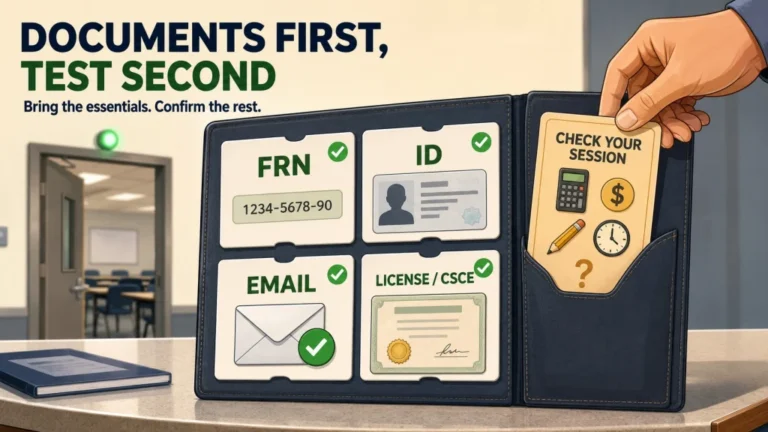
For a first license, bring or prepare the items specified by the exam team, including your FRN, a valid email address, and acceptable identification. A legal photo ID is the usual route for an adult applicant. If the team permits a calculator, its memory must be cleared and the device must meet that team’s rules, so do not assume a phone calculator will be allowed.
You will also complete or confirm application information and answer the FCC basic qualification question. Review your legal name, address, FRN, and email before signing anything. A typo in a practice answer costs one question; a typo in the application can follow the file into FCC processing and take longer to correct.
The Technician exam has 35 questions, and 26 correct answers is a passing score. Once the team grades the exam, it will tell you whether you passed and provide the appropriate documentation or electronic confirmation. The exam-session fee is separate from the FCC application fee and varies by VEC or examining team, so the amount shown in the session listing is the amount to verify before attending.
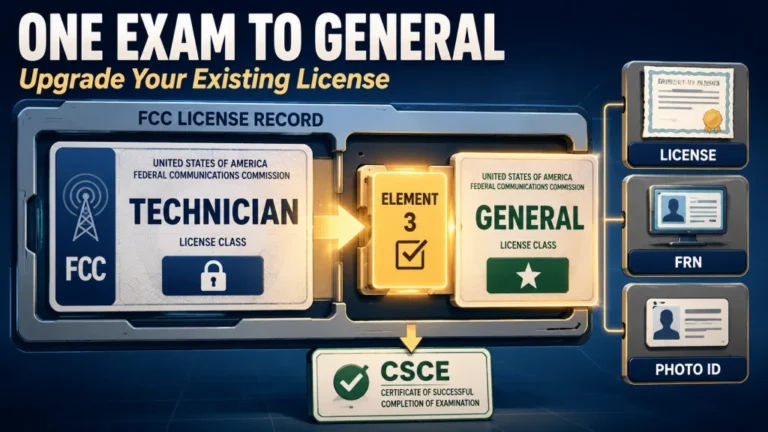
Some teams allow a candidate who passes Technician to attempt the General exam during the same session. That opportunity is team-specific and does not mean you must take it. If you have studied for General and the team offers the exam, passing both elements can allow the successful results to be submitted together; if you have not prepared, finishing Technician cleanly is still a complete success.
Note: An ordinary operator-class upgrade is exempt from the FCC application fee. A first-time applicant who earns a new license still owes the current new-license application fee, even if more than one exam element was passed during the session.
Before leaving an in-person session or closing a remote session, ask what happens next and which VEC is processing the application. You should know whether the team expects any follow-up from you before submission. That one question prevents the common mistake of waiting for an FCC email when the exam team is still missing a form or confirmation.

The Casio fx-260 Solar II is a compact scientific calculator with a 10-digit display. It supports fraction calculations, trigonometric functions, logarithms, exponents, and other scientific operations. The calculator uses solar power with battery backup and is designed as a portable option for school and exam use.
Check On AmazonIf you click this link and buy, we earn a commission at no additional cost to you.
Step 5: Pay the FCC Fee and Wait for Your Call Sign
After a successful exam, the Volunteer Examiners send the session results to their VEC, and the VEC submits the new-license application to the FCC. When a fee is due, the FCC issues payment instructions for the application. You do not pay the $35 FCC new-license application fee before taking the test, and the exam team does not collect it on the FCC’s behalf.
The current $35 FCC application fee applies to new licenses, renewals, rule-waiver requests, and modification applications requesting a new vanity call sign. Ordinary operator-class upgrades, administrative updates, and sequential call sign requests are exempt. Any fee charged by the VE team or VEC for administering the exam is separate and may vary by session.
The FCC currently provides a 10-calendar-day payment window measured from issuance of the application file number. Watch the email account used on the application, including spam or junk folders. If the payment message does not arrive, use your FRN to check the application and payment status through your FCC account rather than assuming the file has not been submitted.
Payment is not the final authorization step. A first-time applicant may transmit only after the FCC grants the license and the assigned call sign appears in the Universal Licensing System. A passing score, a Certificate of Successful Completion of Examination, an application file number, or a payment receipt does not replace the license grant for a new operator.
This is the point at which patience matters. VEC submission schedules, FCC processing, payment timing, weekends, system maintenance, and application issues can all change how long the grant takes, so there is no honest universal promise of same-day issuance. Check the ULS record, and when the call sign appears as granted, you may begin transmitting within the Technician privileges.
Save the FCC account credentials and keep the license record current after the grant. Address changes, future renewals, and call sign requests belong to the separate process for managing your license and call sign, but the FRN and account you created in Step 1 remain the foundation for those transactions.
Final Thoughts: Finish the Licensing Process Before You Transmit
The Technician path is not complicated once the order is clear. Get the FRN first, study the current 2026-2030 pool, choose a session whose rules you can meet, pass the 35-question exam, pay the FCC only after the application is filed, and wait for the call sign to appear in ULS. Most avoidable delays come from skipping one of those transitions, not from the radio theory itself.
I would rather see a new candidate spend ten extra minutes confirming an FRN and email address than lose days untangling an application after passing. Once your Technician license is granted, use it and learn what kind of operating interests you before buying equipment for a goal you have not chosen. When broader HF privileges become the next logical step, the guide to upgrading from Technician to General explains that separate process without mixing it into your first license application.
Explore Each Technician Licensing Step
The five-step sequence above tells you what happens and when. Use the focused guides below when you need the exact procedure, decision checks, or exam-day details for one stage.
| Guide | What it helps with |
|---|---|
| Get Your FCC Registration Number | Create or recover the FRN and avoid duplicate-account problems before registering for an exam. |
| Find a Ham Radio Exam | Compare local and remote sessions, registration rules, time zones, and team-specific requirements. |
| Prepare for Ham Radio Exam Day | Check identification, application information, calculator rules, fees, and what happens after grading. |
| Understand the Current Technician Question Pool | Use the correct 2026-2030 pool, validity dates, errata, question count, and exam structure. |
| Build a Technician Study Plan | Turn the question pool into a practical study sequence instead of relying on one passing practice score. |
Work on the stage that can block your next action. If you already have an FRN, move to study readiness and session selection; if you have passed, stop studying the process and watch the FCC application and payment status until the grant appears.

This Gordon West Technician Class guide covers the 2026-2030 Element 2 question pool. It includes all 409 questions and answers with explanations and organizes the material into related topics for study. The book also covers Technician privileges, operating basics, radio fundamentals, safety, repeaters, satellites, and preparation for the 35-question exam.
Check On AmazonIf you click this link and buy, we earn a commission at no additional cost to you.
FAQs
🪪 Do I need an FRN before taking the Technician exam?
Yes. A first-time applicant must provide an FCC Registration Number to the Volunteer Examiners before taking the exam. Create or recover it before exam day and confirm that you can access the connected FCC account.
📝 How many questions are on the Technician license exam?
The Technician exam contains 35 multiple-choice questions drawn from the current pool. You need at least 26 correct answers to pass.
📚 Which Technician question pool should I study?
For exams from July 1, 2026 through June 30, 2030, use the 2026-2030 Technician pool with the February 19, 2026 errata included. Confirm those dates before relying on any study resource.
💻 Can I take the Technician exam online?
Yes. Remote video sessions are available, but each team sets its own registration, webcam, room-inspection, identification, and payment requirements. Read the complete session instructions before booking.
💳 Do I pay the $35 FCC fee before the exam?
No. The exam team may charge a separate session fee, but the $35 new-license application fee is paid directly to the FCC after a successful application reaches its system. Watch the email address used on the application and check your FCC account if the message does not arrive.
📡 Can I transmit as soon as I pass?
No. A first-time applicant must wait until the FCC grants the license and the call sign appears in ULS. A passing result or payment receipt is not authorization to transmit.
⬆️ Can I take the General exam on the same day?
Many teams offer the next exam element after a passing Technician result, but the policy is session-specific. Ask before the appointment and attempt it only if you have prepared for the General material.