A US amateur license normally runs for 10 years, but keeping it usable requires more than remembering the expiration date. Renewal, call sign lookup, address changes, vanity requests, fee payment, and account access move through connected FCC systems, and each task has a different deadline or fee rule. This guide gives licensed operators a complete ham radio license management map, including what is public, what costs $35, and what happens if a license expires. It covers managing an existing license, not earning a first license or upgrading to a higher operator class.

Start With the Complete License Management Picture
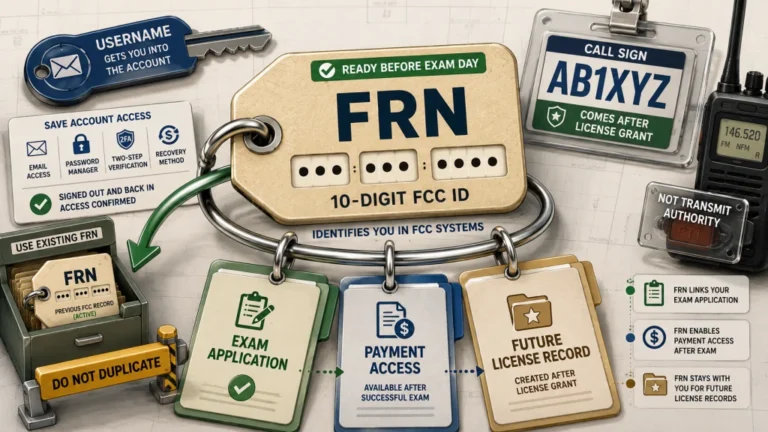
Your license has three practical parts to watch: the authorization itself, the public ULS record, and the FCC account connected to your FRN. A straightforward online renewal can take about 10 minutes once you can sign in and the record is already correct, but password recovery, an outdated email address, or a missed payment step can turn a simple filing into a longer problem. The useful habit is to verify access before the renewal window opens, not on the expiration date.
I separate every management task into two questions. First, what must change on the license record? Second, does the transaction require a payment or an account-level update? That split prevents an operator from changing contact information in one FCC system and assuming the public license record, renewal application, and payment status all changed with it.
| What you need to do | Primary place to handle it | Key condition |
|---|---|---|
| Check call sign, class, status, or expiration | Public ULS license search | No login is normally needed for a public lookup |
| Renew or modify the amateur license | ULS License Manager | Use the FRN-linked account and verify the application purpose |
| Pay a required FCC application fee | CORES payment workflow | Complete payment after the filing generates the fee |
| Maintain the FCC Username or FRN information | CORES | Confirm the Username has permission to manage the correct FRN |
| Download the official authorization | Password-protected ULS account | The FCC generally provides electronic, not mailed paper, authorizations |
The systems are connected, but they are not interchangeable. Treat this table as a navigation map, then use the task-specific sections below to decide what to verify before submitting anything.
Manage the 10-Year Renewal Lifecycle Before It Becomes an Emergency
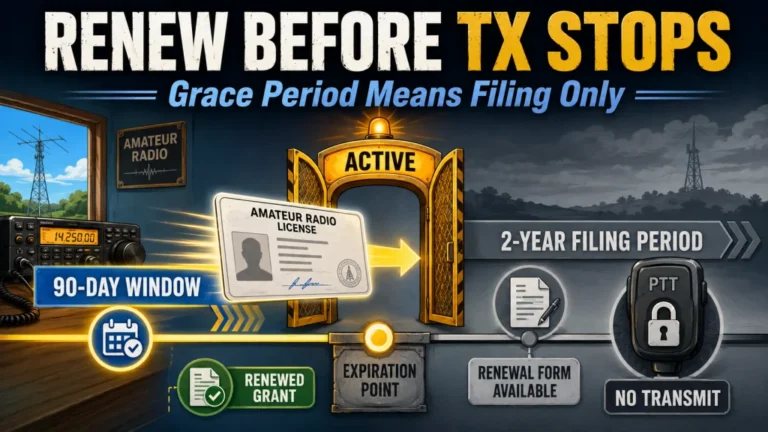
An amateur service license is normally granted for a 10-year term. You may file a ham radio license renewal no sooner than 90 days before the expiration date, so an early reminder set six months ahead is useful for checking account access but not for submitting the renewal itself. When the window opens, verify the call sign, FRN, mailing address, email address, operator class, and expiration date before choosing the renewal action.
A renewal received by the FCC on or before the expiration date preserves operating authority while the application is pending final action. Missing that deadline moves the record into a two-year late-renewal window, changing both the operator’s status and the filing path.
Warning: Do not transmit under an expired license simply because the record is still within the two-year grace period. That window preserves only the ability to apply for renewal.
After the late-renewal window closes, the authorization can no longer be restored through an ordinary renewal filing. Returning to the hobby then becomes a relicensing issue, which may require a current Technician examination even when an older license provides credit for some higher-level elements. Addressing the expiration while renewal remains available avoids that separate process.
The current FCC application fee for an individual amateur renewal is $35. The filing itself begins in the license-management workflow, and a required payment is completed through the FCC payment system. A submitted application with an unpaid fee is not the same as a completed renewal, so save the application confirmation, follow the payment prompt, and check the application status afterward.
For a step-by-step renewal path, including timing and what to check after filing, use the complete amateur license renewal guide.
Use a License Lookup to Verify the Record the Public Can See
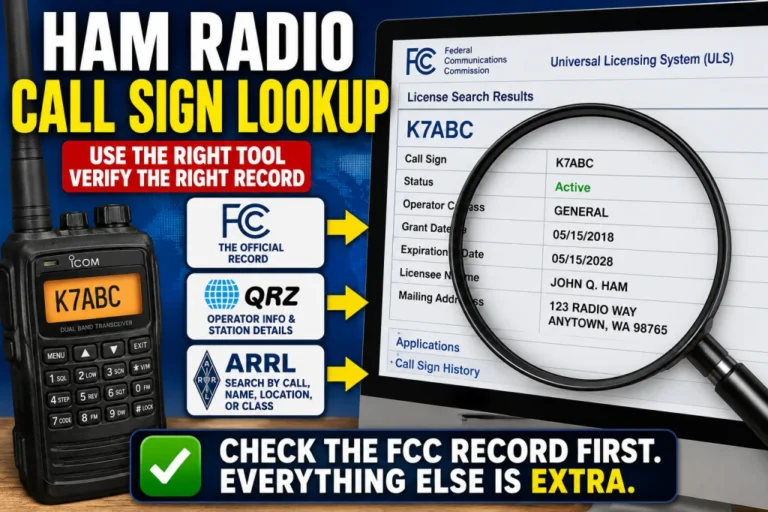
A ham radio license lookup is the fastest way to confirm whether a call sign is active, expired, canceled, or still connected to a pending application. The public ULS record also shows the license class, grant and expiration dates, name, mailing address, FRN, and transaction history. Check the status field rather than assuming that a familiar call sign or a printed copy from years ago proves current authority.
The privacy tradeoff matters. A licensee’s name and mailing address are public, along with the call sign, class, FRN, and several application or administrative details. Social Security numbers, phone numbers, and email addresses are not displayed in the public amateur license record, even though a working email address is required for FCC correspondence and filings.
If you do not want a residential street address displayed, a suitable alternative mailing address may be used, such as a post office box or another address where FCC correspondence can reliably reach you. The goal is not merely privacy. The license grant must contain a correct mailing address and an email address where electronic correspondence can be received.
Key point: A private email address can still be operationally critical. If the FCC cannot deliver required electronic correspondence because the address was not kept current, the license can face serious consequences even though that email is masked from public view.
Use the call sign and license lookup guide when you need to interpret a status, verify an expiration date, or distinguish the license record from a separate application record.
Treat a Vanity Call Sign as an Optional License Modification
The first call sign decision is whether to keep the sequential assignment or request a specific vanity call sign. A vanity call sign is optional and does not add frequency privileges, power, operating authority, or a higher license class. The practical reasons are personal identity, a shorter or preferred call, family significance, or a format that is easier for the operator to use on the air.
The request is a modification application, not a reservation. The applicant may list up to 25 choices in preference order, and the FCC assigns the first choice that is both available and permitted for that operator class when the application is processed. If none of the requested choices can be assigned, the existing call sign remains on the license.
Availability is more complicated than a call sign appearing absent from one search result. Waiting periods can apply after expiration, cancellation, surrender, or the death of a former holder, and some call sign groups are limited by operator class or geographic eligibility. A recently vacated call therefore may not yet be available to an unrelated applicant.
The current FCC fee for a vanity call sign request is $35 per application. Paying the fee does not guarantee assignment of the first choice, or any requested choice, because the FCC still applies availability and eligibility rules. Review how the vanity call sign process works before filing so the preference list is realistic and the current call sign is not treated as expendable.
Separate FCC Licensing From Foreign-License Reciprocal Operation
US citizenship is generally not required to earn an FCC amateur operator license by examination. A person who qualifies through the examination process may apply for an operator and primary station license, except a representative of a foreign government. Residency, citizenship, and eligibility should not be treated as the same test.
Reciprocal operation under a foreign amateur license is a separate route. It can depend on the operator’s citizenship, residence, home-country authorization, and the reciprocal framework being used. Someone eligible to operate temporarily under a foreign authorization is not automatically managing an FCC-issued license, and someone who earns an FCC license by examination is not relying on reciprocal authority.
This distinction matters when a person moves, studies, works, or spends extended time in the United States. The correct next step depends on whether the goal is a new FCC license by examination, temporary operation under a qualifying foreign license, or management of an FCC license already held. Do not submit a renewal or modification application as a substitute for confirming which authority applies.
Use the FCC license eligibility guide for non-US citizens for the examination route and the boundary between an FCC grant and reciprocal operation.

ARRL's sixth-edition Technician manual prepares readers for the 35-question entry-level exam using the question pool effective from July 1, 2026, through June 30, 2030. It covers amateur radio rules, licensing regulations, operating practices, equipment, and safety. That makes it a practical companion for a non-US applicant who chooses the FCC examination route described in this section.
Check On AmazonIf you click this link and buy, we earn a commission at no additional cost to you.
Know Which License Transactions Cost $35 and Which Do Not
The FCC fee is attached to the application purpose, not to every change made inside an amateur record. A new individual license, renewal, rule-waiver request, and modification requesting a new vanity call sign currently carry a $35 FCC application fee. The fee is per application, so combining or separating transactions can change what the filing system asks you to pay.
Administrative updates are exempt. Changing a name, mailing address, or email address does not carry the amateur application fee. Ordinary operator-class upgrades and requests for a sequentially issued call sign are also exempt, although the exam provider may charge a separate session fee when an examination is involved.
| Transaction | Current FCC application fee | Other cost to expect |
|---|---|---|
| New individual amateur license | $35 | A VE or VEC examination-session charge may be separate and varies |
| License renewal | $35 | A third-party processing service may charge separately if used |
| New vanity call sign request | $35 | No assignment is guaranteed |
| Name, mailing address, or email update | No FCC application fee | None when filed directly through the FCC |
| Ordinary operator-class upgrade | No FCC application fee | The exam session may have its own charge |
| Sequential call sign request | No FCC application fee | None when filed directly through the FCC |
Do not send the FCC fee to the VE team merely because the underlying application began at an exam session. When a fee is due, it is paid through the FCC’s payment workflow. Session charges belong to the administering organization and can vary independently from the FCC fee.
For a fuller breakdown of licensing, renewal, vanity, and exam-session expenses, use the complete ham radio license cost guide. Operators considering a higher class can separately review the license upgrade decision path, where exam scope and privileges are the focus rather than routine record management.

The tenth-edition ARRL General Class License Manual prepares Technician licensees for the 35-question General exam and is current through June 30, 2027. It covers procedures, rules, radio signals, equipment, antennas, propagation, and RF safety. It fits this section because an operator considering an upgrade may face exam preparation or a session charge even when the ordinary FCC operator-class upgrade itself has no application fee.
Check On AmazonIf you click this link and buy, we earn a commission at no additional cost to you.
Treat CORES and ULS as Two Connected Records
CORES handles the account and FRN layer, while ULS handles the license and application layer. CORES is used to manage the FCC Username relationship to an FRN, update FRN-level information, review financial standing, and complete payments. ULS License Manager is used to renew, modify, and view the amateur license record and its applications.
The same email address may appear in more than one account context, but changing one profile does not remove the need to verify the other. If a Username cannot manage the FRN connected to the license, fix the FRN association and permissions in CORES. If the license itself shows the wrong mailing address, name, or email address, file the appropriate update through the license-management process.
Field Note: I use a two-record check before any renewal: first confirm that the FCC Username can manage the correct FRN, then open the license record and verify the call sign, class, expiration, mailing address, and email. That sequence catches access trouble before a filing deadline turns it into a licensing problem.
- Confirm access to the email used for the FCC Username.
- Confirm that the Username is associated with the correct FRN and has management permission.
- Open the amateur license in ULS and review the public and private contact details.
- Choose the exact application purpose: renewal, administrative update, vanity request, or another modification.
- Complete any required CORES payment and save the confirmation.
- Return to the application record later and verify that the filing was granted or identify any pending issue.
Do not create a second FRN simply because the old login is difficult to recover. An unnecessary duplicate can make future applications and payments harder to track. Use the FCC account-recovery and support process to regain access to the FRN already connected to the license whenever possible.
Choose the Correct Path Instead of Using the Wrong Application
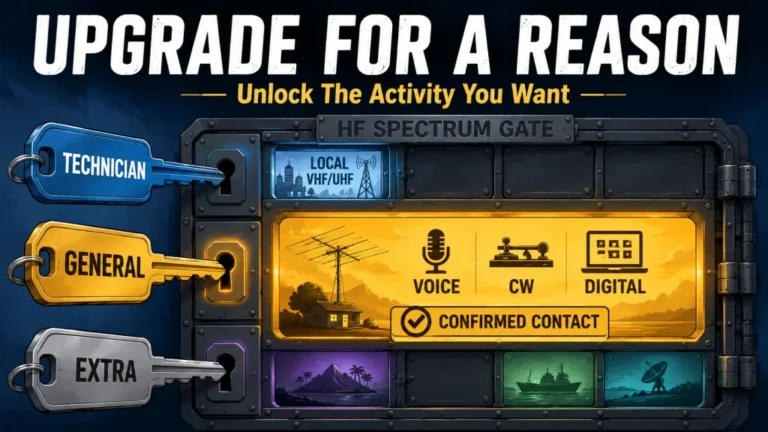
License management begins after the FCC has already granted an amateur license. It does not replace the process for earning a first call sign, and it does not explain the examinations or added privileges involved in moving from Technician to General or Amateur Extra. Keeping those paths separate prevents a renewal or modification form from being used to solve a qualification problem.
If you do not yet hold an FCC amateur license, begin with the Technician licensing process. If you already hold a license and are deciding whether to take another examination, use the upgrade material linked in the cost section. For the complete US licensing picture, including getting licensed, maintaining the record, and understanding class privileges, read the full ham radio license guide.
A good decision rule is simple: use a management filing only when the existing FCC record needs renewal, correction, or an optional call sign change. Use an examination route when the goal is a new license or higher operator class. Use reciprocal-operation rules when the authority comes from a foreign license rather than an FCC grant.

The ARRL Extra Class License Manual 13th Edition is designed for operators preparing to move from General to Amateur Extra. It includes the Extra-class question pool with detailed explanations for exams through June 30, 2028. This supports the section's decision rule that an operator seeking higher privileges should follow an examination path instead of using a renewal or modification filing.
Check On AmazonIf you click this link and buy, we earn a commission at no additional cost to you.
Final Thoughts: Keep Access, Dates, and Contact Records Current
The easiest license problem to fix is the one found before the filing deadline. Check the public record now, confirm the expiration date, verify access to the FCC Username and FRN, and make sure both the mailing and email addresses are current. When the 90-day renewal window opens, file with enough time to complete the $35 payment and resolve an account problem before the license expires.
Keep the FCC account and the amateur authorization aligned, but verify each one separately. A CORES profile change does not automatically prove that the ULS license record now shows the correct information. After any filing, check the resulting application and public record, then use the task-specific guide below when the next change involves renewal, lookup, a vanity call sign, non-US eligibility, or costs.
Explore More License Management Guides
Each license task has a different deadline, fee rule, and application path. Use the guide that matches the exact change you need so a simple record update does not become mixed with renewal, examination, or call sign eligibility questions.
| Guide | What it helps with |
|---|---|
| Renewing an Amateur License | Use the correct filing window, understand the grace period, complete the fee, and confirm the renewed grant. |
| Looking Up a Call Sign | Read license status, expiration, operator class, public address information, and related applications. |
| Requesting a Vanity Call Sign | Check eligibility and availability, build a preference list, and understand the fee without assuming assignment. |
| Licensing for Non-US Citizens | Separate examination-based FCC eligibility from temporary reciprocal operation under a foreign authorization. |
| Understanding License Costs | Compare FCC application fees, exempt transactions, and separate examination or processing charges. |
After completing a transaction, return to the public license record and the password-protected application history to confirm that the result matches what you intended to file.
FAQs
📅 How early can I renew my ham radio license?
You may file no sooner than 90 days before the expiration date. Use an earlier reminder to verify account access and contact details, then submit after the filing window opens.
💰 How much does an FCC amateur license renewal cost?
The current FCC application fee for an individual amateur renewal is $35. A third-party filing service may charge separately, but direct administrative updates such as an address or email change have no FCC application fee.
⏳ Can I operate during the two-year renewal grace period?
No. An expired license carries no operating privileges during the grace period unless and until the FCC renews it. The grace period only preserves the ability to apply for renewal.
🔎 What information is public in a ham radio license lookup?
The public record can show the name, mailing address, call sign, operator class, FRN, status, dates, and transaction details. Social Security numbers, phone numbers, and email addresses are not published in the public amateur record.
📧 Do I have to keep an email address on my FCC license record?
Yes. The address must receive electronic FCC correspondence, even though it is masked from public view. Update it promptly when access changes.
🔤 Does a vanity call sign give me more operating privileges?
No. A vanity call sign changes the station identifier, not the operator class, bands, modes, or power privileges. The request currently carries a $35 FCC fee and does not guarantee assignment.
🌎 Does a non-US citizen qualify for an FCC amateur license?
Citizenship generally is not required for a license earned by examination, but a representative of a foreign government is ineligible. Reciprocal operation under a foreign license is a separate route with different conditions.
🧾 Is CORES the same as the ULS license record?
No. CORES manages the FCC Username, FRN access, financial information, and payments, while ULS manages the wireless license and its applications. Verify both when renewing or changing a record.