Ham radio can support emergency preparedness, outdoor travel, family communication, long-distance contacts, digital operating, and vehicle-based communication, but those activities do not require the same starting plan. The right entry point depends on who you want to reach, where you expect to operate, whether every participant will be licensed, and how much technical setup appeals to you. A Technician license is a practical starting point for many local VHF/UHF activities, while broader HF voice and data goals usually point toward a General upgrade. This guide helps you choose the first use case before choosing equipment or building a station.

Ham Radio Uses Start With the Situation You Want to Solve
What is ham radio used for in practice? It can provide local voice communication, support trained emergency groups, connect licensed family members, reach distant stations, carry digital signals, and create a vehicle-based communication path. Those ham radio uses share one service, but they do not share one universal radio, antenna, license goal, or operating routine.
The pattern I see after licensing sessions is that new operators often ask for an equipment answer before they have named the activity. One person wants a local backup during a power outage. Another wants to contact distant stations from home, while someone else mainly wants a radio for camping trips. Giving all three the same shopping list would be easier, but it would not be useful.
The first decision is therefore not handheld versus mobile versus HF. It is the communication job. Once that job is clear, the beginner path through amateur radio becomes easier to understand because license class, band, station type, and operating practice can be matched to one real outcome.
Field Note: The most useful question I can ask a new licensee is who they want to reach and from where. That answer usually exposes a better starting path than a feature list does.
Choose the Outcome Before the Band or Radio
Most beginner guides describe many ham radio applications and then leave the reader to connect them to a first station. A better method is to define success before discussing hardware. Success might mean checking into a local net during an outage, contacting a licensed partner from a trail, reaching another state on HF, or completing a computer-assisted digital contact.
Use the map below as a decision tool rather than a ranking. More than one row may interest you, but select the one you would actually practice during the first month. A secondary goal can remain on the list without forcing the first station to handle every future activity.
| Primary situation | First proof that the path works | Condition that changes the answer |
|---|---|---|
| Emergency preparedness | You can reach a tested local station or net without depending on your normal phone connection | No active local operators, no backup power, or no practiced communication plan |
| Hiking, camping, or off-road travel | You can reach a known licensed partner or repeater from the places where you actually travel | Terrain blocks the path or nobody in the group is monitoring the agreed channel |
| Family communication | Licensed family members can operate independently using an agreed local plan | Other family members do not want licenses or need grab-and-go use without training |
| Long-distance communication | You complete an HF contact using privileges, antenna space, and operating time that fit your situation | The property, license class, or propagation expectations do not support the planned path |
| Digital and technical operation | The radio, computer, interface, software, and legal band segment work as one understandable system | The operator wants simple voice communication and does not enjoy computer setup |
| Mobile operation | You can communicate from the vehicle without unsafe control use or an improvised installation | The antenna, power route, mounting position, or local driving rules make the plan impractical |
The table also reveals why a radio alone cannot define the entry point. Every row includes people, location, operating habits, and supporting systems. That is the information to settle before moving into the practical steps for getting on air.
Emergency Preparedness: Build a Tested Backup, Not a Promise
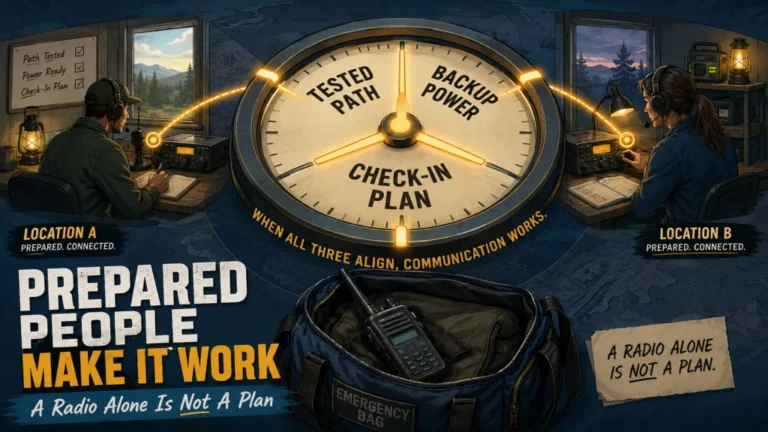
Emergency communication is a valid reason to pursue amateur radio, but owning a radio is not the same as having an emergency path. The station needs power, a suitable antenna, correct programming, licensed operators, and another station that can hear the call. A local repeater or organized net can provide useful coverage, while direct simplex may remain available when the stations are close enough and the path has been tested.
For example, a handheld programmed for a repeater may work during a neighborhood power outage if the repeater remains operational and the operator has charged batteries. The same handheld may provide little value from a basement, behind a ridge, or in an area where nobody is monitoring. The practical question is not whether amateur radio can work without the cellular network. It is whether your specific station can reach a practiced local communication path under the conditions you expect.
Formal public-service participation also involves training and local procedures, not just equipment. A new licensee can begin by listening to local nets, learning concise message handling, testing backup power, and understanding which groups are active nearby. Immediate safety-of-life provisions in the FCC rules are not a substitute for routine preparation or a reason to ignore normal operating rules during drills and ordinary conditions.
Warning: Ham radio is a useful communications layer, not a guaranteed way to summon help. Keep another appropriate means of calling for assistance whenever the situation requires one.

The BTECH UV-PRO is a dual-band VHF/UHF handheld with built-in GPS, APRS, Bluetooth, and 180 memory channels. Its IP67 construction and 2600mAh rechargeable battery suit field drills and outdoor communication where weather exposure and extended monitoring matter. USB-C charging and app-based channel management help support a practiced repeater or simplex plan.
Check On AmazonIf you click this link and buy, we earn a commission at no additional cost to you.
Outdoor Recreation: Plan Around Terrain and Partners
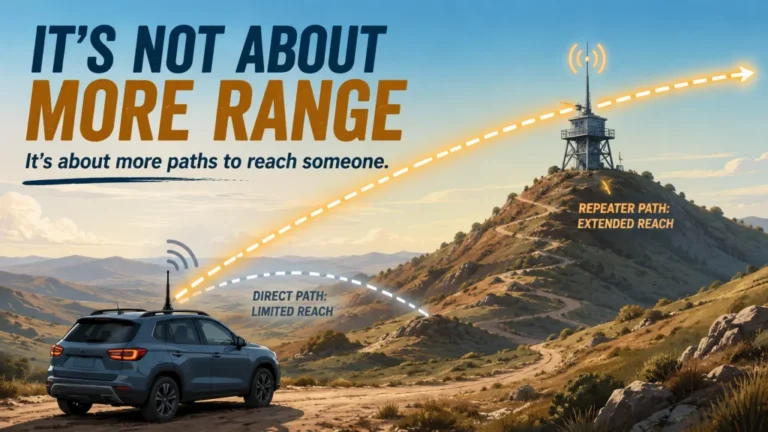
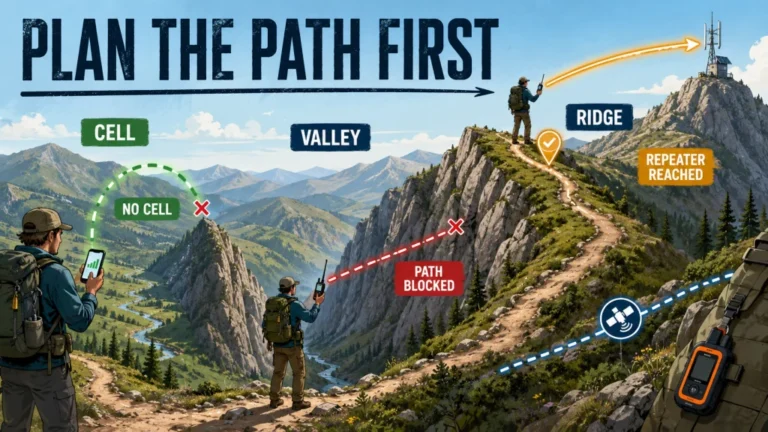
Hikers, campers, and off-road travelers often become interested in radio because cell coverage is uneven. The mistake is assuming that a handheld automatically replaces the phone wherever the phone stops working. VHF and UHF paths are strongly affected by terrain, antenna position, building materials, vegetation, and whether a repeater has favorable elevation.
A useful outdoor plan begins with a destination and a receiving station. That may be a licensed partner in the same group, a known repeater covering the route, or a scheduled check-in with another operator. Test the intended path before depending on it, and repeat the test from the actual trailhead, campsite, valley, or road segment rather than from a convenient parking lot near home.
- Identify who is expected to answer and when they will monitor.
- Confirm the channel, repeater settings, and local band-plan practice.
- Test from representative locations instead of assuming a mileage figure.
- Carry enough power for listening time, cold conditions, and delayed travel.
- Protect the radio and connection points from weather and physical damage.
The outdoor entry point fits someone who enjoys practicing a route-specific system and accepts that coverage changes with geography. It is a poor fit when the requirement is a direct call to any unlicensed person at any time, because amateur radio depends on authorized operators and active stations at the other end.
Family Communication: Licensing Changes the Decision
Family communication sounds like a simple extension of walkie-talkie use, but amateur radio adds an important condition. A family member who independently controls and transmits from an amateur station needs the appropriate amateur license. One person’s license does not give every person in the household independent transmitting privileges.
This can still be a strong entry point when several relatives genuinely want to learn, test, and operate together. A licensed household might build a local simplex plan, use repeaters for wider coverage, and practice moving short status messages without relying on a group text. The system becomes more useful when each operator knows the call signs, channels, check-in times, and fallback sequence rather than reaching for an unfamiliar radio only during a disruption.
The decision changes when the real requirement is that any adult or child should be able to pick up a radio immediately with no individual study or license. In that case, amateur radio may not match the family requirement, even if its technical capability looks attractive. The right service is the one whose licensing and equipment rules fit the people who must actually use it.
Key point: Choose amateur radio for family communication only when the family is willing to become a group of trained, authorized operators, not because one licensed person bought several radios.
Long-Distance Contacts: The Goal Usually Changes the Station
Long-distance contact is the entry point for readers who are interested in propagation, antenna behavior, changing band conditions, and the challenge of reaching stations outside the local area. This is where the plan usually moves from a local VHF/UHF handheld toward HF equipment, a suitable antenna, feed line, power, and enough operating space to use the station effectively.
A Technician can use HF within Technician privileges and should not be told that HF is completely closed until an upgrade. On 10 meters, Technician RTTY and data privileges, including FT8, are limited to 28.000 through 28.300 MHz, while Technician SSB phone privileges are 28.300 through 28.500 MHz. Technicians also have specified CW privileges on portions of 80, 40, and 15 meters, but they do not have general FT8 or data privileges on 20, 40, 80, or 15 meters.
Many operators call distant-station work DX, but the focus here is the beginner decision to pursue HF rather than contest-level operating or advanced propagation strategy. A General license opens much broader HF voice and data access, which is why it is often the practical target for someone whose main interest is routine long-distance operating. Even then, no band or power level guarantees a contact. Propagation, antenna efficiency, noise, timing, operating skill, and the station at the other end all affect the result.
This path fits readers who enjoy learning why yesterday’s easy contact may be absent today. It is less suitable for someone who needs a predictable direct call to a specific person on demand, because HF communication is a technical and operating activity rather than a substitute for a commercial phone network.
Digital Modes: Choose the Software-Connected Path
Some new operators are more interested in data, software-defined radio displays, signal decoding, computer control, logging, and weak-signal techniques than microphone conversations. For them, the most engaging first station may be a radio connected to software rather than a voice-only local setup. Modes such as FT8 can demonstrate how timing, audio levels, frequency accuracy, propagation, and automation-assisted exchanges work together.
The attraction is also the trade-off. Digital operation adds a computer, software configuration, audio or data connections, time synchronization, and mode-specific operating practice. A technically capable radio does not create a working digital station until the complete signal path is configured and the operator understands where the mode is allowed.
License privileges still control the available bands. A Technician may use FT8 and other permitted data modes from 28.000 through 28.300 MHz on 10 meters, but not on popular 20-, 40-, 80-, or 15-meter FT8 activity under Technician privileges. Someone who wants broad HF digital access should treat the General upgrade as part of the operating plan rather than assuming software bypasses license limits.
This entry point covers software-connected amateur operating and technical investigation at a beginner-to-intermediate level. Standalone software-defined radio reviews, advanced signal processing, and kit-building projects remain outside this guide.

Digirig Mobile combines an audio codec, serial CAT interface, and PTT control in a compact interface for amateur radio digital modes. It uses one USB connection to the computer and works with Windows, macOS, and Linux. Radio-specific cables are separate, so the operator can match the interface to the transceiver before configuring modes such as FT8.
Check On AmazonIf you click this link and buy, we earn a commission at no additional cost to you.
Mobile Operation: Separate Radio Performance From Driving Safety
Vehicle-based VHF/UHF operation can provide a dependable local path because the station may use vehicle power and an antenna mounted outside the passenger compartment. It can suit commuters who monitor a local repeater, off-road users who coordinate with licensed partners, or travelers who want a radio that remains part of the vehicle rather than a handheld rolling around in a cup holder.
The installation is part of the use case. Power should be routed and fused appropriately, the antenna and feed line need a suitable mounting path, and the control head or microphone should not block visibility or require the driver to look away from the road. A high-output radio does not correct a poor antenna installation, electrical noise, unsafe cable routing, or controls that cannot be operated responsibly.
Driving laws and enforcement can vary by location, so configure channels while parked and keep interaction to the minimum needed for safe operation. A passenger operator, remote control head, suitable microphone placement, or a decision to monitor without responding may be better than trying to use every feature while moving.
Pro Tips: Evaluate a mobile station as six connected parts: radio, fused power, mounting, control access, coax, and antenna. The installation fails as a communication system when any one of those parts is improvised.
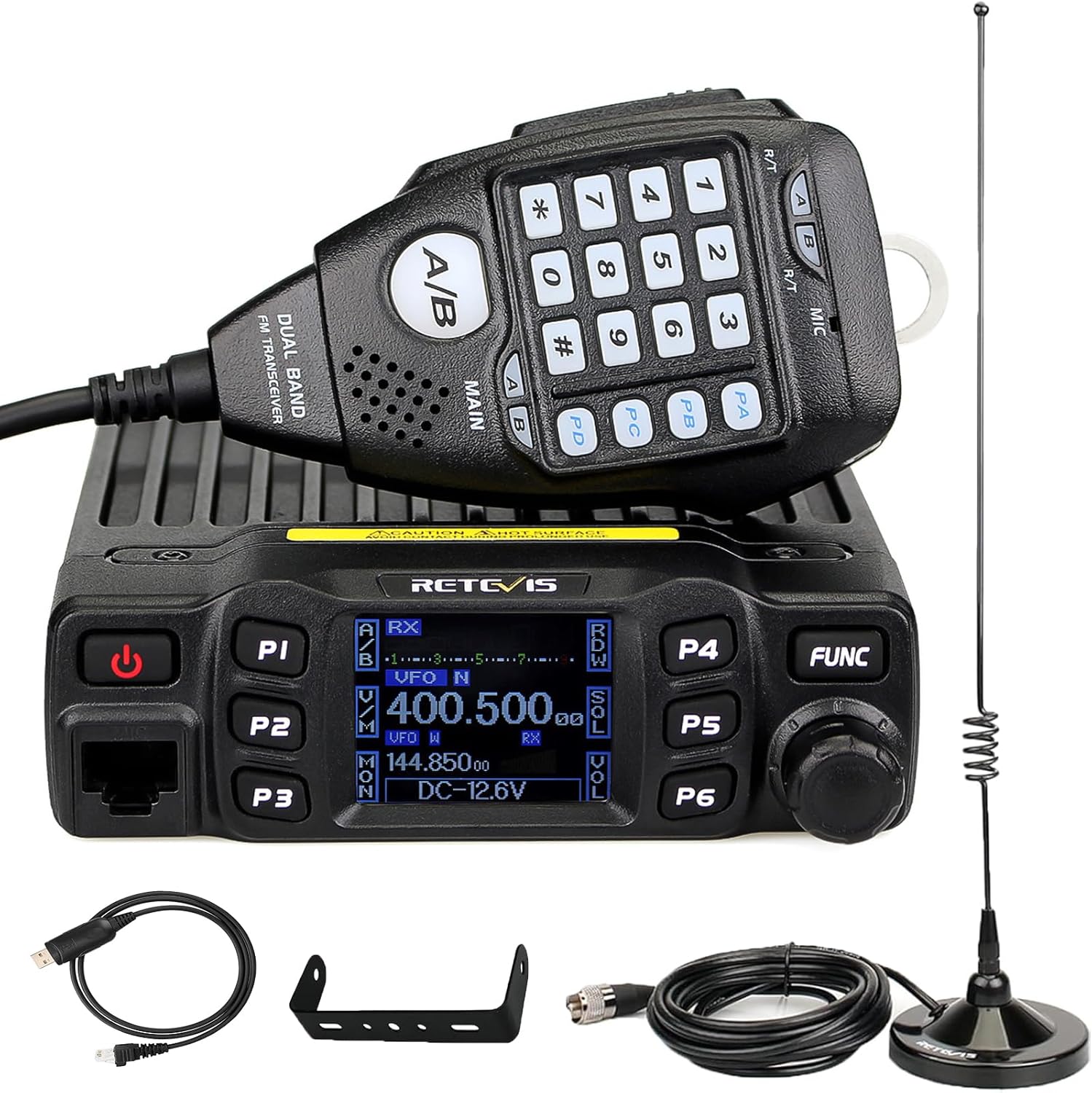
The Retevis RT95 is a 2-meter and 70-centimeter mobile transceiver with 200 memory channels and a 180-degree rotatable LCD. It supports CHIRP programming and includes a handheld microphone for vehicle operation. The compact chassis and adjustable display make it relevant to installations where radio placement, channel setup, and driver visibility all need to be planned together.
Check On AmazonIf you click this link and buy, we earn a commission at no additional cost to you.
Use Three Questions to Separate Overlapping Goals
Several activities can share parts of the same station. A home HF setup may support both voice and digital contacts, while a vehicle station may serve routine repeater use and an outage plan. Shared equipment does not mean the activities have identical licensing, coverage, training, or installation requirements.
Before choosing a route, answer three practical questions. The answers expose whether two interests can reasonably begin with the same setup or should be treated as separate projects.
- Who must answer? A known licensed partner, a local net, a distant amateur station, or any available operator?
- Where will you operate? At home, inside a vehicle, on a trail, around the neighborhood, or from several of those locations?
- What proves the plan works? A completed net check-in, a direct local contact, a distant HF exchange, or a decoded digital contact?
If the variety of amateur radio is the main attraction, explore how amateur radio works as a hobby. That broader view can help distinguish a lasting operating interest from a feature that only looks appealing during early research.
What Ham Radio Does Not Automatically Provide
The service is flexible, but it still depends on licenses, propagation, station design, local activity, and operator practice. Naming those limits early prevents a reader from choosing the right activity for the wrong expectation.
- Emergency contact is conditional: a station still needs power, coverage, monitoring operators, and a practiced plan.
- Family access requires authorization: each person controlling an amateur transmission needs the proper license privileges.
- Range depends on the path: terrain, antenna systems, frequency, noise, power, and station location all change the result.
- HF access varies by license class: broad voice and data goals may require a General license and a different station.
- Technical setup remains part of the activity: programming, antennas, computer interfaces, or vehicle installation may determine whether the path works.
These limits are not reasons to avoid the hobby. They show which route fits your situation and what must be tested before you depend on it. Once the use case is settled, compare equipment by the job it must perform through the radio selection guide by operating goal.
Final Thoughts: Turn the Use Case Into a First Test
Write down who you want to reach, where you expect to operate, and what a successful first contact would look like. Those three answers will point toward the relevant use case and show whether Technician privileges are enough or whether a General upgrade belongs in the plan.
I have seen interest become real progress when a new operator schedules a net check-in, arranges a trail test with a licensed partner, or sets a date to complete a first digital contact. Choose a test you can perform, record what worked, and use the ham radio starting framework to decide the next practical step.
Explore the Use Case That Matches Your Situation
Each guide below takes one entry point far enough to explain the real operating conditions, limitations, and next decisions. Choose the route that matches the outcome you selected, not the activity that appears to require the most equipment.
| Guide | What it helps with |
|---|---|
| Ham Radio for Emergency Preparedness | Build a tested backup communication layer without treating a radio as a guaranteed emergency service. |
| Ham Radio for Hiking and Camping | Plan around terrain, repeater coverage, licensed partners, power, weather protection, and route-specific testing. |
| Ham Radio for Family Communication | Decide whether individual licensing, shared practice, and an agreed local plan fit the people who must communicate. |
| Ham Radio for Long-Distance Communication | Understand how HF privileges, propagation, antenna requirements, and operating expectations shape distant contacts. |
| Digital Modes for New Ham Operators | Choose a software-connected path and understand the radio, computer, interface, and license privileges it requires. |
| Ham Radio for Cars and Trucks | Separate radio performance from safe control placement, fused power, antenna mounting, and responsible driving. |
After selecting a route, use the operating goal to guide licensing, setup, and later equipment decisions instead of restarting with a universal shopping list.
FAQs
📻 How is ham radio used today?
Operators use it for local voice contacts, emergency and public-service communication, outdoor travel, licensed family plans, long-distance HF contacts, digital modes, and mobile operation. The useful starting point depends on who must be reached, from where, and under which license privileges.
🪪 Can a Technician license support all of these activities?
A Technician license supports broad privileges above 30 MHz and limited HF privileges, so it is a strong start for local, outdoor, family, and mobile VHF/UHF operation. Broader routine HF voice and data activity usually makes a General upgrade the practical next step.
🚨 Is ham radio reliable during every emergency?
No. It can operate independently of normal phone or internet systems when the station has power and a reachable radio path, but success still depends on coverage, equipment, trained operators, and monitoring stations. Test the complete plan and retain another suitable way to request help.
👨👩👧 Can my whole family use my ham radio license?
No single license gives every relative independent authority to control and transmit from an amateur station. Family members who will operate independently need their own appropriate licenses and should practice the agreed communication plan.
🌎 Do I need a General license for long-distance contacts?
Not for every possible distant contact, because Technicians have limited HF privileges and can also use VHF/UHF propagation or linked systems. A General license is usually the practical goal for broad, routine HF voice and data access across more bands.
💻 Is FT8 a good first ham radio activity?
It can be when you enjoy computer setup, signal decoding, and learning a connected radio-software system. A Technician may use permitted data modes from 28.000 through 28.300 MHz on 10 meters, but broader HF FT8 access requires additional privileges.
🚗 Is a handheld enough for mobile operation?
It may be enough for occasional monitoring where local coverage is strong. Regular vehicle use may expose limitations in antenna position, audio, power, control access, and mounting, so judge the complete safe installation rather than output power alone.
🧭 What should I do after choosing a use case?
Define one contact path, identify the required license privileges, find the operators or systems at the other end, and then choose the minimum station that supports that path. Practice it before adding a second activity.