Ham radio for families can support communication when cellular service is unavailable, but it works only when the people, licenses, coverage, programming, and practice all line up. It is not a one-license household service, so each family member who must operate independently from a separate location needs an individual amateur license. GMRS is often the simpler choice when the goal is straightforward family voice communication because one adult license can authorize eligible immediate family members to use certified GMRS equipment. The right decision is not which service sounds more capable, but which system every person in the household will legally learn, carry, and practice using.

Ham Radio for Families Starts with Participation, Not Range
Ham radio for families can be a useful household communication system when cellular networks are congested or unavailable. It can also be more licensing, programming, and practice than the household actually wants. I separate the decision into two questions: does every intended operator want to earn a license, and is there a verified radio path between the places where those people are likely to be?
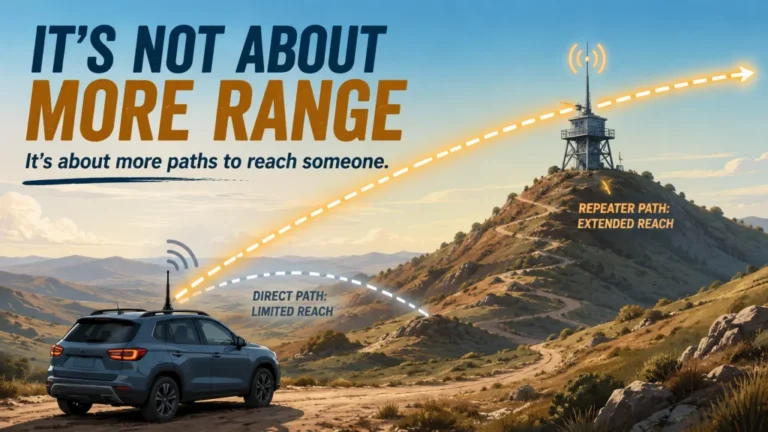
That second question prevents a common planning mistake. A radio does not create coverage merely because it has a long antenna, a high power rating, or access to a repeater menu. Terrain, buildings, antenna position, local noise, repeater availability, and whether the repeater remains powered all affect the path. Before treating amateur radio as a family backup, test the exact route between home, work, school, relatives, and any planned meeting location.
Key point: A household communication plan is only as strong as the least interested operator and the weakest untested path.
When evaluating ham radio for family preparedness, treat it as one layer of the household plan rather than a guaranteed replacement for phones. This article stays focused on household use, licensing reality, and the choice between amateur radio and a simpler family service. It does not cover the full license process or recommend individual radio models. Readers still deciding what the hobby can do should first review the practical uses for ham radio so the family plan is tied to a real purpose rather than a radio purchase.

The BTECH UV-5X3 is a tri-band amateur handheld covering VHF, 1.25-meter, and UHF operation with 128 memory channels. Its included 1500mAh lithium-ion battery supports USB-C charging, and the radio carries an IP54 weather-resistant rating. The kit includes dual-band and 220MHz antennas, a desk charger, earpiece, belt clip, wrist strap, and manual.
Check On AmazonIf you click this link and buy, we earn a commission at no additional cost to you.
What Amateur Radio Can Give a Household
Amateur radio gives separately licensed family members several ways to communicate. Nearby operators may use simplex, which is radio-to-radio communication without a repeater, or they may use a local repeater that receives on one frequency and retransmits on another. A family can also participate in scheduled local nets, learn technical skills together, and expand into different bands and operating activities as interest grows.
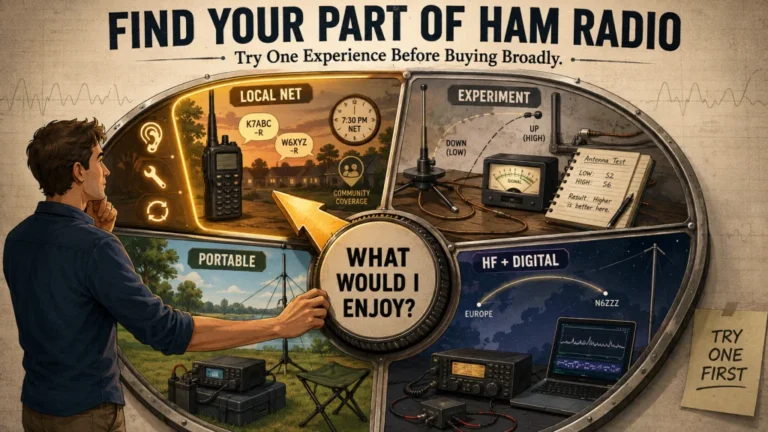
That flexibility is the strongest reason a household may choose amateur radio over a narrowly defined backup system. One person may enjoy local repeater contacts, another may become interested in antennas, and a teenager may prefer digital operation or public-service events. The system can grow with the people using it instead of remaining a fixed set of household channels.
Flexibility is not the same as guaranteed reliability. A local repeater may cover one commute and miss another, and a handheld that works outdoors may struggle inside a concrete building. Local nets can provide routine operating practice and community awareness, but they are not a private family dispatch service and should not be treated as a guaranteed path for personal messages.
Note: Amateur radio communications are generally open to anyone with suitable receiving equipment. Do not build a family plan around private medical, financial, or security details being confidential over the air.
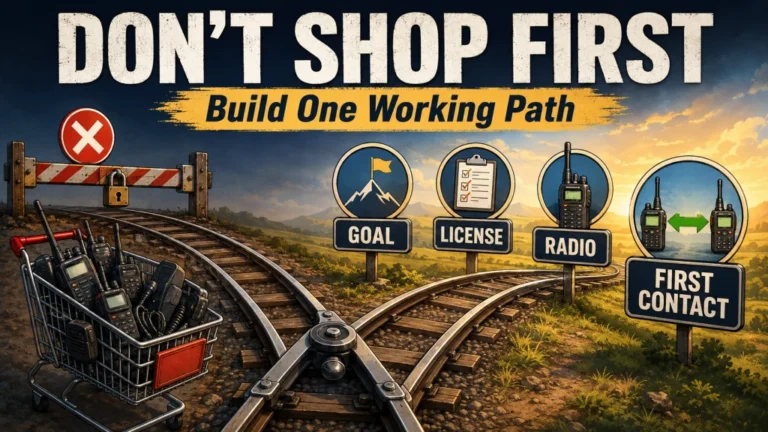
The practical value comes from having operators who know what to say, how to use the programmed channels, and how to recover when the first method fails. A workable family system begins with a plan and practice schedule, not with buying four identical handhelds.
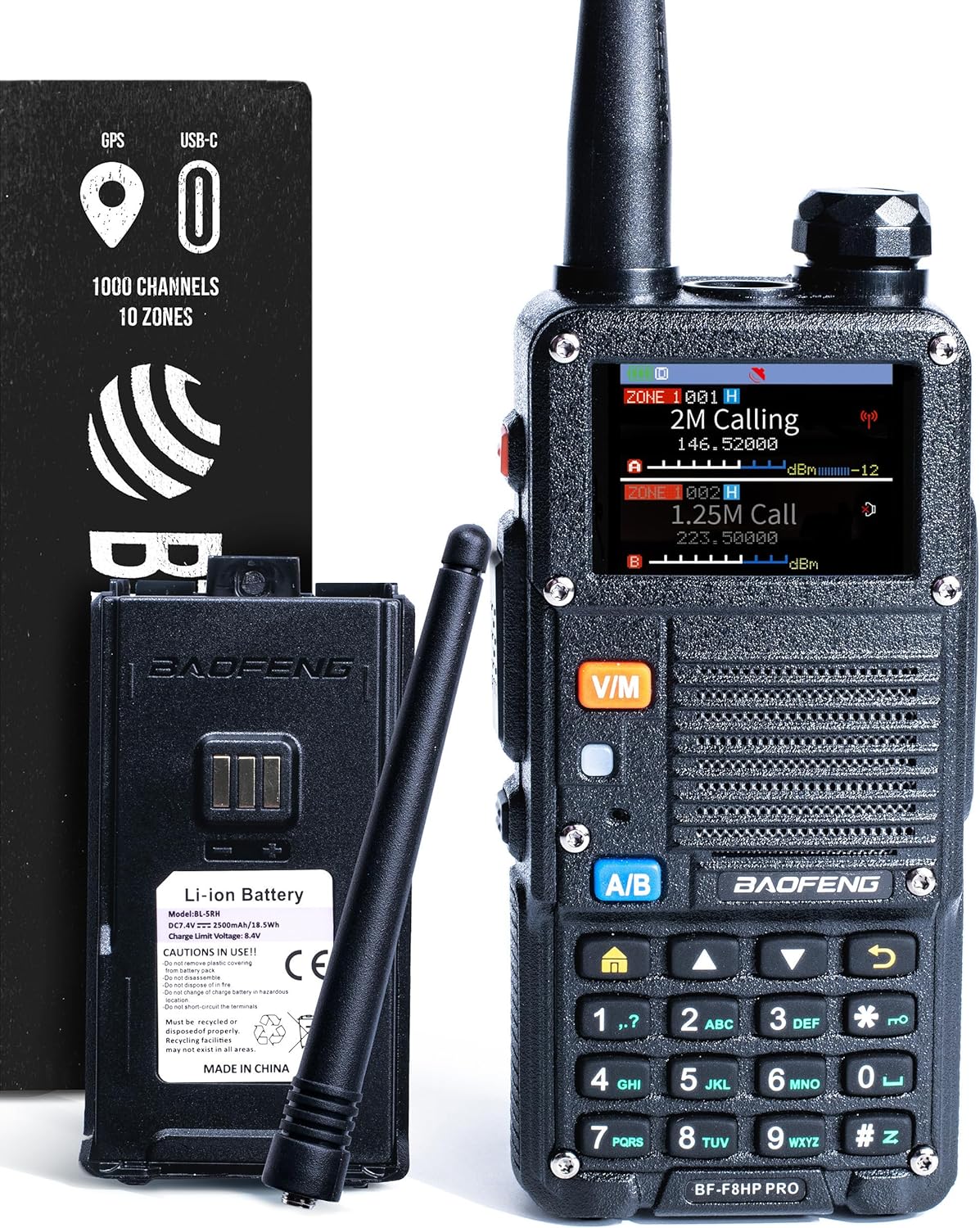
The BAOFENG BF-F8HP PRO is a tri-band amateur handheld for 2-meter, 1.25-meter, and 70-centimeter operation. It provides 1,000 programmable memories organized into 10 zones, plus GPS, aviation AM reception, NOAA weather reception, and wideband scanning. USB-C charging and BTECH CPS or CHIRP support make it practical to build and maintain an organized channel plan.
Check On AmazonIf you click this link and buy, we earn a commission at no additional cost to you.
The Licensing Reality for a Family
Amateur licenses belong to individuals. For independent communication from separate locations, every family member operating a ham station needs an FCC amateur license and must stay within the privileges of that license class. One licensed parent cannot hand radios to three unlicensed relatives and turn that single call sign into a four-person amateur network.
There is a narrow distinction worth understanding. An unlicensed person may speak through an amateur station while a properly licensed control operator is present and controlling that station, subject to the rules. That can be useful for a supervised demonstration at one location, but it does not solve the household planning problem when family members are separated across town. Each remote station still needs its own licensed control operator.
For a family of four starting from zero, four independent amateur operators mean four separate Technician examinations and four separate license applications. The Technician exam is the same 35-question examination for adults and minors. The current $35 FCC application fee applies to each new amateur license, so four new applications would total $140 in FCC fees; VE or VEC examination-session charges are separate and vary. Ordinary operator-class upgrades and requests for a sequentially issued call sign are exempt from the FCC application fee.
The FCC rules do not set a minimum age for an amateur license. A child still has to understand enough material to pass the same exam and must operate responsibly within the rules. ARRL reported in August 2025 that seven-year-old Gertrude Takagi passed the Technician exam, which proves that age alone is not the barrier. It does not mean every seven-year-old is ready, and it should not become a deadline parents impose on a child who has no interest in radio.
Field Note: The licensing question is really a participation test. If only one person wants to study while everyone else wants a push-button family tool, the household has already revealed which type of radio service is more likely to be used.
Families that genuinely want the technical hobby may see four licenses as a shared project rather than a burden. Families that only want simple contact during outings or local disruptions should treat the exam requirement as a design constraint, not as something they will somehow solve after an emergency starts.

The ARRL Ham Radio License Manual 6th Edition is designed for Technician exams given from July 1, 2026 through June 30, 2030. It covers amateur radio rules, operating practices, equipment, antennas, safety, and licensing regulations. The book includes the complete Technician-class question pool with in-depth explanations for self-study or classroom preparation.
Check On AmazonIf you click this link and buy, we earn a commission at no additional cost to you.
Ham Radio or GMRS for a Family Communication Plan?
GMRS changes the licensing math. An eligible adult can obtain an individual GMRS license without taking an exam and may authorize eligible immediate family members to operate the licensee’s GMRS stations. The FCC definition includes a broad list of relatives, but it does not automatically cover roommates, friends, neighbors, or every person who happens to live in the same house.
GMRS transmitting requires equipment certified for GMRS under Part 95E. A ham license does not authorize transmission on GMRS frequencies, and an amateur transceiver is not automatically legal for GMRS merely because it can be programmed to those channels. Keeping the services and equipment separate avoids a mistake that is easy to make when a radio appears technically capable of transmitting in both places.
| Decision factor | Amateur radio | GMRS |
|---|---|---|
| Who may operate independently | Each operator needs an individual amateur license | Licensee and eligible immediate family members may operate under one individual license |
| Examination | Required for each new operator | No examination for the individual license |
| Equipment | Broader amateur equipment and band choices within license privileges | GMRS-certified transmitting equipment required |
| Learning commitment | Higher, with rules, programming, operating procedure, and technical options | Lower for basic family voice communication |
| Repeater and range expectations | Depend on local systems, terrain, antennas, power, and operator setup | Also depend on local systems, terrain, antennas, power, and equipment limits |
| Best household fit | Family members who want the hobby and broader capability | Family members who mainly want a simpler shared voice system |
Neither service wins every comparison. GMRS may be the better household tool even when one parent already holds an amateur license, because the remaining family members may never want to study. Ham radio may be the better long-term choice when several people are genuinely interested in operating, learning, and joining local activity.
Range should not decide the service before local testing. Both services may use repeaters, and both can fail behind terrain or inside difficult buildings. A map of listed repeaters is evidence that equipment exists, not proof that your family can reach it from the kitchen, school parking lot, basement, or evacuation route. The fuller breakdown of licensing and equipment differences is in how ham radio compares with GMRS.

The BTECH GMRS-V2 is an FCC Part 95E-certified GMRS handheld with selectable 0.5-watt and 5-watt transmit levels. It provides 200 user-programmable channels for GMRS, NOAA, and scanner use, with repeater support, dual watch, and an IP54 weather-resistant housing. The included BL-8 lithium-ion battery supports direct USB-C charging as well as the supplied desktop charger.
Check On AmazonIf you click this link and buy, we earn a commission at no additional cost to you.
Build the Household Plan Before Programming Radios
A useful family ham radio plan starts with people and locations. Write down who needs to reach whom, where each person is likely to be, and what message the radio must carry. “Talk during an emergency” is too vague. “Confirm safe arrival between home and the school pickup point when cellular service is unavailable” is specific enough to test.
I recommend building the plan in layers. The first layer is the normal method, usually voice calls or text messages. The second is the radio path that the household has tested. The third is a no-radio fallback, such as a meeting location and a time-based instruction, because batteries fail, repeaters go offline, and people sometimes leave radios on a charger at home.
- Operators: List who is licensed, who is willing to practice, and who should not be assigned a radio-dependent task.
- Locations: Test home, work, school, regular routes, relatives’ homes, and planned meeting points.
- Primary path: Choose one verified repeater or direct channel appropriate to the service and operator privileges.
- Alternate path: Program a second tested option rather than assuming the first system will remain available.
- Simple instructions: Label radios or create a one-page card showing the channel name, call-sign procedure, and check-in words.
- Power: Decide how each radio will be charged during a long outage and how spare batteries will be rotated.
- No-radio action: Set a meeting location, waiting period, and next step if no contact is made.
This checklist exposes weak plans before they become expensive. A family may discover that two people are not eligible under the same GMRS license, that a child cannot reliably change channels, or that the intended repeater cannot be reached from one workplace. Those are planning findings, not radio failures.
The best plan is usually smaller than the first draft. One primary channel, one alternate, one short check-in script, and one meeting rule are easier to remember than a laminated sheet full of frequencies. Extra capability only helps when the operators can use it without searching through menus.

The BTECH BL-8L is a 3600mAh lithium-ion replacement battery for radios that use the BL-8 accessory standard. BTECH specifically lists compatibility with the GMRS-V2, MURS-V2, UV-82HP, and UV-82C. The battery supports direct USB-C charging and remains compatible with existing BL-8 charging docks.
Check On AmazonIf you click this link and buy, we earn a commission at no additional cost to you.
Program First, Then Practice the Exact Check-In
Do not wait for a storm, evacuation, or network outage to enter repeater settings. Program the frequencies, offsets, tones, power levels, and plain-language channel names before the radios enter the family kit. Lock or simplify controls when appropriate so a bump in a bag does not move the radio to an unknown setting.
Then test the actual operating sequence. Each person should turn the radio on, select the correct memory, listen before transmitting, identify properly, call the intended family member, exchange one short status message, and confirm the next action. That exercise is more valuable than a range claim on packaging because it tests the person and the path together.
Store untested radios with a printed frequency list and assume everyone will work out the controls during an outage.
Use programmed channel names, conduct short scheduled check-ins, and test from the locations that matter to the household.
Practice should be brief enough that the family will repeat it. A monthly five-minute check from different normal locations can reveal a dead battery, changed repeater tone, weak indoor path, or forgotten procedure. The purpose is not to turn every family member into a radio enthusiast. It is to make the backup familiar enough that nobody is learning menus while worried about someone else’s safety.
Include one failure drill. Turn off the primary repeater memory or pretend the first call receives no reply, then move to the alternate path and finally to the meeting rule. A plan that only works when every component behaves perfectly is a demonstration, not a household system.

The BTECH PC03 uses an FTDI chipset and a Kenwood K1 two-pin connector to program compatible radios from BTECH, BaoFeng, Kenwood, and other supported brands. The listing specifically names the UV-5R, BF-F8HP, GMRS-V2, and UV-82HP among supported models. It is designed for plug-and-play USB setup without a separate driver.
Check On AmazonIf you click this link and buy, we earn a commission at no additional cost to you.
Children Can Get Licensed, but Readiness Is Individual
There is no universal age at which a child becomes ready for amateur radio. Passing the Technician exam shows that the child learned the tested material, but household readiness also includes following identification rules, using the correct programmed channel, understanding when not to transmit, and communicating clearly without panic. A parent should judge those behaviors directly rather than relying on a birthday.
Supervision can be reduced in stages. A younger operator might begin with scheduled contacts from home, move to a short outdoor simplex exercise, and later use a known repeater independently when the parent is confident in the child’s procedure. The steps should match the child’s attention, judgment, interest, and ability to handle the equipment.
Do not make the child the only technical operator in the family. A preparedness plan becomes fragile when the one person who understands the radios is at school, asleep, injured, or simply not present. At least two adults should understand charging, channel selection, the primary and alternate paths, and the no-contact procedure.
Pro Tips: Let children use a short written script at first: identify, say the person’s call sign, give location and status, confirm the next action, then identify again as required. The script reduces hesitation without replacing proper operating practice.
The same principle applies to adults who are uncomfortable with radio. Responsible supervision is not about age alone. It is about whether the person can perform the assigned task legally and calmly when the normal communication method is unavailable.

ARRL's Tech Q&A 9th Edition is built for Technician exams given from July 1, 2026 through June 30, 2030. It presents every question and answer in the current Element 2 pool with brief explanations for focused review. The book is designed to prepare new operators for the 35-question Technician-class examination.
Check On AmazonIf you click this link and buy, we earn a commission at no additional cost to you.
A Simple Decision Framework for Your Household
The cleanest decision is to start with commitment. If every intended operator wants to pass an exam and the household wants amateur radio as both a communication tool and a technical hobby, build around individual amateur licenses. If the family mainly wants easy local voice communication and one adult can hold the license, evaluate GMRS first.
Some households should use both. Licensed amateur operators may use ham radio for local nets, technical experimentation, or broader operating interests while the same family uses GMRS for simple shared coordination. The licenses and transmitting equipment remain separate, but the communication plan can assign each service a clear job.
| Your household situation | Best next step |
|---|---|
| Several family members want the hobby and will study | Begin the individual amateur licensing path and test local coverage |
| Only one person wants amateur radio | Keep ham as that person’s hobby and evaluate GMRS for shared family use |
| The goal is simple communication during outings | Start with the simpler legal service that everyone can operate consistently |
| The plan depends on a local repeater | Test access from every critical location and create an alternate |
| No one will practice | Do not make radio the only family backup; strengthen meeting and contact procedures first |
The deciding factor is not theoretical capability. It is whether the family can legally operate the system, reach the intended path, keep the equipment powered, and complete a check-in without technical help. A modest system that passes those four tests is more useful than a sophisticated station known by only one person.
Families choosing amateur radio should approach it as a shared skill, not a box of emergency equipment. The beginner path into ham radio explains the broader commitment before anyone starts buying equipment or scheduling exams.

The Midland GXT1000VP4 is a two-radio GMRS package with 50 listed channel options and a JIS4 weather-resistant design. It includes NOAA weather alert reception and direct-call functionality between compatible units. The package contains two handheld radios for paired GMRS communication.
Check On AmazonIf you click this link and buy, we earn a commission at no additional cost to you.
Final Thoughts: Choose the System Your Family Will Use
Ham radio can support a strong household communication plan, but only when the intended operators are individually licensed, the radio paths are tested, and the family practices. Its broader capabilities make sense for households that want the hobby as well as the backup. They do not erase the work required to make every operator competent.
My practical recommendation is to ask for commitment before capability. Find out who will study, who will carry a radio, and who will participate in a five-minute check-in. Then test coverage and choose the legal service that fits those people. For many families, that answer will be GMRS. For others, amateur radio becomes a valuable shared skill that lasts well beyond emergency planning.

The BTECH UV-PRO is an app-connected VHF/UHF handheld that supports licensed amateur operation. It provides 180 channels across six banks, onboard GPS and APRS, Bluetooth packet support, NOAA alerts, and receive-only aviation AM coverage. The included battery charges directly by USB-C, and the official mobile app supports channel-plan setup and management.
Check On AmazonIf you click this link and buy, we earn a commission at no additional cost to you.
FAQs
📻 Can one ham radio license cover my whole family?
No. For independent operation from separate locations, each person needs an individual amateur license. An unlicensed person may speak under the direct control of a licensed operator at the same station, but that does not create a family-wide license.
👨👩👧👦 Is GMRS easier for family communication?
Often, yes. One eligible adult GMRS license can authorize eligible immediate family members to operate the licensee’s certified GMRS equipment, and no examination is required. Coverage still depends on terrain, antennas, buildings, and local repeater availability.
🧒 How old does a child need to be for a ham license?
The FCC does not set a minimum age. The child must pass the same Technician exam and be able to operate responsibly, so readiness depends on knowledge, attention, judgment, and interest rather than a universal age.
📡 Will a local repeater guarantee family coverage?
No. A listed repeater may be unreachable from a building, low area, or distant route, and it may lose power or become unavailable. Test it from every critical location and program an alternate path.
🔋 What should a family radio drill include?
Each person should power on the radio, choose the correct programmed channel, make a proper call, exchange location and status, and confirm the next action. The drill should also include failure of the primary path and a move to the alternate or meeting rule.
🚨 Is ham radio reliable enough for emergencies?
It can be a useful backup, but it is not a guarantee. Reliability depends on licensed operators, working equipment, available power, verified coverage, and practiced procedures, so it should be one layer of a broader household plan.